
A properly designed warehouse lighting layout is one of the most important factors affecting visibility, safety, productivity, and energy efficiency. Simply selecting a high-quality LED fixture is not enough. Fixture placement, mounting height, beam distribution, spacing, and foot candle requirements all influence overall lighting performance.
Whether you’re designing a new warehouse, upgrading an existing facility, or planning a distribution center retrofit, a professional warehouse lighting layout helps ensure the right amount of light reaches every area of the building.
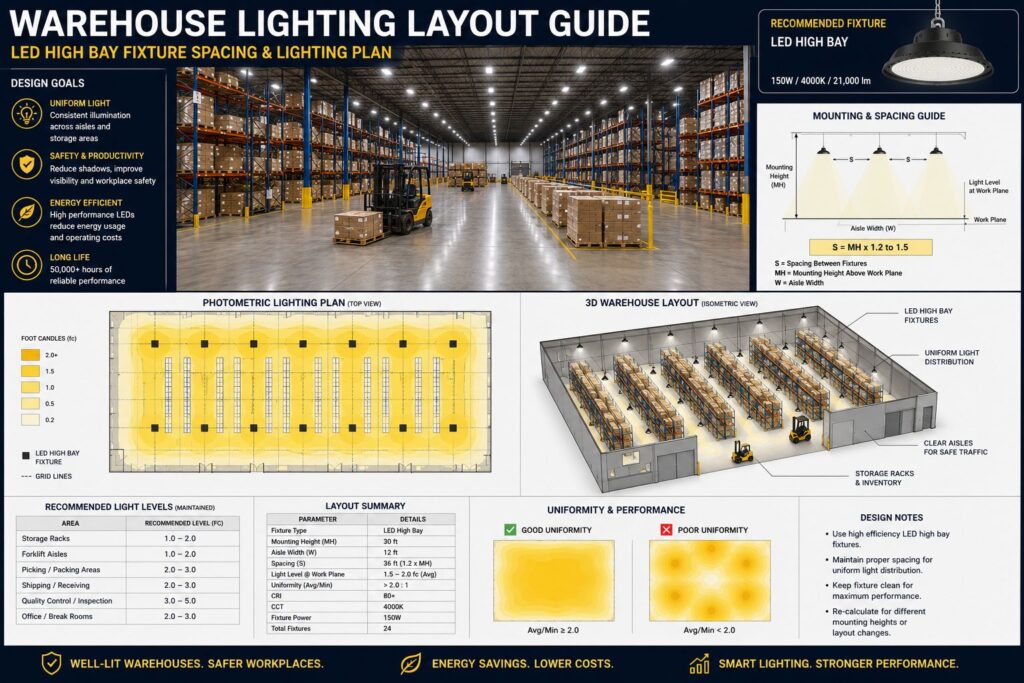
A properly designed warehouse lighting layout coordinates LED high bay fixture spacing, mounting height, beam distribution, storage racks, and target light levels to provide uniform illumination throughout the facility.
Need Help Planning a Warehouse Lighting Layout?
The right warehouse lighting design depends on more than fixture wattage. Ceiling height, rack configuration, aisle width, mounting height, fixture spacing, beam distribution, target foot-candle levels, and uniformity should all be evaluated before fixtures are selected. Explore our LED High Bay Lighting solutions or call 844-533-7767 for help with fixture selection, spacing, and photometric planning for your warehouse.
What Is a Warehouse Lighting Layout?
A warehouse lighting layout is a photometric plan that determines:
- Fixture locations
- Fixture spacing
- Mounting heights
- Light levels
- Uniformity ratios
- Energy consumption
- Lighting performance throughout the facility
The objective is to provide adequate illumination while minimizing energy use and fixture quantities.
A warehouse lighting layout is often created using photometric software that simulates how light will perform within a facility before installation.
Planning a facility-wide industrial lighting project? See Industrial Facility Lighting Design.
Why Warehouse Lighting Layouts Matter
Poor lighting layouts can create:
- Dark spots
- Excessive shadows
- Poor rack visibility
- Unsafe forklift conditions
- Inventory picking errors
- Higher operating costs
Proper lighting design helps improve:
- Employee productivity
- Safety
- Inventory accuracy
- Operational efficiency
- Energy performance
Warehouses, workshops, manufacturing plants, and commercial buildings often require different lighting solutions. The High Bay vs Low Bay Lighting guide explains which fixture is best suited for each environment
Planning a warehouse or manufacturing facility? What Is Industrial Lighting? provides a practical introduction before selecting fixture types and lighting layouts.
Information Required for a Lighting Layout
Several pieces of information are needed before designing a warehouse lighting system.
Facility Dimensions
Including:
- Length
- Width
- Ceiling height
Storage Rack Information
Including:
- Rack height
- Rack orientation
- Aisle widths
Designing high-rack storage areas? Review Warehouse Aisle Lighting Design
Facility Operations
Examples include:
- Storage only
- Distribution center
- Fulfillment center
- Manufacturing support
- Cold storage
Target Light Levels
Required foot candle levels vary depending on facility operations.
Before upgrading your facility, read Commercial vs Industrial Lighting to learn how lighting requirements change between offices, warehouses, manufacturing plants, and distribution centers.
Typical Warehouse Foot Candle Requirements
Recommended Light Levels
| Area | Recommended Foot Candles |
|---|---|
| General Storage | 10-20 FC |
| Warehouse Aisles | 15-30 FC |
| Distribution Operations | 20-40 FC |
| Packing Areas | 30-50 FC |
| Inspection Areas | 50-100 FC |
| Loading Docks | 20-30 FC |
Higher foot candle levels generally improve visibility but also increase energy consumption if not designed efficiently.
Whether you’re designing a new warehouse or upgrading a manufacturing facility, the Industrial Lighting Installation Guide provides practical guidance for planning fixture placement, mounting, wiring, and installation.
Key Warehouse Lighting Design Factors
Mounting Height
| Ceiling / Mounting Height | Typical Fixture Approach |
|---|---|
| 15–20 ft | Low bay or lower-output high bay |
| 20–30 ft | UFO or linear high bay |
| 30–40 ft | Higher-output UFO or linear high bay |
| 40+ ft | High-output high bay selected by photometric design |
Ceiling height significantly impacts fixture selection.
For open warehouse areas with mounting heights in the typical high-bay range, the DM-UFO wattage- and CCT-selectable LED high bay provides field-adjustable output for matching fixture performance to ceiling height, spacing, and target light levels.
Fixture Distribution
The beam pattern affects:
- Coverage area
- Uniformity
- Rack visibility
- Fixture quantity
Fixture Spacing
Proper spacing helps avoid:
- Dark zones
- Excessive overlap
- Wasted energy
Once mounting height, fixture spacing, and photometric requirements have been established, the next step is selecting fixtures capable of producing the required distribution and illumination. Compare commercial and industrial LED high bay lights for warehouse and other high-ceiling applications.
Factors That Influence Warehouse Lighting Layouts
| Design Factor | Impact on Layout |
|---|---|
| Ceiling Height | Fixture Selection |
| Rack Height | Vertical Illumination |
| Aisle Width | Fixture Distribution Pattern |
| Foot Candle Target | Fixture Count |
| Facility Operations | Lighting Requirements |
| Uniformity Goals | Fixture Placement |
Operating a fulfillment facility? Visit Distribution Center Lighting.
Understanding Lighting Uniformity
Average foot candle levels only tell part of the story.
Uniformity measures how evenly light is distributed throughout the facility.
Benefits of improved uniformity include:
- Reduced shadows
- Better visibility
- Improved worker comfort
- Safer forklift operation
- More consistent lighting conditions
Many warehouse lighting projects focus on achieving both adequate foot candles and acceptable uniformity ratios.
Open Warehouse vs Rack Storage Layouts
Open Warehouse Areas
Open storage facilities often allow:
- Wider fixture spacing
- Broader beam patterns
- Fewer fixture restrictions
High Rack Warehouses
Rack-oriented facilities often require:
- Greater vertical illumination
- Narrower distribution patterns
- Aisle-focused fixture placement
Warehouse layouts should always consider how storage systems impact light distribution.
Warehouse aisles and distribution centers require lighting that delivers consistent illumination across long workspaces. The LED Linear High Bay Lighting Guide explains how linear fixtures improve visibility, energy efficiency, and operational performance.
Photometric Lighting Plans
A photometric plan provides a visual representation of lighting performance before installation.
Photometric reports typically show:
- Fixture locations
- Average foot candles
- Minimum foot candles
- Maximum foot candles
- Uniformity ratios
- Light distribution patterns
This allows facility managers to evaluate performance before purchasing equipment.
Common Warehouse Lighting Design Mistakes
Choosing Fixtures Before Creating a Layout
Fixture selection should support the lighting design, not dictate it.
Ignoring Rack Height
Tall storage systems often require specialized lighting layouts.
Focusing Only on Fixture Wattage
Higher wattage does not automatically create better lighting.
Overlooking Uniformity
Dark spots and excessive brightness variations can negatively impact safety and productivity.
LED Controls and Layout Planning
Lighting controls should be considered during the design phase.
Popular options include:
- Motion Sensors
- Occupancy Sensors
- Daylight Harvesting
- Zoned Controls
- Smart Lighting Systems
These technologies can further reduce operating costs while maintaining adequate illumination.
Looking to reduce operating costs? Explore Warehouse Lighting Energy Savings.
Benefits of a Professional Warehouse Lighting Layout
| Benefit | Operational Impact |
|---|---|
| Improved Visibility | Better inventory management |
| Increased Safety | Reduced workplace hazards |
| Better Uniformity | Consistent lighting performance |
| Lower Energy Costs | Reduced utility expenses |
| Optimized Fixture Count | Lower project cost |
| Enhanced Productivity | Improved workflow efficiency |
Life safety is an essential part of commercial lighting design. Continue with our Emergency Exit Signs Guide to understand the role of illuminated exit signage in commercial buildings.
Inline Buyer Q&A
Do I need a lighting layout before ordering warehouse fixtures?
For larger warehouses, distribution centers, high-rack storage facilities, and projects involving significant changes to the existing lighting system, a photometric layout is highly recommended.
It allows fixture selection, quantity, spacing, mounting height, and predicted illumination to be evaluated before equipment is ordered.
For a simple retrofit where existing fixture locations and lighting requirements remain largely unchanged, the level of analysis needed may be different.
How does warehouse racking affect the lighting layout?
Racks can significantly change how light travels through a warehouse.
Tall storage systems can block light from adjacent fixtures and create shadows at lower levels. Aisle width, rack height, product storage, fixture placement, mounting height, and optical distribution should therefore be considered together.
High-rack facilities may also require greater attention to vertical illumination rather than evaluating only horizontal illumination at the floor or work plane.
How far apart should warehouse lights be spaced?
There is no universal spacing formula for warehouse fixtures.
Spacing depends on mounting height, fixture output, optical distribution, required illumination, uniformity objectives, rack and equipment layouts, surface reflectance, and obstructions.
Two warehouses with the same ceiling height can require substantially different fixture spacing because their layouts and activities are different.
Should warehouse lights be positioned directly over aisles?
In racked warehouses, aligning fixtures with aisles can be useful because it helps direct illumination into the areas where employees, equipment, and inventory movement occur.
However, fixture placement should be evaluated with aisle width, rack height, mounting height, optical distribution, cross aisles, staging areas, and other warehouse zones.
Aisle lighting should be designed as part of the complete warehouse layout rather than by simply centering fixtures between racks.
Can a photometric layout reduce the number of fixtures needed?
Sometimes.
A layout may reveal that properly selected fixtures and distributions can achieve the required performance with fewer fixtures than a simple one-for-one replacement.
In other projects, the analysis may show that additional fixtures or different placement are necessary to address dark areas, aisles, workstations, or uniformity.
The objective is not necessarily to minimize fixture quantity. It is to determine an appropriate system for the required lighting performance.
Should every area of a warehouse have the same light level?
Not necessarily.
Storage aisles, picking areas, packing stations, loading areas, shipping and receiving zones, inspection areas, equipment locations, and circulation spaces can involve different visual tasks.
Lighting should be evaluated according to how each area is used rather than assuming one illumination target throughout the entire building.
How should occupancy sensors be incorporated into a warehouse layout?
Controls should be considered during the lighting design rather than added as an afterthought.
Warehouse aisles, storage areas, and intermittently occupied spaces can be good candidates for occupancy-based control. Sensor coverage, mounting height, detection pattern, fixture grouping, operating schedules, and required response should be evaluated for the actual facility.
Controls can reduce unnecessary operating hours when appropriately designed and commissioned.
Need Help With a Warehouse Lighting Layout?
Warehouse lighting design requires coordination between mounting height, fixture output, optical distribution, spacing, racks, aisles, work areas, controls, and required illumination.
Whether you’re planning a new warehouse, upgrading an existing distribution center, or evaluating a high-rack storage facility, our lighting specialists can help with fixture selection and photometric layouts based on the actual facility configuration.
Explore our Industrial LED Lighting solutions or call 1-844-533-7767 to discuss your warehouse lighting project.
Frequently Asked Questions About Warehouse Lighting Layouts
What is a warehouse lighting layout?
A warehouse lighting layout is a plan showing proposed fixture locations and lighting-system characteristics for a facility.
When photometric data is incorporated, the layout can predict illumination and uniformity based on the selected fixtures, mounting heights, spacing, room geometry, racks, equipment, and other modeled conditions.
Why is a photometric plan important?
Photometric analysis allows predicted lighting performance to be evaluated before installation.
It can help compare fixture types, outputs, distributions, quantities, mounting heights, and spacing while identifying potential areas of insufficient illumination, excessive illumination, or poor uniformity.
The accuracy of the prediction depends on the project information and assumptions used in the model.
How many foot-candles should a warehouse have?
There is no single foot-candle level appropriate for every warehouse or every area within one.
Appropriate illumination depends on the visual task, facility activity, storage configuration, equipment, work-plane location, and applicable recommendations or requirements.
General storage, active picking, packing, inspection, loading, and detailed work can have different lighting needs.
Does rack height affect warehouse lighting design?
Yes.
Tall racks can block light and create shadows, particularly at lower storage levels and within aisles.
Rack height, aisle width, fixture mounting height, distribution, spacing, and vertical illumination should be considered when designing lighting for high-rack facilities.
Does mounting height affect warehouse fixture selection?
Yes.
Mounting height influences the fixture output and optical distribution needed to deliver appropriate illumination to the work plane, floor, racks, and vertical surfaces.
Higher mounting does not automatically mean choosing the highest available wattage. Output, distribution, spacing, quantity, and facility geometry should be evaluated together.
Are UFO or linear high bays better for warehouses?
Either can be appropriate.
UFO high bays can work effectively in open warehouse areas, while linear high bays can complement aisles, racks, production areas, and rectangular layouts.
The better option depends on the photometric performance of the specific fixture and how it interacts with the facility geometry, mounting height, spacing, and required illumination.
Can lighting controls reduce warehouse energy use?
Yes. Occupancy sensing, dimming, scheduling, daylight-responsive controls, and other strategies can reduce operating hours or light output when full illumination is unnecessary.
Actual savings depend on occupancy patterns, operating schedules, existing lighting, control strategy, fixture compatibility, and commissioning.
How does equipment affect a warehouse lighting layout?
Forklift routes, conveyors, mezzanines, machinery, storage systems, cranes, ducts, and other equipment can obstruct light or change where illumination is needed.
Accurate facility information improves the usefulness of a photometric model because these features can be considered when fixture placement is evaluated.
Should an LED retrofit reuse the existing warehouse fixture locations?
Existing locations can sometimes be reused, but they should not automatically dictate the new layout.
Older HID or fluorescent systems may have different outputs and distributions from the proposed LED fixtures. A retrofit provides an opportunity to evaluate whether existing locations remain appropriate or whether fixture quantity, spacing, or output should change.
Does a photometric layout guarantee the installed light levels?
No.
A photometric layout predicts performance based on fixture photometric data and the dimensions, reflectances, mounting conditions, equipment, racks, and other assumptions entered into the model.
Actual field conditions can differ from modeled conditions. Photometric analysis is a design tool rather than a guarantee of measured post-installation results.
Stay Connected with Our Lighting Resources
Add IndustrialLightingFixtures.org as a Preferred Source on Google to see more of our lighting guides and technical resources across Google Search experiences.
Related Warehouse Lighting Resources
- LED High Bay Lighting — Explore the primary high bay lighting category for warehouses, distribution centers, manufacturing facilities, and other high-ceiling applications.
- High Bay Mounting Height Guide — Learn how mounting height, fixture spacing, output, and optical distribution affect high bay lighting performance.
- UFO vs. Linear High Bay Lighting — Compare high bay form factors based on warehouse geometry, racks, aisles, mounting conditions, and lighting requirements.
- Warehouse Aisle Lighting Design — Review lighting considerations for racked aisles, including fixture placement, vertical illumination, rack height, aisle width, and distribution.
- Distribution Center Lighting — Explore lighting considerations for distribution facilities with storage, picking, packing, shipping, receiving, and material-handling areas.