Industrial lighting refers to lighting systems specifically designed for demanding commercial and industrial environments where reliability, safety, efficiency, and long operating life are essential. Unlike residential or general commercial lighting, industrial lighting is engineered to perform under challenging conditions such as high ceilings, heavy equipment operation, dust, moisture, extreme temperatures, vibration, and continuous daily use.
Modern industrial facilities depend on properly designed lighting systems to support production, improve worker safety, enhance product quality, and reduce energy consumption. Whether illuminating a warehouse, manufacturing plant, distribution center, food processing facility, or outdoor industrial yard, selecting the appropriate lighting system contributes directly to operational efficiency.
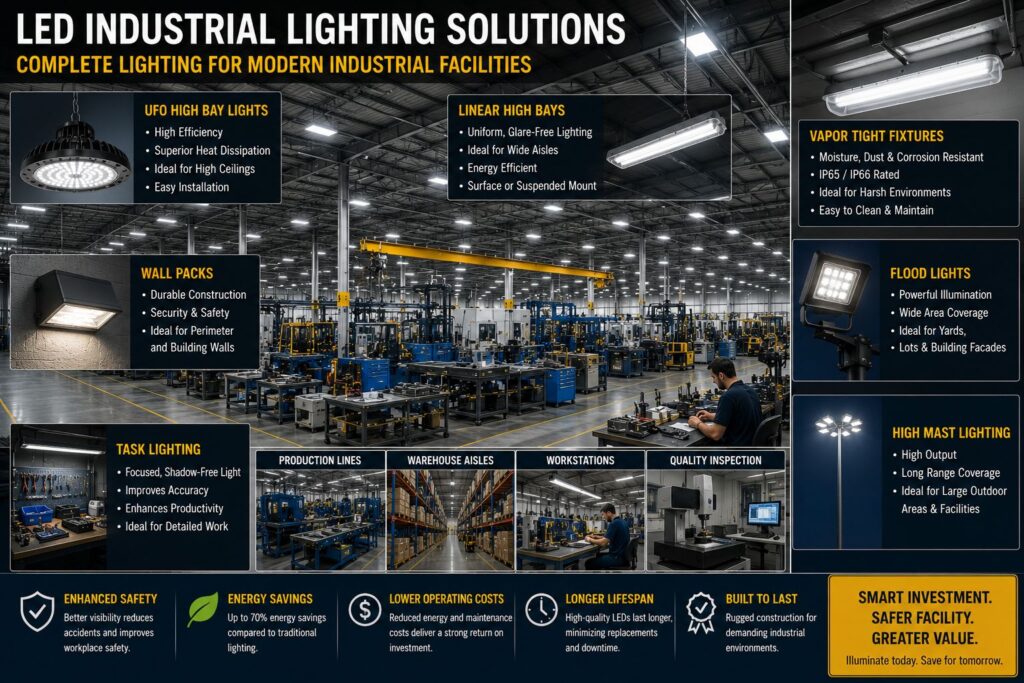
Industrial lighting systems provide safe, reliable illumination for manufacturing plants, warehouses, distribution centers, food processing facilities, and other demanding industrial environments.
Planning an Industrial Lighting Project or LED Upgrade?
Industrial lighting should be selected around the facility, not just fixture wattage. Ceiling height, required light levels, operating conditions, mounting layout, environmental exposure, controls, and energy goals all influence the right lighting solution.
Explore our Industrial LED Lighting solutions or call 844-533-7767 for help selecting the right fixtures for your facility.
Why Industrial Lighting Is Different
Industrial facilities place unique demands on lighting equipment.
Fixtures often operate for extended hours, are mounted at significant heights, and must withstand environmental conditions that standard commercial lighting cannot tolerate.
Industrial lighting is designed to provide:
- High lumen output
- Uniform illumination
- Long service life
- Low maintenance requirements
- High energy efficiency
- Durable construction
- Reliable operation in demanding environments
Rather than relying on a single fixture type, industrial lighting systems combine multiple lighting solutions to meet the needs of different work areas throughout a facility.
Understanding the difference between commercial and industrial lighting is the first step in selecting the right fixtures. Our Commercial vs Industrial Lighting guide compares applications, fixture types, and performance requirements for each environment.
Where Is Industrial Lighting Used?
Industrial lighting supports a wide range of applications, including:
- Warehouses
- Manufacturing plants
- Distribution centers
- Fabrication facilities
- Machine shops
- Food processing plants
- Cold storage warehouses
- Pharmaceutical facilities
- Chemical processing plants
- Aircraft hangars
- Utility plants
- Maintenance facilities
- Shipping terminals
- Outdoor industrial yards
Each environment presents unique lighting requirements based on ceiling height, operating conditions, and employee tasks.
Looking for specific fixture recommendations? Visit Industrial Lighting Fixtures and Their Uses to compare the most common industrial lighting solutions.
Components of an Industrial Lighting System
A complete industrial lighting system typically includes several fixture types working together.
| Lighting Component | Primary Purpose |
|---|---|
| LED High Bays | General interior illumination |
| Linear High Bays | Warehouse aisles and production lines |
| Low Bay Fixtures | Lower ceiling workspaces |
| Vapor Tight Fixtures | Wet and washdown environments |
| Explosion Proof Fixtures | Hazardous locations |
| Wall Packs | Building perimeter security |
| Flood Lights | Outdoor work areas |
| High Mast Lighting | Large industrial sites |
| Task Lighting | Precision workstations |
Designing lighting for warehouses or production facilities? Read What Type of Manufacturing Facilities Require High Bay Lighting for guidance on selecting high bay fixtures.
The Benefits of Modern LED Industrial Lighting
Older HID and fluorescent lighting systems are steadily being replaced by high-performance LED technology.
Modern LED industrial lighting offers several important advantages:
Lower Energy Consumption
LED fixtures consume significantly less electricity while producing high-quality illumination.
Longer Fixture Life
Many industrial LED fixtures are rated for 100,000 hours or more, reducing maintenance interruptions.
Improved Visibility
Consistent light output helps employees identify equipment, inventory, and potential hazards more easily.
Reduced Maintenance
Long operating life minimizes relamping costs, lift rentals, and production downtime.
Better Light Quality
Modern LEDs provide improved color rendering and more uniform light distribution than many legacy technologies.
Selecting the proper high bay fixture improves more than energy efficiency. The Manufacturing Facility High Bay Lighting Guide explains how lighting design supports employee safety, product quality, and operational performance.
Factors That Influence Industrial Lighting Design
No two industrial facilities have identical lighting requirements.
Several factors determine the best lighting solution.
Ceiling Height
Higher mounting heights require different fixture outputs and beam distributions than lower workspaces.
Facility Operations
Manufacturing, warehousing, packaging, and assembly operations each require different lighting levels.
Environmental Conditions
Lighting systems may need protection from:
- Dust
- Moisture
- Humidity
- Washdowns
- Corrosion
- High temperatures
- Freezing environments
Employee Safety
Proper illumination reduces shadows, improves visibility, and helps minimize workplace accidents.
Energy Efficiency Goals
Many organizations upgrade to LED lighting to reduce operating costs while supporting sustainability initiatives.
Before planning your next lighting project, review Industrial LED Lighting Applications to see how LED fixtures improve warehouses, manufacturing plants, distribution centers, and outdoor industrial facilities.
Industrial Lighting vs Commercial Lighting
Although the terms are sometimes used interchangeably, industrial lighting generally serves more demanding applications.
| Industrial Lighting | Commercial Lighting |
|---|---|
| Manufacturing facilities | Retail stores |
| Warehouses | Office buildings |
| Distribution centers | Restaurants |
| Heavy-duty environments | Hospitality |
| Continuous operation | Standard business hours |
| Specialized fixture designs | Decorative and architectural fixtures |
Choosing the Right Industrial Lighting Solution
The best industrial lighting system begins with understanding the facility itself.
Consider:
- Building dimensions
- Ceiling height
- Lighting layout
- Equipment placement
- Employee tasks
- Environmental conditions
- Maintenance accessibility
- Future expansion
- Energy-saving opportunities
A professional lighting plan ensures proper fixture selection while maximizing performance and long-term value.
Interested in comparing fixture categories? Explore Exploring the Different Types of Industrial Lights to learn how high bays, vapor tight fixtures, flood lights, and wall packs differ
Typical Benefits of Industrial LED Lighting
| Objective | Benefit |
|---|---|
| Workplace Safety | Improved visibility |
| Productivity | Better working conditions |
| Maintenance | Fewer fixture replacements |
| Energy Efficiency | Lower electrical costs |
| Reliability | Long operating life |
| Sustainability | Reduced environmental impact |
Considering intelligent lighting controls? Learn how occupancy sensors and daylight controls improve efficiency in Lighting Controls, Occupancy and Vacancy Sensors for Energy Savings.
Inline Buyer Q&A
What qualifies as industrial lighting?
Industrial lighting refers to lighting systems designed for facilities and applications such as manufacturing plants, warehouses, distribution centers, processing facilities, workshops, utility buildings, and other operational environments.
Depending on the application, industrial fixtures may need to accommodate high mounting heights, long operating schedules, dust, moisture, vibration, elevated or low temperatures, corrosive conditions, washdown requirements, or hazardous locations.
Is industrial lighting different from commercial lighting?
The categories overlap, but industrial lighting is generally associated with operational environments that can place greater demands on fixture construction, output, mounting, environmental protection, and maintenance.
Commercial lighting covers a broader range of properties such as offices, retail stores, hospitality facilities, schools, and other business environments.
The appropriate fixture should ultimately be selected according to the application and operating conditions rather than the category name alone.
Why are LED fixtures commonly used for industrial lighting?
LED technology can provide high efficacy, long service intervals, controllability, and useful optical distributions while reducing energy consumption compared with many older HID and fluorescent systems.
LED fixtures are also available in configurations designed for high temperatures, cold storage, wet locations, food processing, hazardous locations, high ceilings, and other specialized industrial applications.
How do I determine which industrial fixture my facility needs?
Start with the application, ceiling or mounting height, required illumination, fixture spacing, operating hours, voltage, temperature, moisture, dust, vibration, corrosive exposure, controls, and any applicable sanitation or hazardous-location requirements.
Fixture selection should address both lighting performance and the environment in which the equipment will operate.
Do industrial lighting projects need a photometric layout?
Photometric analysis is particularly useful for warehouses, manufacturing facilities, production areas, distribution centers, and other large industrial spaces.
A lighting layout can evaluate fixture quantity, mounting height, spacing, predicted illumination, uniformity, and potential over- or under-lighting before equipment is installed.
Upgrade Your Industrial Lighting with Confidence
Understanding industrial lighting is the first step toward selecting a system appropriate for the facility, work being performed, and operating environment.
Whether you’re upgrading a warehouse, planning a manufacturing expansion, replacing older HID or fluorescent lighting, or addressing a demanding industrial environment, our lighting specialists can help evaluate fixture types, mounting heights, environmental conditions, controls, and photometric requirements.
👉 Explore our Industrial Lights solutions or call 1-844-533-7767 to discuss your industrial lighting project.
Frequently Asked Questions
What is the purpose of industrial lighting?
Industrial lighting provides illumination for manufacturing, material handling, storage, inspection, maintenance, equipment operation, circulation, and other activities within industrial facilities.
A properly designed system should provide appropriate visibility for the work being performed while considering energy use, maintenance, environmental conditions, and applicable facility requirements.
What fixtures are used in industrial buildings?
Common industrial fixture types include LED high bays, linear high bays, low bays, vapor-tight fixtures, strip fixtures, task lighting, floodlights, and other luminaires designed for specific facility conditions.
Specialized environments may require high-temperature fixtures, cold-storage lighting, NSF-related solutions for applicable food-processing applications, or hazardous-location fixtures where required.
How long do industrial LED fixtures last?
Industrial LED fixtures can provide long operating life, commonly measured in tens of thousands of hours. Published lifetime ratings vary by product and manufacturer.
Actual service life depends on LED and driver quality, thermal management, operating hours, ambient temperature, electrical conditions, vibration, contamination, environmental exposure, and maintenance.
Can industrial LED lighting reduce operating costs?
It can. Replacing older metal halide, high-pressure sodium, fluorescent, or other legacy systems with appropriately designed LED lighting can reduce energy consumption and maintenance requirements.
Actual savings depend on existing and replacement wattage, fixture quantity, operating hours, electricity rates, controls, maintenance costs, and required lighting performance.
What lighting is used for high-ceiling industrial facilities?
High bay fixtures are commonly used in warehouses, manufacturing facilities, distribution centers, hangars, and other spaces with higher mounting heights.
Linear high bays, round or UFO-style high bays, and specialized high-temperature or hazardous-location high bays may be appropriate depending on facility geometry and operating conditions.
Do industrial facilities need special lighting for harsh environments?
Some do. Facilities exposed to moisture, dust, washdown, corrosive materials, extreme temperatures, vibration, or hazardous substances may require fixtures specifically designed and rated for those conditions.
The environmental requirements should be identified before fixture selection rather than assuming a standard industrial fixture is suitable for every facility.
Can industrial lighting use occupancy sensors and other controls?
Yes. Depending on the application, industrial LED systems can incorporate occupancy or vacancy sensing, scheduling, daylight-responsive controls, dimming, or networked lighting-management systems.
Controls can be particularly useful in warehouses, storage areas, aisles, and other spaces that are not continuously occupied.
Stay Connected with Our Lighting Resources
Add IndustrialLightingFixtures.org as a Preferred Source on Google to see more of our lighting guides and technical resources across Google Search experiences.

Related Industrial Lighting Resources
- Industrial Lights — Explore commercial and industrial LED lighting solutions for warehouses, manufacturing plants, production facilities, distribution centers, and demanding operational environments.
- Industrial Lighting Guide — Take a deeper look at industrial lighting design, fixture selection, mounting, illumination requirements, environmental conditions, and facility planning.
- Industrial Lighting Fixtures and Their Uses — Learn how different industrial fixture types are applied across manufacturing, warehousing, processing, maintenance, and other facility environments.
- Exploring the Different Types of Industrial Lights — Compare common industrial lighting categories and understand where different fixture configurations are typically used.
- Industrial LED Energy Savings Guide — Review the factors that determine potential energy and operating-cost savings when upgrading industrial facilities to LED lighting.