Illuminate Interior Spaces with High-Performance LED Lighting Solutions
Whether you’re upgrading an office building, warehouse, healthcare facility, school, retail store, manufacturing plant, or public building, today’s commercial LED indoor lighting provides superior illumination, lower operating costs, and significantly longer service life than traditional fluorescent and HID technologies.
At LED Pros WorldWide, we supply a comprehensive range of commercial and industrial indoor lighting fixtures engineered to improve visibility, reduce maintenance, enhance occupant comfort, and maximize energy efficiency. From LED troffers and recessed downlights to architectural fixtures, linear strip lights, T8 retrofit tubes, and specialty natatorium lighting, our solutions are designed to meet the unique requirements of virtually every indoor environment.
Planning a complete indoor lighting project? Review our Commercial Indoor LED Lighting Guide for fixture selection, lighting levels, applications, controls, energy efficiency, and project planning.
Modern LED technology not only reduces electrical consumption by up to 70% compared to older lighting systems, but also offers improved color rendering, instant-on operation, dimming capability, smart lighting controls, and service lives often exceeding 100,000 hours. Whether your project involves new construction or a retrofit of an existing facility, selecting the right fixtures can improve productivity, enhance safety, and lower lifetime operating costs.
Our lighting specialists work with facility managers, electrical contractors, engineers, architects, municipalities, schools, healthcare organizations, warehouses, manufacturing facilities, and commercial property owners to specify lighting systems that deliver reliable performance while meeting project budgets and energy goals.
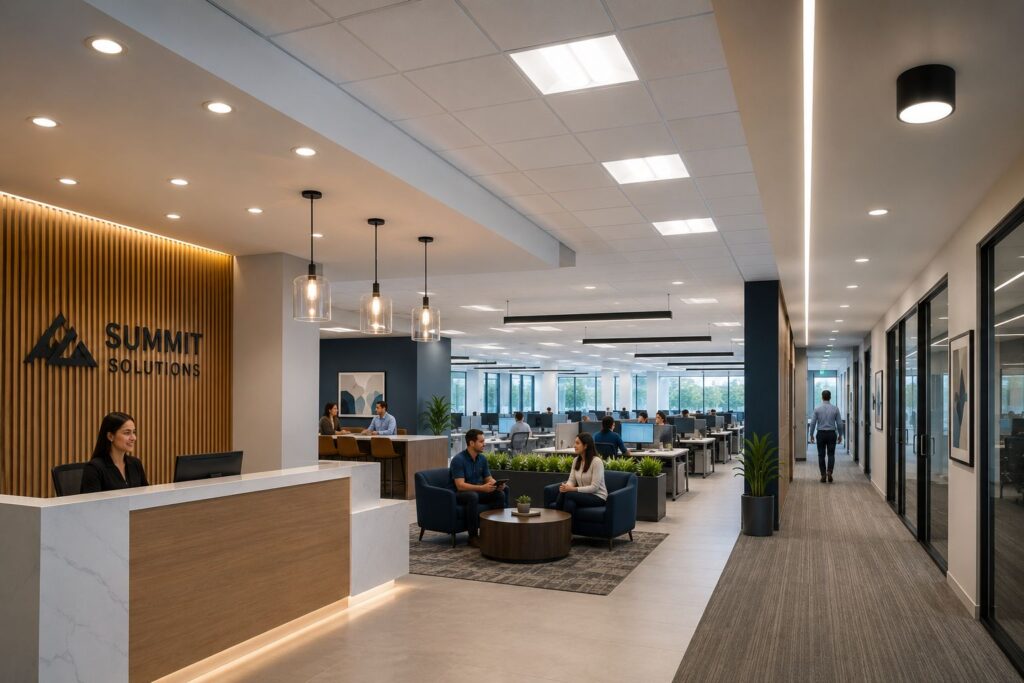
Commercial LED indoor lighting systems improve visibility, reduce operating costs, and provide long-lasting illumination for offices, schools, healthcare facilities, retail spaces, and industrial buildings.
Need Help Selecting Commercial Indoor Lighting?
Whether you’re upgrading fluorescent fixtures, designing a new office, renovating a school, or specifying lighting for a warehouse or healthcare facility, our lighting specialists can help you choose the right LED fixtures for your application and budget.
✓ Free lighting recommendations
✓ Competitive project pricing
✓ Commercial-grade fixtures backed by 5- and 10-year warranties
→ Speak with a Lighting Specialist
Featured Indoor Lighting Categories
Choosing the right fixture begins with understanding the application. Different indoor environments require different lighting distributions, mounting methods, color temperatures, and optical performance. Explore our primary indoor lighting categories below.
LED Ceiling Lights
Surface-mounted LED ceiling fixtures provide dependable general illumination for offices, corridors, classrooms, utility spaces, retail stores, apartment common areas, and commercial buildings. Available in a wide range of wattages and styles, they offer an excellent solution where recessed fixtures are impractical.
Once you’ve selected the right fixtures, our Commercial LED Ceiling Light Installation Guide walks you through planning, coordination, lighting controls, and installation best practices
Typical applications
- Offices
- Hallways
- Utility rooms
- Apartment buildings
- Retail spaces
- Municipal facilities
Starting at approximately $150
Learn More → LED Ceiling Lights
LED Troffers
LED troffers are among the most popular lighting solutions for suspended-grid ceilings. Available in standard 1×4, 2×2, and 2×4 configurations, troffers provide uniform illumination with excellent glare control for offices, schools, hospitals, and commercial interiors.
Typical applications
- Office buildings
- Schools
- Healthcare facilities
- Government buildings
- Commercial interiors
Starting at approximately $225
Learn More → LED Troffers
LED Commercial Recessed Downlights
Commercial recessed downlights provide clean architectural aesthetics while delivering focused illumination for lobbies, hospitality environments, retail stores, conference rooms, restaurants, and upscale commercial interiors.
Available in multiple aperture sizes, beam spreads, and color temperatures, recessed downlights combine energy efficiency with contemporary design.
Typical applications
- Hotels
- Restaurants
- Retail
- Office reception areas
- Healthcare waiting rooms
Starting at approximately $45
Learn More → Commercial Recessed Downlights
LED Architectural Indoor Lighting
Architectural lighting combines visual appeal with functional performance. Decorative pendants, cylinders, linear fixtures, wall-mounted luminaires, and specialty ceiling fixtures help create inviting interior environments while supporting the overall architectural vision.
Ideal for projects where aesthetics are just as important as illumination.
Typical applications
- Universities
- Hotels
- Corporate headquarters
- Museums
- Libraries
- Luxury residential common areas
Starting at approximately $250
Learn More → Architectural Indoor Lighting
LED Linear Strip Lights
Commercial linear strip lights provide economical, high-output illumination for warehouses, workshops, utility rooms, storage facilities, parking garages, and industrial workspaces. Their simple installation and broad light distribution make them an excellent replacement for traditional fluorescent strip fixtures.
Typical applications
- Warehouses
- Workshops
- Utility areas
- Storage facilities
- Mechanical rooms
- Industrial buildings
Starting at approximately $175
Learn More → LED Linear Strip Lights
LED T8 Retrofit Tubes
LED T8 tubes provide one of the fastest, most cost-effective lighting upgrades available. Designed to replace fluorescent lamps, T8 LEDs reduce energy consumption, eliminate mercury, provide instant-on operation, and significantly reduce maintenance requirements.
Available in Type A, Type B, and Hybrid configurations.
Typical applications
- Schools
- Offices
- Retail stores
- Warehouses
- Healthcare facilities
- Government buildings
Starting at approximately $12 per lamp
Learn More →LED T8 Tubes
LED Indoor Swimming Pool & Natatorium Lighting
Natatorium lighting requires specialized fixtures capable of resisting corrosion caused by humidity and chloramine exposure. Our indoor pool lighting solutions feature sealed construction, corrosion-resistant finishes, and optical designs that minimize glare reflected from the water surface while improving visibility for swimmers and lifeguards.
Typical applications
- Community pools
- University aquatic centers
- Competition pools
- Recreation centers
- YMCA facilities
- Hotel indoor pools
Starting at approximately $450
Learn More → Indoor Swimming Pool Lighting
Why Upgrade to Commercial LED Indoor Lighting?
Replacing aging fluorescent or HID lighting with modern LED fixtures offers benefits well beyond lower utility bills. Today’s commercial lighting systems provide better light quality, improved reliability, enhanced occupant comfort, and greater flexibility through integrated controls and smart building technologies.
Organizations upgrading to LED lighting often experience:
- Lower electrical consumption
- Reduced maintenance costs
- Longer fixture life
- Improved occupant comfort
- Better color rendering and visibility
- Instant-on operation without warm-up
- Reduced HVAC loads due to lower heat output
- Compatibility with occupancy sensors and daylight harvesting controls
- Lower total cost of ownership over the life of the system
Commercial Indoor LED Lighting Applications
Selecting the right indoor lighting begins with understanding how the space is used. Every commercial facility has unique illumination requirements based on occupant activities, ceiling height, surface reflectance, operating hours, safety requirements, and energy goals. While modern LED fixtures offer exceptional efficiency and longevity, choosing the proper fixture type, light distribution, and color temperature ensures the lighting system performs as intended for years to come.
Unlike residential lighting, commercial and industrial indoor lighting must balance productivity, occupant comfort, maintenance costs, and regulatory compliance. A warehouse requires bright, uniform illumination for safe material handling, while a hotel lobby prioritizes architectural appeal and guest experience. Schools need glare-controlled lighting that reduces eye fatigue, and healthcare facilities require high color accuracy to support patient care and clinical tasks.
Today’s LED lighting systems allow facility managers and designers to tailor illumination levels for virtually every indoor environment while reducing energy consumption and maintenance compared to fluorescent technologies.
Office Buildings
Modern offices benefit from lighting that improves visual comfort, reduces glare, and supports employee productivity throughout the workday. LED troffers remain one of the most common choices for suspended-grid ceilings, while recessed downlights and architectural fixtures create welcoming reception areas, conference rooms, and executive offices.
Many office buildings now incorporate occupancy sensors, daylight harvesting controls, and dimmable LED fixtures to reduce operating costs while maintaining comfortable illumination levels. Neutral white color temperatures around 4000K are often selected because they provide a clean appearance without feeling overly cool.
For suspended-grid installations, our LED Troffers deliver uniform illumination, while Commercial Recessed Downlights provide accent and task lighting for entrances, meeting rooms, and collaborative workspaces.
🏢 Project Spotlight
A regional medical office building replaced more than 300 fluorescent troffers with LED fixtures featuring occupancy sensors. The upgrade reduced lighting energy consumption by approximately 60% while virtually eliminating lamp replacement throughout the facility.
Warehouses and Distribution Centers
Warehouses demand reliable lighting that improves visibility while minimizing maintenance interruptions. Long operating hours make energy efficiency a critical factor, and modern LED fixtures significantly reduce electricity consumption compared to older fluorescent systems.
Linear strip lights are frequently used in storage aisles, maintenance rooms, packing stations, and utility areas where broad, consistent illumination is required. Facilities with suspended office areas often combine strip lighting in operational spaces with troffers and ceiling fixtures in administrative offices.
Choosing fixtures with long service lives reduces the need for lamp replacements, particularly in facilities where equipment such as lifts is required for maintenance.
Retail Stores and Showrooms
Retail lighting serves two purposes: providing comfortable ambient illumination while highlighting merchandise. Layered lighting designs often combine recessed downlights, architectural pendants, ceiling fixtures, and accent lighting to guide customers through the space and create an inviting shopping environment.
Color rendering also becomes increasingly important in retail settings. High-CRI LED fixtures help merchandise appear more vibrant and accurately represent colors, improving the customer experience.
Architectural fixtures can also reinforce branding by complementing a store’s interior design and enhancing focal areas such as entrances, checkout counters, and product displays.
Schools and Universities
Educational facilities require lighting that promotes concentration while minimizing glare and visual fatigue. LED troffers remain one of the most popular choices for classrooms because they provide even illumination across desks and instructional spaces.
Libraries, administrative offices, laboratories, and student common areas often use a combination of ceiling lights, architectural fixtures, and recessed lighting to create comfortable learning environments while reducing long-term maintenance costs.
Because schools frequently operate for extended hours, replacing aging fluorescent fixtures with LED systems can significantly reduce both energy consumption and maintenance expenses over the life of the building.
Healthcare Facilities
Hospitals, clinics, medical offices, and outpatient facilities require dependable lighting that supports patient care while maintaining comfortable environments for staff and visitors.
Waiting rooms often incorporate recessed downlights and decorative architectural fixtures to create a welcoming atmosphere, while examination rooms, treatment spaces, offices, and administrative areas rely on high-quality ambient lighting with excellent color rendering.
LED fixtures also generate less heat than many legacy lighting technologies, contributing to more comfortable indoor environments and reducing cooling demands.
Manufacturing Facilities
Manufacturing environments require dependable lighting that improves worker safety, product quality, and operational efficiency. Uniform illumination helps employees perform detailed tasks while reducing shadows around equipment and production lines.
Administrative offices, break rooms, quality-control areas, and maintenance shops frequently use combinations of troffers, ceiling fixtures, and linear strip lighting tailored to each workspace’s needs.
Long-life LED fixtures reduce maintenance downtime and help facilities control operating expenses over years of continuous operation.
Hospitality and Public Spaces
Hotels, convention centers, restaurants, museums, libraries, airports, and municipal buildings often emphasize aesthetics as much as illumination. Architectural fixtures, decorative pendants, recessed lighting, and carefully selected ceiling fixtures create inviting environments while complementing the building’s interior design.
Layered lighting strategies allow designers to establish distinct visual experiences throughout the facility, balancing ambient, accent, and decorative lighting to support wayfinding, comfort, and architectural character.
Indoor Aquatic Facilities
Indoor swimming pools and natatoriums present unique lighting challenges because moisture, humidity, and airborne chloramines accelerate corrosion of standard fixtures. Specialized natatorium lighting is engineered with corrosion-resistant materials, sealed housings, and optical systems that minimize reflected glare from the water’s surface.
Proper lighting improves swimmer visibility, enhances spectator comfort, and assists lifeguards by reducing harsh reflections while maintaining consistent illumination across the entire pool area.
Facilities such as recreation centers, schools, universities, hotels, and community aquatic centers benefit from fixtures specifically designed for these demanding indoor environments.
Swim schools often require different lighting systems for the pool area, reception desk, parent viewing room, offices, and changing-area entrances. Review our Swim School Lighting Guide for a coordinated facility-wide approach.
Choosing the Right Indoor LED Fixture
Every commercial project is unique, but selecting the proper fixture typically begins with answering a few key questions:
- What activities take place in the space?
- How high are the ceilings?
- Is the ceiling suspended, exposed, or finished drywall?
- Is uniform ambient lighting or focused task lighting required?
- What color temperature best supports the environment?
- Is high color rendering important?
- Will occupancy sensors or daylight harvesting controls be used?
- Does the application involve moisture, humidity, or corrosive conditions?
- What maintenance strategy and fixture warranty best support long-term ownership?
By evaluating these factors early in the design process, facility owners can create lighting systems that improve visibility, reduce energy consumption, simplify maintenance, and provide years of reliable performance.
Indoor Lighting Design Considerations
Designing an effective commercial indoor lighting system involves more than selecting attractive fixtures. The best lighting plans balance illumination levels, energy efficiency, occupant comfort, maintenance requirements, and long-term operating costs while supporting the specific activities performed within the space.
Modern LED technology gives designers tremendous flexibility through fixture optics, color temperature options, dimming capabilities, occupancy controls, and intelligent lighting management systems. Understanding these design principles helps ensure every area receives appropriate illumination without wasting energy or creating uncomfortable glare.
Whether lighting a corporate office, manufacturing plant, healthcare facility, retail store, educational campus, or municipal building, careful planning results in a lighting system that performs efficiently for many years.
Planning an indoor lighting upgrade? Our LED Troffer Size Guide helps architects, contractors, and facility managers select the ideal fixture size for every commercial space.”
🛠️Design Insight
Instead of specifying the same fixture throughout an office building, consider layering the lighting design. LED troffers provide efficient ambient illumination for open work areas, while recessed downlights can define reception areas and conference rooms. Architectural pendants add visual interest in collaborative spaces without increasing energy consumption.
Recommended Illumination Levels by Application
Different commercial spaces require different illumination levels depending on the visual tasks being performed. Areas dedicated to detailed work typically require brighter, more uniform lighting than circulation spaces or storage rooms.
| Application | Typical Recommended Footcandles |
|---|---|
| Office Workstations | 30–50 fc |
| Conference Rooms | 30–50 fc |
| Classrooms | 30–50 fc |
| Warehouses | 20–30 fc |
| Manufacturing | 30–100 fc (depending on task) |
| Retail Sales Floors | 30–75 fc |
| Healthcare Examination Rooms | 50–100 fc |
| Hallways & Corridors | 10–20 fc |
| Storage Rooms | 10–20 fc |
| Indoor Pool Decks | 20–50 fc |
These recommendations vary depending on ceiling height, fixture spacing, reflectance values, and local project requirements, but they provide a useful starting point when planning a lighting upgrade.
Selecting the Right Color Temperature
Color temperature influences how occupants perceive an indoor environment. Measured in Kelvin (K), it affects the appearance of the light rather than its brightness.
Generally:
3000K — Warm White
Creates a comfortable, inviting atmosphere commonly used in:
- Hospitality
- Restaurants
- Hotels
- Senior living
- Executive spaces
3500K — Neutral White
Offers a balance between warmth and brightness, making it suitable for:
- Retail
- Public buildings
- Reception areas
- Municipal facilities
4000K — Cool Neutral White
The most common choice for commercial interiors because it provides a clean, professional appearance without feeling overly harsh.
Frequently specified for:
- Offices
- Schools
- Healthcare facilities
- Warehouses
- Manufacturing
- Government buildings
5000K — Daylight
Provides maximum visual clarity and is often selected for spaces requiring high visibility and precision.
Typical applications include:
- Manufacturing
- Inspection stations
- Laboratories
- Industrial workspaces
- Maintenance facilities
Typical Color Temperature Guide
| Application | Recommended CCT |
|---|---|
| Hospitality | 3000K |
| Retail | 3500K–4000K |
| Offices | 4000K |
| Schools | 4000K |
| Healthcare | 4000K |
| Warehouses | 4000K–5000K |
| Manufacturing | 5000K |
📐 Specification Tip
For most commercial office renovations, specify 4000K fixtures with a minimum CRI of 80. Retail environments and healthcare applications often benefit from 90+ CRI to improve color accuracy and occupant comfort.
Understanding Color Rendering Index (CRI)
While color temperature determines whether light appears warm or cool, Color Rendering Index (CRI) measures how accurately colors appear under a light source.
Higher CRI values improve color discrimination, making spaces feel more natural and reducing visual fatigue.
General recommendations include:
| Application | Recommended CRI |
|---|---|
| Warehouses | 80+ |
| Offices | 80+ |
| Schools | 80+ |
| Manufacturing | 80+ |
| Retail | 90+ |
| Healthcare | 90+ |
| Museums | 90+ |
High-CRI fixtures are especially valuable where accurate color perception influences purchasing decisions, inspections, or patient care.
Reducing Glare and Improving Visual Comfort
Excessive glare can reduce productivity, contribute to eye fatigue, and create uncomfortable working environments. Modern commercial LED fixtures incorporate advanced optical systems that distribute light evenly while minimizing direct brightness.
Several strategies help improve visual comfort:
- Select fixtures with well-designed optics and diffusers.
- Position fixtures to reduce reflected glare from computer screens.
- Use recessed or indirect lighting where appropriate.
- Maintain uniform fixture spacing across occupied spaces.
- Match fixture output to ceiling height and room dimensions.
- Combine ambient, task, and accent lighting for balanced illumination.
A properly designed lighting system not only improves visibility but also creates a more comfortable environment for employees, visitors, students, and customers.
Uniform Lighting Distribution
Uniform illumination helps eliminate dark spots, excessive brightness, and distracting shadows. Consistent light levels improve safety, simplify visual tasks, and create a more professional appearance throughout a facility.
Factors affecting uniformity include:
- Fixture spacing
- Mounting height
- Beam distribution
- Ceiling reflectance
- Wall finishes
- Furniture and equipment layout
Lighting layouts should be designed so illumination transitions smoothly across the entire workspace rather than concentrating light in isolated areas.
Occupancy Sensors and Smart Lighting Controls
Lighting controls have become an essential component of modern commercial buildings. Instead of operating fixtures continuously, intelligent control systems reduce energy consumption by providing light only when and where it is needed.
Common control options include:
- Occupancy sensors
- Vacancy sensors
- Daylight harvesting
- Scheduled lighting controls
- Networked lighting management systems
- Dimming controls
- Emergency lighting integration
When combined with LED fixtures, these technologies can significantly reduce operating costs while extending fixture life.
Planning for Long-Term Maintenance
Commercial lighting systems should be designed with maintenance in mind. Choosing high-quality fixtures with durable drivers, efficient thermal management, and long service lives minimizes disruptions and lowers ownership costs over time.
Important considerations include:
- Expected fixture life
- Driver quality
- Warranty coverage
- Availability of replacement components
- Ease of installation
- Future expansion requirements
Many premium commercial fixtures now include 5-year warranties, while higher-end product lines featuring premium drivers, superior LEDs, and enhanced thermal management may be backed by 10-year warranties, providing additional confidence for long-term installations.
Why Proper Indoor Lighting Design Matters
A well-designed indoor lighting system does far more than illuminate a room. It enhances employee productivity, supports safety, improves customer experiences, reduces operating expenses, and contributes to the overall appearance and functionality of a commercial facility.
By selecting the appropriate fixtures, color temperatures, controls, and lighting layouts, organizations can create interior environments that remain comfortable, efficient, and dependable for many years while maximizing the return on their lighting investment.
Inline Buyer Q&A
Should we retrofit existing fluorescent lighting or replace the entire fixture?
Both approaches can be appropriate.
LED T8 tubes or retrofit components may provide an economical upgrade when existing housings and electrical components are in suitable condition. Complete fixture replacement provides an opportunity to update the housing, optics, driver, controls, appearance, and overall lighting performance.
The decision should consider fixture age and condition, existing components, labor, ceiling access, operating hours, controls, required illumination, maintenance objectives, and project budget.
How do I choose the right indoor LED fixture for each area of a building?
Start with the application, ceiling type, mounting height, room dimensions, visual tasks, required illumination, desired appearance, controls, and maintenance requirements.
A single building may use troffers or ceiling fixtures in offices and classrooms, recessed downlights in reception and conference areas, architectural fixtures in public spaces, strip lighting in utility or storage areas, and specialized fixtures in environments with additional operating requirements.
Fixture selection should follow the needs of each space rather than applying one fixture type throughout the entire facility.
How important is lighting layout compared with fixture selection?
Both are important.
A high-performance fixture can still produce poor results if fixture quantity, spacing, mounting height, distribution, or output are not appropriate for the space.
For larger or more complex commercial interiors, photometric analysis can help evaluate predicted illumination, uniformity, fixture quantity, and spacing before equipment is installed.
Can different types of indoor LED fixtures be combined within the same building?
Yes. Commercial buildings commonly use multiple fixture types to address different spaces and visual requirements.
Troffers or flat panels can provide broad general illumination, recessed downlights can serve corridors and architectural spaces, strip fixtures can illuminate utility areas, and decorative or architectural fixtures can complement the building’s interior design.
The objective is to coordinate the different fixture types into a functional lighting system.
What lighting controls should I consider for an indoor LED project?
Depending on the facility and equipment, options can include occupancy or vacancy sensing, daylight-responsive controls, dimming, scheduling, wireless controls, and integration with broader building-control systems.
The appropriate strategy depends on occupancy patterns, daylight availability, operating schedules, fixture and driver compatibility, energy objectives, and applicable requirements.
What information should I provide when requesting an indoor lighting quote?
Useful project information includes:
- Building and space type
- Room dimensions or floor plans
- Ceiling type and mounting height
- Existing fixture types and quantities
- Desired or required illumination
- Voltage
- Preferred color temperature or appearance
- Dimming and control requirements
- Operating hours
- New construction or retrofit
- Project schedule
- Any applicable facility or environmental requirements
Providing this information helps narrow fixture choices and determine whether a lighting layout or additional project evaluation would be useful.
Need Help Designing a Commercial Indoor LED Lighting System?
Indoor lighting projects can involve offices, schools, healthcare facilities, retail spaces, institutional buildings, warehouses, manufacturing facilities, and specialized environments, each with different lighting requirements.
Our lighting specialists can help contractors, engineers, architects, facility managers, and building owners evaluate fixture types, retrofit options, controls, lighting layouts, and commercial project requirements.
Call 1-844-533-7767 to discuss your commercial indoor-lighting project.
Frequently Asked Questions About Commercial Indoor LED Lighting
What are the advantages of LED indoor lighting over fluorescent lighting?
LED lighting can reduce energy consumption and maintenance requirements compared with many older fluorescent systems while providing additional options for optical control, dimming, sensing, selectable output, and color temperature.
Actual benefits depend on the existing system, replacement equipment, operating hours, controls, and required lighting performance.
Which indoor LED fixtures are commonly used in office buildings?
Offices can use LED troffers, flat panels, recessed downlights, architectural fixtures, linear fixtures, and other ceiling or task-lighting solutions.
Suspended-grid ceilings commonly accommodate troffers or flat panels, while conference rooms, reception areas, corridors, and other spaces may use different fixture types according to their functional and architectural requirements.
What color temperature is recommended for commercial buildings?
There is no single color temperature appropriate for every commercial interior.
3000K, 3500K, and 4000K are commonly considered across different commercial applications, while other color temperatures may be appropriate depending on the visual tasks, desired appearance, daylight, surrounding finishes, and facility requirements.
Maintaining appropriate color consistency across visually connected spaces can also be important.
How long do commercial LED fixtures last?
Commercial LED fixtures can provide operating lives measured in tens of thousands of hours. Published lifetime ratings vary by fixture, components, manufacturer, and testing methodology.
Actual service life depends on LED and driver quality, thermal management, operating hours, ambient temperature, electrical conditions, controls, and environmental exposure.
What is the difference between LED troffers and other LED ceiling lights?
LED troffers are one type of commercial ceiling fixture and are commonly designed for recessed installation in suspended-grid ceilings.
The broader LED ceiling-lighting category can also include flat panels, recessed downlights, surface-mounted fixtures, and other luminaires designed for different ceiling systems and applications.
Can commercial indoor LED lighting qualify for utility incentives?
Some commercial LED upgrades may qualify for utility or energy-efficiency incentive programs.
Eligibility, approved equipment, documentation, performance requirements, and incentive amounts vary by utility, location, and program. Requirements should be confirmed before equipment is purchased when incentives are part of the project’s financial analysis.
What CRI should I choose for commercial indoor lighting?
The appropriate Color Rendering Index depends on the application.
CRI in the 80 range is commonly used for many general commercial applications, while higher color-rendering performance may be desirable for retail, healthcare, hospitality, museums, design-oriented spaces, color inspection, and other applications where color discrimination is particularly important.
CRI should be evaluated together with color temperature, spectral characteristics, visual tasks, and project requirements.
Are commercial LED fixtures compatible with lighting controls?
Many commercial LED fixtures are available with drivers and components designed for dimming, occupancy sensing, daylight-responsive controls, scheduling, or networked lighting systems.
Compatibility varies by fixture, driver, sensor, and control architecture and should be verified before equipment is selected.
What warranty should I expect from commercial LED lighting?
Warranty duration and coverage vary by manufacturer and product.
Warranty terms should be evaluated together with LED and driver quality, thermal management, published performance, serviceability, manufacturer support, operating environment, and expected usage.
A longer warranty can be valuable, but warranty length alone does not establish fixture quality or expected service life.
How do I choose the right indoor lighting for my facility?
Begin with the activities performed in each space, ceiling construction, mounting height, room dimensions, required illumination, visual tasks, operating environment, controls, maintenance objectives, and energy goals.
Larger or more complex projects may also benefit from photometric analysis to compare fixture quantities, layouts, distributions, and predicted illumination before installation.
Stay Connected with Our Lighting Resources
Add IndustrialLightingFixtures.org as a Preferred Source on Google to see more of our lighting guides and technical resources across Google Search experiences.

Related Indoor Lighting Systems
- Commercial LED Ceiling Lights — Explore ceiling-lighting solutions for offices, schools, healthcare facilities, retail spaces, and other commercial and institutional interiors.
- LED Troffers — Review recessed LED troffers designed for suspended-grid ceilings and broad general illumination in commercial interiors.
- Commercial Recessed Downlights — Explore recessed downlighting for reception areas, conference rooms, corridors, retail environments, and architectural interiors.
- LED Architectural Indoor Lighting — Explore architectural lighting solutions where fixture appearance and integration with interior design are important considerations.
- LED T8 Tubes — Compare LED T8 retrofit approaches for facilities considering upgrades to existing fluorescent lighting systems.