Class I Division 1 and Division 2 lighting are designed for hazardous industrial environments where flammable gases or vapors may be present. Understanding the differences between these NEC hazardous location classifications is critical for selecting safe, compliant, and properly rated explosion proof lighting systems.
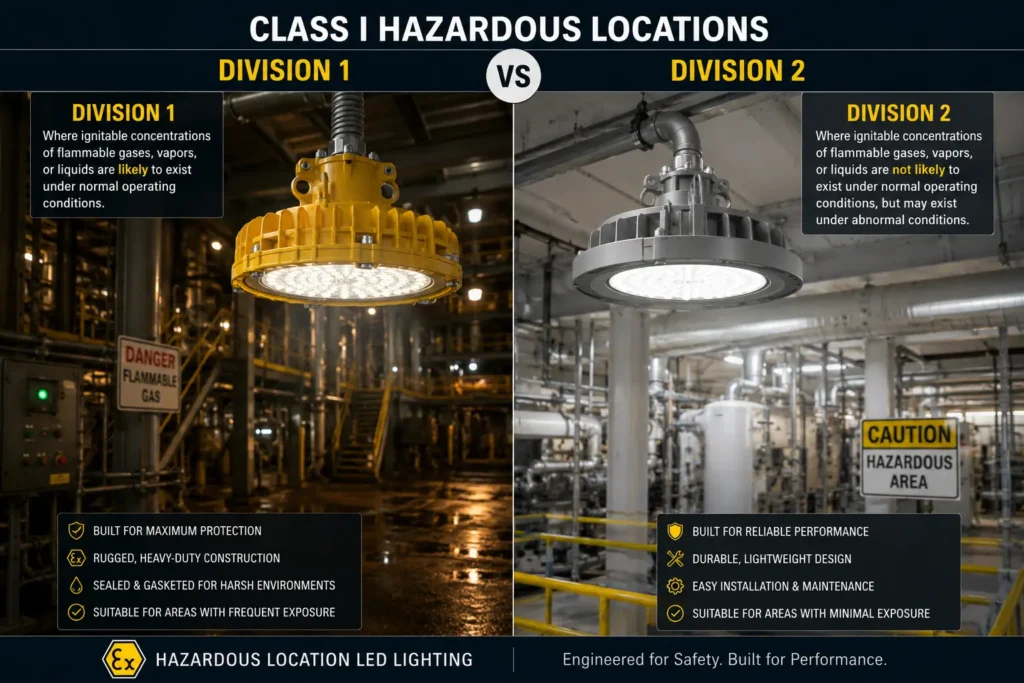
Class I Division 1 and Division 2 LED lighting is designed for hazardous industrial locations where flammable gases or vapors may be present, with the required fixture rating determined by the conditions of the classified area.
Need Help Selecting Class I Division 1 or Division 2 Lighting?
The correct hazardous-location fixture depends on more than the Division rating. Gas or vapor group, temperature code, ambient temperature, mounting conditions, environmental exposure, and required certifications should all be considered before selecting equipment. Explore our Explosion-Proof LED Lighting solutions or call 844-533-7767
for help matching properly rated LED fixtures to your classified-area requirements.
What Is Class I Division 1 Lighting?
Class I Division 1 (CID1) lighting is designed for environments where flammable gases or vapors are present during normal operating conditions or may frequently exist due to maintenance, leaks, or system failures.
These are considered the highest-risk hazardous gas environments under NEC hazardous location classifications.
Common examples include:
- Oil refineries
- Gas processing plants
- Chemical manufacturing facilities
- Aircraft fueling stations
- Paint spray booths
- Petroleum storage areas
- Ethanol processing facilities
In these environments, lighting fixtures must be constructed to prevent internal sparks, arcs, or heat from igniting surrounding explosive atmospheres.
For facilities requiring elevated mounting heights and powerful hazardous location illumination, Explosion Proof High Bay Lighting fixtures are commonly used in oil & gas facilities, chemical plants, manufacturing environments, and industrial processing areas.
CID1 fixtures are typically:
- fully sealed,
- heavy-duty,
- corrosion-resistant,
- impact-resistant,
- engineered to contain internal explosions.
What Is Class I Division 2 Lighting?
Class I Div 2 (CID2) lighting is intended for areas where flammable gases or vapors are not normally present during regular operation but could appear under abnormal conditions such as equipment failure, accidental leaks, or ventilation system problems.
These locations present lower ignition risk compared to Division 1 environments.
Typical applications include:
- adjacent industrial processing areas,
- fuel storage perimeters,
- compressor rooms,
- utility corridors,
- enclosed maintenance areas,
- battery charging rooms,
- areas surrounding hazardous production zones.
Because the hazardous condition is considered less frequent, Division 2 fixtures often have more flexible design options while still meeting strict hazardous location requirements.
Before selecting hazardous location lighting, review Understanding Explosion Proof Lighting Standards to learn how certification requirements, classifications, and testing procedures affect fixture selection.
Key Differences Between Class I Division 1 and Division 2 Lighting
Hazard Presence
Class I Division 1
Hazardous gases or vapors are:
- continuously present,
- intermittently present during normal operations,
- or likely to exist frequently.
Class I Division 2
Hazardous gases or vapors are:
-
- normally confined within closed systems,
- only present during accidental equipment failure,
- or unlikely under normal operating conditions.
Understanding hazardous area classifications is essential for selecting compliant industrial fixtures. Our Hazardous Location Lighting Guide explains hazardous classifications, explosion protection methods, and industrial lighting applications.
Fixture Construction Differences
Division 1 Fixtures
Division 1 fixtures typically feature:
- explosion-proof housings,
- reinforced sealing systems,
- thick cast aluminum construction,
- specialized conduit sealing,
- advanced thermal management,
- higher ingress protection ratings.
These fixtures are designed to contain an internal explosion without allowing ignition to spread outside the fixture enclosure.
Division 2 Fixtures
Division 2 fixtures may use:
- non-incendive designs,
- sealed electronics,
- vapor-resistant housings,
- reduced ignition-source exposure.
While still highly durable, CID2 fixtures are often:
- lighter,
- more compact,
- lower cost,
- easier to install than Division 1 models.
NEC Hazardous Location Classification Overview
The National Electrical Code (NEC) classifies hazardous locations using:
- Class,
- Division,
- Group,
- Temperature Code.
Class I
Flammable gases or vapors are present.
Examples:
- propane,
- gasoline vapors,
- hydrogen,
- acetylene,
- methane.
Division 1
Hazard exists during normal operation.
Division 2
Hazard exists only under abnormal conditions.
Facilities planning hazardous location upgrades should review What Is Class 1 Division 1 LED Lighting? to understand where Division 1 requirements apply and how certified fixtures improve operational safety.
Common Gas Groups
Hazardous gases are further categorized into groups based on ignition characteristics.
Group A
Acetylene
Group B
Hydrogen and similar gases
Group C
Ethylene
Group D
Propane, gasoline vapors, methane
Lighting fixtures must be properly rated for the specific gas group present within the facility.
Temperature Codes (T-Codes)
Hazardous location fixtures also carry temperature ratings known as T-Codes.
These ratings indicate the maximum surface temperature a fixture can reach during operation.
Examples include:
- T1
- T2
- T3
- T4
- T5
- T6
Selecting the correct T-Code helps ensure fixture surface temperatures remain below the ignition temperature of surrounding hazardous materials.
Typical Class I Division 1 Applications
Common CID1 lighting applications include:
Oil & Gas Facilities
Refineries, drilling platforms, and extraction sites often contain continuous flammable vapor exposure.
Chemical Processing Plants
Chemical blending and manufacturing operations frequently require Division 1 rated lighting.
Paint Spray Booths
Combustible solvent vapors can accumulate during normal operation.
Fuel Transfer Stations
Gasoline and fuel vapor exposure creates elevated ignition risks.
Grain Alcohol & Ethanol Facilities
Alcohol vapors may create explosive atmospheres during production.
Typical Class I Div 2 Applications
Common CID2 lighting applications include:
Utility Rooms
Hazardous gases may only appear during equipment failure.
Compressor Buildings
Gas leakage is possible but not expected during standard operation.
Storage Areas
Flammable materials are contained in sealed systems under normal conditions.
Wastewater Treatment Facilities
Methane exposure risks may occur intermittently.
Maintenance Corridors
Adjacent areas surrounding hazardous production zones often fall into Division 2 classificati
LED Lighting Advantages for Hazardous Locations
Modern LED hazardous location fixtures offer significant benefits compared to traditional HID technologies.
Energy Efficiency
LED fixtures reduce electrical consumption while delivering high lumen output.
Reduced Maintenance
Long LED operating life helps minimize maintenance requirements in difficult-to-access hazardous environments.
Improved Durability
LED fixtures are highly resistant to:
- vibration,
- impact,
- thermal cycling,
- moisture,
- corrosion.
Instant-On Performance
Unlike metal halide fixtures, LEDs reach full brightness immediately after power-up.
Better Thermal Control
Advanced thermal management helps maintain compliance with hazardous location temperature ratings.
Explosion Proof vs Non-Incendive Lighting
A common misconception is that all hazardous location lighting is “explosion proof.”
In reality:
Explosion Proof
Typically associated with Division 1 environments.
Fixtures are built to contain internal explosions without igniting surrounding atmospheres.
Non-Incendive
Often used in Division 2 applications.
Fixtures are designed to prevent arcs, sparks, or excessive heat during normal operation.
Selecting the wrong fixture type can create major safety and compliance risks.
Important Compliance Standards
When selecting hazardous location lighting, verify applicable certifications and standards.
Common certifications include:
- UL844
- NEC Article 500
- NEC Article 505
- ATEX
- IECEx
- CSA
- NEMA ratings
- IP ratings
Facilities operating internationally may require both North American and international hazardous location certifications.
How to Choose Between Div 1 and Div 2 Fixtures
The correct classification should always be determined by:
- facility engineers,
- electrical engineers,
- safety officers,
- hazardous area consultants,
- local code authorities.
Key considerations include:
- gas or vapor type,
- frequency of exposure,
- ventilation conditions,
- facility process design,
- operating environment,
- temperature requirements,
- mounting height,
- washdown exposure,
- corrosion risks.
Using an under-rated fixture in a hazardous environment can result in:
- code violations,
- safety hazards,
- equipment failure,
- fire or explosion risks.
Inline Buyer Q&A
What information do I need to determine whether I need Class I Division 1 or Division 2 lighting?
Start with the hazardous-location classification established for the area where the fixture will be installed.
Important information can include:
- Class and Division
- Gas or vapor group
- Temperature code
- Ambient temperature
- Required certifications
- Fixture type
- Mounting location and height
- Voltage
- Required illumination
- Environmental exposure
- Existing equipment for retrofit projects
Do not determine Division classification from the industry or application alone. The classification should come from the actual conditions and applicable requirements for the facility.
Can I choose Class I Division 1 lighting simply to cover both Division 1 and Division 2 areas?
Not solely from the Division marking.
Equipment still needs to be suitable for the complete hazardous-location requirements, including the applicable Class, material group, temperature code, ambient conditions, and other required markings or certifications.
Using equipment rated for more demanding conditions can also add cost, weight, installation requirements, or other characteristics that may not be necessary for a particular Division 2 location.
Does Division 2 mean the area is not very hazardous?
No.
Division 2 is still a classified hazardous location requiring appropriately rated electrical equipment.
The distinction concerns the conditions under which ignitable concentrations may be present. It should not be interpreted as meaning that normal commercial or industrial lighting can automatically be installed there.
Can different areas within the same facility be Division 1 and Division 2?
Yes.
Hazardous-area boundaries can vary within the same facility based on the process, equipment, ventilation, potential release sources, and other conditions.
One portion of a facility may be Division 1, another Division 2, and another unclassified.
Lighting should be selected for the classification of the specific location where each fixture will be installed.
Do Class I Division 1 and Division 2 fixtures provide the same lighting performance?
Hazardous-location classification addresses equipment suitability for the environment, not how effectively the fixture illuminates the space.
Fixtures can differ in lumen output, optical distribution, efficacy, mounting, controls, color characteristics, and other lighting-performance features.
Both hazardous-location suitability and photometric performance should be considered when selecting equipment.
What should I provide when requesting Class I hazardous-location lighting?
Provide the project’s classified-area information whenever available.
Also include fixture quantities, mounting heights, voltage, existing fixture information, required illumination, ambient temperature, environmental exposure, drawings, photographs, and any project-specific certification requirements.
For larger facilities, photometric information can help evaluate fixture placement, output, and distribution.
Match the Division Rating to the Actual Classified Area
Selecting between Class I Division 1 and Division 2 lighting starts with the classification of the installation—not simply the type of facility.
Division, gas or vapor group, temperature code, ambient temperature, fixture type, environmental conditions, and required certifications should all be evaluated before equipment is specified.
Our lighting specialists can help evaluate Class I hazardous-location LED lighting for refineries, chemical facilities, paint and coating operations, fueling areas, manufacturing plants, wastewater facilities, oil and gas operations, and other classified environments.
Call 1-844-533-7767 to discuss your Class I Division 1 or Division 2 lighting requirements.
Frequently Asked Questions About Class I Div 1 vs Division 2 Lighting
What is the difference between Class I Division 1 and Division 2 lighting?
Both classifications involve locations where flammable gases or vapors may create an ignition hazard.
Division 1 generally applies where ignitable concentrations may exist under normal operating conditions or under other conditions included within the applicable Division 1 definition.
Division 2 generally applies where ignitable concentrations are not normally present during normal operation but may occur under specified abnormal conditions, or where other conditions included within the Division 2 classification apply.
The classification of the actual installation should determine which lighting equipment is required.
What does “Class I” mean in hazardous location lighting?
Class I identifies hazardous locations involving flammable gases or vapors.
Depending on the process and facility, materials can include substances such as hydrogen, acetylene, propane, gasoline vapors, methane, ethylene, and other flammable gases or vapors.
The specific material is important because Class I locations also use gas or vapor groups as part of equipment selection.
Where is Class I Division 1 lighting typically used?
Division 1 classifications can occur in applications such as:
- Oil and gas processing
- Refineries
- Chemical processing
- Paint and coating operations
- Fuel handling and transfer
- Aviation fueling
- Petrochemical facilities
- Other processes involving flammable gases or vapors
These are examples only. The presence of a particular industry or process does not automatically establish that the entire facility—or a particular fixture location—is Division 1.
Where is Class I Division 2 lighting commonly installed?
Division 2 classifications can occur in portions of facilities where flammable gases or vapors are normally contained or not expected to form ignitable concentrations during normal operation but could become present under conditions addressed by the applicable classification requirements.
Examples can occur around process equipment, storage and transfer systems, wastewater facilities, compressor areas, support spaces, and locations adjacent to other classified areas.
The actual area classification should determine the required lighting.
Is Class I Division 2 an unclassified or ordinary location?
No.
Class I Division 2 is a classified hazardous location.
Electrical equipment installed there must be suitable for the classification and other applicable requirements.
Can Division 2 lighting be used in Division 1 areas?
Not merely because the fixture is approved for Division 2.
Equipment installed in a Division 1 location must be suitable and properly marked for the Division 1 classification and the other applicable hazardous-location requirements.
A fixture marked only for Division 2 should not be treated as acceptable for Division 1.
Can Division 1 lighting be used in Division 2 areas?
Potentially, when the equipment’s complete markings and characteristics are suitable for the Division 2 location.
The Class, gas or vapor group, temperature code, ambient rating, environmental characteristics, certifications, and other project requirements still need to be checked.
A Division 1 marking by itself should not be treated as universal approval for every Division 2 application.
Does Division 1 always mean flammable gas is continuously present?
No.
Division 1 should not be reduced to “continuous exposure.”
The classification includes conditions defined by the applicable hazardous-location requirements and can involve more than continuous presence of an ignitable concentration.
The actual classification documentation should be used when selecting equipment.
What are Class I gas groups?
Under the North American Class/Division system, Class I gases and vapors are categorized into Groups A, B, C, and D according to characteristics relevant to hazardous-location equipment.
Different gases and vapors can present different ignition characteristics.
The fixture should be marked for the group applicable to the classified location.
What is a temperature code, or T-Code?
A temperature code identifies the maximum surface temperature associated with electrical equipment under specified operating conditions.
The equipment temperature classification must be appropriate for the ignition characteristics of the gas or vapor involved.
Ambient-temperature limitations should also be reviewed when selecting the fixture.
What makes a lighting fixture explosion proof?
In the North American hazardous-location context, explosion-proof equipment uses construction designed so that an explosion of a specified gas or vapor that may occur within the enclosure will be contained and will not ignite the surrounding atmosphere through the enclosure.
This involves more than simply using a heavy or sealed housing.
The complete luminaire must carry the appropriate certification and markings for the hazardous location.
Does explosion proof mean a fixture can withstand an external explosion?
No.
“Explosion proof” should not be interpreted as meaning the fixture is designed to survive any external blast or explosion.
The term relates to the equipment’s hazardous-location construction and its ability to prevent an internal ignition event from propagating to the surrounding specified hazardous atmosphere under its certification requirements.
Are Class I Division 1 fixtures always larger and heavier than Division 2 fixtures?
Not necessarily.
Fixture construction varies considerably by manufacturer, certification, protection method, output, housing design, and application.
Do not use fixture size, weight, or appearance to determine its hazardous-location suitability. Verify the actual certification and markings.
Is UL 844 important for Class I lighting?
UL 844 is an important North American standard covering luminaires for use in hazardous classified locations.
The required listing or certification depends on the project, jurisdiction, classification, and applicable requirements.
Always verify the markings and certification of the specific luminaire being considered.
Can IP-rated industrial lights be used in Class I Division 1 or Division 2 areas?
An IP rating alone is not sufficient.
IP ratings describe specified protection against ingress of solids and water. They do not establish suitability for a Class I hazardous location.
The fixture must carry the appropriate hazardous-location certification and markings for the installation.
Can LED fixtures be used in both Division 1 and Division 2 locations?
Yes, when the complete LED luminaire is specifically rated and certified for the applicable classified location.
LED technology itself does not establish hazardous-location suitability.
The fixture’s complete markings must be checked for the Class, Division, material group, temperature requirements, ambient conditions, and other applicable criteria.
Can a photometric layout be performed for Class I Division 1 and Division 2 facilities?
Yes.
Photometric analysis can help evaluate fixture quantity, placement, output, distribution, illumination, and uniformity.
Photometric performance and hazardous-location certification address different requirements. A good lighting layout does not establish that a fixture is suitable for the classified environment.
Stay Connected with Our Lighting Resources
Add IndustrialLightingFixtures.org as a Preferred Source on Google to see more of our lighting guides and technical resources across Google Search experiences.

Related Class I and Hazardous Location Lighting Resources
- LED Explosion-Proof Lighting — Explore LED lighting fixtures for classified industrial environments involving flammable gases, vapors, combustible dusts, and other hazardous conditions.
- Class 1 Division 1 Lighting — Take a deeper look at lighting selection for locations specifically classified as Class 1 Division 1.
- Explosion-Proof Lighting Guide — Learn how classifications, fixture types, certifications, temperature ratings, and operating conditions affect explosion-proof lighting selection.
- ATEX vs UL 844 Lighting — Compare hazardous-location standards and certification frameworks encountered in North American and international lighting projects.