Outdoor lighting plays an important role in pedestrian safety, security, and wayfinding, but poorly designed lighting systems can contribute to glare, light trespass, and sky glow. Dark Sky bollard lighting offers a solution by providing pedestrian-scale illumination while minimizing the environmental impact of outdoor lighting.
Because bollards direct light closer to the walking surface than traditional pole-mounted fixtures, they are often an excellent choice for projects seeking to balance visibility with responsible lighting practices.
This guide explains how Dark Sky bollard lighting works, key fixture features, and how to select bollards that support Dark Sky objectives.
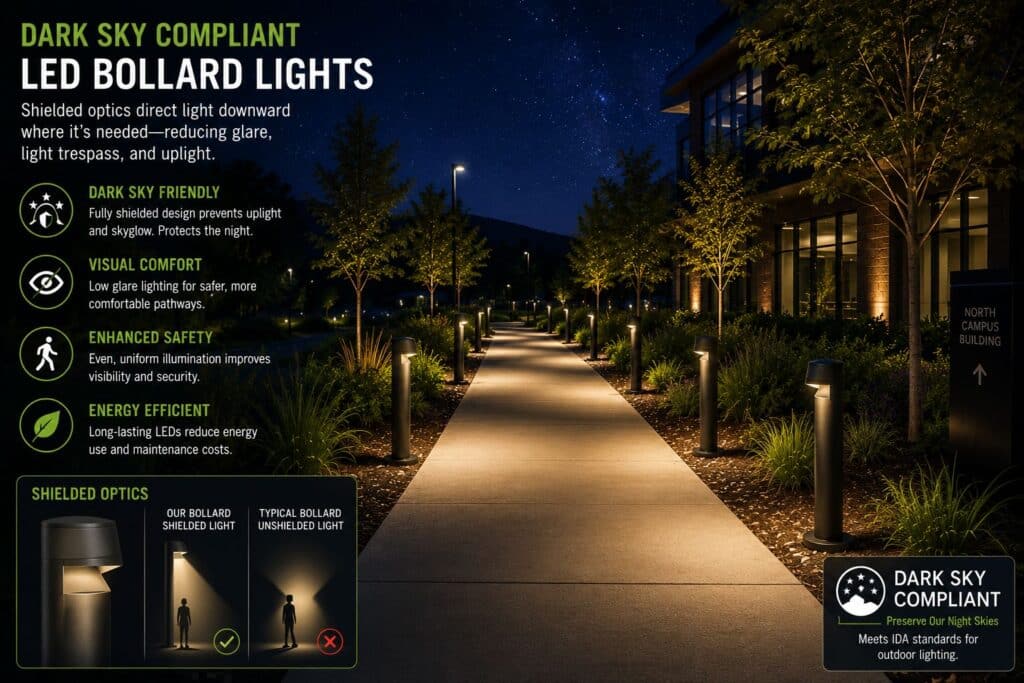
Dark Sky bollard lighting improves pathway visibility while reducing glare, light trespass, and sky glow.
Looking for Dark Sky compliant bollard lighting for pathways, parks, campuses, or community developments?
Explore LED Bollard Lights | Request a Quote
Call 1-844-533-7767 for commercial bollard lighting assistance.
What Is Dark Sky Bollard Lighting?
Dark Sky bollard lighting refers to bollard fixtures designed to minimize unnecessary light emission above the horizontal plane while providing effective illumination where it is needed.
These fixtures typically incorporate:
- Full-cutoff optics
- Shielded LED light sources
- Reduced uplight
- Controlled light distribution
- Warm color temperatures
- Glare reduction technologies
The goal is to improve visibility while minimizing negative impacts on neighboring properties, wildlife, and the night sky.
Why Light Pollution Matters
Excessive outdoor lighting can contribute to:
- Sky glow
- Light trespass
- Visual discomfort
- Wildlife disruption
- Increased energy consumption
- Reduced nighttime visibility
Properly designed bollard lighting helps address these concerns by directing light downward toward pathways and pedestrian areas.
Why Bollards Support Dark Sky Objectives
Unlike tall pole-mounted fixtures that distribute light over large areas, bollards operate closer to the ground and illuminate smaller spaces.
Benefits include:
- Lower mounting heights
- Reduced uplight
- Improved optical control
- Better pedestrian-scale lighting
- Reduced visual clutter
- Improved lighting uniformity
For a broader overview of fixture construction and bollard types, review our Complete LED Bollard Guide.
Key Features of Dark Sky Bollards
Full-Cutoff Design
Full-cutoff bollards prevent light from escaping upward into the night sky.
Benefits include:
- Reduced sky glow
- Improved visual comfort
- Better lighting control
- Enhanced compliance with local regulations
Shielded Optics
Modern Dark Sky bollards often incorporate internal shielding to conceal the LED source from direct view.
Benefits include:
- Reduced glare
- Improved visibility
- Greater pedestrian comfort
Directional Light Distribution
Many Dark Sky bollards utilize directional optics that focus illumination onto pathways and walking surfaces.
Benefits include:
- Less wasted light
- Improved efficiency
- Better pathway visibility
Warm Color Temperatures
Many municipalities encourage lower color temperatures for outdoor lighting.
Common options include:
| Color Temperature | Typical Use |
|---|---|
| 2700K | Wildlife-sensitive areas |
| 3000K | Most Dark Sky projects |
| 4000K | Commercial applications where permitted |
Lower color temperatures generally produce less visual disruption and a more comfortable nighttime environment.
Common Dark Sky Bollard Applications
| Application | Typical Benefits |
| Parks | Reduced environmental impact |
| Nature Trails | Wildlife protection |
| Campuses | Improved pedestrian visibility |
| HOA Communities | Reduced light trespass |
| Multifamily Properties | Better resident comfort |
| Municipal Pathways | Reduced sky glow |
| Healthcare Campuses | Comfortable nighttime navigation |
| Hospitality Properties | Attractive low-glare lighting |
Many community developments incorporate Dark Sky principles into larger outdoor lighting plans. Additional recommendations can be found in our HOA Lighting Design Guide.
BUG Ratings and Bollard Lighting
Many Dark Sky projects evaluate fixtures using BUG ratings:
B – Backlight
Measures light projected behind the fixture.
U – Uplight
Measures light emitted above the horizontal plane.
G – Glare
Measures potential visual discomfort caused by the fixture.
Dark Sky bollards are typically selected with low uplight and glare ratings.
Fixture Height and Dark Sky Performance
Fixture height can influence visual comfort and lighting distribution.
Generally:
| Bollard Height | Dark Sky Consideration |
| 30 Inches | Excellent glare control |
| 36 Inches | Good balance of coverage and control |
| 42 Inches | Suitable for larger pathways |
| 48 Inches | Requires careful optical selection |
For additional recommendations, review our LED Bollard Height Guide.
Spacing and Light Pollution
Increasing fixture density does not necessarily improve visibility.
Proper spacing can help:
- Reduce excessive brightness
- Improve lighting uniformity
- Minimize glare
- Reduce energy consumption
Projects should evaluate both fixture output and spacing requirements.
For layout recommendations, see our Bollard Light Spacing Guide.
Wildlife-Friendly Bollard Lighting
Many environmentally sensitive projects utilize Dark Sky bollards to reduce impacts on wildlife.
Applications include:
- Parks
- Coastal properties
- Wetlands
- Nature preserves
- Recreational trails
Common strategies include:
- Lower lumen outputs
- Shielded fixtures
- Warm color temperatures
- Reduced operating hours
Commercial Dark Sky Bollard Applications
Commercial properties increasingly utilize Dark Sky lighting practices to improve environmental stewardship while maintaining safety.
Common examples include:
- Corporate campuses
- Hotels
- Mixed-use developments
- Healthcare facilities
- Educational campuses
Why Property Owners Choose Dark Sky Bollards
| Benefit | Importance |
| Reduced Glare | High |
| Reduced Sky Glow | High |
| Better Pedestrian Comfort | High |
| Wildlife Protection | Moderate |
| Energy Efficiency | Moderate |
| Regulatory Compliance | High |
| Improved Aesthetics | High |
Inline Buyer Q&A
Are bollard lights Dark Sky compliant?
Many modern bollard fixtures are specifically designed to support Dark Sky objectives through full-cutoff optics and controlled light distribution.
What color temperature is best for Dark Sky projects?
3000K is commonly used, while 2700K is often selected for environmentally sensitive applications.
Do bollards reduce light pollution?
Properly designed bollards can significantly reduce glare, uplight, and light trespass compared to many traditional outdoor fixtures.
Are taller bollards less Dark Sky friendly?
Not necessarily. Fixture optics and shielding generally have a greater impact than height alone.
Can Dark Sky bollards improve visibility?
Yes. Reducing glare often improves visual comfort and pedestrian visibility.
Dark Sky Bollard Lighting Solutions
Dark Sky bollard lighting provides a practical way to improve pedestrian visibility while reducing glare, sky glow, and light trespass. By selecting full-cutoff fixtures, appropriate color temperatures, and proper spacing, property owners can create outdoor lighting systems that enhance safety while supporting responsible environmental stewardship.
For assistance selecting Dark Sky bollard fixtures for pathways, parks, campuses, commercial properties, or community developments, explore our commercial LED bollard lights or request a quote for project-specific fixture recommendations.
Frequently Asked Questions
What is a Dark Sky bollard light?
A Dark Sky bollard is designed to direct light downward while minimizing uplight and glare.
Are Dark Sky bollards required by code?
Some municipalities and development standards encourage or require Dark Sky-compliant outdoor lighting.
Can Dark Sky bollards be used in commercial projects?
Yes. Many commercial campuses, parks, and mixed-use developments utilize Dark Sky lighting principles.
What is the best color temperature for Dark Sky lighting?
Most projects use 2700K or 3000K color temperatures.
Do Dark Sky bollards save energy?
Many Dark Sky fixtures improve efficiency by directing light only where it is needed.
Stay Connected with Our Lighting Resources
Add IndustrialLightingFixtures.org as a Preferred Source on Google to see more of our lighting guides and technical resources across Google Search experiences.
