
Proper bollard light spacing is one of the most important factors in creating safe, attractive, and effective outdoor lighting systems. Even the highest-quality bollard fixtures can produce poor results if installed too far apart or too close together.
Whether illuminating a commercial walkway, university campus, multifamily community, public park, or residential pathway, proper spacing helps maintain consistent illumination, improve pedestrian visibility, and reduce dark areas that can negatively impact safety and appearance.
This guide explains how bollard spacing is determined and provides practical recommendations for common outdoor lighting applications.
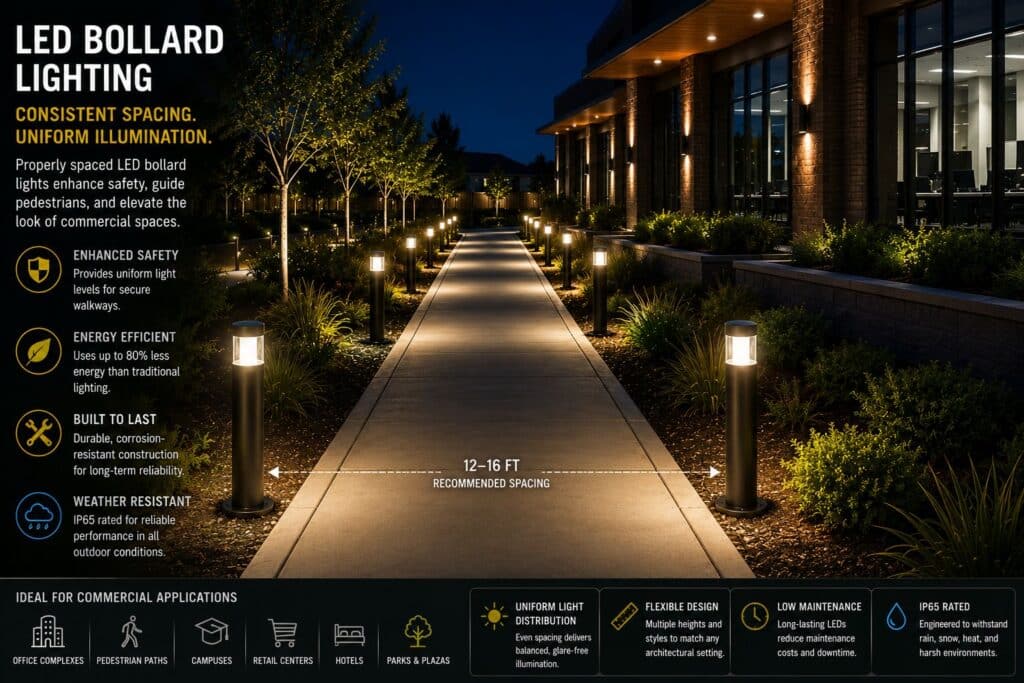
Proper bollard spacing improves pathway visibility, lighting uniformity, and pedestrian safety.
Need assistance selecting bollard fixtures or designing a pathway lighting layout?
Explore LED Bollard Lights | Request a Quote
Call 1-844-533-7767 for commercial bollard lighting assistance.
Why Bollard Light Spacing Matter
Bollards are designed to provide pedestrian-scale illumination. Unlike pole-mounted fixtures that illuminate large areas from elevated positions, bollards create smaller lighting patterns closer to the ground.
Improper spacing can create:
- Dark gaps between fixtures
- Excessive brightness
- Poor uniformity
- Increased glare
- Reduced pedestrian visibility
- Higher installation costs
Proper spacing helps achieve balanced illumination while maximizing fixture performance.
Factors That Affect Bollard Spacing
Several factors influence spacing recommendations.
Fixture Height
Taller bollards generally distribute light over a larger area than shorter fixtures.
For a detailed discussion of bollard heights and applications, visit our LED Bollard Height Guide.
Optical Distribution
Light distribution patterns vary significantly between fixtures.
Common distributions include:
- 360° distribution
- Directional distribution
- Shielded distribution
- Full cutoff optics
Light Output
Higher lumen packages often support greater spacing distances.
Pathway Width
Wider walkways frequently require tighter spacing or staggered layouts.
Lighting Objectives
Security-focused projects often require higher illumination levels than decorative installations.
Typical Bollard Spacing Recommendations
| Application | Typical Spacing |
|---|---|
| Residential Pathways | 10–20 Feet |
| Garden Walkways | 10–15 Feet |
| Commercial Sidewalks | 15–25 Feet |
| Campus Walkways | 20–30 Feet |
| Parks & Recreation Areas | 20–30 Feet |
| Courtyards | 15–25 Feet |
| Multifamily Communities | 15–25 Feet |
| Building Entrances | 10–20 Feet |
Actual spacing should always be verified through photometric analysis.
From Bollard Spacing to Fixture Selection
Proper bollard spacing depends on more than distance between fixtures. Bollard height, lumen output, optical distribution, pathway width, required light levels, uniformity, shielding, and the surrounding environment all affect how far apart fixtures can be installed.
Once the approximate layout and spacing requirements are established, compare commercial LED bollard lights by height, output, distribution, architectural style, controls, and photometric performance.
Common Bollard Layout Patterns
Single-Sided Layout
Fixtures are installed along one side of a pathway.
Best for:
- Narrow walkways
- Residential paths
- Garden applications
Alternating Layout
Fixtures are staggered on both sides of a pathway.
Best for:
- Commercial pathways
- Campuses
- Multifamily properties
Symmetrical Layout
Fixtures are directly opposite one another.
Best for:
- Formal entrances
- Courtyards
- Architectural applications
Spacing by Pathway Width
| Pathway Width | Typical Layout |
| 4–6 Feet | Single-sided |
| 6–8 Feet | Single or alternating |
| 8–12 Feet | Alternating |
| 12+ Feet | Alternating or symmetrical |
Wider pathways generally require additional fixtures to maintain consistent illumination.
Commercial Bollard Spacing Considerations
Commercial properties often prioritize pedestrian safety, accessibility, and wayfinding.
Many facilities utilize bollards along:
- Building entrances
- Sidewalks
- Outdoor gathering spaces
- Healthcare campuses
- Hospitality properties
Residential Bollard Spacing Considerations
Residential projects typically prioritize aesthetics and visual comfort while maintaining adequate visibility.
Common residential applications include:
- Garden pathways
- Driveways
- Patios
- Outdoor living spaces
Homeowners can learn more in our Residential Bollard Lighting Guide.
Campus and Community Pathways
Educational campuses, parks, and HOA communities often utilize longer pathway networks requiring careful spacing and uniformity planning.
Additional pedestrian lighting recommendations can be found in our Campus Pathway Lighting Guide.
Dark Sky and Glare Control
Increasing fixture density does not always improve lighting quality.
Proper spacing combined with full-cutoff optics can reduce:
- Glare
- Light trespass
- Sky glow
Projects seeking environmentally responsible lighting should review our Dark Sky Outdoor Lighting Guide.
Common Spacing Mistakes
Installing Fixtures Too Far Apart
Large gaps create dark areas and inconsistent illumination.
Installing Fixtures Too Close Together
Overlapping light patterns increase installation costs and may create excessive brightness.
Ignoring Fixture Optics
Different bollard designs produce dramatically different light distribution patterns.
Skipping Photometric Analysis
Professional lighting layouts help optimize performance and reduce unnecessary fixtures.
Inline Buyer Q&A
How far apart should bollard lights be spaced?
Most installations utilize spacing between 10 and 30 feet depending on fixture output and application.
Does bollard height affect spacing?
Yes. Taller fixtures generally illuminate larger areas and may support greater spacing distances.
Can spacing reduce glare?
Proper spacing helps maintain visual comfort and reduce excessive brightness.
Should bollards be staggered?
Alternating layouts often improve lighting uniformity on wider pathways.
Is photometric analysis necessary?
For commercial projects, photometric analysis is strongly recommended to verify lighting performance.
Plan the Right Bollard Spacing for Your Project
Effective bollard spacing depends on fixture output, mounting height, optical distribution, pathway width, and the illumination levels required for the application. Evaluating these factors before installation can improve uniformity, pedestrian visibility, and overall lighting performance.
👉 Explore Commercial LED Bollard Lighting or call 1-844-533-7767 to discuss fixture selection, spacing, and pathway lighting for your project.
Frequently Asked Questions
What is the ideal spacing for bollard lights?
Many typical pathway installations fall within 15 to 25 feet, although actual requirements vary by fixture and application.
How do I determine bollard spacing?
Fixture output, mounting height, pathway width, and lighting objectives all influence spacing recommendations.
Are bollard lights better than pole lights for pathways?
Bollards provide pedestrian-scale illumination while pole lights illuminate larger areas from elevated positions.
Can bollards be used in Dark Sky projects?
Yes. Many full-cutoff bollards support Dark Sky lighting objectives.
Do commercial projects require tighter spacing?
Not necessarily. Proper spacing depends on fixture performance and project requirements rather than property type alone.
Stay Connected with Our Lighting Resources
Add IndustrialLightingFixtures.org as a Preferred Source on Google to see more of our lighting guides and technical resources across Google Search experiences.

Related Bollard & Pathway Lighting Resources
Continue planning bollard and pathway lighting for commercial properties, campuses, pedestrian areas, and outdoor environments with these related fixture-selection and lighting-design resources:
-
- LED Bollard Lighting — Explore commercial LED bollard fixtures for pathways, building entrances, landscaped areas, campuses, and other pedestrian-scale lighting applications.
- Campus Pathway Lighting Guide — Learn how fixture placement, spacing, illumination levels, and pedestrian visibility influence pathway lighting design for campuses and similar environments.
- Dark Sky Outdoor Lighting Guide — Review shielding, light distribution, glare control, and other considerations for reducing unnecessary uplight and light trespass in outdoor lighting projects.