
Selecting the proper bollard height is one of the most important decisions in outdoor lighting design. The height of a bollard affects light distribution, pedestrian visibility, aesthetics, glare control, and overall project appearance.
While many property owners focus primarily on fixture style and lumen output, choosing the wrong height can result in poor illumination, excessive brightness, visual clutter, or insufficient pathway coverage.
This guide explains the most common bollard heights, where they are typically used, and how to determine the best option for your project.
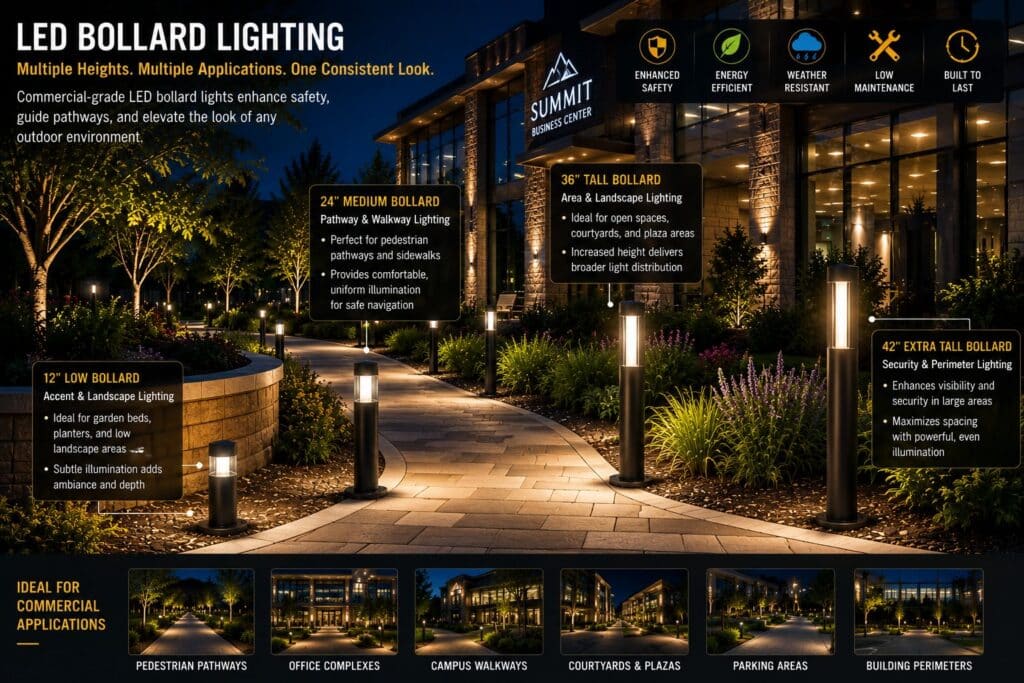
Bollard height affects lighting performance, visibility, aesthetics, and pedestrian safety.
Need help selecting the right bollard height for your project?
Explore LED Bollard Lights | Request a Quote
Call 1-844-533-7767 for commercial bollard lighting assistance.
Why Bollard Height Matters
The height of a bollard influences several important performance characteristics:
- Light distribution
- Pathway visibility
- Fixture spacing
- Visual comfort
- Architectural appearance
- Glare control
- Maintenance accessibility
Choosing the correct height helps create a balanced lighting system that meets both functional and aesthetic objectives.
Most Common LED Bollard Heights
30-Inch Bollards
Thirty-inch bollards are among the most popular choices for residential and decorative applications.
Typical uses include:
- Garden pathways
- Residential walkways
- Courtyards
- Decorative landscapes
- Small community spaces
Advantages:
- Low visual profile
- Reduced glare
- Attractive residential appearance
36-Inch Bollards
Thirty-six-inch bollards are widely used in both commercial and residential projects.
Typical uses include:
- Sidewalks
- HOA communities
- Multifamily developments
- Commercial pathways
- Hospitality properties
Advantages:
- Balanced appearance
-
- Good light distribution
- Versatile application range
Many property owners consider 36-inch fixtures the industry’s most versatile bollard height.
42-Inch Bollards
Forty-two-inch bollards are commonly specified for larger pedestrian environments.
Typical uses include:
- University campuses
- Healthcare facilities
- Commercial plazas
- Public pathways
- Transit facilities
Advantages:
- Increased visibility
- Larger lighting pattern
- Improved wayfinding
Educational facilities often incorporate 42-inch bollards throughout extensive pedestrian networks. Additional recommendations can be found in our Campus Pathway Lighting Guide.
48-Inch Bollards
Forty-eight-inch bollards are typically used where greater visibility or larger light distribution patterns are required.
Typical uses include:
- Public parks
- Municipal properties
- Large courtyards
- Outdoor gathering spaces
Advantages:
- Enhanced visibility
- Larger coverage area
- Strong architectural presence
Specialty Bollards (54 Inches and Taller)
Although less common, specialty bollards exceeding 48 inches are occasionally used in unique architectural or municipal applications.
These fixtures are often selected for:
- Landmark projects
- Civic plazas
- Specialty wayfinding systems
- Architectural lighting designs
Height Selection by Application
| Application | Recommended Height |
|---|---|
| Residential Walkways | 30–36 Inches |
| Garden Paths | 30 Inches |
| Driveways | 30–36 Inches |
| HOA Communities | 36 Inches |
| Multifamily Properties | 36–42 Inches |
| Commercial Sidewalks | 36–42 Inches |
| Campuses | 42 Inches |
| Parks | 42–48 Inches |
| Public Plazas | 42–48 Inches |
How Height Impacts Fixture Spacing
Bollard height and spacing work together to determine overall lighting performance.
Generally:
| Bollard Height | Typical Spacing Range |
| 30 Inches | 10–20 Feet |
| 36 Inches | 15–25 Feet |
| 42 Inches | 20–30 Feet |
| 48 Inches | 20–35 Feet |
For a deeper discussion of fixture spacing, visit our Bollard Light Spacing Guide.
Height vs Visual Appearance
Different bollard heights create very different visual effects.
Lower Bollards
Provide a subtle appearance that blends into landscaping.
Medium Heights
Balance performance and aesthetics.
Taller Bollards
Create a stronger architectural statement and improve long-distance visibility.
Designers often evaluate bollard height alongside surrounding architecture, landscaping, and pathway dimensions.
Fixture height is only one component of responsible outdoor lighting design. Our Dark Sky Bollard Lighting Guide explains how optics, shielding, and color temperature influence lighting performance.
Height vs Glare Control
Many people assume taller bollards create better lighting.
In reality, improper fixture selection can increase glare regardless of height.
Factors that influence visual comfort include:
- Fixture optics
- Shielding
- Light distribution
- Color temperature
- Mounting location
Projects focused on reducing glare and light pollution should review our Dark Sky Outdoor Lighting Guide.
Typical Bollard Heights by Property Type
| Property Type | Most Common Height |
| Residential | 30–36 Inches |
| HOA Communities | 36 Inches |
| Multifamily Housing | 36–42 Inches |
| Office Campuses | 42 Inches |
| Universities | 42 Inches |
| Hospitals | 42 Inches |
| Parks | 42–48 Inches |
| Municipal Facilities | 48 Inches |
Commercial Bollard Height Considerations
Commercial properties often prioritize:
- Pedestrian safety
- ADA accessibility
- Wayfinding
- Uniform illumination
- Architectural consistency
Many facilities utilize 36-inch or 42-inch bollards because they provide an effective balance of visibility and aesthetics.
Once the appropriate fixture height is established, compare commercial LED bollard lights by height, lumen output, optical distribution, shielding, architectural style, color temperature, controls, and photometric performance.
Residential Bollard Height Considerations
Residential projects frequently prioritize:
- Landscape integration
- Visual comfort
- Decorative appearance
- Lower mounting profiles
Many homeowners select 30-inch or 36-inch bollards for pathways and outdoor living areas.
Additional recommendations are available in our Residential Bollard Lighting Guide.
Bollard Base Size Considerations
Height is only one component of fixture selection.
Commercial bollards commonly utilize:
| Base Diameter | Typical Application |
| 6 Inches | Residential and decorative projects |
| 8 Inches | Commercial, campus, and municipal installations |
Larger 8-inch bases often provide improved stability and accommodate more robust internal components.
Inline Buyer Q&A
What is the most common bollard height?
Thirty-six-inch bollards are among the most commonly specified heights due to their versatility.
Are taller bollards better?
Not necessarily. The best height depends on the application, pathway width, and lighting objectives.
What height is best for residential pathways?
Most residential projects utilize 30-inch or 36-inch bollards.
What height is recommended for campuses?
Many campuses utilize 42-inch bollards to improve visibility and wayfinding.
Does bollard height affect spacing?
Yes. Taller fixtures often support greater spacing distances when combined with appropriate optics.
Selecting the Right Bollard Height for Your Project
The appropriate bollard height depends on pathway width, fixture spacing, architectural goals, pedestrian traffic, desired illumination, optics, and surrounding conditions. Height should be evaluated together with fixture output and distribution rather than as an isolated specification.
Once your approximate height and layout requirements are established, explore our commercial LED bollard lights or send LED PROS your project dimensions, fixture quantity, preferred height, spacing, drawings, or photometric requirements for assistance selecting appropriate fixtures.
Explore Commercial LED Bollard Lights | Request a Quote
Call 1-844-533-7767 for bollard lighting assistance.
Frequently Asked Questions
What is the standard height of an LED bollard?
Most LED bollards range between 30 and 48 inches tall.
Which bollard height provides the best visibility?
Forty-two-inch and 48-inch bollards typically provide greater visibility in larger pedestrian environments.
Are taller bollards more expensive?
In many cases, taller fixtures may cost slightly more due to increased material requirements.
Can bollard height affect Dark Sky compliance?
Indirectly. Fixture optics and shielding generally have a greater impact on Dark Sky performance than height alone.
Should all bollards on a project be the same height?
Most projects utilize consistent heights to maintain a uniform appearance.
Stay Connected with Our Lighting Resources
Add IndustrialLightingFixtures.org as a Preferred Source on Google to see more of our lighting guides and technical resources across Google Search experiences.
