
What Is Commercial Walk-In Freezer Lighting?
Commercial walk-in freezer lighting consists of LED lighting systems specifically designed to operate reliably inside refrigerated coolers and freezer rooms where temperatures, moisture, and condensation can quickly shorten the life of standard lighting fixtures.
Unlike general commercial lighting, freezer lighting must continue operating consistently despite frequent door openings, temperature fluctuations, humidity, and frost accumulation. Proper lighting improves employee safety, inventory management, food handling, and operational efficiency while reducing maintenance costs.
Commercial walk-in refrigeration systems are commonly found in:
- Restaurants
- Grocery stores
- Convenience stores
- Institutional kitchens
- Hotels
- Hospitals
- Schools and universities
- Food processing facilities
- Beverage distributors
- Floral coolers
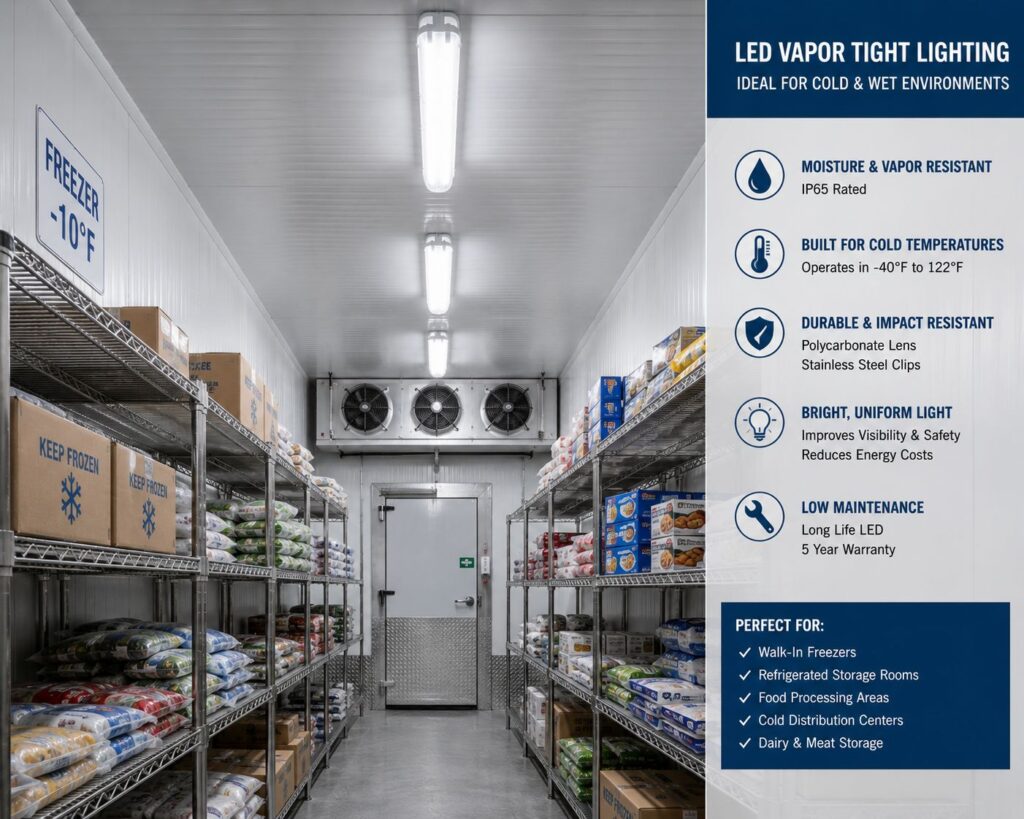
Commercial walk-in freezer lighting requires cold-rated LED fixtures designed for low temperatures, moisture, condensation, shelving layouts, and the demanding operating conditions found inside refrigerated food-storage environments.
Need LED Lighting for a Walk-In Cooler or Freezer?
LED PROS can help identify cold-rated LED fixtures based on your cooler or freezer dimensions, minimum operating temperature, mounting height, moisture and condensation exposure, washdown or sanitation requirements, voltage, shelving configuration, and required illumination.
Explore Cold Storage Lighting Fixtures | Request a Quote
Call 1-844-533-7767 for walk-in cooler and freezer lighting assistance.
Challenges of Lighting Walk-In Freezers
Walk-in coolers and freezer rooms create environmental conditions that require specialized lighting equipment.
Common challenges include:
- Sub-freezing temperatures
- Condensation
- Frost buildup
- Frequent door openings
- Moisture exposure
- High humidity
- Washdown procedures
- Limited maintenance access
Lighting fixtures should be selected specifically for these demanding operating conditions to maximize long-term reliability.
Walk-in coolers and freezer rooms are frequently exposed to moisture, condensation, and regular cleaning procedures. Explore our LED Vapor Tight Lighting to compare sealed commercial fixtures engineered for refrigerated storage, food processing facilities, utility rooms, and other wet or humid industrial environments.
Why LED Lighting Is the Preferred Choice
Modern LED lighting offers several advantages over older fluorescent and HID lighting technologies.
Benefits include:
- Instant-on operation
- Excellent low-temperature performance
- Reduced energy consumption
- Longer fixture life
- Lower maintenance costs
- Better product visibility
- Improved worker safety
- Compatibility with lighting controls
Because LEDs perform efficiently in cold environments, they are well suited for refrigerated food storage applications.
Operating a refrigerated distribution center? Read Refrigerated Warehouse Lighting for Cold Storage Distribution Facilities for guidance on warehouse aisles, high bay lighting, and logistics facilities.
Recommended Fixture Types
Selecting the right fixture depends on freezer size, sanitation requirements, and environmental exposure.
Vapor Tight LED Fixtures
Vapor tight fixtures are commonly used because they provide sealed protection against moisture, condensation, and dust.
Ideal applications include:
- Walk-in coolers
- Freezer rooms
- Food preparation areas
- Beverage storage
- Utility rooms
NSF-Certified LED Fixtures
Food processing and commercial kitchen environments may require NSF-certified lighting where hygienic design and simplified cleaning procedures are priorities.
Typical applications include:
- Food production
- Packaging
- Commercial kitchens
- Beverage processing
Linear LED Fixtures
Linear fixtures provide even illumination throughout shelving and storage areas.
Best suited for:
- Long cooler rooms
- Food storage aisles
- Beverage coolers
- Preparation rooms
Planning a complete lighting layout? Explore the Cold Storage Lighting Design Guide for fixture spacing, beam angles, lighting controls, and photometric planning.
Explore LED Fixtures for Walk-In Coolers & Freezers
Cold-Rated LED Lighting — Compare LED fixtures designed for refrigerated warehouses, cool rooms, walk-in coolers, freezers, and other temperature-controlled facilities.
Vapor-Tight LED Lighting — Explore sealed linear fixtures for environments exposed to moisture, condensation, humidity, dust, and other demanding conditions.
NSF-Certified LED Lighting — Review certified fixtures for food-processing, sanitation-sensitive, washdown, refrigerated, and related applications where NSF certification may be required.
Walk-In Cooler vs Walk-In Freezer
Although both environments require reliable lighting, operating conditions differ significantly.
| Walk-In Cooler | Walk-In Freezer |
|---|---|
| Refrigerated temperatures | Sub-zero temperatures |
| Moderate humidity | Frost and ice accumulation |
| General food storage | Frozen food storage |
| Moisture-resistant fixtures | Low-temperature-rated fixtures |
| Moderate environmental exposure | Severe environmental exposure |
Selecting fixtures appropriate for the operating temperature improves reliability and service life.
Lighting Controls
Lighting controls help reduce unnecessary operating hours while improving overall facility efficiency.
Recommended controls include:
- Occupancy sensors
- Motion sensors
- Door-activated switches
- Programmable timers
- Wireless lighting controls
These systems automatically reduce lighting operation when freezer rooms are unoccupied, helping lower electrical consumption.
Color Temperature for Walk-In Coolers & Freezers
There is no universal color temperature required for commercial walk-in coolers or freezers. 4000K and 5000K are commonly considered where clear product, label, shelving, and inventory visibility is desired.
The appropriate color temperature depends on the application, stored products, surrounding surfaces, desired appearance, and facility requirements. Color temperature should be selected separately from fixture output and required illumination levels.
Lighting Layout Considerations
Even small walk-in freezers benefit from thoughtful lighting design.
Important considerations include:
- Room dimensions
- Shelving configuration
- Door locations
- Product storage height
- Fixture placement
- Uniform illumination
- Shadow reduction
- Emergency egress visibility
Proper fixture placement improves safety while minimizing dark corners and uneven illumination.
Designing lighting for a larger refrigerated warehouse? Visit the Cold Storage Facility Lighting Guide for comprehensive recommendations covering industrial cold storage operations.
Typical Application
| Facility | Recommended Lighting |
| Restaurant Walk-In Freezer | Vapor Tight LED |
| Grocery Store Cooler | Vapor Tight or NSF LED |
| Convenience Store Cooler | Vapor Tight LED |
| Hospital Food Service | NSF-Certified LED |
| School Cafeteria | Vapor Tight LED |
| Beverage Cooler | Linear LED Fixtures |
| Floral Cooler | Moisture-Resistant LED |
| Commercial Kitchen | NSF or Vapor Tight Fixtures |
Fixture selection note: These examples illustrate common lighting approaches, not universal requirements. Verify minimum operating temperature, moisture exposure, cleaning procedures, sanitation requirements, and applicable certifications before specifying a fixture.
Common Installation Mistakes
Avoid these common specification errors:
- Installing fixtures not rated for freezer temperatures
- Selecting residential-grade lighting
- Ignoring condensation exposure
- Using incorrect fixture spacing
- Omitting occupancy controls
- Choosing fixtures based only on wattage
- Overlooking sanitation requirements
Selecting commercial-grade LED fixtures designed for refrigerated environments helps maximize lighting performance and minimize maintenance.
Inline Buyer Q&A
Do LED lights work reliably in commercial walk-in freezers?
Yes, when the complete fixture is rated for the operating temperature and environmental conditions.
Commercial LED fixtures designed for refrigerated and freezer environments can provide instant-on operation at low temperatures and avoid some of the cold-temperature performance issues associated with older lighting technologies.
The fixture’s published minimum operating temperature should always be compared with the actual conditions inside the cooler or freezer.
Are vapor-tight fixtures recommended for walk-in coolers and freezers?
Vapor-tight LED fixtures are commonly used because their sealed construction can help protect internal components from moisture, condensation, humidity, dust, and similar environmental exposure.
However, vapor-tight construction does not automatically mean that a fixture is suitable for every washdown application.
Where fixtures are exposed to cleaning procedures or direct water, verify that the specific fixture and its environmental ratings are appropriate for the expected conditions.
Do walk-in freezers require NSF-certified lighting?
Not necessarily.
NSF-certified or other appropriately constructed fixtures may be specified in food-processing, food-handling, or sanitation-sensitive areas depending on the application and facility requirements.
A refrigerated storage room and a food-processing area can have different requirements even when both operate at low temperatures.
Temperature suitability, environmental protection, and sanitation requirements should therefore be evaluated separately.
Can occupancy sensors reduce operating costs?
Yes, particularly in walk-in coolers and freezers that are occupied intermittently.
Occupancy-based controls can reduce unnecessary lighting operation when the space is vacant. Sensor selection should account for the operating temperature, fixture compatibility, detection pattern, mounting location, doors, shelving, and how employees use the space.
The sensor and other control components should be rated for the environment in which they are installed.
What information should I provide when selecting walk-in freezer lighting?
Useful project information includes:
- Cooler or freezer dimensions
- Ceiling and fixture mounting height
- Minimum and typical operating temperatures
- Existing fixture type and wattage
- Available voltage
- Shelving or storage configuration
- Moisture and condensation conditions
- Cleaning or washdown procedures
- Food-processing or sanitation requirements
- Controls or occupancy sensing requirements
These details help determine the appropriate fixture construction, output, environmental ratings, mounting, and controls.
Should I replace fluorescent freezer lighting one-for-one with LED?
Not automatically.
Existing fixture locations and electrical infrastructure can sometimes be reused, but LED fixtures may have different output and distribution characteristics from the fluorescent equipment being replaced.
Fixture quantity, placement, output, shelving, room dimensions, and required illumination should be evaluated before assuming a one-for-one replacement.
Specify the Right Lighting for Your Walk-In Cooler or Freezer
Walk-in cooler and freezer lighting should be selected around the minimum operating temperature, moisture and condensation exposure, cleaning or washdown procedures, sanitation requirements, room dimensions, shelving configuration, mounting height, required illumination, voltage, and controls.
Send LED PROS your cooler or freezer dimensions, minimum temperature, fixture quantities, voltage, mounting information, cleaning requirements, existing lighting information, drawings, or other available project specifications. We’ll help identify appropriate cold-rated, vapor-tight, NSF-certified, or other LED fixtures for the application.
Request a Quote or call 1-844-533-7767 for walk-in cooler and freezer lighting assistance.
Frequently Asked Questions About Commercial Walk-In Freezer Lighting
What is the best lighting for commercial walk-in freezers?
LED fixtures specifically rated for the operating temperature and environmental conditions are commonly used in commercial walk-in freezers.
Vapor-tight or other sealed fixtures can be appropriate where moisture and condensation are present. Food-processing or sanitation-sensitive applications may have additional construction or certification requirements.
The best fixture depends on the complete application rather than one fixture type alone.
What color temperature is recommended for walk-in freezer lighting?
There is no universal color temperature required for commercial walk-in freezers.
4000K and 5000K are commonly considered where clear product and label visibility is desired, but the appropriate choice depends on the application, merchandise or stored products, surrounding surfaces, desired appearance, and facility requirements.
Color temperature should not be confused with fixture brightness or illumination level.
Do walk-in freezers need emergency lighting?
Emergency and egress lighting requirements depend on the building configuration, occupancy, means of egress, jurisdiction, and applicable building, fire, life-safety, and electrical requirements.
A walk-in cooler or freezer should not automatically be assumed to require a particular emergency-lighting configuration solely because it is refrigerated.
Applicable project requirements should be confirmed for the specific installation.
Can LED lighting reduce maintenance in walk-in freezers?
Yes. Commercial LED fixtures can provide operating lives measured in tens of thousands of hours and can reduce relamping compared with many older lighting technologies.
Actual service life depends on fixture and driver quality, thermal design, operating hours, electrical conditions, controls, moisture exposure, and the operating environment.
What environmental rating should a freezer light have?
There is no single environmental rating appropriate for every freezer.
Fixture selection should consider moisture, condensation, dust, cleaning procedures, direct water exposure, and the installation location.
The published ratings of the complete fixture should be matched to the actual environment rather than selecting equipment from an IP number alone.
Are all vapor-tight LED fixtures suitable for freezers?
No.
A fixture may have sealed vapor-tight construction but still have a minimum operating temperature that is unsuitable for the freezer.
Both environmental protection and temperature ratings should be verified.
Can occupancy sensors operate in a freezer?
Yes, when the sensor and associated control components are rated for the operating conditions.
Cold temperatures, shelving, doors, fixture mounting, detection patterns, and employee movement can affect sensor selection and placement.
Can existing freezer fixtures and wiring be reused during an LED retrofit?
Sometimes.
Existing housings, mounting locations, wiring, voltage, controls, and other electrical infrastructure should be evaluated for condition and compatibility with the proposed LED system.
Existing infrastructure should not automatically be assumed suitable simply because it is already installed.
Are walk-in cooler and walk-in freezer lighting requirements the same?
Not necessarily.
Freezers generally operate at lower temperatures, while coolers may have different temperature, moisture, condensation, cleaning, and operating conditions.
The lighting equipment should be selected according to the actual environment rather than treating all refrigerated spaces identically.
Stay Connected with Our Lighting Resources
Add IndustrialLightingFixtures.org as a Preferred Source on Google to see more of our lighting guides and technical resources across Google Search experiences.
Related Walk-In Freezer & Cold Storage Lighting Resources
- Cold Storage Lighting — Explore the primary commercial cold-storage lighting category for refrigerated warehouses, walk-in freezers, coolers, and food-related facilities.
- Freezer Lighting Requirements for Commercial Cold Storage Facilities — Review temperature, moisture, environmental, installation, and application considerations that affect commercial freezer lighting.
- Refrigerated Warehouse Lighting for Cold Storage Distribution Facilities — Explore lighting for larger refrigerated warehouses with elevated mounting heights, racks, aisles, and material-handling operations.
- LED Vapor-Tight Linear Lighting — Review sealed linear fixtures for refrigerated, damp, dusty, and other demanding commercial and industrial environments.
- NSF-Certified LED Lighting — Learn how sanitation, cleanability, fixture construction, and certification can influence lighting selection in food-related facilities.