Commercial lighting is a long-term investment. While energy savings often receive the most attention, the true value of modern LED lighting extends well beyond lower utility bills. Longer fixture life means fewer maintenance calls, reduced labor costs, less disruption to building occupants, and a lower total cost of ownership throughout the life of the facility.
Today’s commercial buildings commonly use a combination of Commercial LED Ceiling Lights, LED flat panels, LED Troffers, Commercial Recessed Downlights, and Architectural Indoor Lighting to create efficient, comfortable indoor environments. When properly selected and installed, these fixtures can provide decades of dependable performance while dramatically reducing maintenance compared with fluorescent lighting.
Understanding what influences fixture lifespan helps building owners, facility managers, architects, and contractors make better purchasing decisions and maximize the return on their lighting investment.
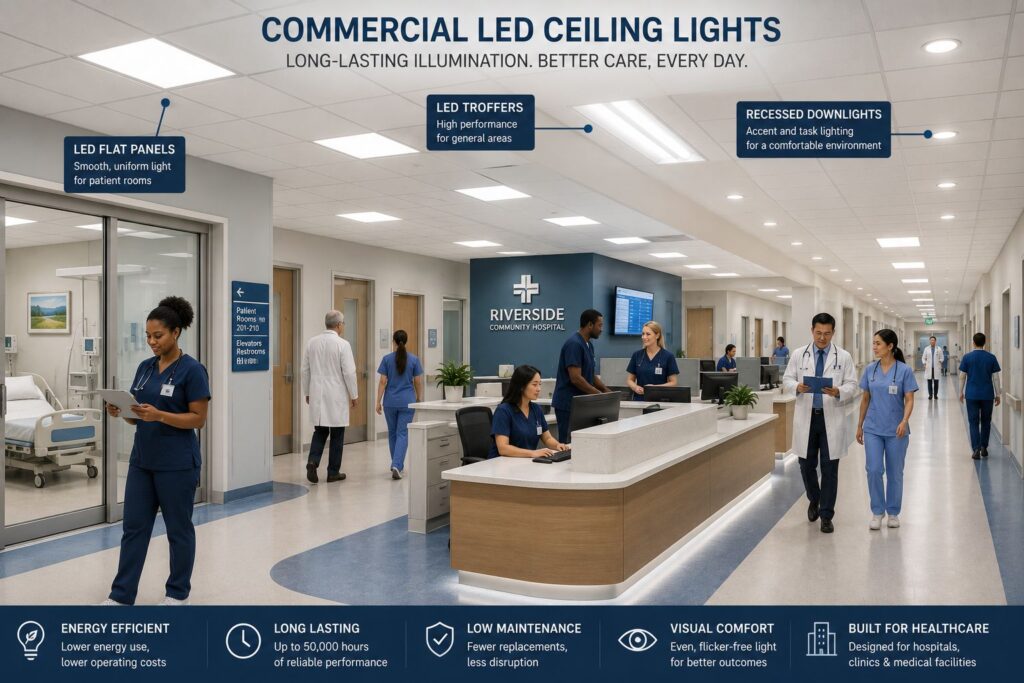
High-quality commercial LED ceiling lights deliver years of reliable performance while reducing maintenance, energy consumption, and operating costs compared with older fluorescent systems.
Looking for Commercial LED Ceiling Lights Built to Last?
Selecting high-quality commercial LED fixtures reduces maintenance, lowers operating costs, and provides dependable illumination for years. LED Pros WorldWide offers commercial lighting solutions backed by industry-leading warranties and expert product support.
Call 1-844-533-7767 to discuss your next commercial lighting project.
Why Fixture Lifespan Matters
Replacing a failed ceiling fixture involves much more than purchasing a replacement.
Every maintenance visit may require:
- Scheduling maintenance personnel
- Accessing occupied workspaces
- Moving furniture or equipment
- Using ladders or personnel lifts
- Interrupting employees or customers
- Disposing of failed components
- Installing replacement parts
- Testing lighting controls
For facilities with hundreds—or even thousands—of ceiling fixtures, maintenance costs often exceed the cost of the fixtures themselves over time.
Choosing longer-lasting commercial LED lighting significantly reduces these ongoing expenses while improving overall building reliability.
🛠️ Design Insight
The least expensive fixture to purchase isn’t always the least expensive to own. Long service life, quality drivers, and comprehensive warranties often provide greater long-term value than simply selecting the lowest initial purchase price.
Understanding LED Rated Life
Unlike fluorescent lamps that often fail suddenly, LED fixtures gradually lose light output over time.
Manufacturers typically measure LED lifespan using L70, which represents the point at which a fixture continues producing 70% of its original light output.
For many commercial LED ceiling fixtures, this rating ranges from:
- 50,000 hours
- 70,000 hours
- 100,000 hours or more
The exact lifespan depends on fixture quality, operating environment, driver performance, and thermal management.
High-quality commercial fixtures are engineered to maintain consistent light output for many years while requiring minimal maintenance.
Typical Lifespan of Commercial Ceiling Fixtures
Different commercial ceiling fixtures often share similar LED technology, but expected service life varies depending on their design, components, and operating conditions.
| Fixture Type | Typical Rated Life | Common Applications |
|---|---|---|
| LED Flat Panels | 50,000–100,000 hours | Offices, schools, healthcare, retail |
| LED Troffers | 50,000–100,000 hours | Administrative offices, classrooms, commercial buildings |
| Commercial Recessed Downlights | 50,000–100,000 hours | Reception areas, conference rooms, corridors |
| Architectural Fixtures | 50,000–100,000 hours | Executive offices, collaborative workspaces, premium interiors |
| Surface-Mount LED Fixtures | 50,000–100,000 hours | Utility rooms, corridors, support spaces |
LEDs Rarely Fail First
Many people assume the LEDs themselves determine how long a fixture lasts.
In reality, the LED driver often reaches the end of its service life before the LED chips.
The driver converts incoming electrical power into the precise current required by the LEDs. Like any electronic component, its reliability depends on:
- Internal component quality
- Operating temperature
- Electrical surges
- Ventilation
- Manufacturing quality
This is one reason premium commercial fixtures typically cost more than entry-level products—they often incorporate higher-quality drivers designed for longer service life.
📐 Specification Tip
When evaluating commercial lighting products, compare more than lumen output and wattage. Driver quality, surge protection, thermal management, and warranty coverage are often better indicators of long-term reliability than purchase price alone.
What Affects the Lifespan of Commercial LED Ceiling Lights?
While LED technology is inherently long-lasting, not all commercial fixtures deliver the same level of performance.
Several factors determine how long a commercial lighting system will continue operating efficiently.
These include:
- Component quality
- Thermal management
- Driver reliability
- Electrical power quality
- Operating environment
- Installation practices
- Maintenance procedures
Understanding these factors helps facility managers make better purchasing decisions while avoiding premature fixture replacement.
Heat Is the Biggest Enemy of LED Performance
LEDs generate significantly less heat than fluorescent or HID lighting, but they still produce heat that must be managed effectively.
Excessive operating temperatures can accelerate the aging of:
- LED chips
- Drivers
- Capacitors
- Power supplies
- Electronic components
High-quality commercial fixtures are designed with efficient heat dissipation systems that keep internal temperatures within acceptable operating limits.
Features that improve thermal performance include:
- Heavy-duty aluminum housings
- Integrated heat sinks
- Ventilated driver compartments
- Premium thermal interface materials
- Efficient airflow around electronic components
These design features help maintain consistent light output while extending fixture life.
🛠️ Design Insight
Better thermal management doesn’t simply extend LED life—it also helps preserve lumen output and color consistency throughout the fixture’s service life.
Most Early Fixture Failures Are Driver-Related
When a commercial LED ceiling fixture stops working during its first few months or years of operation, the LEDs themselves are rarely the cause.
In real-world commercial installations, the LED driver is often the first electronic component to fail, while the LED chips remain fully functional. This is because the driver continuously converts incoming AC power into the precise DC current required by the LEDs and is exposed to heat, voltage fluctuations, electrical surges, and thousands of hours of continuous operation.
A high-quality driver is engineered to withstand these demanding conditions, while lower-cost drivers often use less robust electronic components that may be more susceptible to premature failure.
For facility managers, this distinction is important because replacing a failed driver is far less disruptive than replacing an entire lighting system—but choosing fixtures with premium drivers from the beginning significantly reduces the likelihood of early service calls.
🛠️ Design Insight
In many commercial lighting service calls, the LEDs are still operating properly. Replacing the failed driver often restores the fixture to full operation, demonstrating why driver quality is one of the most important factors in long-term reliability.
Premium LED Driver Manufacturers
Many commercial-grade lighting fixtures utilize drivers from well-established manufacturers known for long service life, electrical protection, and consistent performance.
Some of the most respected names in the commercial lighting industry include:
| Driver Manufacturer | Why They’re Trusted |
|---|---|
| Inventronics | Excellent reliability, high surge protection, long operating life, commonly used in premium commercial and industrial fixtures. |
| Mean Well | Known for dependable power supplies, wide operating temperature range, and strong reputation across commercial and industrial applications. |
| Sosen | Frequently used in high-performance commercial fixtures, offering good efficiency, surge protection, and reliable long-term performance. |
| Philips Xitanium (Signify) | Designed specifically for professional lighting applications, with advanced dimming compatibility, diagnostics, and long service life. |
| Tridonic | Premium European driver manufacturer recognized for intelligent controls, dimming performance, and commercial reliability. |
| Osram OPTOTRONIC (AMS Osram) | High-quality drivers used in demanding architectural and commercial lighting projects, offering excellent power management and compatibility with advanced lighting controls. |
These manufacturers are widely specified for commercial, institutional, healthcare, educational, and industrial lighting projects because they prioritize long-term performance over minimum manufacturing cost.
🏗️ Project Spotlight: Sometimes the Driver Is the Only Problem
Over the years, we’ve worked with many customers who assumed an entire LED fixture had failed because it stopped working after only a year or two. In the vast majority of those cases, the LED chips were still operating as designed—the culprit was a failed LED driver.
One project that stands out involved a customer who had installed dozens of commercial LED ceiling fixtures in an office renovation. Several fixtures stopped operating within the first few years, leading the facility manager to believe the entire lighting system would need to be replaced.
After troubleshooting the fixtures, we determined that the LED arrays were still in excellent condition. Replacing the failed drivers restored the fixtures to full brightness, eliminating the need to purchase new fixtures and dramatically reducing repair costs.
Experiences like this reinforce an important lesson: the quality of the LED driver is just as important as the quality of the LEDs themselves. When selecting commercial lighting, we encourage customers to ask not only about lumens and wattage, but also about the driver manufacturer, surge protection, operating temperature, and warranty. Those components often determine whether a fixture delivers years of reliable service or requires unexpected maintenance.
Takeaway: When evaluating commercial LED fixtures, don’t just ask “Who makes the LEDs?” Ask “Who makes the driver?” A premium driver from a trusted manufacturer is one of the best indicators of long-term reliability and lower maintenance costs.
That experience taught us an important lesson: the name on the LED driver often tells you more about a fixture’s long-term reliability than its advertised lumen output. In the following section are the features we recommend evaluating before purchasing commercial LED ceiling lights.
What Makes a Quality LED Driver?
When evaluating commercial LED fixtures, ask more than “How many lumens?” or “What’s the wattage?”
Also consider whether the driver includes:
- Premium electronic capacitors
- High surge protection ratings (typically 6kV–10kV or greater)
- Wide input voltage range
- High power factor
- Low total harmonic distortion (THD)
- Thermal overload protection
- Short-circuit protection
- Over-voltage and over-current protection
- 0–10V dimming compatibility
- UL Recognized or equivalent safety certifications
These features help improve reliability while extending the overall service life of the lighting system.
📐 Specification Tip
One of the quickest ways to compare commercial lighting products is to ask, “Who manufactures the LED driver?” Premium driver brands are often paired with better thermal management, stronger surge protection, and longer warranties—features that can significantly reduce maintenance costs over the life of the fixture.
Power Quality and Surge Protection
Electrical power isn’t always perfectly stable.
Commercial buildings may experience:
- Voltage fluctuations
- Utility switching events
- Lightning-related surges
- Equipment startup loads
- Power interruptions
Repeated electrical disturbances can shorten the life of lighting electronics if fixtures lack adequate surge protection.
Many commercial-grade fixtures include integrated surge protection, while facilities in areas prone to electrical storms or unstable power may benefit from additional surge protection at the electrical panel.
Protecting lighting systems from electrical surges helps reduce unexpected driver failures and improves long-term system reliability.
Environmental Conditions Matter
The environment where a fixture operates also influences its expected lifespan.
Indoor commercial lighting generally experiences fewer environmental stresses than outdoor fixtures, but conditions still vary considerably.
Factors affecting longevity include:
- Ambient temperature
- Humidity
- Dust accumulation
- Airborne contaminants
- Ceiling plenum temperatures
- Building ventilation
- Operating hours
Facilities such as manufacturing plants, commercial kitchens, natatoriums, or healthcare environments may require specialized fixtures designed for those conditions.
Selecting the appropriate fixture for each application improves both reliability and performance.
Quality Components Make a Difference
Not all commercial LED fixtures are built to the same standard.
Higher-quality products often feature:
- Premium LED chips
- Commercial-grade drivers
- Heavy-duty aluminum housings
- Superior optical lenses
- Enhanced surge protection
- Higher-quality capacitors
- Better thermal management systems
- Tighter manufacturing tolerances
These components contribute to longer service life, improved light consistency, and reduced maintenance requirements.
This is especially important for facilities operating hundreds or thousands of fixtures where maintenance labor represents a significant operating expense.
📐 Specification Tip
When comparing products, ask about the driver manufacturer, surge protection rating, operating temperature range, and warranty—not just wattage and lumen output.
Standard 5-Year vs. Premium 10-Year Warranties
Warranty coverage often reflects the manufacturer’s confidence in the quality of its components.
Many commercial fixtures include a standard 5-year warranty, which is appropriate for many applications.
Premium commercial fixtures frequently extend coverage to 10 years, supported by:
- Higher-grade drivers
- Better thermal management
- Improved surge protection
- Premium LED packages
- More durable construction
For facilities where maintenance access is difficult or labor costs are high, investing in longer-warranty products may significantly reduce lifetime ownership costs.
LED vs. Fluorescent: A Maintenance Comparison
One of the biggest advantages of commercial LED lighting is the reduction in routine maintenance.
| Feature | Commercial LED Ceiling Lights | Fluorescent Ceiling Fixtures |
|---|---|---|
| Typical Rated Life | 50,000–100,000+ hours | 15,000–30,000 hours |
| Lamp Replacements | Rare | Frequent |
| Ballast Maintenance | None | Regular ballast replacement |
| Energy Consumption | Lower | Higher |
| Heat Output | Lower | Higher |
| Mercury Content | None | Contains mercury |
| Lighting Controls | Easily integrated | Limited compatibility |
| Maintenance Labor | Significantly reduced | Higher ongoing maintenance |
For organizations managing large commercial facilities, reducing maintenance visits often becomes just as valuable as lowering energy consumption.
Lifecycle Cost Is More Important Than Purchase Price
Initial fixture cost represents only a portion of the total investment.
The true cost of ownership includes:
- Fixture purchase
- Installation labor
- Energy consumption
- Maintenance labor
- Replacement components
- Downtime
- Disposal costs
- Future upgrades
A premium fixture that lasts longer, consumes less energy, and requires fewer maintenance visits often delivers greater long-term value than a lower-priced alternative.
Organizations planning a Commercial LED Lighting Retrofit should evaluate lifecycle costs alongside fixture specifications to maximize return on investment.
🏢 Project Spotlight
A regional financial institution upgraded more than 800 fluorescent ceiling fixtures across multiple office locations. Rather than selecting the lowest-cost products, the facilities team chose premium Commercial LED Ceiling Lights with 10-year warranties, enhanced surge protection, and high-performance drivers. Over the following years, the organization experienced significantly fewer maintenance calls, lower energy consumption, and reduced replacement costs, validating the decision to prioritize lifecycle value over initial purchase price.
How to Maximize the Lifespan of Commercial LED Ceiling Lights
Although commercial LED fixtures are engineered for decades of reliable operation, their actual service life depends on how they are installed, operated, and maintained.
Following a few best practices can help facility managers reduce maintenance costs while ensuring consistent lighting performance throughout the building.
Start with Proper Fixture Selection
Long-term reliability begins before the fixtures are even installed.
Choosing the appropriate fixture for each application helps prevent overheating, premature component wear, and unnecessary maintenance.
For example:
Commercial LED Ceiling Lights provide excellent general illumination for offices, schools, retail spaces, and healthcare facilities.
LED Troffers are ideal for suspended ceilings where glare control and visual comfort are priorities.
Commercial Recessed Downlights are well suited for corridors, conference rooms, reception areas, and architectural applications.
Architectural Indoor Lighting enhances executive offices, hospitality spaces, universities, and other premium commercial interiors.
Using fixtures outside their intended environment can shorten component life and reduce overall performance.
Maintain Proper Operating Temperatures
Heat remains one of the primary factors affecting the longevity of electronic components.
To help maximize fixture life:
- Avoid covering ventilation openings.
- Maintain adequate airflow above suspended ceilings.
- Keep insulation away from fixtures unless they are specifically rated for direct contact.
- Install fixtures within the manufacturer’s recommended ambient temperature range.
- Select fixtures designed for demanding environments when higher temperatures are expected.
Proper thermal management helps protect both the LEDs and the driver electronics.
🛠️ Design Insight
Commercial lighting systems often operate 10–16 hours each day. Even a modest reduction in operating temperature can significantly extend the life of electronic components over tens of thousands of hours.
Keep Fixtures Clean
Dust and debris do more than reduce light output—they can also trap heat around the fixture.
A routine maintenance program should include:
- Cleaning lenses and diffusers.
- Inspecting air vents and heat sinks.
- Removing accumulated dust above suspended ceilings.
- Checking for signs of moisture or contamination.
- Inspecting wiring connections during scheduled maintenance.
Simple preventive maintenance helps preserve both appearance and performance.
Protect Fixtures from Electrical Problems
Stable electrical power contributes to longer driver life.
Consider:
- Surge protection devices
- Proper grounding
- Correct circuit loading
- Voltage monitoring in facilities with unstable power
- Regular inspection of electrical connections
These measures reduce stress on electronic components and help prevent unexpected failures.
Use Lighting Controls Wisely
Modern lighting controls not only reduce energy consumption—they can also extend fixture life by reducing operating hours.
Popular control strategies include:
- Occupancy sensors
- Vacancy sensors
- Daylight harvesting
- Time scheduling
- Dimming controls
- Building automation integration
Operating fixtures only when needed decreases cumulative operating hours, reducing wear on drivers and other electronic components.
Inspect Fixtures During Routine Maintenance
Commercial ceiling lighting should be inspected periodically rather than waiting for failures to occur.
Maintenance personnel should look for:
- Flickering
- Delayed startup
- Uneven brightness
- Discoloration
- Physical damage
- Loose wiring
- Driver noise
- Water intrusion
Addressing minor issues early can prevent larger maintenance problems later.
Signs It May Be Time to Replace a Fixture
Even high-quality commercial LED fixtures eventually reach the end of their useful life.
Common indicators include:
- Noticeable reduction in light output
- Persistent flickering after driver replacement
- Significant color shift between fixtures
- Multiple driver failures in the same fixture
- Cracked or yellowed lenses
- Obsolete lighting controls
- Physical damage or corrosion
- Increasing maintenance frequency
For older buildings still using fluorescent lighting, replacing the complete lighting system with modern LED technology often provides greater long-term value than continuing to repair aging fixtures.
📐 Specification Tip
If a fixture is more than 15–20 years old and replacement parts are becoming difficult to obtain, replacing the entire fixture is often more cost-effective than repeated repairs. Modern LED systems offer higher efficacy, improved optics, better controls, and significantly lower maintenance requirements.
Energy Savings Snapshot
The benefits of commercial LED ceiling lighting extend far beyond energy efficiency.
A properly designed lighting system can provide:
- 50–75% lower energy consumption compared with many legacy fluorescent systems.
- 50,000–100,000+ hours of rated service life.
- Fewer maintenance visits.
- Lower labor costs.
- Improved occupant comfort.
- Better light uniformity.
- Reduced downtime.
- Lower total cost of ownership over the life of the building.
For facilities operating hundreds or thousands of ceiling fixtures, these advantages compound year after year, making high-quality LED lighting one of the most cost-effective building upgrades available.
Project Spotlight
A regional medical office complex replaced more than 1,200 aging fluorescent troffers with a combination of LED Troffers, Commercial LED Ceiling Lights, and Commercial Recessed Downlights. The project also incorporated occupancy sensors in administrative offices and conference rooms.
By selecting fixtures equipped with premium drivers, integrated surge protection, and 10-year warranties, the facility significantly reduced maintenance requests while improving light quality throughout the building. Facility managers reported fewer service interruptions, lower operating costs, and a more comfortable environment for employees and patients.
Commercial LED Ceiling Light Lifespan Checklist
Before investing in new commercial ceiling lighting, use this checklist to select fixtures that will deliver years of dependable performance.
✓ Evaluate the Fixture
- Verify the fixture is designed for your specific application.
- Select the appropriate lumen package.
- Choose the correct color temperature (CCT).
- Confirm CRI requirements.
- Review DLC or other efficiency qualifications if applicable.
✓ Evaluate the LED Driver
Before purchasing, ask:
- Who manufactures the LED driver?
- Does it include integrated surge protection?
- Is it dimming compatible (0–10V)?
- Is the driver UL Recognized?
- Is it designed for commercial-duty operation?
- Can replacement drivers be sourced if needed?
✓ Review the Warranty
- Standard 5-year warranty
- Premium 10-year warranty available
- Driver included under warranty
- Clear warranty process
- Manufacturer support available
✓ Plan for Long-Term Reliability
- Professional lighting layout completed
- Proper fixture spacing verified
- Adequate ceiling ventilation
- Surge protection considered
- Lighting controls specified
- Preventive maintenance schedule established
Following these best practices helps maximize fixture life while reducing maintenance costs throughout the life of the building.
Inline Buyer Q&A
How long should commercial LED ceiling lights last?
Most commercial LED ceiling fixtures are rated between 50,000 and 100,000 hours, depending on component quality, operating conditions, and driver performance. In many commercial buildings, this can translate to well over a decade of dependable service.
Do LEDs usually fail before the driver?
In many commercial applications, no. The LED chips often continue operating long after the driver has experienced a failure. This is why selecting fixtures with premium drivers and quality electronic components is so important.
Can a failed LED driver be replaced?
In many cases, yes. Commercial-grade fixtures are often designed so the driver can be replaced without replacing the entire fixture, provided a compatible replacement is available.
Is a 10-year warranty worth the additional investment?
For facilities with high ceilings, numerous fixtures, or expensive maintenance access, a premium fixture backed by a 10-year warranty often delivers lower lifecycle costs than replacing lower-cost fixtures more frequently.
What should I ask before purchasing commercial LED fixtures?
In addition to lumen output and wattage, ask about:
- Driver manufacturer
- Surge protection
- Operating temperature
- Warranty coverage
- Driver replacement availability
- Expected rated life
- Lighting control compatibility
These specifications often have a greater impact on long-term ownership costs than initial purchase price alone.
Invest in Lighting That Lasts
Commercial lighting is more than a fixture purchase—it’s a long-term investment in your building’s performance, energy efficiency, and operating costs. While LED technology has transformed indoor lighting, the quality of the components behind the LEDs—especially the driver, thermal management system, and surge protection—often determines how well a fixture performs over the next 10 to 20 years.
At LED Pros WorldWide, we help facility managers, contractors, engineers, architects, and building owners select commercial lighting solutions designed for reliability, efficiency, and long service life. From product selection and photometric layouts to premium fixtures backed by industry-leading warranties, our team is ready to help you make an informed investment.
Browse our complete selection of Commercial LED Ceiling Lights, or contact our lighting specialists to discuss your next commercial project.
📞 Call 1-844-533-7767 to speak with a commercial lighting expert today.
Frequently Asked Questions
What is L70?
L70 is the industry standard for measuring LED lifespan. It represents the point at which a fixture continues producing 70% of its original light output rather than indicating complete failure.
Why do some LED fixtures fail much sooner than others?
Differences in driver quality, thermal management, surge protection, component selection, manufacturing standards, and operating conditions all influence long-term reliability.
Does turning LEDs on and off shorten their lifespan?
Unlike fluorescent lamps, commercial LED fixtures generally tolerate frequent switching very well. Occupancy sensors and automated lighting controls typically improve overall efficiency without significantly reducing LED life.
Can commercial LED ceiling lights operate for decades?
Many premium commercial fixtures are rated for 50,000 to 100,000 hours or more. Actual service life depends on operating hours, environmental conditions, maintenance practices, and the quality of the fixture’s components.
Should I replace individual components or the entire fixture?
If the fixture housing and LEDs remain in good condition, replacing a failed driver may be the most economical solution. However, if multiple components are failing or the fixture is outdated, replacing the complete fixture often provides better long-term value.
Are premium commercial fixtures worth the extra investment?
For most commercial facilities, yes. Better drivers, improved thermal management, longer warranties, and reduced maintenance typically lower the total cost of ownership over the life of the lighting system.
Related Commercial LED Ceiling Lighting Resources
Continue exploring our Indoor Lighting resources:
Commercial LED Ceiling Lights – Compare commercial ceiling lighting systems for offices, schools, healthcare, retail, and municipal facilities.
LED Troffers vs. LED Flat Panels – Learn the differences between today’s most popular suspended ceiling fixtures.
LED Troffer Size Guide – Choose the right 1×4, 2×2, or 2×4 fixture for your project.
Commercial LED Ceiling Light Installation Guide – Best practices for installation, commissioning, and maintenance.
Commercial LED Lighting Retrofit Guide – Plan a successful commercial lighting upgrade while minimizing disruption and maximizing ROI.