
Commercial Light Poles & Mounting Systems Guide
Commercial outdoor lighting systems rely on more than just luminaires. The structural infrastructure that supports these fixtures—light poles, mounting arms, brackets, foundations, and hardware—plays a critical role in ensuring durability, proper illumination distribution, and long-term performance.
Commercial light poles and mounting systems are engineered to safely elevate lighting fixtures above parking areas, roadways, pedestrian walkways, campuses, and commercial properties. The pole design, material selection, mounting configuration, and foundation type must all be coordinated to achieve structural stability while delivering the required lighting coverage.
Selecting the correct commercial light poles and accessories ensures proper mounting support for luminaires while maintaining long-term structural stability.
This guide explains the key components used in commercial light pole systems, including steel and aluminum poles, direct burial poles, pole base covers, mounting arms, brackets, tenons, precast bases, anchor bolts, and decorative architectural pole styles.
Steel vs Aluminum Light Poles
Commercial light poles are typically manufactured from either galvanized steel or extruded aluminum, each offering different structural and environmental advantages.
Steel Light Poles
Steel poles are widely used in parking lots, roadway lighting, and industrial environments due to their high structural strength and durability. These poles are commonly fabricated from heavy-gauge steel tubing and finished with galvanization or powder coating to provide corrosion protection. Steel poles are well suited for installations requiring higher mounting heights, large luminaires, or locations exposed to strong wind loads.
Aluminum Light Poles
Aluminum poles are lighter in weight and naturally corrosion resistant. They are frequently used in coastal environments, pedestrian areas, commercial campuses, and architectural lighting projects where long-term resistance to oxidation is important. Aluminum poles are also easier to transport and install due to their reduced weight while still providing reliable structural performance.
Modern outdoor lighting projects often combine commercial light poles with LED parking lot lighting solutions designed to deliver uniform illumination across large commercial properties.
Direct Burial Light Poles
Direct burial poles are designed to be installed directly into the ground without a separate foundation base. A portion of the pole shaft extends below grade, where it is anchored in compacted soil or concrete.
This installation method is often used in applications such as:
-
Parks and recreational areas
-
Pathway lighting
-
Campus environments
-
Rural roadway lighting
Direct burial poles simplify installation by eliminating anchor bolts and base plates. However, they must be properly specified to ensure adequate soil support and long-term structural stability.
Base-Mounted Light Poles
Most commercial lighting installations use base-mounted poles, which attach to a concrete foundation using anchor bolts. A base plate welded to the bottom of the pole secures the pole to the anchor bolt pattern.
This configuration provides several advantages:
-
Simplified pole replacement if needed
-
Precise vertical alignment
-
Compatibility with engineered concrete foundations
-
Greater stability for taller poles and larger luminaires
Base-mounted poles are the standard for parking lot lighting, roadway lighting, sports facilities, and commercial developments.
Municipal and roadway installations frequently use tapered steel poles paired with LED street lighting systems engineered for long-distance illumination and durability.
Pole Base Covers
Pole base covers are used to conceal anchor bolts and structural hardware at the base of a pole while providing a finished architectural appearance.
One-Piece Base Covers
One-piece pole base covers are typically installed during the pole installation process and slide over the pole shaft before it is secured to the foundation.
Two-Piece Clamshell Pole Base Covers
Two-piece clamshell base covers provide greater flexibility because they can be installed after the pole is already in place. The two halves surround the pole base and fasten together to create a finished appearance.
These covers improve aesthetics while protecting anchor bolts from exposure to weather and debris.
Mounting Arms and Brackets
Mounting arms and brackets attach lighting fixtures to poles and determine the orientation and projection distance of the luminaire.
Common configurations include:
Single Arm Mounts
Used for parking lot or roadway lighting where a single fixture extends from the pole.
Double Arm Mounts
Provide symmetrical lighting coverage across two directions, often used in roadway medians or large parking areas.
Quad Arms
Allow multiple fixtures to be mounted from a single pole, frequently used in sports fields or large outdoor spaces.
Slip Fitter Brackets
Adjustable brackets designed for flood lights and area lights, allowing angle adjustments for precise aiming.
Mounting arms are engineered to support fixture weight while maintaining structural integrity under wind loading.
Tenons and Adapter Systems
Tenons are cylindrical adapters that allow luminaires to be mounted onto the top or side of a pole.
They are commonly used for fixtures designed with slip-fitter mounts or top-mount configurations.
Typical tenon sizes include:
-
2-inch tenon
-
2⅜-inch tenon
-
3-inch tenon
Tenons allow flexibility in fixture selection and simplify the process of upgrading luminaires without replacing the entire pole.
Precast Concrete Pole Bases
Precast pole bases are factory-produced concrete foundations designed to simplify light pole installation.
Instead of pouring concrete on site, these pre-engineered bases are delivered ready for installation and include integrated anchor bolt patterns.
Advantages of precast bases include:
-
Faster installation
-
Consistent structural quality
-
Reduced site labor
-
Simplified project scheduling
Precast bases are commonly used in commercial developments, parking areas, and roadway lighting projects where installation efficiency is important.
Anchor Bolts and Base Templates
Anchor bolts are embedded in concrete foundations and provide the structural connection between the pole base plate and the foundation.
These bolts must match the pole’s base plate bolt pattern and are installed using a base template during the concrete pour.
The template ensures that the anchor bolts remain precisely aligned and spaced so the pole can be installed correctly once the concrete has cured.
Proper anchor bolt installation is essential for maintaining pole stability and ensuring compliance with structural engineering requirements.
Pole Diameter, Wind Loads, and Fixture Weight Considerations
Selecting the correct commercial light pole requires careful evaluation of structural loading conditions. The pole must safely support the weight of lighting fixtures while also resisting environmental forces such as wind pressure and vibration. Engineers typically evaluate several factors when specifying a pole, including pole height, shaft diameter, wall thickness, fixture weight, and projected wind area.
Pole Diameter and Structural Strength
Pole diameter directly affects the structural strength of a lighting pole. Larger diameters and thicker wall construction increase the pole’s ability to withstand bending forces caused by wind and fixture loads. Taller poles, such as those used for parking lots or roadway lighting, generally require wider base diameters and heavier wall thickness to maintain stability.
Many commercial poles are tapered, meaning the diameter gradually decreases from the base to the top. This design provides increased structural strength at the base—where bending forces are greatest—while reducing weight higher on the pole.
Wind Load Ratings
Wind loading is one of the most critical design considerations for outdoor lighting poles. Wind force acting on the pole and attached luminaires creates lateral pressure that must be safely absorbed by the pole structure and foundation.
Pole manufacturers typically publish EPA (Effective Projected Area) ratings that define the maximum allowable surface area of fixtures and accessories that can be mounted on a pole at a given height and wind speed.
Common wind design criteria in the United States range from:
-
90–100 mph wind zones for many inland areas
-
110–120 mph wind zones for coastal regions
-
130+ mph wind zones for hurricane-prone areas
Lighting installations located in regions such as Puerto Rico, coastal Florida, and other hurricane-exposed locations often require poles engineered for higher wind ratings and reinforced mounting systems. Local building codes and structural engineering requirements should always be consulted when selecting poles for these environments.
Fixture Weight and Mounting Loads
In addition to wind exposure, lighting poles must support the static weight of luminaires and mounting hardware. Modern LED fixtures are typically lighter than traditional HID luminaires, but multiple fixtures, long mounting arms, or floodlight arrays can still create significant loads.
Key factors that affect pole loading include:
-
Number of fixtures mounted on the pole
-
Fixture weight
-
Length of mounting arms or brackets
-
Fixture EPA rating
-
Mounting height
These variables influence the bending moment applied to the pole, which must remain within the structural limits defined by the pole manufacturer.
Marine and Coastal Environments
Outdoor lighting systems installed near oceans, harbors, marinas, or large bodies of water face increased exposure to salt air, humidity, and corrosive environmental conditions. In these environments, poles are often finished with marine-grade powder coating systems or specialized corrosion-resistant coatings designed to protect metal surfaces from long-term exposure to salt and moisture.
Marine-grade coatings help extend the service life of lighting poles and maintain the appearance of architectural installations in coastal and waterfront locations.
Why Structural Pole Design Matters
Properly specifying pole diameter, wind load ratings, fixture weight limits, and corrosion protection ensures that outdoor lighting systems remain safe, stable, and reliable for many years. By coordinating pole design with lighting fixture selection and foundation engineering, commercial properties can achieve both optimal illumination performance and long-term structural integrity.
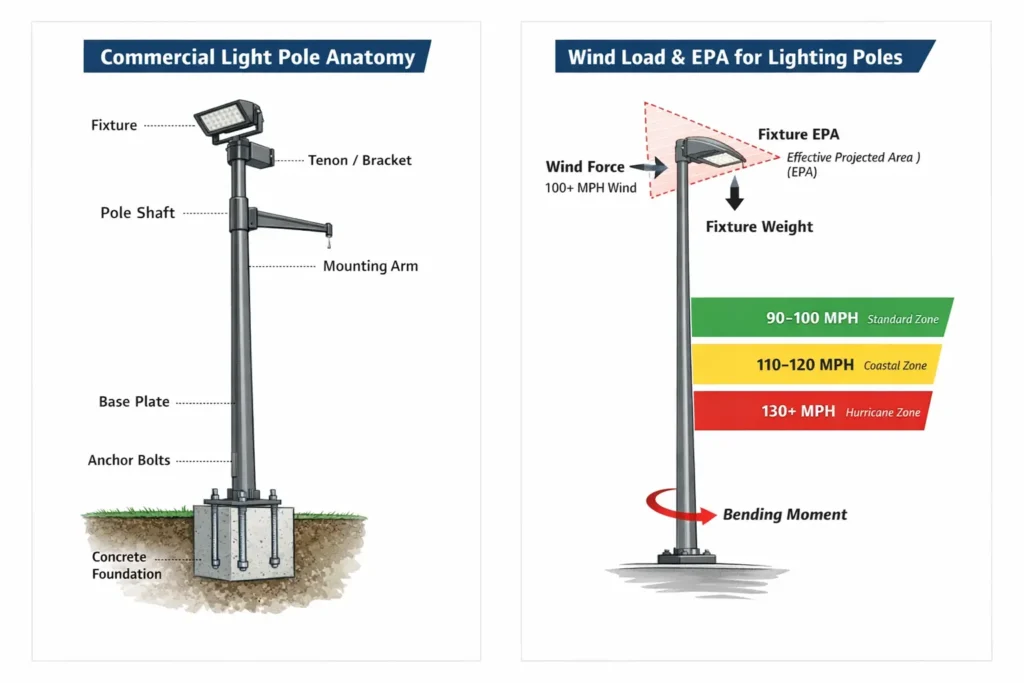
Commercial light pole structure and wind load considerations including mounting arms, tenons, anchor bolts, and concrete foundation.
Decorative and Architectural Light Poles
Beyond functional lighting infrastructure, many commercial environments require poles that contribute to the overall architectural aesthetic of a property.
Decorative pole designs may include:
Fluted Poles
Feature vertical grooves along the shaft for a traditional architectural appearance.
Tapered Poles
Gradually narrow toward the top, providing a refined and balanced visual profile.
Straight Poles
Maintain a uniform diameter from base to top and are often used in modern commercial environments.
Decorative poles are frequently installed in locations such as:
-
Retail centers
-
Hospitality properties
-
Municipal streetscapes
-
Campus environments
-
Pedestrian promenades
These poles combine structural functionality with architectural design to enhance the visual identity of a property.
Integrating Light Poles with Outdoor Lighting Systems
When planning an outdoor lighting project, the pole system must be carefully coordinated with the selected lighting fixtures. Pole height, arm length, mounting configuration, and foundation type all influence how light is distributed across a space.
Parking lots are one of the most common applications for pole-mounted outdoor area lighting. See our Parking Lot Illumination with Commercial Light Poles guide for additional planning recommendations.
Well-designed pole systems help ensure:
-
Proper illumination coverage
-
Reduced glare and light spill
-
Structural safety and stability
-
Long-term durability in outdoor environments
Selecting the correct pole material, mounting hardware, and foundation system is therefore an essential step in any commercial lighting installation.
Commercial facilities replacing older HID fixtures can better understand efficiency improvements by exploring Solar vs Traditional LED Lighting technologies.
Inline Buyer Q&A
How do I determine the right commercial light pole for my project?
Start with the application, required mounting height, fixture configuration, project location, and site conditions.
Important considerations include:
- Pole height
- Steel or aluminum construction
- Square or round pole design
- Anchor-base or direct-burial installation
- Fixture mounting configuration
- Number and type of fixtures
- Fixture EPA
- Local wind conditions
- Foundation design
- Finish and architectural requirements
The pole and fixtures should be evaluated as a complete system rather than selected independently.
How tall should commercial light poles be?
There is no single correct pole height for every commercial property.
Appropriate mounting height depends on the application, property dimensions, fixture output and distribution, desired spacing, surrounding conditions, and lighting objectives.
Parking lots, roadways, pedestrian areas, campuses, storage yards, and other applications can require substantially different pole heights and layouts.
For a deeper look at this decision, see How Tall Is a Commercial Light Pole?.
How do I know whether a pole can support the LED fixtures I want to install?
Fixture weight alone is not enough to determine compatibility.
The fixture’s Effective Projected Area (EPA), quantity, mounting arrangement, pole design, mounting height, and project wind conditions should be evaluated together.
Provide the fixture specifications and project location when requesting poles so the proposed configuration can be reviewed.
Can I replace an existing commercial light pole without changing the lighting fixtures?
Potentially.
A replacement pole must be compatible with the existing fixture mounting configuration and appropriate for the fixture load, EPA, site conditions, and installation method.
For existing installations, photographs and measurements of the pole, base, bolt pattern, mounting hardware, and fixtures can help identify suitable replacement options.
Can new LED fixtures be installed on existing parking lot poles?
Often, but the existing poles and mounting hardware should be evaluated before assuming compatibility.
Consider the condition of the pole, fixture mounting method, new fixture weight and EPA, mounting height, existing tenons or arms, electrical requirements, and site wind conditions.
An LED retrofit does not automatically mean the pole itself needs replacement.
What information should I provide when requesting a commercial light pole quote?
When possible, provide:
- Project location
- Pole height
- Pole shape and material
- Anchor-base or direct-burial requirement
- Fixture manufacturer and model
- Number of fixtures per pole
- Fixture EPA and weight
- Mounting configuration
- Tenon or arm requirements
- Finish or color
- Existing pole information for replacement projects
- Site plans, drawings, or specifications
If some of this information is unknown, photographs and project drawings can help establish the starting point.
Plan Your Commercial Light Pole System with the Right Components
Commercial light poles are more than mounting structures for outdoor fixtures. Pole height, construction, mounting configuration, fixture EPA, wind conditions, foundation requirements, and the lighting layout all need to be considered when specifying a pole system for a commercial site.
Whether you’re planning a parking lot, roadway, campus, industrial property, retail development, municipal project, or other outdoor application, our lighting specialists can help evaluate:
- Commercial light pole selection
- Pole height and mounting configurations
- Fixture and pole compatibility
- Wind-load and EPA considerations
- Anchor-base and foundation requirements
- Parking lot and area-lighting applications
- Replacement and retrofit pole projects
- Photometric layouts and fixture selection
Explore our Commercial Light Poles & Accessories for pole options and components for professional outdoor lighting projects.
For project assistance, have your site plan, pole height requirements, fixture information, mounting configuration, and project location available when possible.
Call 1-844-533-7767 to discuss your commercial light pole requirements.
Frequently Asked Questions About Commercial Light Poles
What are commercial light poles used for?
Commercial light poles support outdoor lighting fixtures used for parking lots, roadways, campuses, retail properties, industrial facilities, municipal areas, pedestrian spaces, and other exterior applications.
Pole selection depends on both the lighting requirements and structural conditions of the project.
What are commercial light poles made from?
Commercial light poles are commonly manufactured from steel or aluminum.
Material selection can depend on pole design, mounting height, environmental conditions, structural requirements, finish, appearance, maintenance considerations, and project specifications.
What is the difference between square and round light poles?
Square and round poles primarily differ in shape, appearance, construction, and available mounting configurations.
Either style can be appropriate for commercial outdoor lighting when properly specified for the fixture configuration and site conditions.
The decision is often based on architectural preference, existing site standards, mounting requirements, and project specifications.
What is the difference between anchor-base and direct-burial light poles?
Anchor-base poles are mounted to a foundation using a base plate, anchor bolts, nuts, and related hardware.
Direct-burial poles are installed with a portion of the pole embedded below grade according to the pole design and installation requirements.
The appropriate method depends on the pole, site conditions, foundation design, project specifications, and installation requirements.
What is EPA on a commercial light pole?
EPA stands for Effective Projected Area.
It is used when evaluating the wind-loading effect of fixtures, arms, brackets, and other equipment mounted on a pole.
The allowable configuration depends on the pole design, mounting height, wind conditions, fixture EPA, and other structural considerations.
Why is the project location important when selecting a light pole?
Project location helps determine the wind conditions and other environmental factors that may need to be considered when specifying the pole.
A pole and fixture configuration suitable for one location should not automatically be assumed suitable for another.
How tall are commercial parking lot light poles?
Parking lot poles are available in many heights, and there is no universal height that works for every parking area.
The appropriate height depends on property dimensions, fixture distribution, spacing, desired illumination, surrounding properties, architectural considerations, and other site conditions.
See How Tall Is a Commercial Light Pole? for additional planning considerations.
Does a taller light pole provide better lighting?
Not automatically.
Greater mounting height can allow fixtures to distribute light across a larger area, but fixture optics, lumen output, pole spacing, aiming, site geometry, and the desired lighting criteria also affect performance.
A photometric layout can help evaluate different mounting heights and fixture configurations.
How far apart should commercial light poles be?
There is no universal spacing rule.
Spacing depends on mounting height, fixture output, optical distribution, pole locations, property dimensions, obstructions, required illumination, uniformity objectives, and other site conditions.
Photometric modeling is the better method for evaluating spacing on larger commercial projects.
What type of fixtures can be mounted on commercial light poles?
Depending on the pole and mounting configuration, commercial poles can support area lights, parking lot fixtures, street and roadway fixtures, floodlights, decorative luminaires, and other outdoor lighting equipment.
Fixture compatibility should be verified before specifying the pole.
Can multiple LED fixtures be mounted on one pole?
Yes, when the pole, mounting hardware, and structural configuration are designed for the proposed fixture arrangement.
Adding fixtures changes the total fixture weight, EPA, and wind-loading characteristics, so the complete configuration should be evaluated.
What mounting options are available for commercial light poles?
Depending on the pole and fixtures, mounting configurations can include direct mounting, tenons, bullhorns, cross arms, brackets, and other pole-top or side-mount arrangements.
The mounting method should be selected with the fixture and pole rather than treated as an independent accessory decision.
Can commercial light poles be used with LED parking lot lights?
Yes.
Commercial light poles are commonly used with LED parking lot and area-lighting fixtures.
Pole height, fixture distribution, mounting arrangement, spacing, EPA, and site conditions should be coordinated when designing the system.
Do commercial light poles require concrete foundations?
Many anchor-base poles are installed on engineered concrete foundations, while other pole types can use different installation methods.
Foundation dimensions and reinforcement should not be selected from a universal rule. Pole loads, soil conditions, wind conditions, project requirements, and applicable engineering criteria can affect foundation design.
Can damaged commercial light poles be repaired?
It depends on the type, location, and severity of the damage.
Structural damage, significant corrosion, impact damage, compromised welds, or base problems should be evaluated before deciding whether a pole can remain in service.
A decorative base cover should not be used to conceal unresolved structural damage.
Can light pole base covers be replaced without replacing the pole?
Often, yes.
When the pole and structural components remain serviceable, missing or damaged decorative base covers can frequently be replaced separately.
For retrofit options, see our Clam Shell Pole Base Covers.
Can existing commercial light poles be reused during an LED retrofit?
Potentially.
Existing poles may be reusable when they remain in suitable condition and are compatible with the proposed fixtures and mounting configuration.
The pole condition, mounting hardware, fixture EPA and weight, electrical system, and site requirements should be evaluated before reuse.
Are commercial light poles available in different finishes and colors?
Yes.
Available finishes and colors vary by manufacturer and pole construction. Options can include painted or powder-coated finishes and other treatments intended for specific architectural or environmental applications.
Verify available finishes and their suitability for the installation environment.
How long do commercial light poles last?
There is no universal service life.
Material, finish, environmental exposure, corrosion, installation quality, drainage, physical damage, maintenance, structural loading, and site conditions can all affect pole condition over time.
Regular inspection is particularly important where poles are exposed to vehicle impacts, moisture, corrosive environments, or other demanding conditions.
Do I need a photometric layout when selecting commercial light poles?
Not every project requires one, but photometric modeling is valuable when pole height, spacing, fixture quantity, distribution, and illumination levels need to be evaluated together.
For parking lots, roadways, campuses, industrial sites, and other larger projects, a photometric layout can help compare different pole and fixture configurations before installation.
Stay Connected with Our Lighting Resources
Add IndustrialLightingFixtures.org as a Preferred Source on Google to see more of our lighting guides and technical resources across Google Search experiences.
Related Commercial Light Pole Resources
- Commercial Light Poles & Accessories — Explore commercial light poles, mounting options, and related components for parking lots, campuses, roadways, and other outdoor lighting applications.
- How Tall Is a Commercial Light Pole? — Learn how application, site dimensions, fixture distribution, and lighting objectives influence commercial pole height.
- Improve a Parking Area with a Commercial Light Pole — Review how pole height, fixture selection, spacing, and layout work together in commercial parking lot applications.
- Area Lighting Pole Height Guide — Examine mounting-height considerations for commercial area-lighting systems and larger outdoor sites.
- Clam Shell Pole Base Covers — Explore retrofit base covers for concealing exposed base plates, anchor bolts, nuts, and mounting hardware on existing commercial light poles.