
How LED Technology Is Transforming Athletic Facilities
Sports lighting has evolved dramatically over the past two decades. What was once limited to high-wattage metal halide fixtures with long warm-up times and frequent maintenance has become an intelligent, energy-efficient lighting ecosystem capable of adapting to everything from youth practices to nationally televised championship games.
Today’s commercial LED sports lighting systems deliver more than brighter playing surfaces. They improve athlete safety, reduce operating costs, enhance the spectator experience, support live streaming, and provide facility managers with unprecedented control over how and when lighting is used.
As technology continues to advance, sports lighting is becoming an integral part of smarter, more sustainable athletic facilities.
Before exploring future technologies, it’s helpful to understand today’s commercial lighting fundamentals. Our LED Sports Lighting Guide explains the principles behind modern athletic lighting design.
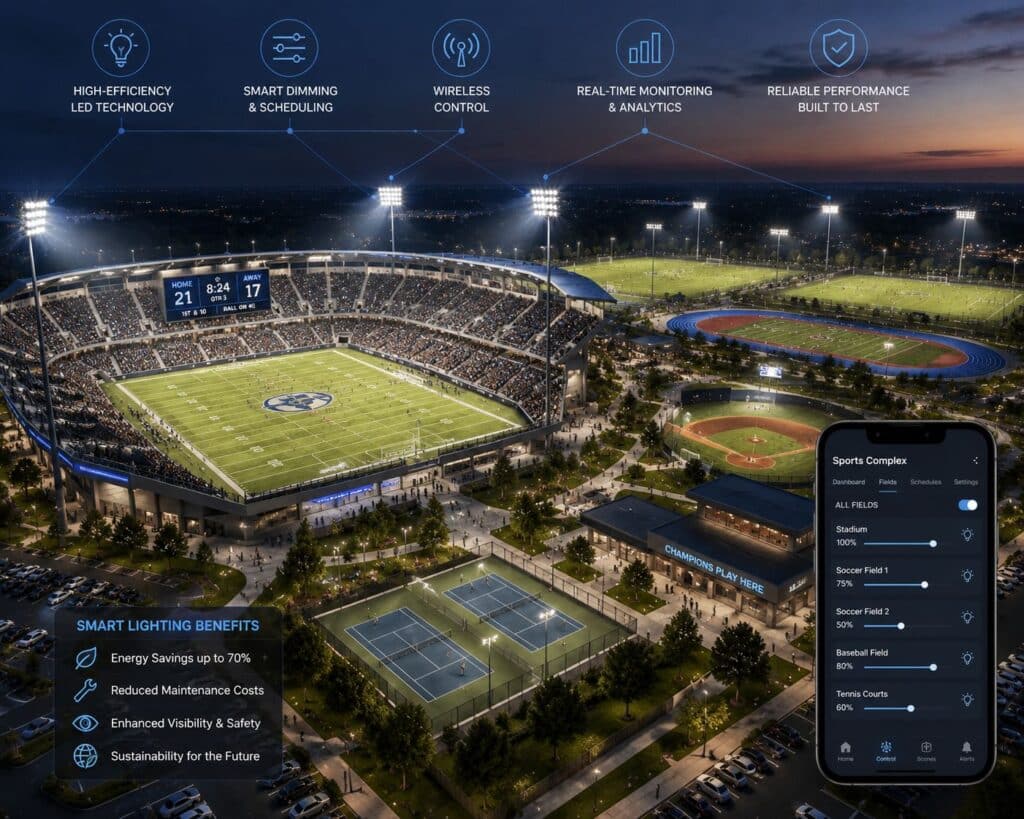
The next generation of commercial LED sports lighting combines energy efficiency, intelligent controls, precision optics, and immersive fan experiences for stadiums and athletic facilities.
Planning a new athletic facility or preparing for the next generation of sports lighting?
LED Pros WorldWide helps schools, municipalities, universities, parks departments, engineers, architects, and contractors design future-ready commercial LED sports lighting systems that combine exceptional performance with long-term energy savings. From intelligent lighting controls and precision optics to premium LED stadium and sports field fixtures, our specialists provide FREE photometric lighting layouts, expert product recommendations, and customized solutions for projects of every size.
Call 1-844-533-7767 today to speak with a lighting specialist, or explore our Commercial LED Sports Lighting Fixtures to begin planning a smarter, more efficient athletic lighting system built for the future.
From Metal Halide to Intelligent LED Lighting
For many years, metal halide fixtures dominated outdoor sports lighting because they produced the high light levels needed for football fields, baseball diamonds, and stadiums.
Although effective for their time, these systems presented several challenges:
- Long warm-up and restrike times
- Significant energy consumption
- Frequent lamp replacements
- Declining light output as lamps aged
- Higher maintenance costs
- Limited lighting controls
- Poor flexibility for multi-use facilities
Modern LED technology has addressed virtually all of these limitations while introducing capabilities that were previously impossible.
Today’s LED sports lighting provides:
- Instant-on operation
- Superior light uniformity
- Precision optical control
- Lower energy consumption
- Longer service life
- Reduced maintenance
- Programmable lighting scenes
- Smart control integration
These advantages have made LED lighting the preferred solution for new athletic facilities and retrofit projects alike.
LED Efficiency Continues to Improve
One of the most significant developments in sports lighting has been the steady increase in LED efficiency.
Early commercial LED sports fixtures often produced approximately 100 lumens per watt, representing a major improvement over traditional metal halide technology.
Today’s premium commercial luminaires commonly exceed 160 lumens per watt, with some high-performance products approaching 200 lumens per watt under ideal operating conditions.
This continued improvement allows facility owners to:
- Lower electrical demand
- Reduce fixture wattage
- Improve lighting performance
- Decrease operating costs
- Support sustainability initiatives
Higher efficacy also enables engineers to achieve required illumination levels with fewer fixtures or lower input power while maintaining excellent field coverage.
Better Optics Mean Better Performance
Brightness alone no longer defines a quality sports lighting system.
Modern LED luminaires use precision-engineered optical systems that place light exactly where it is needed while minimizing wasted illumination.
Advanced optics help improve:
- Field uniformity
- Vertical illumination
- Ball visibility
- Player recognition
- Spectator comfort
- Glare control
- Spill light reduction
Rather than flooding an area with excessive light, today’s fixtures are designed to maximize usable illumination on the playing surface.
Lighting for More Than the Game
Athletic facilities have evolved into year-round community assets.
In addition to sporting events, many venues host:
- Graduation ceremonies
- Community festivals
- Outdoor concerts
- Charity events
- Movie nights
- School assemblies
- Emergency response staging
- Public celebrations
Modern LED systems provide the flexibility to support these diverse activities through programmable lighting scenes and intelligent controls.
Instead of operating at full output throughout every event, facilities can tailor lighting levels to suit each application, improving both efficiency and user experience.
Sustainability Is Driving Investment
Schools, municipalities, universities, and professional sports organizations continue to pursue sustainability goals.
Sports lighting plays an important role by helping facilities:
- Reduce electricity consumption
- Lower greenhouse gas emissions
- Minimize maintenance-related waste
- Extend equipment life
- Reduce operating budgets
Many organizations also seek lighting systems that comply with Dark Sky principles by reducing uplight, glare, and unnecessary light trespass into neighboring communities.
As energy costs continue to rise, efficient LED sports lighting provides measurable financial and environmental benefits.
Designed for a Connected Future
Perhaps the biggest change in sports lighting isn’t the fixture itself—it’s the intelligence behind it.
Today’s commercial LED lighting systems are increasingly integrated with digital control platforms that allow operators to manage lighting remotely, automate schedules, monitor performance, and optimize energy use.
What was once a simple electrical system is rapidly becoming part of a connected facility infrastructure that supports smarter operations and a better experience for athletes, spectators, and maintenance teams.
To learn how today’s commercial systems are engineered for athletic performance, visit our LED Sports Lighting Guide, which explains the fundamentals of modern sports lighting design.
Evolution of Sports Lighting Technology
| Generation | Key Characteristics | Primary Benefits |
|---|---|---|
| Metal Halide | High energy use, long warm-up, frequent maintenance | Industry standard for many years |
| Early LED Systems | Improved efficiency, instant-on operation | Lower energy and maintenance costs |
| Current Commercial LEDs | Precision optics, smart controls, high efficacy, premium drivers | Superior performance, flexibility, and reliability |
| Next-Generation Systems | Connected controls, AI-assisted monitoring, advanced analytics | Smarter facility management and future-ready infrastructure |
Emerging technologies are transforming athletic venues of every size. Our Outdoor Sports Lighting Guide demonstrates how these innovations are being applied across parks, schools, sports complexes, community event spaces, and specialized recreational facilities.
🏟️ Project Spotlight: A Community Stadium Looks Ahead
A growing suburban school district replaced its aging metal halide lighting at a football stadium that also hosted soccer matches, graduation ceremonies, marching band competitions, and community events.
Rather than simply installing brighter fixtures, the district invested in a modern LED lighting system designed for long-term flexibility. The upgrade featured high-efficiency luminaires, precision optics, programmable lighting scenes, and infrastructure ready for future smart controls.
The results included:
- Lower annual energy consumption
- Improved field visibility for athletes and officials
- Reduced maintenance interruptions
- Faster event setup with programmable lighting scenes
- Capacity to support future streaming, digital controls, and expanded community use
By planning beyond its immediate needs, the district created an athletic facility capable of adapting to changing technologies and community expectations for years to come.
💡 Design Insight
The future of sports lighting isn’t simply about producing more light—it’s about producing better light. Advances in LED efficacy, precision optics, intelligent controls, and system connectivity are helping athletic facilities improve safety, lower operating costs, reduce environmental impact, and create more versatile venues for sports and community events alike.
The Next Generation of LED Sports Lighting Technology
LED sports lighting has advanced at an impressive pace over the last decade, and innovation continues to accelerate.
While the first generation of LED fixtures focused primarily on reducing energy consumption, today’s commercial lighting systems emphasize precision optics, intelligent controls, higher efficacy, improved reliability, broadcast-quality performance, and reduced environmental impact.
The next generation of sports lighting will not simply make athletic facilities brighter—it will make them smarter, more efficient, easier to maintain, and better suited for the evolving needs of athletes, spectators, broadcasters, and facility managers.
Planning for tomorrow begins with a solid foundation today. Our Sports Field Lighting Design Guide covers photometric layouts, pole placement, fixture selection, and sport-specific lighting strategies.
Higher Efficiency Continues to Lower Operating Costs
One of the most significant improvements in LED technology has been the steady increase in luminous efficacy.
Only a decade ago, commercial sports lighting fixtures producing approximately 100 lumens per watt represented excellent performance.
Today’s premium commercial luminaires commonly exceed 160 lumens per watt, with some high-performance fixtures approaching 200 lumens per watt under ideal operating conditions.
These improvements allow facilities to:
- Reduce electrical demand
- Lower operating costs
- Improve lighting performance
- Reduce fixture wattage
- Support sustainability initiatives
As LED chip technology continues to evolve, future systems are expected to become even more efficient while maintaining exceptional optical performance.
Precision Optics Continue to Improve
The greatest advances in sports lighting are no longer occurring solely within the LED chips.
Modern optical engineering allows manufacturers to place light with remarkable accuracy.
Next-generation optics provide:
- Better beam control
- Improved uniformity
- Reduced glare
- Increased vertical illumination
- Less spill light
- Better long-distance performance
Instead of increasing fixture quantity, designers increasingly rely on sophisticated optical systems to maximize usable light exactly where athletes need it.
Improved Thermal Management
Heat remains one of the primary factors affecting LED performance and longevity.
Modern commercial luminaires incorporate advanced thermal management features such as:
- Larger heat sinks
- Optimized airflow
- Improved fin designs
- Better housing materials
- Enhanced thermal interfaces
Lower operating temperatures help preserve:
- LED output
- Driver reliability
- Color consistency
- Overall fixture life
As thermal technology improves, future luminaires are expected to maintain higher light output for even longer periods with less lumen depreciation.
Premium Drivers Continue to Advance
While LED chips receive much of the attention, the driver remains one of the most critical components of every lighting system.
The newest commercial drivers provide:
- Improved efficiency
- Better surge resistance
- More accurate dimming
- Enhanced power quality
- Longer operating life
- Remote diagnostics
- Programmable operating parameters
Many manufacturers now design fixtures with field-serviceable drivers, reducing maintenance costs by allowing technicians to replace individual components instead of entire luminaires.
Broadcast-Ready Lighting
Athletic events are increasingly viewed through cameras rather than from the stands.
Today’s sports lighting systems are being engineered specifically for:
- Television broadcasting
- Live streaming
- High-definition cameras
- Slow-motion replay
- Drone video
- Social media production
One major advancement is the use of low-flicker LED drivers.
These drivers maintain stable light output during high-speed recording, eliminating flicker that can appear in slow-motion video or high-frame-rate broadcasts.
As streaming continues to expand at every level of athletics, broadcast-quality lighting is becoming increasingly important—even for community sports facilities.
Better Color Quality
Color rendering continues to improve across commercial lighting products.
Higher-quality LED systems allow athletes, officials, and spectators to distinguish:
- Team uniforms
- Field markings
- Equipment
- Sponsor graphics
- Scoreboards
- Safety signage
Improved color quality also enhances photography and video production while creating a more vibrant appearance throughout the athletic facility.
Reduced Glare Through Better Engineering
Earlier generations of sports lighting often relied on increasing light output to improve visibility.
Today’s engineering philosophy focuses on reducing glare while maximizing usable illumination.
Advancements include:
- Precision optical lenses
- Optical shields
- Improved aiming techniques
- Better beam distributions
- Higher mounting strategies
The result is lighting that feels more comfortable for athletes and spectators while improving overall field visibility.
Dark Sky and Responsible Lighting
Communities are placing greater emphasis on reducing unnecessary light pollution.
Manufacturers continue developing fixtures that minimize:
- Sky glow
- Spill light
- Light trespass
- Driver distraction
- Environmental impact
Future sports lighting systems will likely provide even greater optical precision, allowing athletic facilities to illuminate only the intended playing areas while protecting surrounding neighborhoods and natural environments.
Responsible lighting design is becoming an increasingly important part of commercial sports lighting projects.
Longer Product Life
Advances in materials and engineering continue extending the useful life of commercial lighting systems.
Improvements include:
- More durable housings
- Better corrosion resistance
- Stronger protective coatings
- Higher-quality electronic components
- Improved gasket systems
- Enhanced environmental sealing
Premium commercial fixtures are increasingly designed to provide decades of dependable service with minimal maintenance.
Modular Fixture Designs
Another emerging trend is modular fixture construction.
Rather than replacing an entire luminaire, future maintenance may involve replacing only individual components such as:
- Drivers
- LED arrays
- Optical assemblies
- Control modules
- Communication hardware
This approach reduces waste, lowers maintenance costs, and extends the overall life of the lighting system.
Smarter Manufacturing
Manufacturers themselves are benefiting from technological advances.
Improved production methods now deliver:
- More consistent optical performance
- Better quality control
- Improved thermal performance
- Reduced manufacturing tolerances
- More reliable electronic assemblies
These improvements contribute directly to longer-lasting products and more predictable lighting performance.
Emerging LED Technology Trends
| Technology | Future Benefit |
|---|---|
| Higher LED Efficacy | Lower operating costs and reduced energy consumption |
| Advanced Optics | Better beam control and reduced glare |
| Premium Drivers | Longer life and improved reliability |
| Low-Flicker Electronics | Superior broadcast and streaming performance |
| Improved Thermal Management | Longer fixture life and consistent lumen output |
| Modular Construction | Easier maintenance and lower lifecycle costs |
| Better Environmental Sealing | Increased durability in harsh outdoor environments |
| Dark Sky Optics | Reduced spill light and improved community compatibility |
🏟️ Project Spotlight: Investing in the Next Generation
A university athletic department planned a phased renovation of its football stadium and multi-sport athletic complex.
Rather than purchasing fixtures based solely on initial cost, the project team evaluated long-term performance, maintenance requirements, and future technology compatibility.
The selected lighting system included:
- High-efficacy commercial LED luminaires
- Precision optical distributions
- Low-flicker drivers for broadcast-quality video
- Advanced thermal management
- Modular driver assemblies
- Smart-control compatibility for future expansion
Although the initial investment was slightly higher than competing products, the university gained a lighting system designed to support future technologies while reducing maintenance and operating expenses for many years.
📐 Design Insight
The next generation of sports lighting will be defined less by brighter fixtures and more by better engineering. Higher efficacy, improved optics, premium drivers, advanced thermal management, broadcast-ready performance, and modular construction are creating lighting systems that deliver greater value throughout their entire lifecycle.
The Future Stadium Experience: Beyond the Game
Modern sports venues are evolving into year-round entertainment destinations.
While exceptional field lighting remains essential, today’s fans expect much more than simply watching a game under bright lights. Athletic facilities increasingly serve as community gathering places that host concerts, festivals, graduation ceremonies, charity events, outdoor movie nights, esports competitions, and civic celebrations.
As a result, lighting is no longer viewed solely as infrastructure—it has become part of the overall entertainment experience.
The next generation of LED sports lighting will combine architectural illumination, intelligent controls, dynamic color-changing effects, integrated digital technology, and smart facility management to create more engaging and versatile venues.
Large athletic venues require additional planning for spectators, broadcast systems, security, and architectural lighting. Explore our Stadium Lighting Design Guide to learn how these systems work together to create world-class venues.
Lighting as Entertainment
Traditionally, sports lighting remained static throughout an event.
Today’s LED technology allows venues to transform lighting into part of the presentation.
Facilities can now create dynamic lighting scenes for:
- Team introductions
- Player entrances
- National anthems
- Halftime presentations
- Championship celebrations
- Victory ceremonies
- Community events
- Holiday programs
Rather than simply illuminating the game, lighting helps build excitement and strengthen the emotional connection between fans and the venue.
RGB Lighting Is Expanding
Color-changing RGB and RGBW LED systems are becoming increasingly common at athletic facilities.
These systems allow operators to illuminate:
- Stadium facades
- Entrance plazas
- Scoreboard structures
- Towers
- Monument signs
- Public gathering areas
- Architectural features
Programming can celebrate:
- Team colors
- School spirit
- Holiday events
- Charity campaigns
- National holidays
- Community awareness initiatives
Unlike functional field lighting, architectural RGB lighting creates memorable experiences before and after athletic competitions.
Synchronizing Lighting with Scoreboards
Future sports venues will increasingly integrate lighting with digital displays.
Lighting systems may synchronize with:
- LED scoreboards
- Ribbon displays
- Video walls
- Public address systems
- Music
- Countdown clocks
- Victory celebrations
Coordinated lighting sequences help create immersive environments that rival professional entertainment venues.
As technology becomes more affordable, these capabilities are expanding beyond professional stadiums into colleges, high schools, and municipal sports complexes.
Drone Light Shows Are Transforming Stadium Entertainment
One of the fastest-growing trends in live sports and entertainment is the use of coordinated drone light shows.
Rather than relying exclusively on traditional fireworks, many universities, professional sports organizations, and municipalities are incorporating synchronized fleets of LED-equipped drones into halftime shows, championship celebrations, opening ceremonies, and community events.
Unlike fireworks, drone shows can be:
- Repeated multiple times
- Customized for specific events
- Programmed with team logos
- Synchronized with music
- Environmentally friendlier
- Quieter for surrounding neighborhoods
- Easier to integrate into themed presentations
As drone technology continues to mature, it is becoming an increasingly popular complement to modern sports lighting systems.
Coordinating Stadium Lighting with Drone Displays
Future stadium control systems will increasingly coordinate multiple technologies into a single presentation.
Examples include synchronized operation of:
- LED stadium lighting
- RGB architectural lighting
- Digital scoreboards
- Ribbon displays
- Drone light shows
- Public address systems
- Music
- Video production
- Mobile fan engagement
Rather than operating independently, these systems work together to create immersive experiences before games, during halftime, and following championship victories.
Beyond Fireworks
Many venues are exploring drone light shows because they offer several operational advantages.
Compared to fireworks, drone displays:
- Produce no explosive debris
- Generate significantly less noise
- Can display detailed animations
- Support sponsor branding
- Celebrate school mascots and team logos
- Reduce smoke and environmental impact
- Allow repeated performances throughout the year
While fireworks will likely remain part of many major celebrations, drone technology provides venue operators with an additional entertainment option that complements modern LED lighting systems.
🏟️ Project Spotlight
A regional university wanted to create a memorable fan experience without relying exclusively on post-game fireworks.
During a major homecoming celebration, the athletic department combined RGB architectural lighting, synchronized scoreboards, dynamic stadium lighting scenes, and a coordinated drone light show featuring the university mascot and school colors.
The integrated presentation transformed the stadium into an immersive entertainment venue while reducing setup time and allowing the university to reuse customized drone programs for future sporting events, graduation ceremonies, and community celebrations.
Multi-Purpose Venues Continue to Grow
Modern athletic facilities rarely serve only one purpose.
Many venues now host:
- Football
- Soccer
- Baseball
- Concerts
- Community festivals
- Food truck events
- Graduation ceremonies
- Outdoor worship services
- Fundraising events
- Emergency response operations
Future lighting systems will become increasingly adaptable, allowing operators to create customized lighting scenes for each activity while maintaining excellent energy efficiency.
Supporting the Fan Experience
The future of sports lighting extends well beyond the playing field.
Lighting contributes to every stage of the visitor experience.
Examples include:
- Welcoming entry plazas
- Comfortable pedestrian walkways
- Enhanced concession areas
- Attractive gathering spaces
- Safe parking lots
- Architectural landmarks
- Interactive public spaces
Thoughtfully designed lighting encourages visitors to arrive earlier, stay longer, and enjoy more of what the venue has to offer.
Integration with Smart Cities
Many municipalities are investing in broader smart city initiatives.
Athletic facilities may eventually integrate lighting with:
- Traffic management
- Public transportation
- Emergency communications
- Public Wi-Fi
- Environmental monitoring
- Security systems
- Parking guidance
- Building automation
This connected infrastructure improves operational efficiency while enhancing public safety and visitor convenience.
Artificial Intelligence and Automation
Artificial intelligence is expected to play a growing role in sports facility operations.
Future lighting platforms may automatically:
- Optimize lighting schedules
- Detect fixture abnormalities
- Predict maintenance needs
- Adjust lighting based on occupancy
- Respond to changing weather
- Improve energy efficiency through continuous analysis
Rather than replacing facility managers, AI will provide better operational data that supports faster and more informed decision-making.
Personalized Lighting Experiences
Future venues may allow lighting to adapt to specific events and audiences.
Possible applications include:
- Team-specific lighting themes
- Sponsor branding
- Interactive fan experiences
- Youth tournament settings
- Championship presentations
- Community celebrations
Lighting may become another tool for strengthening the identity of schools, universities, municipalities, and professional organizations.
Flexible Infrastructure
The future of sports lighting is not only about today’s technology.
Facilities should be designed with infrastructure that supports future upgrades.
Forward-looking planning includes:
- Expandable control systems
- Additional electrical capacity
- Network-ready communication
- Modular fixtures
- Upgradeable software
- Open control platforms
A flexible design allows facilities to adopt emerging technologies without replacing the entire lighting system.
Sustainability Will Continue to Influence Design
Environmental responsibility will remain a major driver of lighting innovation.
Future systems will continue emphasizing:
- Lower electrical consumption
- Reduced maintenance
- Better optical control
- Reduced light trespass
- Lower carbon emissions
- Longer equipment life
- Responsible material selection
These improvements benefit both facility owners and the surrounding community.
The Future Stadium Experience
| Emerging Technology | Future Benefit |
|---|---|
| RGB Architectural Lighting | Enhanced fan engagement and community events |
| Intelligent Lighting Scenes | Flexible operation for multiple event types |
| Scoreboard Integration | Coordinated entertainment experiences |
| AI-Assisted Facility Management | Smarter operations and predictive maintenance |
| Smart City Connectivity | Improved safety and operational efficiency |
| Expandable Control Platforms | Easier future upgrades |
| Modular Fixture Design | Lower maintenance and longer service life |
| Sustainable Lighting Systems | Reduced operating costs and environmental impact |
🏟️ Project Spotlight: Building a Community Destination
A rapidly growing city planned a new multi-purpose athletic complex designed to serve far more than organized sports.
In addition to football and soccer competitions, the facility would host outdoor concerts, graduation ceremonies, community festivals, holiday celebrations, and civic events throughout the year.
Rather than designing a traditional lighting system, the project incorporated:
- High-efficiency LED sports lighting
- RGB architectural lighting at entrances and gathering areas
- Programmable lighting scenes for different event types
- Smart controls with remote scheduling
- Infrastructure ready for future digital integration
- Expandable control networks for future technology upgrades
The result was a venue capable of supporting athletics while also becoming one of the community’s premier gathering places.
The lighting system was no longer simply illuminating the facility—it became an important part of the visitor experience.
💡 Design Insight
Tomorrow’s sports venues will be judged not only by the quality of their playing surfaces but also by the experiences they create. Intelligent lighting, architectural illumination, connected technologies, and flexible control systems are transforming athletic facilities into year-round destinations that support sports, entertainment, education, and community engagement.
Planning for the Future: Building a Sports Lighting System That Lasts
Technology continues to evolve, but one principle remains constant: a well-planned lighting system delivers value for decades.
Whether you’re upgrading an aging football field, developing a new municipal sports complex, or modernizing a collegiate stadium, today’s decisions should support tomorrow’s technology. The most successful projects balance current performance with future flexibility, allowing facilities to adopt new innovations without requiring complete system replacements.
By selecting scalable infrastructure, commercial-grade components, and intelligent controls, athletic facilities can protect their investment while remaining prepared for the next generation of sports lighting technology.
Build with Future Expansion in Mind
Athletic facilities rarely remain unchanged.
Over time, many complexes add:
- Additional playing fields
- Larger grandstands
- Digital scoreboards
- Practice facilities
- Parking expansions
- Walking trails
- Concession buildings
- Broadcast equipment
- Security upgrades
Planning for future growth during the initial lighting design helps minimize renovation costs later.
Future-ready planning should include:
- Additional electrical capacity
- Expandable control systems
- Spare conduit where practical
- Network connectivity
- Pole locations that accommodate future expansion
- Modular lighting infrastructure
A small investment during construction often prevents costly modifications years later.
Choose Open and Scalable Control Platforms
One of the biggest mistakes facility owners make is selecting lighting controls that are difficult to expand or integrate.
As new technologies emerge, facilities benefit from systems that support:
- Additional fixtures
- Future athletic fields
- Wireless communication
- Cloud connectivity
- Building automation
- Security integration
- Remote software updates
- Emerging smart technologies
Choosing scalable platforms protects your investment and reduces the likelihood of premature system replacement.
Retrofit with the Future in Mind
Many athletic facilities still operate older metal halide systems that are approaching the end of their useful life.
Rather than replacing fixtures one-for-one, retrofit projects should evaluate the entire lighting system.
Questions to consider include:
- Can existing poles remain in service?
- Is electrical capacity adequate?
- Should lighting controls be upgraded?
- Will additional fields be added?
- Is live streaming planned?
- Could RGB architectural lighting be incorporated in the future?
- Will drone shows or enhanced entertainment lighting become part of future events?
Looking beyond the immediate project creates greater long-term value.
Invest in Quality Components
Technology changes quickly, but quality engineering never goes out of style.
Commercial lighting systems should include:
- Premium LED drivers
- Precision optics
- Die-cast aluminum housings
- Corrosion-resistant finishes
- High surge protection
- Field-serviceable components
- Smart control compatibility
- Comprehensive manufacturer support
Although premium products may carry a higher initial cost, they frequently deliver lower lifecycle costs through improved reliability and reduced maintenance.
Lifecycle Planning Matters
The purchase price represents only a fraction of the total cost of ownership.
Facility managers should also consider:
- Energy consumption
- Maintenance labor
- Lift rentals
- Replacement components
- Software updates
- Warranty coverage
- Future upgrade costs
Selecting products with long service life and readily available replacement parts helps reduce operational expenses throughout the life of the installation.
Annual Technology Review
Technology is advancing faster than ever before.
Facility owners should periodically review whether new innovations could improve operations.
Annual evaluations may include:
- Lighting control software updates
- Driver performance
- Energy usage trends
- New optical technologies
- Security integration
- Broadcast requirements
- Sustainability initiatives
- Emerging entertainment technologies
Small, incremental improvements often provide greater long-term value than waiting decades for a complete replacement.
Future-Ready Sports Lighting Checklist
Before beginning a sports lighting project, verify that your design includes:
Planning
✓ Professional photometric lighting layout
✓ Future expansion considerations
✓ Scalable electrical infrastructure
✓ Pole and structural evaluation
✓ Long-term maintenance strategy
Fixtures
✓ High-efficacy LED luminaires
✓ Premium LED drivers
✓ Precision optics
✓ Integrated surge protection
✓ Corrosion-resistant construction
✓ Field-serviceable components
Controls
✓ Smart lighting controls
✓ Programmable lighting scenes
✓ Remote monitoring
✓ Wireless communication capability
✓ Expandable control platform
Future Technologies
✓ Live-streaming compatibility
✓ Broadcast-ready low-flicker drivers
✓ RGB architectural lighting options
✓ Smart building integration
✓ Infrastructure ready for future entertainment technologies
Warranty
✓ Standard 5-year warranty or premium 10-year warranty
✓ Driver coverage
✓ Finish protection
✓ Replacement parts availability
✓ Long-term manufacturer support
Inline Buyer Q&A
Will today’s LED lighting become obsolete?
Quality commercial LED lighting systems are designed with long service lives. Choosing fixtures with modular components and expandable controls makes future upgrades much easier.
Should I invest in smart controls now?
Yes. Even if every feature isn’t used immediately, installing expandable controls today typically costs less than retrofitting them later.
Are RGB lighting systems only for professional stadiums?
No. High schools, universities, municipalities, and community sports complexes increasingly use RGB architectural lighting for school spirit, special events, and community celebrations.
How important are premium LED drivers?
Extremely important. The driver is one of the most critical electronic components in an LED fixture and plays a major role in reliability, dimming performance, and overall service life.
Will future sports facilities rely more on automation?
Yes. Connected controls, predictive maintenance, energy monitoring, and integrated facility management are expected to become increasingly common across athletic venues of all sizes.
Can existing sports lighting systems be upgraded over time?
In many cases, yes. Facilities that use scalable control systems and quality infrastructure can often incorporate new technologies without replacing the entire lighting system.
Lighting the Next Generation of Athletics
The future of sports lighting extends far beyond brighter fixtures. Intelligent controls, premium LED technology, advanced optics, connected infrastructure, and immersive fan experiences are transforming athletic facilities into smarter, more efficient, and more versatile destinations.
At LED Pros WorldWide, we help schools, municipalities, universities, architects, engineers, contractors, and sports organizations design commercial LED lighting systems that are ready for both today’s performance expectations and tomorrow’s innovations.
Our team provides:
- FREE professional photometric lighting layouts
- Commercial-grade LED sports lighting fixtures
- Smart lighting control solutions
- High-efficiency retrofit strategies
- Stadium and sports field lighting expertise
- Technical support from planning through installation
- Long-term guidance for scalable, future-ready systems
Whether you’re upgrading a community sports complex, designing a collegiate athletic venue, or planning a next-generation stadium, we’re ready to help you build a lighting system that will continue delivering value for years to come.
Call 1-844-533-7767 today to speak with a lighting specialist, or explore our Commercial LED Sports Lighting Fixtures to begin planning the future of your athletic lighting system.
Frequently Asked Questions
What is the future of sports lighting?
The future of sports lighting combines higher-efficiency LED luminaires, intelligent controls, precision optics, connected infrastructure, AI-assisted facility management, and enhanced fan experiences through programmable lighting technologies.
Are sports lighting systems becoming smarter?
Yes. Modern systems increasingly support remote monitoring, wireless communication, fixture diagnostics, programmable schedules, and integration with building management platforms.
Will LED efficiency continue improving?
Commercial LED efficacy has steadily increased over the past decade, allowing facilities to achieve excellent illumination while consuming less energy. Manufacturers continue to improve both efficiency and optical performance.
Are drone light shows replacing fireworks?
Drone light shows are becoming a popular complement to traditional fireworks, particularly at universities, professional sporting events, and municipal celebrations. Many facilities are incorporating drone technology alongside programmable stadium and architectural lighting to create memorable entertainment experiences.
Is AI being used in sports lighting?
Artificial intelligence is beginning to assist facility managers through predictive maintenance, energy optimization, system diagnostics, and automated scheduling. These capabilities are expected to expand as connected lighting platforms continue to evolve.
What warranty should I expect?
Commercial sports lighting systems typically include a 5-year warranty, while premium fixtures often offer 10-year warranties backed by higher-quality components and long-term manufacturer support.
Stay Connected with Our Lighting Resources
Add IndustrialLightingFixtures.org as a Preferred Source on Google to see more of our lighting guides and technical resources across Google Search experiences.
Related Resources
Continue exploring our commercial sports lighting resources:
LED Sports Lighting Fixtures
LED Sports Lighting Guide
Sports Field Lighting Design Guide
Stadium Lighting Design Guide
LED High Mast Lighting