
Outdoor advertising works around the clock, but once the sun sets, the effectiveness of a billboard depends almost entirely on its lighting system. A professionally illuminated billboard preserves the advertiser’s message, maintains brand recognition, and ensures that graphics remain clear and readable throughout the night.
Modern commercial LED billboard lighting uses precision optics, advanced LED technology, and carefully engineered mounting systems to deliver consistent illumination across the entire sign face. Rather than simply making a billboard brighter, today’s lighting systems are designed to improve readability, eliminate shadows, preserve color accuracy, and maximize the impact of every advertising impression.
Whether the billboard promotes a national brand, a local business, or a municipal message, proper lighting protects the investment while helping the display perform effectively every night of the year.
Understanding how billboard fixtures work makes it easier to design an efficient lighting system. Continue with our How Commercial LED Billboard Lighting Works guide to learn about optics, LED drivers, thermal management, and weather-resistant construction.
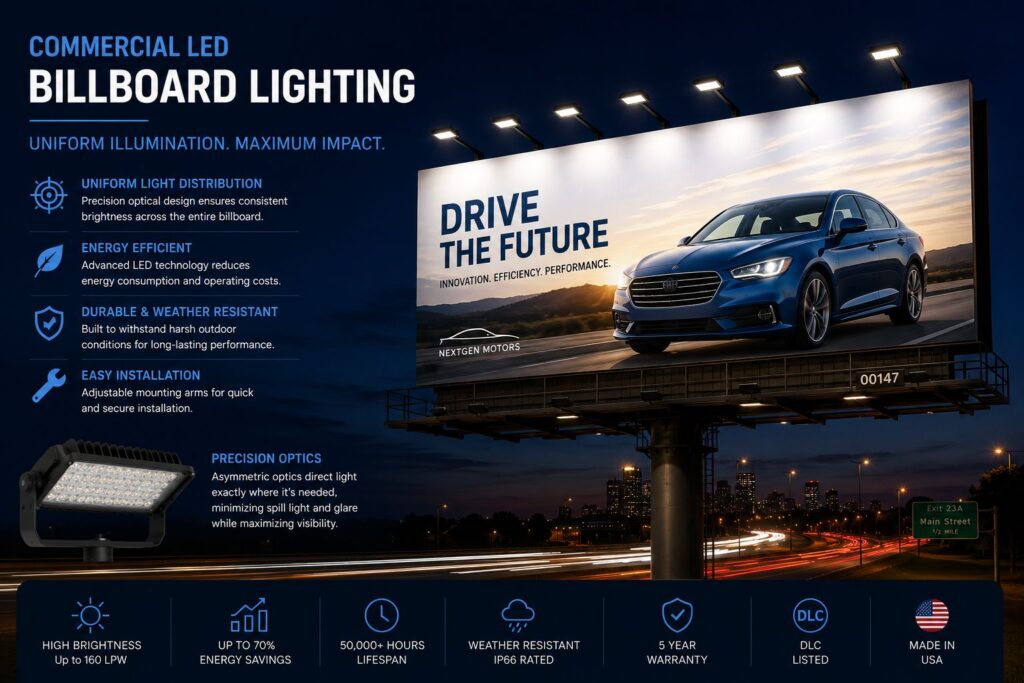
Proper billboard lighting improves advertising effectiveness by increasing visibility, enhancing color accuracy, and creating uniform illumination that makes messages easier to read after dark.
Looking to improve the visibility of your billboard or outdoor advertising display?
Our lighting specialists help billboard companies, contractors, municipalities, and commercial property owners select LED billboard lighting systems that deliver outstanding nighttime visibility, uniform illumination, energy efficiency, and long-term reliability.
👉 Explore our complete selection of Commercial LED Billboard Lights for roadside advertising, wall-mounted graphics, monument signs, and outdoor commercial displays.
Advertising Visibility at a Glance
| Visibility Factor | Design Objective |
|---|---|
| Uniform Illumination | Eliminate hot spots and shadows |
| Optical Distribution | Even coverage across the billboard face |
| Color Temperature | 4000K–5000K |
| Color Rendering (CRI) | Accurate reproduction of logos and graphics |
| Mounting Method | Top Mount or Bottom Mount |
| Controls | Photocells • Timers • Smart Controls |
| Overall Goal | Maximum Readability and Visual Impact |
Learn how fixture spacing, aiming, optics, and mounting methods work together to create professional billboard illumination in our Commercial Billboard Lighting Design Guide.
Visibility Begins with Uniform Illumination
One of the biggest mistakes in billboard lighting is assuming that brighter automatically means better.
Successful advertising depends on consistent illumination, not excessive brightness.
A properly designed lighting system should:
- Eliminate dark corners
- Reduce bright hot spots
- Maintain even brightness across the sign face
- Improve readability
- Preserve graphic detail
- Create a professional appearance
Modern LED billboard fixtures use precision asymmetric optics that distribute light evenly across the billboard, allowing the advertisement to be viewed comfortably from a wide range of distances and viewing angles.
Ready to select fixtures? Our How to Choose Commercial LED Billboard Lighting guide compares fixture types, beam patterns, controls, warranties, and commercial specifications.
Contrast Makes Advertising Easier to Read
Lighting plays a major role in preserving contrast throughout the advertisement.
Poor illumination can wash out colors, flatten images, and reduce the visual impact of important information.
Proper lighting helps maintain:
- Sharp lettering
- Crisp logos
- Graphic detail
- Product photography
- White-to-dark contrast
- Overall message clarity
Even subtle improvements in contrast can significantly improve readability, especially for motorists traveling at highway speeds.
Viewing Distance Should Influence Lighting Design
Drivers often have only a few seconds to recognize and process a billboard message.
Lighting design should consider:
- Vehicle speed
- Traffic volume
- Billboard height
- Viewing angle
- Road geometry
- Surrounding ambient lighting
Rather than maximizing brightness, the objective is to present the message clearly throughout the intended viewing distance.
Daytime Branding vs. Nighttime Branding
A billboard works differently during the day than it does after sunset.
During daylight hours, natural sunlight illuminates the printed graphics, allowing colors, logos, and imagery to appear as designed.
At night, however, the lighting system becomes an extension of the advertisement itself.
If the lighting is poorly designed, the billboard may appear:
- Unevenly illuminated
- Washed out
- Difficult to read
- Poorly maintained
- Less professional than competing advertisements
Conversely, a well-lit billboard preserves brand identity after dark by presenting graphics with consistent brightness, accurate colors, and excellent readability. In many ways, the lighting system becomes part of the advertiser’s overall brand presentation.
Top-Mounted vs. Bottom-Mounted Billboard Lighting
One of the first decisions in any billboard lighting project is determining where the fixtures should be installed. While both top-mounted and bottom-mounted systems can provide effective illumination, each offers distinct advantages depending on the structure, maintenance requirements, and site conditions.
Top-Mounted (Downlighting)
Top-mounted fixtures are the industry standard for most commercial billboard installations.
Advantages include:
- Excellent lighting uniformity
- Better control of beam distribution
- Reduced driver glare
- Easier compliance with light trespass requirements
- Better vandal resistance
- Cleaner architectural appearance
- Simpler maintenance access on many billboard structures
This configuration is widely used for roadside billboards, interstate advertising, and large commercial displays because it allows precision optics to direct light downward across the billboard face with excellent uniformity.
Bottom-Mounted (Uplighting)
Bottom-mounted systems project light upward across the advertising surface.
Although less common, they can be an excellent solution when overhead mounting is impractical.
Typical applications include:
- Wall-mounted advertising panels
- Monument signs
- Existing retrofit installations
- Architectural graphics
- Urban streetscapes
Careful aiming is essential to minimize glare while maintaining even illumination across the display.
Comparing Mounting Methods
| Feature | Top-Mounted | Bottom-Mounted |
|---|---|---|
| Uniformity | Excellent | Very Good when properly aimed |
| Driver Glare | Lower | Requires careful aiming |
| Light Spill | Easier to control | Requires precision optics |
| Vandal Resistance | Better | More accessible |
| Typical Applications | Highway billboards, roadside advertising | Wall signs, monument signs, retrofit projects |
Modern asymmetric optics allow both mounting methods to produce excellent lighting performance when properly specified, but top-mounted downlighting remains the preferred choice for most commercial billboard installations.
Selecting the right fixture is only the first step. Continue with our Billboard Lighting Best Practices for Professional Installation and Performance guide to learn how proper installation and commissioning maximize fixture performance.
Color Accuracy Helps Protect Brand Identity
A billboard often represents a significant investment in branding, graphic design, and advertising. While proper illumination makes a billboard visible, Color Rendering Index (CRI) determines how accurately those colors appear after dark.
High-quality LED billboard lighting with good CRI helps preserve:
- Corporate logos
- Brand colors
- Product packaging
- Restaurant advertising
- Vehicle graphics
- Retail promotions
- Photography
- Fine graphic details
When colors appear natural and consistent, advertisers maintain the same visual identity at night that customers see during the day.
Precision Optics Improve Visibility
Modern commercial billboard lighting is engineered around optical performance rather than simply producing more lumens.
Dedicated billboard luminaires use precision asymmetric optics that direct light across the vertical advertising surface while minimizing wasted light.
Proper optical control provides:
- Uniform illumination
- Better readability
- Reduced hot spots
- Minimal light trespass
- Improved energy efficiency
- Reduced glare toward motorists
Rather than relying on general-purpose flood lights, billboard-specific optics distribute light where it contributes most to advertising visibility.
Weather Conditions Influence Nighttime Visibility
Outdoor advertising must remain effective under a wide range of environmental conditions.
Rain, fog, snow, airborne dust, and humidity all influence how drivers perceive illuminated billboards.
Commercial-grade lighting systems help maintain consistent visibility through:
- Stable light output
- High-quality optics
- Durable lens materials
- Corrosion-resistant finishes
- Reliable LED drivers
- Proper fixture aiming
Projects in coastal environments often specify marine-grade powder-coated finishes to resist corrosion from salt air and extend fixture service life.
Smart Controls Keep Advertising Visible While Reducing Costs
Most billboard lighting operates every evening, making automatic controls an important part of efficient operation.
Common control options include:
- Photocells
- Astronomical time clocks
- Programmable scheduling
- Wireless lighting controls
- Remote monitoring
- Centralized lighting management
These technologies ensure advertising remains illuminated during appropriate operating hours while reducing unnecessary energy consumption and simplifying maintenance.
Energy Efficiency Improves Return on Investment
LED billboard lighting significantly reduces operating expenses compared to older HID systems.
Benefits include:
- Lower electrical consumption
- Longer fixture life
- Reduced maintenance
- Fewer service calls
- Instant startup
- Stable light output over time
- Lower total cost of ownership
Because billboard lighting typically operates every night, even modest improvements in efficiency can produce meaningful savings over the life of the installation.
Common Billboard Visibility Problems
Even professionally printed graphics cannot overcome poor lighting design.
Common problems include:
- Uneven illumination
- Bright hot spots
- Dark corners
- Incorrect beam distribution
- Poor fixture aiming
- Driver glare
- Mixed color temperatures
- Dirty fixture lenses
- Aging LED drivers
- Insufficient maintenance
Routine inspections and periodic fixture adjustments help ensure billboards continue delivering consistent advertising performance.
Commercial Billboard Lighting Buyer's Checklist
Before upgrading or installing billboard lighting, consider the following:
| Buyer’s Question | Why It Matters |
|---|---|
| Is illumination uniform across the billboard face? | Improves readability and presentation |
| Are billboard-specific optics being used? | Maximizes efficiency and visibility |
| Is the mounting method appropriate? | Improves performance and reduces glare |
| Does the fixture provide good color rendering? | Preserves brand colors and graphics |
| Is the fixture designed for the local environment? | Improves long-term reliability |
| Does the lighting system support automatic controls? | Reduces operating costs |
| Is the fixture backed by a commercial warranty? | Protects the investment |
Many lighting principles discussed here also apply to monument signs, building-mounted signs, and architectural graphics. Continue with our Commercial Outdoor Sign Lighting guide for additional design and specification guidance.
Inline Buyer Q&A
Is brighter lighting always better for billboards?
No. Effective billboard lighting depends on uniform illumination, appropriate light levels, controlled optics, accurate color rendering, and proper fixture placement. Simply increasing light output can create bright spots, glare, wasted light, and unnecessary energy consumption without improving the appearance of the advertisement.
Why do dedicated billboard fixtures outperform standard flood lights?
Commercial billboard fixtures can use optical distributions specifically designed to project light across large vertical sign faces from typical mounting positions. Properly selected optics can improve uniformity while reducing wasted light and excessive spill beyond the advertising surface.
Does higher CRI really matter?
CRI can be important when accurate reproduction of logos, product colors, photographs, and advertising graphics is a priority. Fixture selection should consider color quality along with lumen output, optical distribution, color temperature, efficiency, and overall lighting uniformity.
How many LED fixtures does a billboard need?
Fixture quantity depends on billboard dimensions, mounting location, setback distance, fixture output, beam distribution, aiming, and the desired illumination level. Large or unusually configured signs may benefit from a photometric evaluation rather than relying on a fixed fixture-per-sign rule.
Should billboard lights be mounted above or below the sign?
Either arrangement may be possible depending on the billboard structure, site conditions, fixture optics, maintenance access, and applicable lighting requirements. The goal is to illuminate the advertising face uniformly while controlling glare, spill light, and unnecessary uplight.
Ready to Improve Your Billboard's Nighttime Visibility?
Outstanding outdoor advertising depends on more than creative graphics. The lighting system must present those graphics clearly and consistently after dark. Proper fixture selection combines controlled optics, uniform illumination, appropriate light levels, color quality, and intelligent controls to help maintain the visual impact of the advertisement.
Whether you’re illuminating highway billboards, commercial advertising displays, monument signs, or large wall graphics, our lighting specialists can help evaluate fixture output, optical distribution, mounting locations, aiming, controls, and other project requirements.
👉 Explore our Commercial LED Billboard Lights or call 1-844-533-7767 to discuss your commercial billboard lighting project.
Frequently Asked Questions
Should billboard lighting remain on all night?
Not necessarily. Operating schedules depend on local requirements, advertiser needs, traffic patterns, property restrictions, and business objectives. Photocells, timers, scheduling systems, and other controls can limit operation to the nighttime periods when illumination is needed.
Can LED billboard lighting improve nighttime advertising visibility?
Properly designed LED billboard lighting can improve nighttime readability, uniformity, contrast, and color presentation. The result depends on fixture selection, optical distribution, mounting, aiming, sign dimensions, surrounding ambient light, and the design of the advertisement itself.
Can existing billboard lighting be upgraded to LED?
Often, yes. Existing billboard structures may be candidates for LED retrofit projects, but mounting arms, electrical systems, voltage, wiring, fixture weight, aiming, structural condition, and applicable requirements should be evaluated before reusing existing infrastructure.
What color temperature works well for billboard lighting?
The appropriate color temperature depends on the advertising graphics, surrounding environment, desired appearance, and applicable outdoor-lighting requirements. Commercial billboard systems are available in different color temperatures, allowing the lighting to be matched to project objectives rather than relying on one universal specification.
Can billboard lighting reduce energy and maintenance costs?
LED billboard fixtures can reduce energy consumption and maintenance compared with many older HID lighting systems. Actual savings depend on existing fixture wattage, replacement wattage, operating hours, controls, electricity costs, fixture life, and maintenance requirements.
Stay Connected with Our Lighting Resources
Add IndustrialLightingFixtures.org as a Preferred Source on Google to see more of our lighting guides and technical resources across Google Search experiences.
Related Commercial Billboard Lighting Resources
Continue planning your billboard lighting project with these resources covering fixture selection, floodlighting, outdoor-lighting design, and commercial applications:
- Commercial LED Billboard Lights — Explore LED fixtures designed for commercial billboards, advertising displays, large signs, and other exterior sign-lighting applications.
- Advertise the Right Way With LED Billboard Lights — Learn how fixture selection, optical distribution, color quality, mounting, and system design affect commercial billboard lighting performance.
- Commercial LED Flood Lights — Review commercial floodlighting options for signs, façades, architectural features, outdoor displays, and other exterior applications.
- Outdoor LED Lighting Guide — Explore broader outdoor-lighting considerations including fixture selection, light distribution, controls, environmental exposure, and energy efficiency.
- Commercial Lighting Guide — Review commercial LED lighting selection, efficiency, controls, maintenance, and other considerations for business and institutional properties.