
Heliport lighting systems have evolved significantly over the past decade. As hospitals, emergency response agencies, commercial operators, and private facilities continue to expand helicopter operations, the demand for reliable, energy-efficient, and heliport lighting designed around applicable FAA requirements.
Today’s heliport lighting systems utilize advanced LED technology to improve visibility, reduce maintenance requirements, and support safe helicopter operations during nighttime and low-visibility conditions. Whether installed on a rooftop hospital heliport, corporate facility, offshore platform, or emergency response center, modern heliport lighting plays a critical role in helping pilots identify landing areas and safely approach touchdown zones.
Rather than focusing solely on illumination, modern heliport lighting systems are designed to improve situational awareness, enhance operational safety, and support compliance with current aviation standards.
Planning a new heliport project? Learn how perimeter lighting, touchdown area lighting, and windsock illumination work together to improve safety.
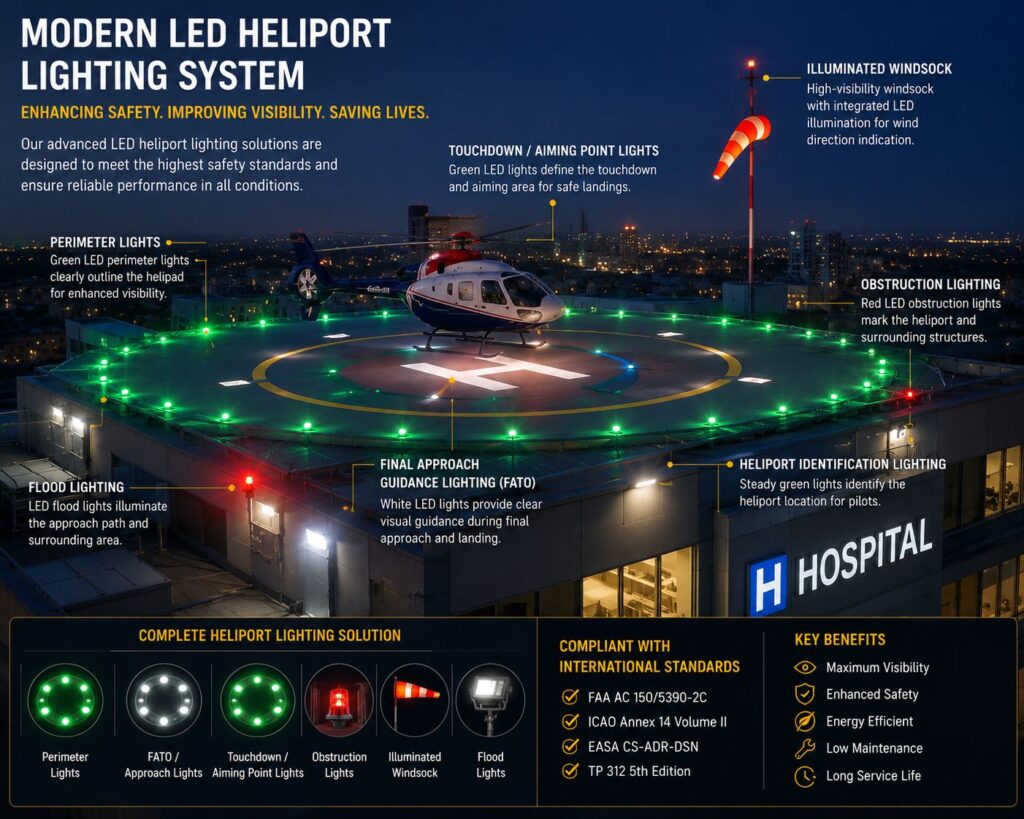
Modern heliport lighting systems utilize LED technology to improve visibility, reduce maintenance, and support safe helicopter operations.
Need Heliport Lighting for Your Project?
LED PROS can help identify appropriate perimeter lights, TLOF and FATO lighting, illuminated windsocks, visual guidance equipment, and complete heliport lighting systems based on applicable FAA requirements and your project specifications. Explore LED Heliport Lighting Systems or Request a Quote for help selecting equipment for your project.
Call 1-844-533-7767.
The Evolution of Heliport Lighting
Older heliport lighting systems frequently relied on incandescent fixtures that required regular maintenance and consumed significant amounts of energy.
Modern LED heliport lighting systems provide several advantages:
- Longer operating life
- Reduced energy consumption
- Improved reliability
- Enhanced visibility
- Lower maintenance costs
- Better performance in harsh environments
As a result, LED technology has become the preferred solution for both new heliport construction and retrofit projects.
Understanding design criteria? Review Heliport Lighting Standards for guidance on helicopter landing facility illumination.
Why Heliport Lighting Is Critical
Helicopter pilots often operate in challenging conditions, including:
- Nighttime flights
- Emergency medical transport
- Urban rooftop landings
- Remote landing locations
- Adverse weather conditions
Proper lighting helps pilots quickly identify critical heliport features, including:
- Landing areas
- Touchdown zones
- Perimeter boundaries
- Wind direction indicators
- Obstacle locations
These visual references improve safety during approach, landing, and departure operations.
Looking for reasons to upgrade an existing heliport? This guide explains how modern heliport lighting improves safety, visibility, and operational efficiency.
Key Components of Modern Heliport Lighting Systems
Perimeter lights define the boundaries of the heliport landing area.
Benefits
- Improves landing zone recognition
- Identifies touchdown boundaries
- Enhances pilot orientation
- Supports nighttime operations
Perimeter lighting is often the most recognizable component of a heliport lighting system.
Comparing visual guidance systems? Explore Heliport Perimeter vs Approach Lights to understand the purpose of each lighting type.
Touchdown and Lift-Off Area Lighting (TLOF)
TLOF lighting helps identify the designated helicopter landing surface.
Common Applications
| Facility Type | Typical Application |
|---|---|
| Hospital Heliports | Emergency Medical Flights |
| Commercial Heliports | Corporate Operations |
| Offshore Platforms | Crew Transport |
| Public Safety Facilities | Emergency Response |
Proper TLOF lighting improves pilot confidence during final approach and landing.
Illuminated Windsocks
Windsocks provide critical wind direction and velocity information.
Advantages
- Improved approach planning
- Enhanced situational awareness
- Better operational safety
- Increased visibility during nighttime operations
Illuminated windsocks are particularly important for rooftop hospital heliports and emergency response facilities operating around the clock.
Designing wind indication systems? Review Heliport Windsock Requirements for proper placement and illumination.
Floodlighting
Floodlighting may be used to illuminate specific heliport features and surrounding operational areas.
Common applications include:
- Access routes
- Equipment areas
- Safety zones
- Emergency operations spaces
Properly designed floodlighting helps support ground personnel without creating excessive glare for pilots.
LED Heliport Lighting Advantages
The transition from conventional lighting technologies to LED systems continues to accelerate throughout the aviation industry.
Comparison of LED vs Traditional Lighting
| Feature | LED Heliport Lighting | Traditional Lighting |
| Energy Consumption | Low | Higher |
| Maintenance | Minimal | Frequent |
| Fixture Life | Long | Shorter |
| Reliability | Excellent | Moderate |
| Operating Costs | Lower | Higher |
| Visibility | Consistent | Variable |
LED systems often provide substantial long-term operating cost savings while improving system reliability.
Looking for operational advantages? Read Benefits of Heliport Lights to learn how modern lighting improves helicopter safety.
Rooftop Hospital Heliports
Hospital heliports represent one of the fastest-growing heliport applications.
Typical Requirements
- Reliable perimeter lighting
- Windsock illumination
- Emergency backup power
- Durable fixtures
- Minimal maintenance requirements
Healthcare facilities often require lighting systems capable of supporting continuous operation and emergency medical transport missions.
Common Benefits
- Faster emergency response
- Improved nighttime operations
- Enhanced patient transport capabilities
- Greater operational reliability
Need detailed compliance guidance? Review FAA Heliport Lighting Requirements for rooftop hospital and commercial heliport applications.
Commercial Heliport Applications
Commercial helicopter operators increasingly utilize modern lighting systems to improve safety and efficiency.
Common Facilities
- Corporate campuses
- Industrial facilities
- Energy facilities
- Offshore platforms
- Logistics centers
LED heliport lighting helps reduce maintenance disruptions while supporting safe operational practices.
Focusing on landing zone visibility? Explore Heliport Perimeter Lighting Systems for perimeter lighting best practices.
Emerging Trends in Heliport Lighting
Several trends continue to shape the future of heliport lighting systems.
LED Technology Adoption
LED lighting continues to replace legacy systems due to lower operating costs and improved reliability.
Smart Monitoring Systems
Remote monitoring allows operators to verify lighting performance without onsite inspections.
Solar-Powered Lighting
Solar-powered systems are becoming increasingly attractive for remote heliports and temporary installations.
Enhanced Durability
Modern fixtures are designed to withstand:
- Wind
- Rain
- Snow
- Salt exposure
- Temperature extremes
For coastal and offshore heliport environments where corrosion resistance is an important consideration, the AH-HP-I LED flush heliport inset light is available with an optional marine-treatment configuration for FATO, TLOF, aiming-point, and flight-path applications.
Reduced Maintenance Requirements
Facility owners continue to prioritize systems that reduce service calls and downtime.
Typical Heliport Lighting Components
| Component | Primary Function |
| Perimeter Lights | Define Landing Area |
| TLOF Lights | Identify Touchdown Zone |
| Windsock Lighting | Wind Direction Visibility |
| Floodlighting | Ground Area Illumination |
| Control Systems | Lighting Management |
| Backup Power Systems | Emergency Operation |
Inline Buyer Q&A
Why are LED heliport lights replacing traditional lighting systems?
LED systems offer longer service life, lower maintenance costs, and improved energy efficiency.
What lighting is required on a heliport?
Requirements vary depending on the facility type, operational use, and applicable aviation standards.
Are rooftop hospital heliports different from ground-level heliports?
Yes. Rooftop heliports often require additional considerations related to visibility, obstacle clearance, and facility integration.
Can existing heliports be upgraded to LED lighting?
Many existing heliport lighting systems can be retrofitted or upgraded using modern LED fixtures.
Why is windsock lighting important?
Pilots rely on windsocks to determine wind direction and speed during approach and departure operations.
Specify the Right Heliport Lighting System
Heliport lighting should be selected around the landing-area configuration, applicable FAA requirements, TLOF and FATO boundaries, fixture mounting, power and control requirements, environmental conditions, and required visual guidance.
Send us your available project information—including heliport type, TLOF/FATO dimensions, fixture requirements, quantity, voltage, mounting, controls, and project specifications—and we’ll help identify appropriate perimeter lights, illuminated windsocks, floodlights, touchdown-area lighting, and other heliport lighting equipment.
Request a Quote or call 1-844-533-7767 for heliport lighting and project assistance.
Frequently Asked Questions
What is a heliport lighting system?
A heliport lighting system consists of visual aids that help pilots safely identify and use helicopter landing facilities.
Are LED heliport lights energy efficient?
Yes. LED systems typically consume significantly less energy than traditional lighting technologies.
How long do LED heliport lights last?
Many LED systems provide years of reliable service with minimal maintenance requirements.
Can heliport lighting operate during emergencies?
Most professional heliport systems are designed to support emergency operations and backup power integration.
What is the most important heliport lighting component?
Perimeter lighting is among the most important elements because it clearly defines the landing area for approaching pilots.
Related Heliport Lighting Resources
-
HL-50 LED Heliport Perimeter Inset Light — Review the flush-mounted perimeter fixture for low-profile TLOF and FATO boundary lighting.
- LED Heliport Lighting — Explore the primary heliport lighting category for perimeter lights, approach systems, windsocks, floodlights, controls, and related equipment.
- FAA Heliport Lighting Requirements — Review FAA-focused lighting and visual-aid considerations for hospital, rooftop, commercial, and other helicopter landing facilities.
- Heliport Perimeter vs. Approach Lights — Understand how perimeter and approach lighting perform different functions within the heliport visual-aid system.
- ICAO vs. FAA Heliport Lighting — Compare U.S. FAA and ICAO frameworks when planning heliport visual aids for domestic and international projects.