
Billboards compete for attention every hour of the day, but after sunset their effectiveness depends almost entirely on lighting. Even the most creative advertising can lose its impact if the billboard is unevenly illuminated, washed out, or difficult to read from a distance.
Modern LED billboard lighting systems are designed to deliver consistent illumination across the entire advertising face while minimizing glare, reducing maintenance, and lowering operating costs. Advances in LED technology, optical engineering, and precision fixture design have made it possible to illuminate larger billboard faces more efficiently than ever before.
Whether lighting a roadside billboard, digital sign structure, commercial building graphic, or large promotional display, thoughtful lighting design improves visibility, protects brand presentation, and extends the value of outdoor advertising throughout the night.
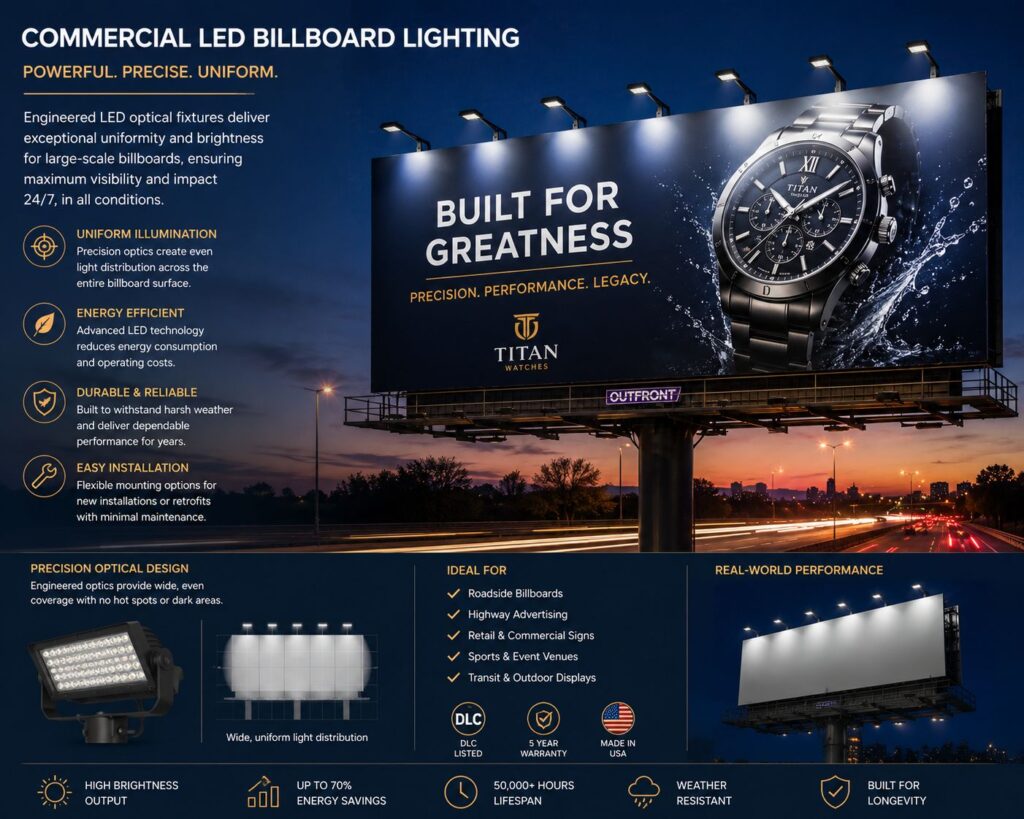
Properly designed commercial LED billboard lighting provides uniform illumination, excellent nighttime visibility, reduced maintenance, and improved advertising effectiveness.
Planning a new billboard lighting installation or upgrading older HID fixtures?
Our lighting specialists help sign companies, billboard owners, municipalities, contractors, and commercial property managers select LED billboard lighting systems that deliver uniform illumination, excellent visibility, energy efficiency, and long-term reliability.
👉 Explore our complete selection of Commercial LED Billboard Lights for roadside billboards, building signage, outdoor advertising displays, and commercial sign lighting.
Commercial Billboard Lighting Design at a Glance
| Design Element | Typical Recommendation |
|---|---|
| Fixture Type | LED Billboard Lights or Asymmetric LED Flood Lights |
| Color Temperature | 4000K–5000K |
| Beam Distribution | Asymmetrical or Billboard-Specific Optics |
| Mounting Location | Top Mount (most common), Bottom Mount (site dependent) |
| Controls | Photocells • Time Clocks • Smart Lighting Controls |
| Primary Objectives | Uniform Illumination • Visibility • Energy Efficiency • Low Maintenance |
Once you understand billboard lighting design principles, the next step is selecting the right equipment. Read our How to Choose Commercial LED Billboard Lighting guide to compare fixture styles, beam patterns, warranties, and commercial specifications.
Start with the Viewing Distance
Unlike parking lots or pedestrian pathways, billboards are designed to communicate with drivers and passengers who may only have a few seconds to absorb the message.
Lighting design should consider:
- Vehicle travel speed
- Driver viewing angle
- Road geometry
- Billboard size
- Mounting height
- Nearby ambient lighting
- Competing illuminated signs
The objective is to create a billboard that is easy to read from a distance without distracting motorists or creating unnecessary glare.
After designing the lighting system, discover how proper illumination enhances advertising effectiveness in our How Proper Billboard Lighting Improves Advertising Visibility guide.
Uniform Illumination Is More Important Than Maximum Brightness
One of the most common misconceptions is that brighter lighting automatically creates a more effective billboard.
In reality, uniformity is often more important than raw light output.
A well-designed lighting system should:
- Eliminate dark areas
- Reduce bright “hot spots”
- Maintain consistent brightness from edge to edge
- Preserve image contrast
- Improve readability
- Accurately reproduce colors
Modern LED billboard fixtures use precision optics to distribute light evenly across the sign face, creating a professional appearance while maximizing advertising impact. Billboard-specific luminaires commonly use asymmetric beam patterns engineered to illuminate wide vertical surfaces efficiently.
Successful lighting begins with meeting applicable standards and recommendations. Our Billboard Lighting Requirements guide explains key considerations for compliance, illumination levels, and outdoor advertising installations.
Select the Proper Mounting Configuration
Fixture location has a major influence on overall lighting performance.
Top-Mounted Fixtures
Top-mounted installations are the most common configuration for commercial billboards.
Advantages include:
- Uniform downward illumination
- Reduced accumulation of dirt on fixture lenses
- Simplified maintenance access
- Better control of beam distribution
- Improved long-distance visibility
Bottom-Mounted Fixtures
Bottom-mounted systems are sometimes used when structural limitations prevent top installation.
They may be appropriate for:
- Wall-mounted signs
- Smaller advertising panels
- Certain architectural signage
- Existing retrofit projects
Proper aiming is essential to prevent glare while maintaining consistent illumination across the sign surface.
Choose the Right Optical Distribution
The optical system—not simply the LED output—determines how effectively a billboard is illuminated.
Commercial billboard fixtures commonly utilize asymmetrical optics that project light across the vertical face of the sign rather than wasting light into the sky or surrounding areas.
The proper beam distribution helps:
- Improve lighting uniformity
- Reduce spill light
- Increase advertising visibility
- Preserve image contrast
- Minimize driver glare
Selecting the correct optical package often has a greater impact on lighting quality than increasing fixture wattage alone.
Choose an Appropriate Color Temperature
Color temperature influences how advertising graphics appear after dark.
Most commercial billboard installations use:
| Color Temperature | Typical Application |
|---|---|
| 4000K | General commercial advertising, retail corridors, mixed-use environments |
| 5000K | Highway billboards, high-visibility advertising, locations with strong ambient lighting |
Both options provide excellent visibility, but the final selection should complement the artwork, surrounding environment, and local lighting conditions.
Consider the Entire Viewing Experience
Successful billboard lighting is about more than illuminating a sign—it is about presenting the advertisement clearly and professionally.
A well-designed lighting system should:
- Highlight graphics without creating glare.
- Preserve accurate color reproduction.
- Maintain consistent brightness across the display.
- Minimize light trespass onto adjacent properties.
- Operate reliably in harsh outdoor environments.
When these design principles are combined with high-quality LED fixtures, billboard owners can maximize the effectiveness of their advertising while reducing energy and maintenance costs.
Still operating older HID billboard fixtures? Our LED vs. Metal Halide Billboard Lighting comparison explains how LED technology improves efficiency, reduces maintenance, and delivers superior lighting performance over the life of the system.
Proper Fixture Spacing and Aiming
Even the highest-quality LED billboard fixtures cannot produce professional results if they are improperly spaced or aimed.
The objective is to create smooth, uniform illumination across the entire billboard face without excessive overlap or noticeable dark areas.
Proper fixture spacing depends on several factors:
- Billboard dimensions
- Fixture output
- Optical distribution
- Mounting height
- Fixture setback distance
- Local ambient lighting
Once installed, fixtures should be carefully aimed to:
- Eliminate dark corners
- Minimize bright hot spots
- Reduce spill light
- Improve overall uniformity
- Prevent glare toward motorists
On larger billboard faces, using multiple lower-wattage fixtures often produces more even illumination than relying on a few high-output luminaires.
After upgrading to modern LED billboard lighting, establish a maintenance program to maximize performance and service life. Our Commercial Billboard Lighting Maintenance Guide provides practical inspection and preventive maintenance recommendations.
Structural Considerations and Wind Loading
Outdoor billboard lighting systems operate in demanding environments where fixtures are exposed to:
- High winds
- Heavy rain
- Snow and ice
- UV exposure
- Extreme temperatures
- Coastal salt air
- Roadway contaminants
When specifying billboard lighting, engineers should consider:
- Fixture weight
- EPA (Effective Projected Area)
- Wind loading
- Mounting brackets
- Structural integrity of extension arms
- Corrosion resistance
- Vibration resistance
Large billboard structures located along highways or in coastal regions may require additional engineering review to ensure lighting systems comply with local building codes and wind-load requirements.
Reduce Operating Costs with Smart Controls
Billboard lighting typically operates every night, making energy management an important part of long-term operating costs.
Modern control options include:
- Photocells
- Astronomical time clocks
- Smart scheduling
- Wireless lighting controls
- Remote monitoring
- Dimming controls
These systems automatically operate lighting only when needed, reducing unnecessary energy consumption while extending fixture life.
For billboard owners managing multiple locations, centralized lighting controls simplify maintenance and improve operational efficiency across an entire advertising network.
Commercial Product Specifications
Commercial billboard lighting should be evaluated on more than wattage alone.
High-quality fixtures often include specification-grade features that improve reliability and simplify maintenance.
| Specification | Typical Benefit |
|---|---|
| UL or ETL Listed | Electrical safety certification |
| DLC Listed | Performance verification and potential utility rebate eligibility |
| IP66 Weather Rating | Protection from dust, rain, and harsh outdoor environments |
| 10kV–20kV Surge Protection | Protection against lightning and electrical surges |
| Marine-Grade Powder Coat | Superior corrosion resistance in coastal and humid climates |
| Premium LED Drivers | Longer service life and improved electrical reliability |
| Field-Serviceable Components | Simplified maintenance and lower lifecycle costs |
| Photocell Compatibility | Automatic dusk-to-dawn operation |
Projects located near coastal environments, marine terminals, or regions with high humidity often specify marine-grade finishes to help protect fixtures from corrosion and extend service life.
LED Technology Reduces Maintenance
One of the greatest advantages of LED billboard lighting is the significant reduction in ongoing maintenance.
Compared to older metal halide or high-pressure sodium systems, commercial LED fixtures provide:
- Longer operating life
- Fewer lamp replacements
- No ballast maintenance
- Consistent light output
- Improved color stability
- Lower energy consumption
- Faster return on investment
Many commercial-grade LED billboard fixtures are designed for service lives approaching 100,000 hours, dramatically reducing maintenance visits and operating expenses.
Common Billboard Lighting Design Mistakes
Even quality fixtures can produce disappointing results if the lighting system is poorly designed.
Avoid these common mistakes:
- Selecting fixtures with the wrong optical distribution.
- Using excessive wattage instead of improving fixture placement.
- Uneven fixture spacing that creates hot spots or dark areas.
- Improper aiming that causes glare toward motorists.
- Ignoring wind-loading requirements for mounting brackets.
- Mixing different color temperatures on the same billboard.
- Choosing fixtures without adequate surge protection.
- Failing to consider long-term maintenance access.
- Overlooking local sign ordinances or lighting regulations.
Thoughtful planning almost always delivers better advertising performance than simply installing brighter fixtures.
Commercial Billboard Lighting Buyer's Checklist
Before selecting a lighting system, confirm the following:
| Buyer’s Question | Why It Matters |
|---|---|
| Is the fixture designed specifically for billboard illumination? | Improves optical performance |
| Does the optical distribution provide uniform coverage? | Eliminates hot spots and shadows |
| Is the mounting location appropriate for the billboard structure? | Maximizes lighting efficiency |
| Are weather resistance and corrosion protection adequate? | Improves long-term reliability |
| Does the fixture support photocells or smart controls? | Reduces operating costs |
| Is the warranty appropriate for a commercial installation? | Protects long-term investment |
| Are maintenance requirements minimized? | Lowers lifecycle costs |
Inline Buyer Q&A
Inline Buyer Q&A
Is brighter always better for billboard lighting?
No. Uniform illumination and controlled light distribution are generally more important than simply maximizing fixture output. Excessive brightness can create hot spots, glare, wasted light, and unnecessary energy consumption without improving the presentation of the advertisement.
The objective is consistent illumination across the billboard face so graphics, text, and branding remain clearly visible after dark.
Should billboard fixtures always be mounted above the sign?
No. Fixture position should be determined by the billboard structure, dimensions, mounting locations, optical distribution, aiming requirements, maintenance access, and applicable outdoor-lighting requirements.
Top- and bottom-mounted configurations can both be used when the fixture optics and installation geometry are appropriate for the sign.
How can I improve lighting uniformity across a billboard?
Start with fixtures that provide optical distributions appropriate for illuminating large vertical surfaces. Mounting distance, fixture spacing, aiming angle, billboard dimensions, and lumen output should then be coordinated so adjacent beams overlap appropriately without creating excessive bright or dark areas.
For larger installations, photometric modeling can help evaluate predicted illumination before fixtures are installed.
Should billboard lighting use photocells or timers?
Lighting controls can reduce unnecessary operating hours and energy consumption. Photocells can activate lighting based on ambient light levels, while timers and programmable controls can limit operation to designated nighttime periods.
The appropriate operating schedule should consider advertising requirements, traffic patterns, local ordinances, and property restrictions.
How long do commercial LED billboard fixtures typically last?
Commercial LED billboard fixtures can provide long operating life, often measured in tens of thousands of hours. Some products may carry substantially higher published lifetime ratings, but actual service life depends on driver quality, thermal management, electrical conditions, operating hours, environmental exposure, fixture construction, and maintenance.
Ready to Maximize Your Billboard Lighting Performance?
Effective billboard lighting depends on more than fixture wattage. Proper optical distribution, mounting location, aiming, uniformity, color quality, controls, and commercial-grade fixture construction all contribute to how effectively an advertisement is presented after dark.
Whether you’re improving an existing roadside billboard, retrofitting older HID fixtures, or planning lighting for a new advertising display, our lighting specialists can help evaluate fixture output, mounting configuration, optics, controls, and project requirements.
👉 Explore our Commercial LED Billboard Lights or call 1-844-533-7767 to discuss your billboard lighting project.
Frequently Asked Questions
Can existing billboard structures be retrofitted with LED lighting?
Often, yes. Existing billboard structures may be candidates for LED retrofit projects, but mounting arms, electrical systems, voltage, wiring, fixture weight, aiming requirements, structural condition, and applicable requirements should be evaluated before existing infrastructure is reused.
What color temperature works best for billboard lighting?
4000K and 5000K are commonly available for commercial outdoor lighting, but there is no single color temperature that is best for every billboard. Selection should consider advertising graphics, color appearance, surrounding ambient light, location, visual objectives, and applicable outdoor-lighting requirements.
Can LED billboard lighting qualify for utility rebates?
Possibly. Some commercial LED lighting projects may qualify for incentives when the selected equipment and project meet the requirements of the applicable utility or energy-efficiency program.
Rebate eligibility, qualifying product requirements, incentive amounts, and program availability vary by utility and location and should be verified before purchasing equipment.
How can billboard lighting reduce operating costs?
LED fixtures can reduce energy consumption compared with many older HID systems, while longer service intervals can reduce maintenance requirements. Photocells, timers, scheduling, and appropriately sized fixtures can provide additional savings by limiting unnecessary wattage and operating hours.
When should a billboard lighting layout be evaluated?
A lighting evaluation is particularly useful for large billboards, unusual mounting configurations, retrofit projects, signs with difficult setback distances, or installations subject to illumination or spill-light requirements. Reviewing fixture placement and predicted light distribution before installation can help identify potential uniformity or aiming problems.
Stay Connected with Our Lighting Resources
Add IndustrialLightingFixtures.org as a Preferred Source on Google to see more of our lighting guides and technical resources across Google Search experiences.

Related Commercial Billboard Lighting Resources
Continue optimizing your billboard lighting system with these resources covering fixtures, lighting requirements, illumination levels, mounting, and LED retrofit decisions:
- Commercial LED Billboard Lights — Explore commercial LED fixtures designed for billboards, advertising displays, large signs, and other exterior sign-lighting applications.
- Billboard Lighting Requirements — Review important considerations involving illumination, fixture placement, glare, spill light, operating conditions, and outdoor-lighting requirements.
- Billboard Lighting Foot-Candle Requirements — Learn how illumination levels and uniformity influence nighttime billboard visibility and lighting-system design.
- Billboard Lighting Mounting Heights — Understand how mounting position, distance, aiming, billboard dimensions, and fixture optics influence light distribution across the advertising surface.
- LED vs. Metal Halide Billboard Lighting — Compare LED and traditional metal halide billboard systems in terms of energy consumption, maintenance, fixture performance, and retrofit considerations.