
A professionally illuminated billboard does much more than make advertising visible after dark. Proper lighting preserves brand identity, improves readability, reduces maintenance costs, and helps maximize the return on every advertising dollar.
Modern commercial LED billboard lighting combines precision optics, intelligent controls, durable construction, and thoughtful installation practices to create consistent illumination across the entire billboard face. However, even the highest-quality fixtures cannot deliver their full potential without proper planning, installation, aiming, and ongoing maintenance.
Whether you’re installing lighting for a new billboard or upgrading an existing advertising structure, following proven best practices helps ensure reliable performance for many years.
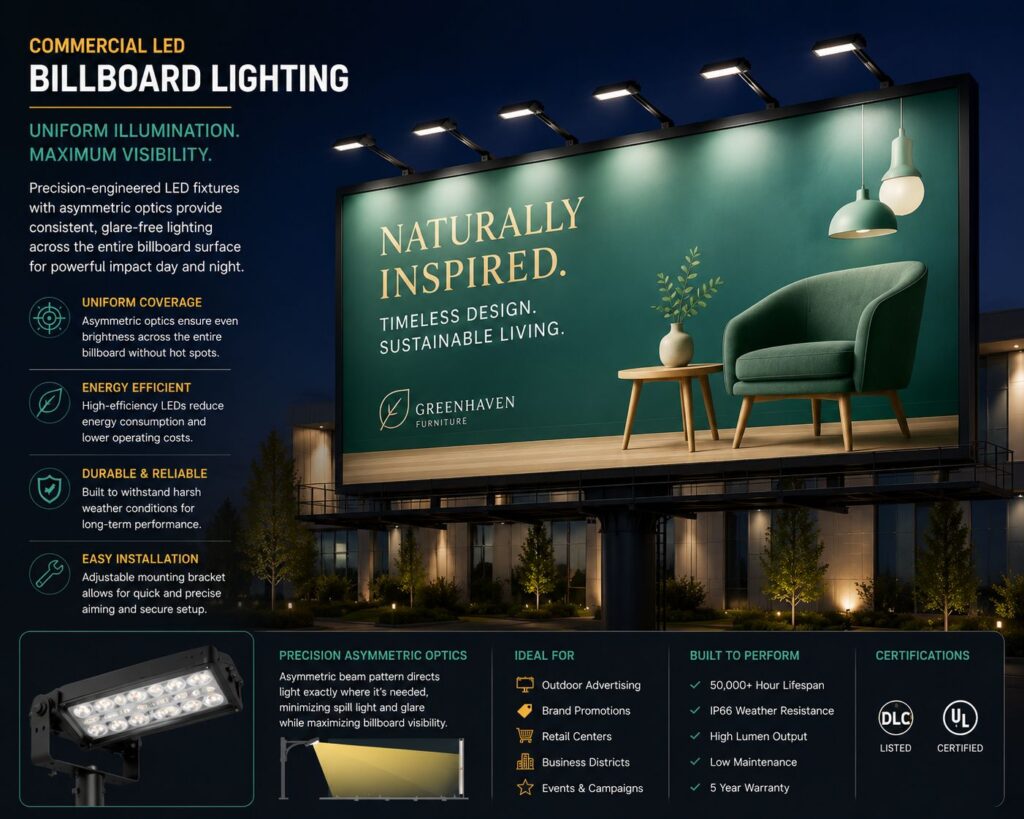
Following commercial billboard lighting best practices improves illumination uniformity, advertising visibility, energy efficiency, and long-term system performance.
Planning a billboard lighting installation or modernization project?
Our lighting specialists work with billboard companies, sign contractors, municipalities, and commercial property owners to specify LED billboard lighting systems that deliver exceptional visibility, energy efficiency, and long-term reliability.
👉 Explore our complete collection of Commercial LED Billboard Lights engineered for professional outdoor advertising applications.
Professional Installation Checklist
| Best Practice | Why It Matters |
|---|
| Select billboard-specific fixtures | Improves optical performance |
| Use precision asymmetric optics | Produces uniform illumination |
| Choose proper mounting locations | Maximizes light distribution |
| Aim fixtures carefully | Reduces glare and hot spots |
| Verify illumination uniformity | Improves readability |
| Install surge protection | Protects electronic components |
| Use automatic controls | Reduces operating costs |
| Schedule periodic inspections | Extends system life |
Start with Fixtures Designed for Billboards
One of the most common mistakes is selecting general-purpose flood lights instead of luminaires specifically engineered for billboard illumination.
Purpose-built commercial billboard fixtures utilize precision asymmetric optics that direct light across the vertical advertising surface while minimizing wasted light.
Compared to general flood lights, dedicated billboard fixtures typically provide:
Better illumination uniformity
Reduced spill light
Improved driver visibility
Greater energy efficiency
Better long-term advertising performance
Our Commercial LED Billboard Lighting Buyer’s Guide explains how to compare fixture types, warranties, optics, and commercial specifications.
Choose the Proper Mounting Method
Professional installations begin with selecting the appropriate fixture location.
Most billboard lighting systems utilize top-mounted (downlighting) fixtures because they provide:
Better optical control
Lower driver glare
More uniform illumination
Reduced light trespass
Easier beam control
Bottom-mounted (uplighting) systems remain valuable when structural conditions prevent overhead mounting or when illuminating architectural signs and monument displays.
Proper mounting is just as important as selecting the fixture itself.
For detailed recommendations, see our Billboard Lighting Mounting Heights Guide.
Aim Fixtures for Uniform Illumination
Proper fixture aiming separates professional billboard lighting from average installations.
The objective is not maximum brightness but consistent illumination across the entire advertising surface.
Professional aiming helps:
- Eliminate hot spots
- Reduce shadows
- Improve readability
- Minimize glare
- Preserve image contrast
- Improve overall presentation
Multiple properly aimed fixtures often outperform fewer high-output luminaires.
Use Precision Optics Instead of More Wattage
Increasing fixture wattage is not always the best solution.
Modern billboard luminaires use precision asymmetric optics that distribute light where it contributes most to advertising visibility.
Benefits include:
Improved efficiency
Better edge-to-edge coverage
Reduced light spill
Lower glare
Better contrast
Reduced operating costs
Optical design frequently has a greater impact on lighting quality than increasing lumen output.
For a closer look at the technology behind modern billboard fixtures, read our How Commercial LED Billboard Lighting Works guide.
Maintain Consistent Illumination Levels
Professional billboard lighting emphasizes consistency.
Rather than chasing the highest foot-candle values, successful installations focus on maintaining balanced illumination across the entire billboard face.
Uniform lighting:
Improves readability
Preserves graphic quality
Enhances brand presentation
Creates a more professional appearance
Maximizes advertising effectiveness
For recommended illumination targets, visit our Billboard Lighting Foot-Candle Requirements Guide.
Follow Electrical Best Practices
Reliable billboard lighting begins with proper electrical design.
Commercial installations should use electrical components that match the operating environment and expected service life of the lighting system.
Best practices include:
- Selecting the proper input voltage (120–277V or 277–480V)
- Installing properly sized branch circuits
- Using weatherproof electrical connections
- Providing disconnects where required
- Utilizing NEMA photocell receptacles when automatic controls are specified
- Installing integrated surge protection
- Following all applicable electrical codes
Proper electrical installation not only improves reliability but also simplifies future maintenance and fixture replacement.
Use Smart Controls to Reduce Operating Costs
Professional billboard lighting should operate only when necessary.
Today’s commercial lighting systems commonly incorporate intelligent controls that improve efficiency while maintaining consistent nighttime visibility.
Popular control options include:
- Photocells
- Astronomical time clocks
- Programmable schedules
- Wireless lighting controls
- Remote monitoring
- Centralized lighting management
For billboard owners with multiple locations, remote monitoring systems can quickly identify outages, allowing maintenance crews to respond before advertisers notice a problem.
Design for the Environment
Every billboard installation operates under different environmental conditions.
Professional lighting designers evaluate site conditions before selecting fixtures.
Considerations include:
- Coastal salt air
- Heavy rainfall
- Snow and ice
- High winds
- Desert temperatures
- Dust
- Industrial pollution
- UV exposure
Billboards located near oceans, ports, or coastal highways often benefit from marine-grade powder-coated finishes, stainless steel hardware, and enhanced corrosion protection to maximize fixture life.
Likewise, installations in high-wind regions should consider fixture EPA (Effective Projected Area), mounting arm strength, and structural loading to ensure long-term stability.
Plan for Long-Term Maintenance
The most successful billboard lighting projects are designed with maintenance in mind.
Routine inspections help preserve lighting quality while preventing unexpected failures.
Recommended maintenance includes:
- Cleaning fixture lenses
- Inspecting mounting hardware
- Checking electrical connections
- Verifying fixture aiming
- Testing photocells and controls
- Inspecting surge protection devices
- Looking for corrosion or water intrusion
Preventive maintenance helps maintain consistent illumination while extending the service life of the lighting system.
A professionally installed lighting system will continue to perform at its best when supported by routine inspections and preventive maintenance. Continue with our Commercial Billboard Lighting Maintenance Guide to learn how to protect your investment and extend fixture life.
Think Beyond Initial Cost
The lowest purchase price does not always represent the lowest lifetime cost.
Professional buyers evaluate the total cost of ownership, considering:
- Fixture efficiency
- LED driver quality
- Optical performance
- Warranty coverage
- Maintenance requirements
- Energy consumption
- Expected service life
- Replacement component availability
Higher-quality commercial fixtures often provide better long-term value by reducing maintenance visits, minimizing downtime, and lowering operating expenses over many years.
Common Installation Errors
Even experienced installers can overlook details that affect billboard performance.
Avoid these common mistakes:
- Using standard flood lights instead of billboard-specific luminaires
- Selecting excessive wattage instead of improving optical distribution
- Improper fixture aiming
- Uneven fixture spacing
- Mixing color temperatures
- Ignoring Color Rendering Index (CRI)
- Omitting surge protection
- Failing to account for wind loading
- Neglecting future maintenance access
- Choosing fixtures based solely on purchase price
Following professional installation practices helps ensure the lighting system performs as intended from the first night of operation
Commercial Billboard Lighting Best Practices Checklist
Before completing a project, verify the following:
| Best Practice | Benefit |
|---|---|
| Billboard-specific luminaires selected | Better optical performance |
| Precision asymmetric optics specified | Uniform illumination |
| Proper mounting method chosen | Reduced glare and improved coverage |
| Fixture aiming verified | Eliminates hot spots and shadows |
| Illumination uniformity confirmed | Better advertising readability |
| Surge protection installed | Improved electrical reliability |
| Automatic lighting controls configured | Lower operating costs |
| Maintenance plan established | Longer fixture life |
Inline Buyer Q&A
What is the most important factor in billboard lighting?
Uniform illumination across the advertising surface is generally more useful than simply maximizing brightness.
A properly designed system should provide sufficient illumination for the graphics while limiting distracting bright spots, dark areas, glare, and unnecessary spill light.
Should billboard lights be mounted above or below the sign?
Either arrangement can be appropriate.
Top-mounted fixtures direct light downward across the billboard face, while bottom-mounted fixtures illuminate upward. The best configuration depends on billboard dimensions, structure, existing mounting locations, fixture optics, setback distance, maintenance access, surrounding properties, and applicable lighting requirements.
The mounting position should be evaluated together with the luminaire’s optical distribution rather than assuming one arrangement is appropriate for every billboard.
Why choose billboard-specific fixtures instead of general-purpose floodlights?
Billboard-specific LED luminaires can use optical distributions designed to project light across large vertical advertising surfaces.
Properly selected optics can improve uniformity and direct more useful light toward the billboard face while reducing wasted light compared with a general-purpose fixture that is not well matched to the application.
How many LED fixtures does a billboard require?
Fixture quantity depends on billboard dimensions, fixture output, optical distribution, mounting position, setback distance, aiming, and required illumination.
Larger signs do not simply require proportionally higher wattage. Fixture placement and optics strongly influence how evenly the billboard surface is illuminated.
Should billboard lighting be evaluated with a photometric layout?
For larger commercial billboards or projects where uniformity, glare, spill light, or specific illumination criteria are important, photometric analysis can help evaluate the proposed lighting system before installation.
A layout can model fixture locations, mounting positions, aiming, predicted illumination across the billboard face, and areas where excessive or insufficient light may occur.
Professional Installation Creates Professional Results
Effective billboard lighting depends on coordinated fixture selection, mounting position, optical distribution, aiming, electrical design, controls, and maintenance.
Rather than simply increasing fixture wattage, the objective should be to deliver useful, reasonably uniform illumination across the advertising surface while controlling glare and unnecessary light beyond the sign.
Ready to Build a Better Billboard Lighting System?
Whether you’re illuminating a new outdoor advertising structure, modernizing an existing billboard, or replacing older HID equipment, our lighting specialists can help evaluate billboard dimensions, mounting locations, fixture output, optics, controls, and lighting-layout requirements.
Explore our Commercial LED Billboard Lights or call 1-844-533-7767 to discuss your billboard lighting project.
Frequently Asked Questions
How often should billboard lighting be inspected?
Inspection frequency depends on the installation, operating environment, equipment, and maintenance program.
Periodic inspections can include checking fixture aiming and mounting hardware, cleaning lenses when necessary, examining electrical components and wiring, and verifying that photocells, timers, or other controls continue operating as intended.
Can older billboard lighting systems be upgraded to LED?
Yes. Many existing billboard structures can be retrofitted with LED luminaires.
Existing mounting locations, wiring, electrical service, brackets, controls, and structural components should be evaluated before determining what equipment can be reused.
A retrofit is also an opportunity to reconsider fixture quantity, optics, mounting position, and aiming rather than automatically duplicating the original lighting configuration.
What is the expected lifespan of commercial LED billboard lighting?
Commercial LED billboard fixtures can provide long operating life, commonly measured in tens of thousands of hours. Published lifetime ratings vary by product and manufacturer.
Actual service life depends on LED and driver quality, thermal management, operating schedule, ambient temperature, electrical conditions, surge exposure, moisture, environmental conditions, and maintenance.
What color temperature should be used for billboard lighting?
There is no single color temperature appropriate for every billboard.
Selection can depend on advertising graphics, desired appearance, surrounding environment, owner preference, fixture availability, and applicable local requirements. Color quality and consistency across fixtures can also be important when illuminating large advertising surfaces.
Should billboard lights use photocells or timers?
Automatic controls can help ensure billboard lighting operates only during intended nighttime hours.
Depending on the installation, photocells, astronomical time clocks, scheduling controls, dimming, or other control strategies may be appropriate. Local operating restrictions or lighting requirements should also be considered.
How can billboard lighting reduce glare and light spill?
Fixture optics, mounting position, setback distance, aiming, output, shielding, and the relationship between the fixture and billboard surface all influence where the light is directed.
Properly designed billboard lighting should concentrate useful illumination on the sign while limiting unnecessary light above, behind, or beyond the intended advertising surface.
Stay Connected with Our Lighting Resources
Add IndustrialLightingFixtures.org as a Preferred Source on Google to see more of our lighting guides and technical resources across Google Search experiences.
Related Billboard Lighting Resources
- Commercial LED Billboard Lights — Explore commercial LED fixtures and optical solutions designed specifically for illuminating outdoor billboard and advertising surfaces.
- Billboard Lighting Requirements — Review the illumination, uniformity, glare, operating, and site considerations that can influence commercial billboard lighting projects.
- Billboard Lighting Foot-Candle Requirements — Learn how measured illumination and uniformity across the billboard face can be evaluated when designing a lighting system.
- Billboard Lighting Mounting Heights — Explore how mounting position, setback, billboard dimensions, fixture optics, and aiming influence billboard illumination.
- LED vs. Metal Halide Billboard Lighting — Compare LED and traditional metal halide billboard systems in terms of energy use, maintenance, optical control, and retrofit considerations.