
Installing commercial LED billboard lighting is only the beginning of the system’s lifecycle. While modern LED fixtures require significantly less maintenance than traditional metal halide systems, routine inspections and preventive care remain essential for preserving illumination quality, maximizing equipment life, and protecting advertising investments.
Dust, weather, vibration, electrical surges, and normal environmental exposure can gradually affect lighting performance over time. Establishing a proactive maintenance program helps billboard owners maintain consistent visibility, minimize unexpected outages, and reduce long-term operating costs.
Whether managing a single billboard or an entire advertising network, regular maintenance ensures outdoor advertising continues to perform reliably every night of the year.
Routine maintenance helps preserve the energy-saving benefits of LED lighting. Learn how efficient fixtures reduce operating costs in our Billboard Lighting Energy Savings guide.
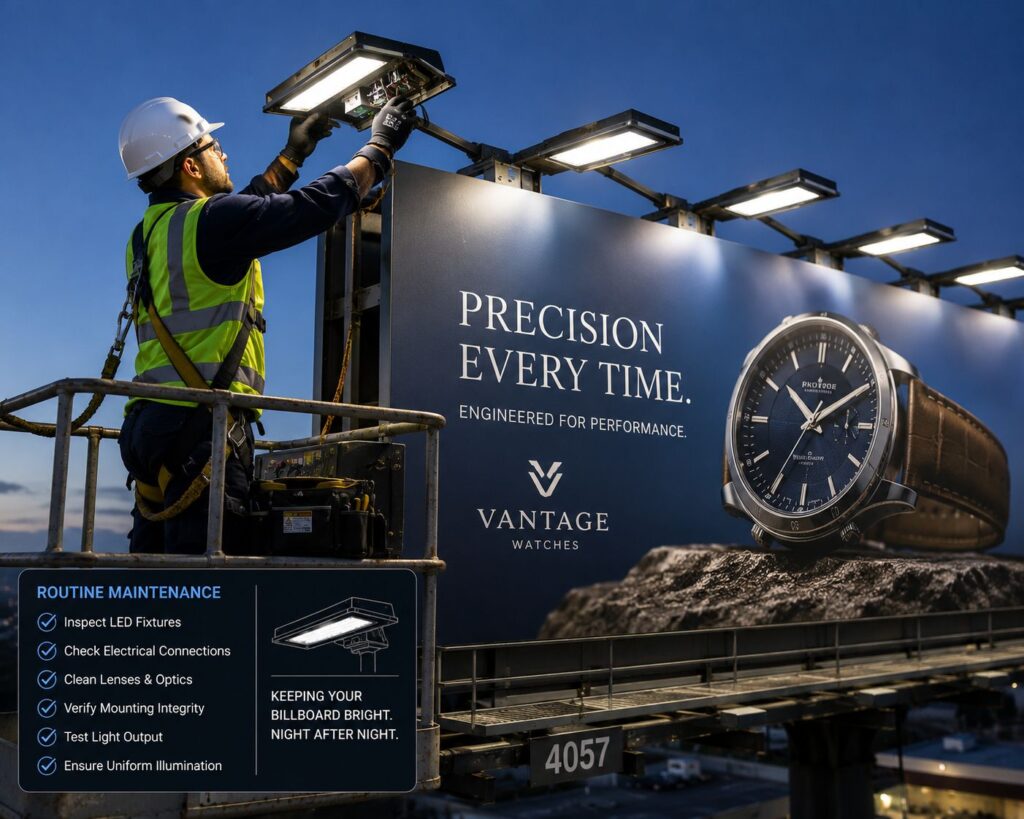
Routine inspection and preventive maintenance help commercial LED billboard lighting deliver reliable performance, uniform illumination, and long service life.
Need reliable commercial billboard lighting designed for long service life and minimal maintenance?
Our lighting specialists help billboard companies, municipalities, contractors, and commercial property owners select specification-grade LED billboard lighting systems that provide dependable performance, superior optical control, and reduced maintenance costs.
👉 Explore our complete selection of Commercial LED Billboard Lights engineered for professional outdoor advertising applications.
Commercial Billboard Maintenance at a Glance
| Maintenance Task | Recommended Frequency |
|---|---|
| Visual Inspection | Monthly |
| Lens Cleaning | Every 3–6 Months (or as needed) |
| Fixture Aiming Verification | Semi-Annually |
| Hardware Inspection | Semi-Annually |
| Electrical Inspection | Annually |
| Surge Protection Check | Annually |
| Photocell & Controls Testing | Annually |
| Comprehensive System Review | Every 2–3 Years |
Maintenance frequency should be adjusted for coastal environments, high-pollution areas, regions with frequent storms, or locations exposed to heavy dust and road contaminants.
Understanding the technology inside your fixture makes troubleshooting and maintenance easier. Read our How Commercial LED Billboard Lighting Works guide to learn about drivers, optics, surge protection, and thermal management.
Establish a Preventive Maintenance Program
Successful billboard owners rarely wait for a fixture to fail before scheduling service.
Instead, they implement preventive maintenance programs that identify small issues before they become costly repairs.
A preventive maintenance program should include:
- Routine visual inspections
- Scheduled cleaning
- Fixture aiming verification
- Electrical testing
- Hardware inspections
- Control system testing
- Maintenance documentation
Regular inspections reduce unexpected outages while helping maintain consistent advertising visibility.
Before implementing a maintenance program, learn the installation techniques that help reduce future maintenance needs in our Billboard Lighting Best Practices for Professional Installation and Performance guide.
Keep Optical Lenses Clean
Even the most advanced LED billboard fixture cannot perform properly if the optical lens is covered with dirt or debris.
Common contaminants include:
- Road dust
- Pollen
- Airborne pollution
- Salt deposits
- Bird droppings
- Spider webs
- Tree sap
Dirty lenses reduce light output, create uneven illumination, and diminish the overall effectiveness of the billboard.
Cleaning should always follow the manufacturer’s recommendations using non-abrasive materials and approved cleaning solutions.
Verify Fixture Aiming
Billboard lighting is designed to produce uniform illumination across a large vertical surface.
Over time, fixtures may gradually shift due to:
- High winds
- Vibration
- Maintenance activity
- Hardware loosening
- Severe weather events
Even slight changes in aiming can create:
- Bright hot spots
- Dark corners
- Increased glare
- Uneven lighting
- Reduced readability
Periodic verification ensures the lighting system continues to perform as originally designed.
Inspect Mounting Hardware
The structural components supporting billboard lighting deserve the same attention as the fixtures themselves.
Inspect:
- Mounting brackets
- Extension arms
- Bolts
- Lock washers
- Structural connections
- Welds
- Pole attachments
Look for signs of:
- Corrosion
- Metal fatigue
- Loose hardware
- Cracking
- Excessive movement
Billboards located in high-wind regions should receive more frequent structural inspections.
Inspect Electrical Components
Although LED billboard fixtures require significantly less maintenance than traditional HID lighting systems, their electrical components should still be inspected on a routine basis.
Annual inspections should include:
- LED drivers
- Electrical connections
- Conduit fittings
- Junction boxes
- Disconnect switches
- Grounding conductors
- Wiring insulation
- Moisture seals
Loose connections or deteriorated wiring can reduce fixture performance, create intermittent outages, or lead to premature component failures.
Routine electrical inspections help ensure safe operation while extending the overall life of the lighting system.
Check Surge Protection Devices
Outdoor billboard structures are particularly vulnerable to electrical surges caused by lightning strikes and utility power fluctuations.
Commercial billboard fixtures commonly include integrated surge protection, but these devices should be inspected periodically.
Recommended practices include:
- Verify surge protection status indicators (when equipped)
- Inspect surge protection wiring
- Replace damaged surge protection modules
- Confirm proper grounding
- Inspect after major lightning events
Protecting the LED driver and electronic components from surges can significantly reduce downtime and maintenance expenses.
Protect Against Corrosion
Billboard lighting systems installed in coastal or industrial environments require additional attention.
Salt air, humidity, airborne chemicals, and road contaminants can accelerate corrosion.
Preventive measures include:
- Marine-grade powder-coated finishes
- Stainless steel fasteners
- Corrosion-resistant mounting hardware
- Routine washing in coastal environments
- Touch-up of damaged finishes
- Inspection for galvanic corrosion where dissimilar metals meet
Proper corrosion protection helps preserve both the appearance and structural integrity of the lighting system.
Maintain Smart Controls
Modern billboard lighting often incorporates intelligent control systems that improve efficiency and reduce operating costs.
These systems should be tested as part of the regular maintenance program.
Verify proper operation of:
- Photocells
- Astronomical time clocks
- Programmable schedules
- Wireless control systems
- Remote monitoring platforms
- NEMA receptacles
- Lighting management software
Correctly functioning controls ensure the billboard remains illuminated when required while avoiding unnecessary operating hours.
Know When to Repair or Replace
Not every maintenance issue requires replacing the entire fixture.
Many specification-grade billboard luminaires are designed with field-serviceable components that simplify repairs.
Common repair items include:
- LED drivers
- Surge protection devices
- Photocells
- Wiring components
- Gaskets
- Mounting hardware
However, replacement may be the better option when fixtures exhibit:
- Significant corrosion
- Cracked housings
- Yellowed or damaged optical lenses
- Obsolete LED technology
- Declining light output
- Repeated electrical failures
Evaluating lifecycle costs often helps determine whether repair or replacement provides the better long-term value.
Maintain Detailed Service Records
Professional billboard operators maintain maintenance records for every lighting system.
Recommended documentation includes:
- Installation dates
- Fixture model numbers
- Driver specifications
- Warranty information
- Maintenance history
- Cleaning schedules
- Inspection reports
- Repair records
- Surge events
- Component replacements
Detailed records simplify warranty claims, improve budgeting, and support long-term asset management.
Plan for Lifecycle Costs
Successful billboard owners evaluate lighting systems based on total cost of ownership, not simply the initial purchase price.
Lifecycle planning should consider:
- Energy consumption
- Maintenance labor
- Replacement components
- Warranty coverage
- Driver replacement costs
- Cleaning requirements
- Expected fixture lifespan
- Future LED upgrades
Premium commercial fixtures often deliver lower lifecycle costs through improved reliability, better optical performance, and reduced maintenance requirements.
Annual Billboard Lighting Maintenance Checklist
| Inspection Item | Status |
|---|---|
| Clean fixture lenses | ☐ |
| Verify fixture aiming | ☐ |
| Inspect mounting hardware | ☐ |
| Check electrical connections | ☐ |
| Test photocells and controls | ☐ |
| Verify surge protection | ☐ |
| Inspect for corrosion | ☐ |
| Confirm uniform illumination | ☐ |
| Document maintenance performed | ☐ |
A documented annual inspection helps maintain consistent lighting quality while reducing unexpected service interruptions.
Inline Buyer Q&A
Q: Do LED billboard fixtures require regular maintenance?
Yes. Although LED systems require far less maintenance than older HID lighting, periodic inspections, cleaning, and testing help preserve lighting quality, maximize equipment life, and prevent unexpected failures.
Q: How often should billboard lighting be cleaned?
Cleaning frequency depends on the environment. Installations near highways, industrial facilities, coastal regions, or agricultural areas may require more frequent cleaning due to dust, salt, and airborne contaminants.
Q: Can most LED billboard fixtures be repaired?
Many commercial-grade billboard luminaires feature replaceable drivers, surge protection devices, photocells, and electrical components, allowing repairs without replacing the complete fixture.
Routine Maintenance Protects Your Billboard Investment
Commercial LED billboard lighting is designed for exceptional reliability, but like any outdoor infrastructure, it performs best when supported by a proactive maintenance program. Regular inspections, cleaning, electrical testing, and preventive service help maintain uniform illumination, reduce operating costs, extend fixture life, and ensure advertising remains visible night after night.
Ready to Invest in Long-Lasting Commercial Billboard Lighting?
Whether you’re installing a new billboard lighting system or maintaining an existing advertising network, our lighting specialists can help you select commercial LED billboard fixtures engineered for long service life, minimal maintenance, and dependable performance.
Explore our complete selection of Commercial LED Billboard Lights and discover how specification-grade fixtures, precision optics, and durable construction can reduce maintenance while maximizing the performance of your outdoor advertising.
Frequently Asked Questions
Should maintenance schedules differ by location?
Yes. Coastal environments, regions with frequent storms, and areas exposed to heavy dust or industrial pollution typically require more frequent inspections and cleaning.
What is the biggest cause of premature fixture failure?
Electrical surges, poor maintenance, corrosion, and excessive heat are among the leading causes of premature outdoor lighting failures.
How long should commercial LED billboard lighting last?
Many specification-grade LED billboard fixtures are designed for operating lives approaching 100,000 hours, provided they receive proper installation and routine maintenance.