
Aircraft hangars require more than simply high-output overhead lighting. Large open interiors, high mounting heights, aircraft wings and fuselages, maintenance equipment, and detailed inspection work can create challenging lighting conditions that conventional warehouse layouts may not adequately address.
Modern LED aircraft hangar lighting combines high lumen output, controlled optical distribution, improved uniformity, and long operating life to support aircraft maintenance, inspection, storage, and ground operations. Proper fixture selection can also reduce energy consumption and the cost and disruption associated with servicing luminaires mounted high above the hangar floor.
Whether the facility supports commercial aviation, general aviation, MRO operations, FBO services, helicopters, military aircraft, or private aircraft storage, the lighting system should be designed around the aircraft, work being performed, mounting height, and required visibility.
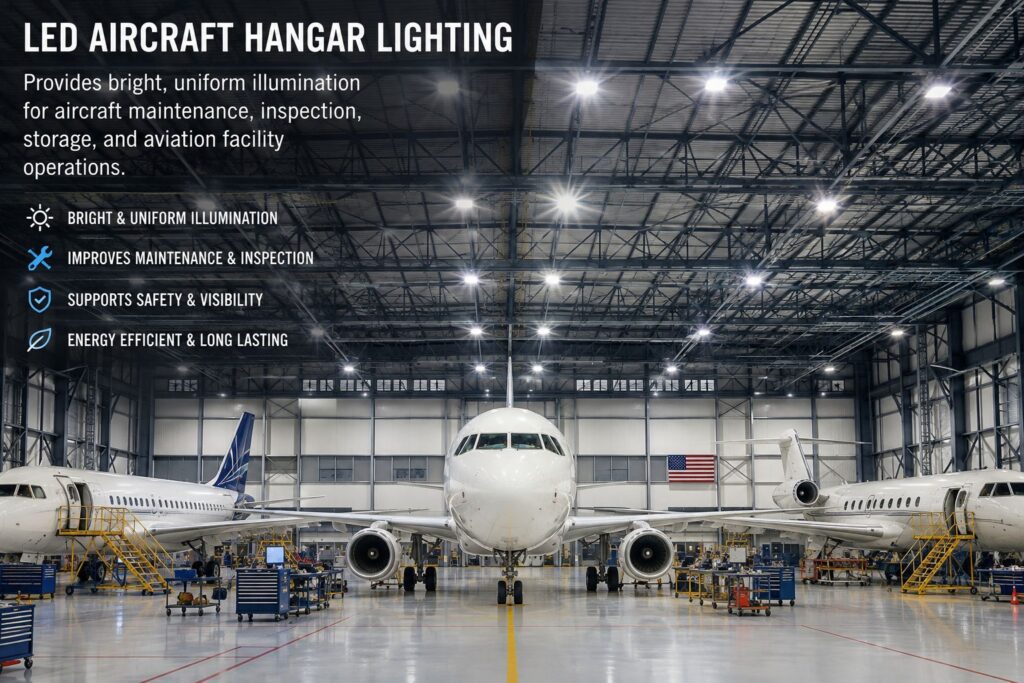
LED aircraft hangar lighting provides bright, uniform illumination for aircraft maintenance, inspection, storage, and aviation facility operations.
👉 Explore our LED High Bay Lighting for high-output lighting solutions for aircraft hangars
and other high-ceiling facilities, or call 1-844-533-7767 to discuss your aviation lighting project.
What Is Aircraft Hangar Lighting?
Aircraft hangar lighting includes the overhead, supplemental, and task lighting systems used to illuminate enclosed aviation facilities where aircraft are stored, inspected, maintained, repaired, or prepared for operation.
High bay LED fixtures commonly provide the primary overhead illumination because hangars typically combine substantial ceiling heights with large unobstructed floor areas. However, designing an effective hangar lighting system involves more than selecting fixtures with sufficient lumen output.
Aircraft themselves become part of the lighting environment.
Wings can block overhead illumination from reaching work areas underneath them. Large fuselages can create significant shadows along the opposite side of an aircraft. Tail assemblies, maintenance stands, lifts, tool carts, and other equipment can create additional areas of reduced visibility.
A successful layout therefore considers both horizontal illumination across the hangar floor and useful illumination around the aircraft and maintenance areas where technicians actually work.
Aircraft hangar lighting is commonly required in:
- Commercial airline maintenance hangars
- MRO (maintenance, repair, and overhaul) facilities
- General aviation hangars
- FBO maintenance and service facilities
- Corporate and private aircraft hangars
- Helicopter maintenance hangars
- Military aviation facilities
- Aircraft storage and service buildings
Why Aircraft Hangars Need Specialized Lighting
Although an aircraft hangar may share some characteristics with a warehouse or manufacturing facility, the presence of large aircraft creates lighting challenges unique to aviation environments.
High Ceilings and Expansive Floor Areas
Hangar luminaires may be mounted well above the working plane and must deliver useful illumination across very large areas.
High-output LED high bays with appropriate optical distributions can provide broad coverage while maintaining the light levels required at floor and maintenance-task height. Fixture output, beam distribution, mounting height, and spacing should be evaluated together rather than selecting fixtures by wattage alone.
Aircraft Create Large Shadow Zones
An empty hangar can appear uniformly illuminated while performing very differently once an aircraft is positioned inside.
Aircraft wings can shade work areas underneath them. Fuselages can obstruct light reaching maintenance areas on the opposite side. Tail sections, platforms, lifts, and other service equipment can further interrupt overhead illumination.
For this reason, hangar lighting layouts should account for expected aircraft positions and maintenance activities rather than relying solely on an empty-floor photometric layout.
Maintenance and Inspection Require Clear Visibility
Aircraft technicians perform visually demanding work, including component inspection, equipment servicing, reading labels and instruments, identifying wiring and connections, and examining aircraft surfaces.
Adequate illumination, good uniformity, controlled glare, and appropriate color rendering can improve visibility for these tasks.
LED lighting with good color quality can also help technicians distinguish markings, wiring, components, fluids, and surface conditions more accurately.
Uniformity Matters Alongside Brightness
More lumens do not automatically create better hangar lighting.
Large differences between bright and dark areas increase visual contrast and can make shadows around aircraft more pronounced. Workers moving between these areas must continually adapt to changing brightness levels.
An effective design balances lumen output, optics, fixture spacing, mounting height, and aircraft positioning to provide more consistent usable illumination throughout the facility.
Long Operating Hours Increase the Value of Efficiency
Busy aviation maintenance facilities may operate for extended hours or around the clock. Lighting can therefore represent a meaningful portion of facility energy consumption.
LED fixtures can substantially reduce electrical demand compared with many legacy HID systems while providing instant full-output illumination. Occupancy sensors, dimming, scheduling, and lighting zones can provide additional savings when individual hangar areas are not continuously occupied.
High-Mounted Fixtures Increase Maintenance Costs
Servicing lighting above an aircraft hangar floor can require lifts, specialized equipment, restricted work areas, and interruption of normal operations.
Long-life LED fixtures reduce routine relamping and can decrease the frequency with which maintenance personnel need to access luminaires at ceiling height.
For large hangars, reducing maintenance at height can be an important lifecycle advantage in addition to energy savings.
Interior and Exterior Aviation Lighting Serve Different Functions
Aircraft hangar lighting primarily addresses visibility inside the facility for maintenance, inspection, storage, and aircraft servicing. Exterior airport and aviation areas have different lighting requirements.
Aprons, aircraft parking areas, cargo ramps, FBO ramps, and other large outdoor airside areas may require elevated exterior lighting systems designed for broad-area coverage.
For those applications, see our Airport High Mast Lighting Guide.
Choosing LED Lighting for an Aircraft Hangar
Aircraft hangar lighting should be selected according to the facility’s operating requirements rather than fixture wattage alone. Ceiling height, aircraft size, maintenance activity, required light levels, fixture spacing, optics, and controls all influence the final design.
A storage hangar and a full-service MRO facility may occupy buildings of similar size but require very different lighting systems.
LED High Bay Lights
LED high bay fixtures are the primary lighting source in many aircraft hangars because they can deliver high lumen output from substantial mounting heights.
Two common configurations are:
Round or UFO LED high bays — Compact fixtures that can provide high output and controlled beam distributions for large open areas.
Linear LED high bays — Longer fixtures that can provide broad light distribution and may be useful where the building geometry, structural layout, or maintenance areas favor a more rectangular lighting pattern.
Neither fixture style is automatically better for every hangar. The appropriate choice depends on mounting height, fixture spacing, structural obstructions, aircraft positioning, and the required distribution of light.
For additional fixture-selection information, see our LED High Bay Lighting Guide.
How Many Foot-Candles Does an Aircraft Hangar Need?
There is no single foot-candle level appropriate for every aircraft hangar.
The amount of illumination required depends heavily on the activity being performed. Aircraft storage and general movement require less light than detailed maintenance, inspection, assembly, or precision work.
Useful planning ranges include:
| Aircraft Hangar Application | Typical Planning Range |
|---|---|
| General aircraft storage and circulation | 30–50 fc |
| General aircraft maintenance | 50–100 fc |
| Detailed maintenance | 75–100 fc |
| Aircraft inspection | 50–200 fc |
| Drilling, riveting and fastening | 75–100 fc |
| Detailed or difficult inspection | Supplemental task lighting may be required |
These values should be treated as design guidance rather than universal requirements. The appropriate maintained illuminance depends on the specific work being performed, applicable standards, facility conditions, and project requirements.
For a broader reference covering commercial and industrial applications, see our Lighting Level Recommendations.
Why Average Foot-Candles Don't Tell the Whole Story
A photometric calculation showing adequate average illumination across an empty floor does not necessarily mean technicians will have adequate light once an aircraft is inside the hangar.
A wing may block overhead illumination from reaching the floor or work area below it. A fuselage can create a large vertical shadow. Maintenance platforms and equipment can further change the lighting environment.
This makes minimum illumination, uniformity, vertical illumination, and shadow control important considerations alongside the average foot-candle value.
Mounting Height, Lumens and Fixture Spacing
Hangar lighting design requires the fixture output and optical distribution to work together.
A higher mounting height generally requires greater fixture output or a more carefully selected optical distribution to deliver useful illumination to the working plane. Lower mounting heights may allow lower-output fixtures but can increase the potential for glare if high-lumen fixtures are placed too close to normal viewing angles.
The basic design variables include:
- Ceiling and fixture mounting height
- Fixture lumen output
- Beam angle and optical distribution
- Distance between fixtures
- Aircraft dimensions and parking positions
- Structural beams and overhead obstructions
- Required maintained foot-candles
- Desired uniformity
- Reflectance of floors, walls, and ceilings
Selecting a fixture solely because it produces a large number of lumens can result in bright areas directly below the luminaires while leaving other portions of the hangar inadequately illuminated.
Narrow vs. Wide Beam Distribution
Optics become increasingly important as mounting heights increase.
A narrower distribution can concentrate more light toward the working plane from high mounting positions, while wider distributions can help spread illumination across larger areas and improve fixture-to-fixture overlap.
The best solution is not necessarily one beam angle throughout the entire building. Large or complex hangars may benefit from different distributions in different zones.
Why a Photometric Lighting Plan Matters
For a substantial aircraft hangar project, fixture count should not be estimated simply by dividing the building’s square footage by a generic fixture-spacing formula.
A photometric lighting plan models how the proposed fixtures distribute illumination throughout the actual space.
The plan can account for:
- Hangar dimensions
- Mounting heights
- Fixture locations
- Fixture lumen packages
- Optical distributions
- Structural obstructions
- Aircraft maintenance zones
- Required foot-candle levels
- Minimum and average illumination
- Lighting uniformity
Where aircraft dimensions and expected parking positions are known, those conditions should also be considered when evaluating areas susceptible to shadowing.
A photometric plan allows the lighting system to be evaluated before fixtures are purchased and installed, reducing the risk of discovering dark areas, excessive brightness, or poor uniformity after installation.
👉 Request a Lighting Layout and Fixture Recommendation or call 1-844-533-7767
to discuss your aircraft hangar dimensions, mounting height, maintenance requirements, and target light levels.
Color Temperature and CRI for Aircraft Hangars
Light quality can be particularly important in aviation maintenance and inspection environments.
Color Temperature
Commercial and industrial aircraft hangars commonly use neutral-to-cool white LED lighting, often in the 4000K to 5000K range.
These color temperatures provide a clean, bright visual environment suitable for maintenance and inspection without relying on the warmer appearance associated with many older lighting technologies.
The appropriate color temperature can also depend on existing lighting, facility preferences, and the specific work being performed.
Color Rendering Index
CRI measures how accurately a light source renders colors.
In an aircraft maintenance environment, accurate color recognition can help personnel distinguish:
- Electrical wiring and color coding
- Labels and safety markings
- Fluids and possible leaks
- Paint and surface finishes
- Components and connectors
- Surface discoloration or abnormalities
For general hangar applications, CRI 80+ is a practical starting point. Facilities performing visually demanding inspection or color-sensitive work may benefit from higher color-rendering performance.
Controlling Glare in Aircraft Maintenance Areas
More light is not always better.
Aircraft surfaces can be highly reflective, and excessive fixture brightness can produce direct or reflected glare. This can reduce visual comfort and make detailed inspection more difficult.
Glare control should therefore be considered when selecting fixture output, optics, lenses, mounting positions, and spacing.
Good hangar lighting seeks a balance:
Enough illumination for the work being performed without creating excessive brightness or uncomfortable visual contrast.
This is another reason uniformity can be more useful than simply maximizing fixture output.
Supplemental and Task Lighting
Overhead high bays should provide the primary illumination, but they cannot eliminate every shadow created by a large aircraft.
Supplemental lighting may be appropriate for:
- Work beneath wings
- Engine and equipment compartments
- Aircraft interiors
- Landing gear areas
- Maintenance platforms
- Detailed inspection
- Portable maintenance operations
Portable LED work lights can provide localized illumination where fixed overhead lighting cannot effectively reach the task.
For these applications, see our LED Portable Work Lights.
The goal is not to compensate for a poor overhead lighting design with portable fixtures everywhere. Instead, facility lighting and task lighting should work together: the overhead system provides consistent general illumination while supplemental lighting supports detailed or obstructed maintenance tasks.
Lighting Controls for Aircraft Hangars
Aircraft hangars are excellent candidates for LED lighting controls because large portions of the building may remain illuminated even when individual work zones are temporarily unoccupied.
Rather than operating every high bay at full output throughout the entire facility, modern LED systems can divide the hangar into controllable lighting zones.
Common control strategies include:
- Occupancy and motion sensors
- Daylight harvesting near hangar doors and windows
- Scheduled lighting
- Fixture-level dimming
- Separate maintenance and storage zones
- Wireless lighting controls
- Building automation system integration
Occupancy-Based Lighting
Aircraft maintenance activity frequently moves from one part of a hangar to another.
Occupancy sensors can reduce lighting output in inactive areas while maintaining required illumination around occupied maintenance zones.
This can be particularly valuable in large facilities where illuminating the entire hangar at full output is unnecessary during portions of the operating day.
Daylight Harvesting
Large hangar doors can introduce substantial natural light when open during daytime operations.
Compatible LED fixtures and controls can reduce artificial lighting output when adequate daylight is available and gradually increase output as exterior light levels decrease or hangar doors close.
The objective is to maintain appropriate illumination without consuming energy to produce light that is not needed.
Energy Savings When Retrofitting Hangar Lighting to LED
Many older aircraft hangars were originally illuminated with metal halide, high-pressure sodium, fluorescent, or other legacy lighting systems.
Replacing these systems with LED technology can reduce lighting energy consumption while improving light distribution, startup performance, and controllability.
The potential savings depend on:
- Existing fixture wattage
- Number of fixtures
- Annual operating hours
- Proposed LED wattage
- Lighting control strategy
- Local electricity rates
- Maintenance requirements
LED retrofits can provide an additional advantage over many HID systems because LEDs reach full output immediately.
There is no lengthy warm-up period, and compatible LED systems can be dimmed or switched according to occupancy and operational requirements.
For a broader look at efficiency opportunities in industrial facilities, see our Industrial LED Energy Savings Guide.
Fixture Durability in Aircraft Hangar Environments
Aircraft hangars can expose lighting equipment to conditions that differ significantly from ordinary office or retail environments.
Depending on the facility, fixtures may encounter:
- Dust and airborne contaminants
- Temperature fluctuations
- Moisture
- Vibration
- Maintenance chemicals
- Equipment movement
- Frequent door openings
- Unconditioned or partially conditioned environments
Fixture construction should be selected according to the actual conditions within the hangar.
IP Ratings
Where dust or moisture exposure is a concern, luminaires with an appropriate Ingress Protection (IP) rating can help protect internal components.
The required rating depends on the installation environment. A clean, conditioned aircraft storage hangar may have very different requirements from a maintenance facility where equipment washing, airborne contaminants, or moisture are present.
Operating Temperature
Hangars with large doors can experience significant temperature changes, particularly in facilities located in very hot or cold climates.
LED drivers and other electronic components should be rated for the expected ambient operating temperature.
This becomes especially important near ceilings, where temperatures can differ considerably from those measured at floor level.
Do Aircraft Hangars Require Explosion-Proof Lighting?
Not every aircraft hangar requires explosion-proof lighting throughout the entire facility.
This distinction is important.
Aircraft maintenance and servicing operations can involve fuels, vapors, solvents, paints, batteries, and other potentially hazardous materials. Depending on the activities performed and the design of the facility, specific areas may be classified as hazardous locations under applicable electrical codes and regulations.
Where a hazardous location classification applies, lighting equipment installed within that classified area must be suitable for the specific classification.
However, the presence of aircraft alone does not mean every overhead high bay in every hangar should automatically be specified as explosion-proof.
Factors that can affect classification include:
- Whether aircraft are fueled or defueled inside the hangar
- Maintenance activities performed
- Presence of flammable liquids or vapors
- Ventilation
- Aircraft servicing procedures
- Distance from potential vapor sources
- Vertical and horizontal location of electrical equipment
- Applicable NEC and local code requirements
A qualified electrical professional should determine the hazardous-location classification for the actual facility before lighting equipment is specified.
For facilities where classified-location lighting is required, see our LED Explosion Proof Lighting and Hazardous Location Lighting Guide.
Retrofitting an Existing Aircraft Hangar
A successful LED retrofit should begin with an evaluation of the existing lighting system rather than simply replacing each old fixture with an LED fixture of similar wattage.
Record the existing:
- Fixture type
- Fixture wattage
- Quantity
- Mounting height
- Fixture spacing
- Electrical voltage
- Current light levels
- Maintenance areas
- Aircraft positions
- Controls
- Areas with excessive glare or poor illumination
This information establishes a baseline for evaluating the proposed LED system.
Don't Assume One-for-One Replacement Is Best
A one-for-one retrofit can sometimes be appropriate, but it should not be assumed.
Modern LED fixtures may provide very different lumen output and optical distribution from existing HID fixtures. A photometric analysis may show that a different fixture quantity, output level, spacing pattern, or optical distribution provides better performance.
The goal should be to improve the lighting system, not merely replace the old fixtures.
Common Aircraft Hangar Lighting Mistakes
Several design mistakes can reduce the performance of an otherwise capable LED lighting system.
Choosing Fixtures by Wattage Alone
LED wattage measures power consumption, not the amount or distribution of useful light reaching the work area.
Compare lumen output, efficacy, optical distribution, mounting height, and photometric performance rather than treating wattage as the primary selection criterion.
Designing the Layout Around an Empty Floor
An empty hangar does not represent normal operating conditions.
Aircraft wings, fuselages, tails, maintenance platforms, and equipment can significantly alter illumination once the facility is occupied.
Expected aircraft positions should be considered during lighting design whenever possible.
Ignoring Uniformity
High average foot-candle levels can hide poorly illuminated areas.
Evaluate minimum illumination and uniformity along with average light levels, particularly around maintenance and inspection areas.
Using Excessively High-Output Fixtures
Installing the highest-lumen fixture available can create glare, excessive contrast, and unnecessary energy consumption.
The objective is controlled illumination—not maximum brightness.
Ignoring Task Lighting
Even a well-designed overhead system cannot eliminate every aircraft-induced shadow.
Maintenance and inspection activities may require supplemental portable or fixed task lighting.
Ignoring Controls
Installing efficient LED fixtures but operating every fixture at full output whenever the hangar is open leaves a significant portion of the potential energy savings unused.
Controls should be considered during the initial lighting design rather than treated as an afterthought.
Overlooking Future Aircraft or Facility Changes
Aircraft types, maintenance operations, and hangar configurations can change over the life of the lighting system.
Where practical, zoning, dimming, flexible controls, and adaptable fixture layouts can make the lighting system easier to adjust as facility requirements evolve.
How to Choose the Right LED Lights for an Aircraft Hangar
The best aircraft hangar lighting system is one designed around the facility rather than selected from a generic wattage or fixture-count formula.
Before specifying fixtures, determine:
- Hangar dimensions and ceiling height
- Fixture mounting height
- Aircraft types and typical parking positions
- Storage, maintenance, and inspection activities
- Required maintained light levels
- Areas susceptible to aircraft-induced shadows
- Existing electrical voltage
- Environmental conditions
- Required lighting controls
- Any hazardous-location classifications
- Current fixture types and wattages when planning a retrofit
For large maintenance and MRO facilities, a photometric lighting plan is particularly valuable because it allows fixture output, spacing, optics, uniformity, and expected work areas to be evaluated before installation.
The result should be a system that provides the right light in the right locations, rather than simply producing the highest possible lumen output.
Inline Buyer Q&A
What type of LED light is best for an aircraft hangar?
LED high bay fixtures are commonly used for primary overhead illumination because they provide high lumen output from substantial mounting heights. The appropriate fixture depends on ceiling height, required light levels, optical distribution, aircraft positions, and maintenance activities.
How do aircraft affect a hangar lighting layout?
Aircraft wings, fuselages, tails, and maintenance equipment can block overhead illumination and create significant shadows. A hangar lighting layout should account for expected aircraft positions rather than evaluating only an empty floor.
Should I choose hangar lights based on wattage?
No. Wattage measures energy consumption and does not indicate how effectively a fixture will illuminate the work area. Lumen output, optics, mounting height, spacing, uniformity, and photometric performance are more useful selection factors.
Do aircraft maintenance areas need task lighting?
Often, yes. Overhead high bays provide general illumination, while portable or fixed task lighting can improve visibility underneath wings, around landing gear, inside equipment compartments, and during detailed inspection.
Do all aircraft hangars require explosion-proof lights?
No. Hazardous-location lighting requirements depend on the facility classification, activities performed, potential presence of flammable vapors or liquids, and applicable electrical codes. A qualified professional should determine the classification before fixtures are specified.
Improve Visibility Throughout Your Aircraft Hangar
Effective aircraft hangar lighting supports much more than general building illumination. The right LED system can improve visibility around aircraft, provide better conditions for maintenance and inspection, reduce shadows and glare, lower lighting energy consumption, and reduce the maintenance associated with high-mounted fixtures.
Whether you’re upgrading an existing metal-halide system or designing lighting for a new aircraft maintenance facility, fixture output, optics, mounting height, aircraft positioning, controls, and required light levels should all be considered together.
👉 Explore LED High Bay Lighting for Your Aircraft Hangar or call 1-844-533-7767 to discuss your hangar dimensions, mounting height, aircraft maintenance requirements, and lighting goals.
Frequently Asked Questions
How many lumens are needed for an aircraft hangar?
There is no single lumen requirement for every hangar. Required fixture output depends on mounting height, fixture spacing, optical distribution, facility dimensions, required foot-candle levels, aircraft positioning, and the activities performed inside the facility.
What color temperature is best for an aircraft hangar?
LED lighting in the 4000K to 5000K range is commonly used in commercial and industrial environments where good visibility is important. The final selection should reflect facility preferences and the maintenance or inspection work being performed.
What CRI should aircraft hangar lighting have?
CRI 80+ is a practical starting point for general hangar lighting. Higher color-rendering performance may be beneficial where detailed inspection or accurate color identification is important.
Can metal halide hangar lights be replaced with LEDs?
Yes. Aircraft hangars are common candidates for LED retrofits. However, replacement fixtures should be selected according to required illumination and photometric performance rather than automatically matching each existing fixture one-for-one.
Can LED hangar lights use motion sensors and dimming controls?
Yes. Compatible LED fixtures can be integrated with occupancy sensors, daylight harvesting, dimming, scheduling, and other lighting controls. Zoning can be particularly useful in large hangars where different areas are occupied at different times.
Are aircraft hangar lights the same as warehouse lights?
They can use some of the same high bay fixture technologies, but the lighting design can be substantially different. Aircraft create large shadows and maintenance operations may require greater attention to vertical illumination, glare, uniformity, color quality, and supplemental task lighting.
Why is a photometric plan important for an aircraft hangar?
A photometric plan estimates how proposed fixtures will distribute light throughout the facility before installation. It can help evaluate average and minimum light levels, uniformity, fixture spacing, optics, and potential problem areas.
Related Aircraft Hangar & Aviation Lighting Resources
- LED High Bay Lighting — Explore high-output LED fixtures for aircraft hangars and other high-ceiling commercial and industrial facilities.
- Airport High Mast Lighting Guide — Learn how large outdoor aviation areas such as aprons, ramps, aircraft parking areas, and airside support facilities are illuminated.
- LED Portable Work Lights — Supplemental portable lighting for aircraft maintenance, inspection, repair, and other localized work areas.
- Lighting Level Recommendations — Reference typical illumination levels for commercial, industrial, maintenance, and task-oriented environments.
- Industrial Lighting Guide — Review fixture selection, light levels, layouts, efficiency, and other considerations for large industrial facilities.
- Hazardous Location Lighting Guide — Understand lighting considerations for areas where hazardous-location classifications apply.