
🔋 Understanding the Heart of Every Commercial Solar Lighting System
While solar panels often receive most of the attention, the battery is the component that keeps commercial solar lighting operating after sunset. During the day, solar panels harvest energy from the sun. At night, stored battery energy powers the LED fixture, allowing the system to operate independently of the electrical grid.
Modern commercial solar lighting systems use advanced battery technologies that provide dependable performance for years while requiring very little routine maintenance. In fact, many property owners are surprised to learn that replacing a battery is considered normal long-term maintenance—not an indication that the entire lighting system has reached the end of its life.
Understanding how commercial batteries work, what affects their lifespan, and when replacement may eventually be required helps facility managers, municipalities, developers, and property owners make informed purchasing decisions while protecting their long-term investment.
Organizations evaluating complete off-grid lighting systems often begin with Commercial Solar Powered LED Lighting Systems to understand how batteries, solar panels, controllers, and LED fixtures work together as a complete renewable energy solution.
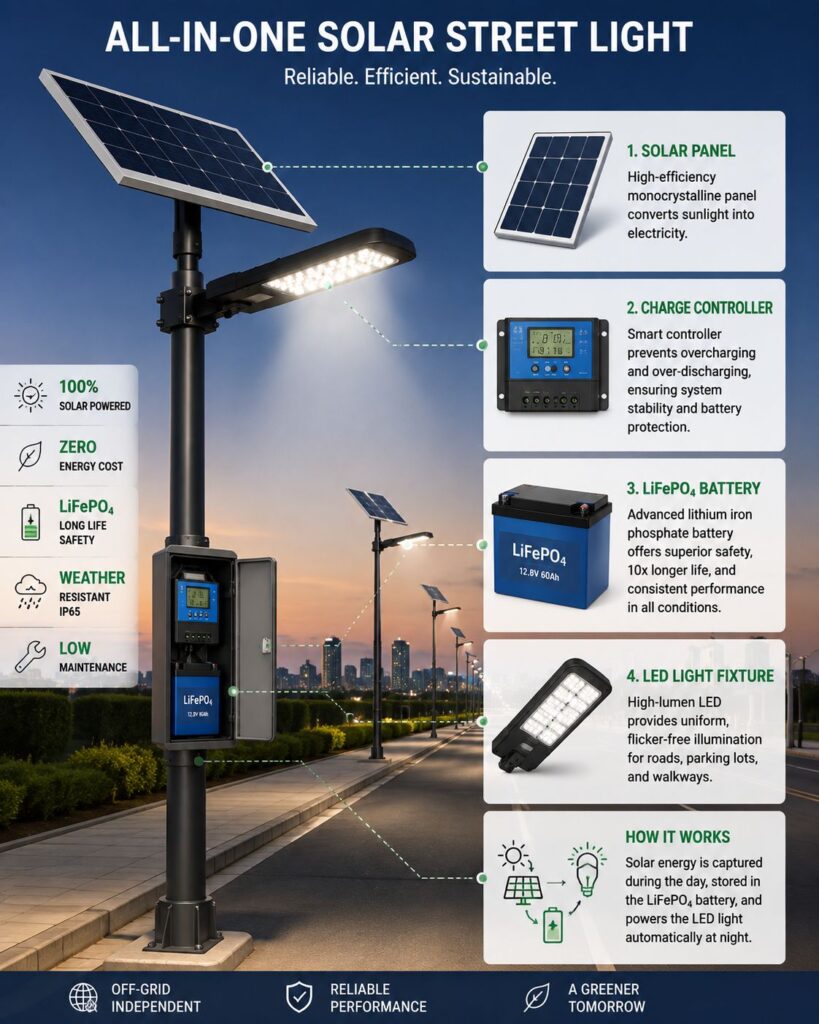
Modern commercial solar lighting systems use intelligent battery technology and Battery Management Systems (BMS) to deliver dependable nighttime illumination with minimal maintenance.
Build a Commercial Solar Lighting System Designed for Long-Term Reliability
Battery technology plays a critical role in the performance of every commercial solar lighting installation. Our lighting specialists can help you evaluate battery chemistry, backup autonomy, intelligent controls, and overall system design to ensure dependable nighttime performance for years to come.
Whether you’re planning a parking lot, roadway, industrial facility, corporate campus, or municipal project, we’ll help you select a commercial solar lighting system designed for reliability, serviceability, and long-term value. – Call 1-844-533-7767 to speak with a solar lighting specialist
Why Batteries Matter More Than Most Buyers Realize
A commercial solar battery does much more than simply store electricity.
It is responsible for:
- Storing energy collected during daylight hours
- Powering LED fixtures throughout the night
- Providing backup during cloudy weather
- Supporting intelligent dimming schedules
- Maintaining reliable dusk-to-dawn operation
- Protecting overall system performance
Because the battery cycles every day, it is often the first major component to require replacement during the life of a commercial solar lighting system. Fortunately, many infrastructure-grade systems are designed with replaceable battery modules, allowing the rest of the lighting system to continue operating for many additional years.
Battery technology is one factor in a successful installation. The Commercial Solar Lighting Buyer’s Guide shows how batteries, photometrics, warranties, installation costs, and future expansion all work together when evaluating a complete system.
Modern Battery Technologies
Today’s commercial solar lighting systems primarily utilize lithium-based battery technologies because they provide longer service life, higher efficiency, improved thermal stability, and lower maintenance requirements than older battery chemistries.
LiFePO₄ (Lithium Iron Phosphate)
LiFePO₄ has become the preferred battery chemistry for many commercial solar lighting applications because it offers:
- Long service life
- Excellent thermal stability
- High cycle durability
- Improved safety
- Deep discharge capability
- Minimal maintenance requirements
Many premium commercial systems now utilize LiFePO₄ batteries because they provide dependable long-term performance in demanding outdoor environments.
Battery replacement is only one part of long-term ownership. Our Commercial Solar Lighting Lifespan Guide explains how every major component contributes to decades of reliable system performance.
Lithium-Ion Batteries
Some commercial systems continue to use traditional lithium-ion batteries, which offer:
- High energy density
- Compact size
- Efficient charging
- Lightweight construction
However, many manufacturers have shifted toward LiFePO₄ technology because of its longer cycle life and improved safety characteristics.
Older Battery Technologies
Earlier generations of commercial solar lighting often relied on AGM or other lead-acid battery technologies. While these batteries served the industry well for many years, they generally offer shorter service lives, greater maintenance requirements, and lower cycle durability than modern lithium-based alternatives.
Battery Management Systems (BMS)
One of the biggest advances in commercial solar lighting has been the widespread adoption of Battery Management Systems (BMS).
Think of the BMS as the battery’s onboard protection system. It continuously monitors battery performance and automatically manages charging and discharging to maximize safety and service life.
A modern BMS helps:
- Prevent overcharging
- Prevent excessive discharge
- Monitor battery temperature
- Balance battery cells
- Improve charging efficiency
- Extend battery lifespan
For commercial property owners, this intelligent protection means greater reliability, lower maintenance, and longer battery life over the course of the system’s operation.
Design Insight
The best commercial solar lighting systems are designed as long-term infrastructure, not disposable products. While batteries are expected to be replaced at some point during the system’s life, high-quality solar panels, LED fixtures, poles, and controllers often continue providing dependable service for many years beyond the first battery replacement. That long-term serviceability is one of the key advantages of commercial-grade solar lighting over inexpensive consumer products.
⏳ What Determines Battery Life?
The lifespan of a commercial solar lighting battery depends on much more than its chemistry. Daily charging cycles, environmental conditions, system design, and intelligent charging controls all influence how long a battery will provide dependable performance.
High-quality commercial solar lighting systems are engineered so that the battery, solar panel, charge controller, and LED fixture work together as a balanced system. When properly designed, these components maximize efficiency while helping extend battery life for many years.
☀️ Daily Charging Cycles
Every commercial solar lighting battery experiences a charging and discharging cycle each day.
The process is simple:
☀️ Daylight
Solar panels collect energy and recharge the battery.
🌙 Night
The battery powers the LED fixture until sunrise.
Because this cycle repeats every day throughout the year, commercial batteries are designed to withstand thousands of charging cycles while maintaining dependable performance.
Proper system sizing ensures enough solar energy is collected each day to fully recharge the battery while supporting overnight operation.
Organizations evaluating complete off-grid systems often review Commercial Solar Powered LED Lighting Systems to understand how battery capacity, solar panel sizing, and LED efficiency work together.
Environmental Conditions Matter
Commercial solar lighting operates year-round in demanding outdoor environments.
Several environmental factors influence long-term battery performance:
❄️ Cold Weather
Cold temperatures temporarily reduce battery capacity, meaning less stored energy is available during extremely cold nights.
Modern commercial systems compensate through intelligent battery management and proper battery sizing.
☀️ High Temperatures
Heat generally has a greater long-term impact on battery lifespan than cold weather.
Premium commercial fixtures incorporate thermal management strategies that help protect battery performance while extending service life in warmer climates.
🌧️ Consecutive Cloudy Days
Commercial solar systems are typically designed with battery reserves—often referred to as autonomy—that allow lighting to continue operating during periods of limited sunlight.
Proper battery sizing is critical in regions that experience extended cloudy weather.
🔋 Battery Capacity vs. Battery Life
Battery capacity and battery lifespan are often confused.
Battery capacity determines:
- How long lights operate each night
- How many cloudy days the system can support
- Available stored energy
Battery lifespan refers to:
- Total years of service
- Number of charging cycles
- Long-term performance degradation
- Expected replacement interval
A larger battery does not automatically last longer—it simply stores more energy.
🔑 Key Takeaway
Replacing a commercial solar lighting battery is a planned maintenance event—not a system failure. High-quality commercial solar lighting is engineered as long-term infrastructure, allowing serviceable components such as batteries to be replaced while the solar panels, LED fixtures, poles, and structural components continue delivering reliable performance for many additional years.
Intelligent Controls Extend Battery Life
Modern commercial solar lighting systems continuously monitor battery performance using intelligent electronic controls.
These systems help maximize battery life by:
- Optimizing charging cycles
- Preventing overcharging
- Preventing excessive discharge
- Automatically adjusting lighting schedules
- Monitoring battery temperature
- Balancing battery cells
Together, these functions reduce battery stress while improving long-term system reliability.
Signs a Battery May Need Replacement
Like any energy storage device, commercial solar batteries gradually lose capacity over time.
Common signs include:
- Reduced nighttime operating hours
- Lights turning off before sunrise
- Longer charging times
- Reduced performance during cloudy weather
- Increased battery fault notifications (where applicable)
Replacing the battery at the appropriate time restores system performance while allowing the remaining lighting components to continue operating.
Project Spotlight
A municipal parks department noticed that several solar pathway lighting systems were no longer operating until sunrise during the winter months. Initial inspections showed that the LED fixtures, solar panels, and controllers remained in excellent condition, but the batteries had gradually lost storage capacity after years of daily charging cycles.
Rather than replacing the entire lighting system, the department installed new battery modules while retaining the existing fixtures and solar panels. The upgrade restored dependable dusk-to-dawn performance, reduced project costs, minimized waste, and extended the useful life of the lighting infrastructure for many additional years.
Sustainability Through Serviceability
One of the greatest advantages of commercial solar lighting is that it is designed to be maintained rather than discarded.
Replacing a battery when needed:
- Extends system life
- Reduces material waste
- Lowers lifecycle costs
- Improves return on investment
- Supports sustainability initiatives
- Keeps valuable infrastructure in service
This serviceable approach distinguishes commercial-grade solar lighting from inexpensive consumer products that are often replaced entirely when battery performance declines.
💡 Design Insight
The longest-lasting commercial solar lighting systems are not simply built with the best batteries—they are designed as balanced systems where battery capacity, solar panel output, intelligent controls, and LED efficiency work together. Proper system design reduces stress on every component, resulting in greater reliability, lower maintenance costs, and a longer overall service life.
Managing Commercial Solar Lighting Batteries for Long-Term Performance
Commercial solar lighting is designed as long-term infrastructure. Like any critical asset, routine inspection and preventive maintenance help maximize reliability while protecting the investment. Fortunately, modern lithium-based battery systems require very little ongoing attention compared to older battery technologies.
The goal is not to constantly maintain the battery, but to periodically verify that the entire solar lighting system continues operating as designed.
Routine Inspection Best Practices
Most commercial solar lighting systems can be inspected during normal facility maintenance visits.
A typical inspection should include:
- Cleaning solar panels if dirt or debris reduces solar exposure
- Checking battery compartments for moisture intrusion
- Inspecting electrical connections
- Verifying fixture operation
- Confirming dusk-to-dawn operation
- Examining mounting hardware
- Inspecting poles and foundations
- Removing vegetation that may shade the solar panel
These simple inspections help identify minor issues before they affect system performance.
☀️ Keeping Solar Panels Clean
Even the highest-quality battery cannot perform properly if the solar panel is unable to fully recharge it.
Dust, pollen, bird droppings, leaves, snow, and other debris reduce charging efficiency by limiting the amount of sunlight reaching the panel.
Periodic cleaning helps ensure:
- Maximum charging efficiency
- Longer battery life
- Consistent overnight runtime
- Reliable year-round operation
Proper solar panel performance benefits every component of the lighting system.
Understanding System Autonomy
One specification often overlooked by buyers is system autonomy.
Autonomy refers to the number of nights a commercial solar lighting system can continue operating without receiving a full solar charge.
For example, a system designed with three nights of autonomy can typically continue operating through several consecutive cloudy days before requiring additional solar charging.
Autonomy is influenced by:
- Battery capacity
- Solar panel size
- LED power consumption
- Lighting schedule
- Geographic location
- Seasonal weather patterns
Projects in northern climates or regions with extended cloudy seasons often benefit from higher autonomy ratings to maintain dependable year-round performance.
When planning commercial solar installations, it’s important to consider not only the brightest summer days but also the shortest winter days and the most challenging weather conditions.
Planning for Future Battery Replacement
One of the advantages of commercial solar lighting is that batteries are typically considered serviceable components, not disposable products.
Rather than replacing an entire lighting system, organizations can often replace only the battery module when it eventually reaches the end of its service life.
Planning ahead includes:
- Documenting installation dates
- Maintaining product records
- Recording battery specifications
- Following manufacturer recommendations
- Budgeting for future battery replacement
This proactive approach helps reduce downtime while extending the useful life of the overall lighting system.
💰 Understanding Total Cost of Ownership
Commercial buyers should evaluate more than the initial purchase price.
The total cost of ownership (TCO) includes:
- Initial equipment costs
- Installation savings from eliminating trenching
- Utility cost reductions
- Routine maintenance
- Future battery replacement
- Component serviceability
- Expected system lifespan
When viewed over decades of operation, commercial solar lighting often provides substantial long-term value by reducing electrical infrastructure costs while minimizing ongoing operating expenses.
Organizations evaluating complete off-grid systems frequently compare these long-term ownership costs with traditional utility-powered lighting before selecting the most appropriate solution.
Battery Maintenance Checklist
A simple maintenance program can significantly improve long-term system performance.
Recommended practices include:
✔ Inspect solar panels regularly
✔ Remove dirt and debris from panel surfaces
✔ Verify nightly operation
✔ Check battery compartments for moisture or damage
✔ Inspect wiring and electrical connections
✔ Trim vegetation that may shade panels
✔ Maintain service records
✔ Follow manufacturer maintenance recommendations
✔ Schedule battery replacement when performance declines
Preventive maintenance helps maximize battery life while reducing unexpected service interruptions.
🏗️ Commercial Solar Lighting Is Infrastructure—Not a Disposable Product
One of the biggest misconceptions about solar lighting comes from inexpensive consumer products, where declining battery performance often means replacing the entire fixture.
Commercial solar lighting is fundamentally different.
Professional-grade systems are engineered as long-term infrastructure investments. Individual components—including batteries, controllers, LED drivers, and occasionally LED modules—can often be serviced or replaced independently while the solar panel, pole, fixture housing, and mounting system continue providing dependable service for many additional years.
This modular approach reduces waste, lowers lifecycle costs, simplifies maintenance, and supports long-term sustainability initiatives by extending the useful life of the overall lighting system.
For municipalities, universities, corporate campuses, industrial facilities, and commercial property owners, serviceability is one of the key advantages that distinguishes commercial solar lighting from consumer-grade alternatives.
💡 Design Insight
The most successful commercial solar lighting projects are designed with the entire lifecycle in mind. A well-engineered system combines high-quality components, intelligent battery management, appropriate autonomy, and preventive maintenance practices to deliver dependable performance for many years while minimizing total ownership costs and future replacement expenses.
💬 Buyer Questions About Commercial Solar Lighting Batteries
How often do commercial solar lighting batteries need to be replaced?
Battery replacement intervals vary depending on battery chemistry, climate, charging cycles, and system design. Modern commercial LiFePO₄ battery systems are designed for long service lives, and many provide years of dependable operation before replacement becomes necessary. The rest of the lighting system—including the solar panel, LED fixture, and pole—can often continue operating well beyond the first battery replacement.
Can I replace only the battery instead of the entire lighting system?
In many commercial systems, yes. Premium solar lighting is designed with serviceable components, allowing battery modules to be replaced while retaining the existing solar panel, controller, LED fixture, and mounting hardware. This significantly reduces lifecycle costs and minimizes waste.
Does cold weather damage commercial solar batteries?
Cold temperatures can temporarily reduce available battery capacity, but properly designed commercial systems compensate through appropriate battery sizing, intelligent charging controls, and Battery Management Systems (BMS). Performance generally returns as temperatures increase.
Should commercial solar batteries be maintained?
Modern lithium-based batteries require very little direct maintenance. Routine inspections should instead focus on keeping solar panels clean, verifying proper operation, checking electrical connections, and ensuring the solar panel remains free from shading.
How can I maximize battery life?
Battery longevity is influenced by proper system design, quality components, intelligent charging controls, regular inspections, and keeping the solar panel clean so the battery receives a full daily charge whenever weather conditions permit.
Plan for Decades of Reliable Performance
Commercial solar lighting is more than an alternative to traditional utility-powered lighting—it’s a long-term infrastructure investment. By selecting high-quality batteries, intelligent Battery Management Systems, and properly engineered solar lighting solutions, organizations can achieve dependable performance while minimizing maintenance, reducing operating costs, and supporting long-term sustainability goals.
Whether you’re planning a municipal streetscape, university campus, industrial facility, corporate headquarters, or commercial development, our lighting specialists can help you select a system designed for durability, serviceability, and maximum lifecycle value.
Contact our lighting experts today for assistance with battery selection, autonomy planning, maintenance strategies, and complete commercial solar lighting system design.
👉 Request Bulk Pricing or call 1-844-533-7767 to discuss your commercial solar lighting project.
Frequently Asked Questions
What is a Battery Management System (BMS)?
A Battery Management System continuously monitors battery health, regulates charging and discharging, balances battery cells, and protects against conditions such as overcharging, excessive discharge, and abnormal temperatures. These intelligent controls help maximize battery safety, reliability, and service life.
What is battery autonomy?
Battery autonomy refers to the number of nights a commercial solar lighting system can continue operating without receiving a full solar recharge. Systems designed for greater autonomy provide additional reliability during extended cloudy weather or seasonal reductions in available sunlight.
Are commercial solar lighting batteries recyclable?
Yes. Many lithium-based commercial batteries can be recycled through approved battery recycling programs. Following local regulations and manufacturer recommendations helps ensure environmentally responsible disposal when batteries eventually reach the end of their service life.
Does replacing a battery affect the warranty?
Warranty coverage varies by manufacturer and product. Some manufacturers provide separate warranty periods for batteries and other system components. Always review the product warranty documentation to understand coverage for batteries, solar panels, controllers, and LED fixtures.
Is battery replacement considered a system failure?
No. Battery replacement is generally considered a normal part of the long-term maintenance lifecycle for commercial solar lighting. Just as vehicles eventually require new tires or HVAC systems require replacement filters, commercial solar batteries are expected to be replaced periodically while the overall lighting system continues serving the property for many additional years.
🔗 Related Commercial Solar Lighting Resources
Commercial Solar Powered LED Lighting Systems — Learn how solar panels, batteries, controllers, and LED fixtures work together as a complete off-grid lighting solution.
Commercial Solar Lighting — Explore our complete collection of commercial and industrial solar lighting solutions.
Commercial Solar Lighting Brightness Guide — Understand lumens, optics, photometric reports, and how professional lighting designers evaluate performance.
Commercial Solar Lighting for Industrial Facilities — Discover how commercial solar systems support manufacturing, logistics, ports, rail yards, and industrial operations.
Commercial Solar Parking Lot Lighting — Learn how commercial parking lot systems balance battery capacity, autonomy, and nighttime performance.
Commercial Solar Street Lights — Explore roadway lighting systems designed for dependable year-round operation and long service life.
All-In-One Solar Street Lighting — See how integrated solar lighting systems combine batteries, LEDs, controllers, and solar panels into compact, easy-to-install solutions.