Choosing Commercial Solar Lighting Starts with the Right Questions
Selecting commercial solar lighting involves much more than comparing fixture specifications or looking for the lowest purchase price. Every project has unique objectives, environmental conditions, operational requirements, and long-term performance expectations that influence which lighting solution will deliver the best results.
Whether you’re planning a municipal streetscape, expanding an industrial facility, developing a corporate campus, or improving safety throughout a residential community, successful projects begin by understanding the application—not simply selecting a product.
By asking the right questions early in the planning process, organizations can reduce installation costs, simplify future expansion, improve sustainability, and maximize the long-term value of their investment.
If you’re new to off-grid lighting, our Commercial Solar Lighting overview provides an excellent introduction to the technologies, applications, and benefits of modern solar-powered lighting systems.
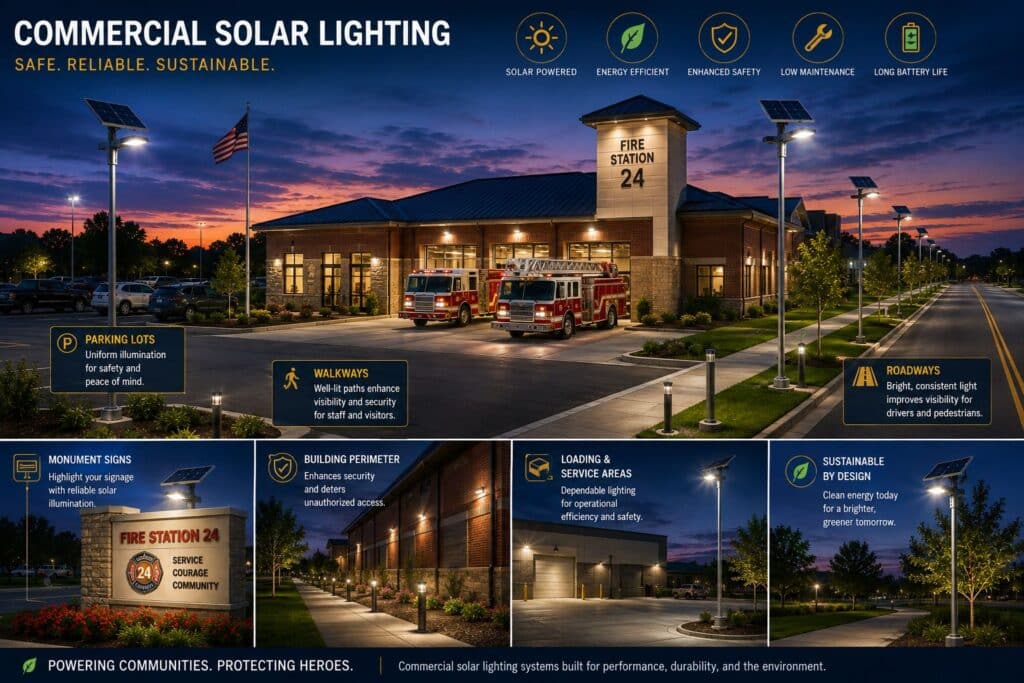
Choosing the right commercial solar lighting solution begins with understanding your project’s goals, lighting requirements, long-term performance expectations, and future expansion plans.
Let Our Lighting Specialists Help You Evaluate Your Options
Every commercial solar lighting project is unique. Our experienced lighting specialists can help you compare technologies, evaluate applications, review project requirements, and recommend solutions that balance performance, sustainability, serviceability, and long-term value.
Whether you’re planning a single installation or a campus-wide lighting upgrade, we’ll help you choose the right commercial solar lighting solution for your project. – Call 1-844-533-7767 to speak with a solar lighting specialist
Every Successful Project Starts with the Right Questions
Before selecting a commercial solar lighting system, consider the following:
What are you trying to illuminate?
Different applications require different lighting strategies.
For example:
- Parking lots prioritize visibility and security.
- Roadways focus on driver safety and uniform illumination.
- Parks emphasize pedestrian comfort and aesthetics.
- Industrial facilities support operational efficiency.
- Monument signs reinforce branding and wayfinding.
Clearly defining the application helps determine the most appropriate lighting solution.
Is utility power available?
One of the biggest advantages of commercial solar lighting is the ability to illuminate locations where extending electrical service would be expensive, disruptive, or impractical.
Off-grid lighting is often ideal for:
- Remote locations
- New construction
- Facility expansions
- Municipal improvements
- Temporary infrastructure
- Utility-limited properties
What are your long-term objectives?
Commercial buyers often prioritize goals such as:
- Reducing installation costs
- Eliminating electrical trenching
- Improving public safety
- Supporting sustainability initiatives
- Lowering operating expenses
- Simplifying future expansion
- Reducing maintenance
- Improving return on investment
Understanding these priorities helps guide the selection process.
How important is long-term serviceability?
Commercial solar lighting should be viewed as long-term infrastructure rather than a short-term purchase.
Questions to consider include:
- Are batteries replaceable?
- Is technical support available?
- Can additional fixtures be added later?
- What warranty is provided?
- Will replacement components remain available?
- Is the system designed for future growth?
Organizations planning for decades of service often achieve a lower total cost of ownership than those focused solely on initial purchase price.
Matching the Right Solar Lighting Solution to Your Project
Once project goals are clearly defined, selecting the appropriate lighting solution becomes much easier.
🚗 Improve Parking Lot Safety & Security
Parking areas require dependable illumination that improves visibility for both drivers and pedestrians while reducing operating costs.
Our guide to Commercial Solar Parking Lot Lighting explains how off-grid lighting reduces trenching while improving security and long-term value.
🏢 Support Corporate Campuses & Commercial Developments
Business parks, healthcare campuses, and mixed-use developments often require coordinated lighting strategies that include parking lots, pedestrian pathways, monument signs, and roadways.
Explore Commercial Solar Powered LED Lighting Systems to understand how complete off-grid lighting systems are planned.
🏭 Improve Industrial Operations
Manufacturing facilities, logistics centers, ports, rail yards, and equipment storage areas require durable lighting systems designed for demanding operating environments.
Learn more in our guide to Commercial Solar Lighting for Industrial Facilities.
🌳 Create Attractive Community Spaces
HOA communities, municipalities, universities, and public parks often combine decorative lighting with pedestrian pathways and landscape features to improve safety while enhancing community character.
Discover how Commercial Solar Outdoor Lighting helps create inviting public spaces.
🛣 Illuminate Streets & Roadways
Commercial solar street lighting provides dependable illumination for roadways, business parks, campuses, and municipal streets while reducing dependence on utility infrastructure.
Compare solutions in Commercial Solar Street Lights and All-In-One Solar Street Lighting.
🏛 Strengthen Visibility & Wayfinding
Illuminated monument signs, gateway entrances, business directories, and traffic signs improve navigation while reinforcing a property’s identity.
Explore Commercial Solar Sign Lighting and Commercial Solar Traffic Signs for signage and wayfinding applications.
💡 Buyer’s Insight
The best commercial solar lighting decisions begin long before fixture selection. Organizations that first define their project goals, operational requirements, and long-term ownership expectations consistently achieve better performance, lower lifecycle costs, and greater overall satisfaction than those who focus primarily on purchase price.
Evaluating Commercial Solar Lighting Systems
Once you’ve identified your project goals, the next step is comparing the systems themselves. While many commercial solar lighting products may appear similar at first glance, significant differences in component quality, engineering, performance, and long-term serviceability can dramatically affect the success of your project.
Rather than focusing on a single specification, evaluate the complete lighting system and how each component contributes to long-term reliability and performance.
Solar Panel Quality
The solar panel is the system’s primary energy source, making its efficiency and durability critical to long-term performance.
When comparing systems, consider:
- Panel efficiency
- Monocrystalline vs. polycrystalline technology
- Weather resistance
- Panel orientation
- Mounting design
- Expected service life
High-quality solar panels maximize energy production throughout the year, helping maintain dependable overnight operation even during changing seasonal conditions.
🔋 Battery Technology
Battery technology directly influences runtime, autonomy, maintenance requirements, and long-term ownership costs.
Modern commercial systems increasingly utilize LiFePO₄ batteries because they provide:
- Long cycle life
- Excellent thermal stability
- High charging efficiency
- Low maintenance
- Improved safety
Learn more in our guide to Commercial Solar Lighting Batteries: Lifespan, Maintenance & Replacement.
💡 LED Performance & Lighting Quality
Commercial buyers should evaluate lighting quality—not simply lumen output.
Important considerations include:
- LED efficacy
- Color temperature
- Color consistency
- Optical performance
- Uniform illumination
- Glare control
Understanding how these characteristics affect real-world performance is just as important as comparing lumen ratings.
Our Commercial Solar Lighting Brightness Guide explains why professional lighting design considers optics, beam patterns, and photometric performance—not just lumens.
Photometric Lighting Design
One of the biggest differences between commercial and residential lighting projects is the use of photometric analysis.
Professional lighting layouts evaluate:
- Foot-candle levels
- Uniformity
- Pole spacing
- Mounting height
- Beam distribution
- Glare
- Coverage
Rather than estimating fixture quantities, photometric layouts help ensure the completed installation performs as expected before construction even begins.
Serviceability & Future Maintenance
Commercial lighting should be viewed as infrastructure rather than disposable equipment.
Ask questions such as:
- Are batteries replaceable?
- Can individual components be serviced?
- Is replacement hardware readily available?
- Is technical support provided?
- Will the system remain serviceable ten years from now?
Choosing serviceable equipment can significantly reduce long-term ownership costs.
Climate & Site Conditions
Every project operates under different environmental conditions.
Evaluate:
- Geographic location
- Winter daylight hours
- Typical weather patterns
- Wind exposure
- Coastal environments
- High-temperature operation
- Snow accumulation
- Nearby trees and shading
Selecting equipment appropriate for local conditions improves both performance and reliability.
💰 Hidden Costs Buyers Often Overlook
Many buyers compare fixture prices without considering the full cost of the project.
Potential costs include:
- Underground trenching
- Electrical infrastructure
- Utility coordination
- Concrete restoration
- Copper wiring
- Electrical permits
- Future expansion
- Utility bills
- Maintenance labor
One frequently overlooked benefit of commercial solar lighting is the elimination—or significant reduction—of underground electrical infrastructure. In addition to lowering installation costs, reducing copper wiring also minimizes exposure to copper theft, a growing concern for municipalities, school districts, parks, transportation agencies, and commercial properties. Fewer underground conductors can mean fewer service interruptions, lower repair costs, and improved public safety.
Evaluating the total cost of ownership rather than simply the purchase price often reveals the true long-term value of commercial solar lighting.
Questions Every Commercial Buyer Should Ask
Before selecting a commercial solar lighting system, ask:
✔ Is the system designed for commercial applications?
✔ Does the manufacturer provide photometric layouts?
✔ What battery technology is used?
✔ What optical distributions are available?
✔ How many nights of autonomy are provided?
✔ Is the battery replaceable?
✔ What warranty is included?
✔ Can additional fixtures be added later?
✔ Is technical support available after installation?
✔ What is the expected lifecycle of the major components?
These questions help buyers compare solutions based on long-term value rather than initial purchase price alone.
Project Spotlight
A regional distribution center planned to illuminate a newly constructed employee parking area and truck staging yard. Rather than comparing fixtures solely by lumen output or purchase price, the facility evaluated installation costs, battery technology, photometric layouts, future expansion, warranty coverage, and long-term maintenance requirements.
The selected commercial solar lighting system eliminated trenching across active traffic lanes, reduced construction costs, simplified future expansion, and provided dependable nighttime illumination with replaceable battery modules and minimal ongoing maintenance.
💡 Buyer’s Insight
The best commercial solar lighting investment isn’t necessarily the least expensive system—it’s the one that delivers the lowest lifecycle cost, the greatest reliability, and the flexibility to adapt as your property grows. Evaluating component quality, serviceability, lighting performance, and future maintenance from the beginning helps ensure your investment continues delivering value for many years after installation.
🏗️ Planning for Long-Term Success
Selecting the right commercial solar lighting system is only the beginning. The most successful projects are designed with long-term performance, future expansion, maintenance, and evolving property needs in mind.
Whether planning a new commercial development or upgrading an existing facility, taking a long-term approach helps maximize return on investment while ensuring the lighting system continues meeting operational requirements for years to come.
📐 Start with a Lighting Plan—Not a Fixture
One of the most common mistakes in commercial lighting projects is selecting fixtures before developing a lighting plan.
Professional projects typically begin by evaluating:
- Property layout
- Traffic patterns
- Pedestrian activity
- Security requirements
- Existing infrastructure
- Future development plans
- Local lighting ordinances
- Environmental conditions
Once these factors are understood, fixture selection becomes significantly more straightforward.
Organizations planning larger installations often begin with Commercial Solar Powered LED Lighting Systems, which explains how complete off-grid lighting systems are designed and integrated.
Request a Photometric Lighting Layout
A photometric layout is one of the most valuable planning tools available for commercial lighting projects.
Rather than estimating fixture quantities, a photometric analysis predicts how the completed installation will perform before construction begins.
Photometric layouts help determine:
- Fixture placement
- Pole spacing
- Mounting height
- Average foot-candle levels
- Uniformity
- Glare control
- Coverage areas
For larger parking lots, campuses, industrial facilities, municipal streets, and public spaces, photometric planning often reduces both installation costs and future modifications.
To better understand photometric reports and optical distributions, explore our Commercial Solar Lighting Brightness Guide.
Plan for Future Growth
Commercial properties rarely remain static.
Facilities expand.
Communities grow.
Parking lots are enlarged.
New buildings are added.
Roadways are extended.
Planning for future expansion today can significantly reduce costs tomorrow.
When evaluating a solar lighting system, consider:
- Can additional fixtures be added later?
- Will future lighting match existing installations?
- Is replacement equipment readily available?
- Can the system be expanded without redesigning the entire site?
A scalable lighting strategy protects today’s investment while supporting tomorrow’s growth.
Think Beyond Installation Day
Commercial buyers should evaluate how the system will perform over decades—not simply how it performs when first installed.
Questions worth considering include:
- How easily can batteries be replaced?
- Are controllers serviceable?
- Is technical support available?
- Will replacement parts remain available?
- How difficult are routine inspections?
- Can maintenance be performed without specialized equipment?
Well-designed systems simplify ownership throughout their lifecycle.
For more information, see our guide to Commercial Solar Lighting Batteries: Lifespan, Maintenance & Replacement.
Design for Your Environment
Climate has a direct impact on commercial solar lighting performance.
Projects should account for:
- Winter daylight hours
- Geographic latitude
- Cloud cover
- Snow accumulation
- Coastal conditions
- High temperatures
- Wind exposure
- Vegetation growth
- Seasonal shading
Selecting equipment designed for local environmental conditions improves long-term reliability and reduces maintenance requirements.
Evaluate Total Lifecycle Value
Rather than comparing fixture prices alone, evaluate the overall lifecycle value of the project.
Factors include:
- Installation savings
- Electrical infrastructure eliminated
- Utility savings
- Maintenance requirements
- Battery replacement planning
- Serviceability
- Warranty coverage
- Expected system lifespan
- Future expansion costs
Commercial solar lighting often delivers its greatest value over many years of operation rather than immediately after installation.
Choose a Lighting Partner—Not Just a Product Supplier
One of the most important decisions in any commercial lighting project is selecting an experienced supplier who understands lighting design, system integration, and long-term project support.
A knowledgeable lighting partner can assist with:
- Product selection
- Photometric layouts
- Optical distribution recommendations
- Pole height recommendations
- Battery sizing
- Autonomy planning
- Lighting controls
- Future expansion strategies
- Technical support after installation
That expertise helps reduce costly mistakes while ensuring the lighting system continues meeting project objectives throughout its service life.
Project Spotlight
A university planned a phased expansion that included new parking areas, pedestrian walkways, athletic facilities, and additional academic buildings over several years. Rather than purchasing unrelated lighting systems for each phase, the campus developed a long-term master lighting plan.
By selecting commercial solar lighting designed for future expansion, the university maintained a consistent architectural appearance, simplified maintenance, standardized replacement components, and avoided repeated electrical infrastructure upgrades as the campus continued to grow.
💡 Buyer’s Insight
The best commercial solar lighting projects are not measured by how quickly fixtures are installed—they are measured by how effectively they continue serving the property years later. Careful planning, scalable system design, quality components, and experienced technical guidance help ensure today’s investment remains reliable, efficient, and adaptable well into the future.
💬 Buyer Questions About Commercial Solar Lighting
How do I know if commercial solar lighting is the right choice for my project?
Commercial solar lighting is an excellent solution when reducing trenching, avoiding utility infrastructure, lowering long-term operating costs, supporting sustainability initiatives, or illuminating remote locations are important project objectives. It is commonly used for parking lots, roadways, campuses, industrial facilities, parks, HOA communities, municipalities, and commercial developments.
What is the biggest mistake buyers make?
Many buyers compare products based only on lumen output or purchase price. Successful commercial projects evaluate the complete system, including battery technology, solar panel quality, optical distributions, photometric performance, serviceability, warranty coverage, and long-term ownership costs.
Should I request a photometric lighting layout?
Yes. Photometric layouts help determine fixture placement, pole spacing, mounting height, and predicted illumination levels before installation begins. They reduce guesswork while helping ensure the completed lighting system meets project objectives.
How important is battery technology?
Battery technology directly affects runtime, autonomy, maintenance requirements, and long-term reliability. Modern LiFePO₄ battery systems have become the preferred choice for many commercial applications because of their long cycle life, excellent thermal stability, and low maintenance requirements.
Can commercial solar lighting be expanded later?
In many cases, yes. Properly planned commercial solar lighting systems are designed to support future expansion, making it easier to illuminate new parking areas, roadways, campuses, or facility additions without extending underground electrical infrastructure.
📋 Commercial Solar Lighting Buyer's Checklist
Before requesting proposals, confirm that you can answer the following questions:
✅ Project Planning
- What areas need to be illuminated?
- What are the primary project goals?
- Is utility power available?
- Is future expansion anticipated?
- Are there local lighting ordinances or Dark Sky requirements?
✅ System Performance
- Is the fixture designed for commercial applications?
- Does it provide the appropriate optical distribution?
- Has a photometric layout been completed?
- Will the lighting provide uniform coverage?
- Is glare properly controlled?
✅ Battery & Solar Components
- What battery chemistry is used?
- How many nights of autonomy are provided?
- Are batteries replaceable?
- What type of Battery Management System (BMS) is included?
- Is the solar panel properly sized for the location?
✅ Long-Term Ownership
- What warranty is included?
- Are replacement parts readily available?
- Can additional fixtures be added later?
- What maintenance is recommended?
- What is the expected lifecycle of the major components?
Completing this checklist before comparing products often leads to better purchasing decisions and lower long-term ownership costs.
⚡ Make an Informed Commercial Solar Lighting Investment
The best commercial solar lighting projects begin with informed decisions. By defining project goals, evaluating complete system performance, planning for future growth, and considering long-term ownership costs, organizations can select lighting solutions that deliver dependable performance, lower operating expenses, and lasting value.
Whether you’re planning a municipal roadway, corporate campus, industrial facility, parking lot, public park, healthcare campus, or mixed-use development, our lighting specialists can help you compare technologies, review photometric layouts, recommend appropriate equipment, and design a commercial solar lighting solution tailored to your project.
Contact our lighting experts today for application guidance, photometric lighting assistance, product recommendations, and competitive project pricing.
👉 Request Bulk Pricing or call 1-844-533-7767 to discuss your commercial solar lighting project.
Frequently Asked Questions
What makes commercial solar lighting different from residential solar lighting?
Commercial systems are engineered for larger applications, higher reliability, longer service life, and greater durability. They typically incorporate larger solar panels, commercial-grade LED fixtures, intelligent controls, replaceable battery systems, and robust mounting structures designed for continuous operation.
Is commercial solar lighting suitable for new construction?
Yes. New construction projects often achieve the greatest installation savings because solar lighting can eliminate or significantly reduce trenching, underground conduit, utility coordination, and electrical infrastructure.
Can commercial solar lighting be installed at existing facilities?
Absolutely. Commercial solar lighting is frequently used to expand parking lots, illuminate remote areas, improve pedestrian safety, or upgrade existing properties where extending utility power would be expensive or disruptive.
What information should I provide before requesting a quote?
Helpful information includes:
- Site plans or aerial images
- Application type
- Pole height preferences (if known)
- Lighting objectives
- Geographic location
- Existing site conditions
- Future expansion plans
The more project information available, the more accurately a lighting system can be designed.
Why should I work with a commercial lighting specialist?
Experienced lighting specialists help evaluate applications, prepare photometric layouts, recommend appropriate optics, size battery systems, and develop scalable lighting solutions that balance performance, reliability, and long-term value.
🔗 Related Commercial Solar Lighting Resources
Commercial Solar Lighting — Explore our complete collection of commercial and industrial off-grid lighting solutions.
Commercial Solar Powered LED Lighting Systems — Learn how complete off-grid lighting systems are designed and integrated.
Commercial Solar Lighting Brightness Guide — Understand lumens, optics, light distributions, and photometric reports.
Commercial Solar Lighting Battery Guide — Learn about battery lifespan, autonomy, maintenance, and replacement planning.
Commercial Solar Parking Lot Lighting — Discover off-grid lighting solutions for parking facilities and commercial developments.
Commercial Solar Street Lights — Explore roadway lighting solutions for municipalities, campuses, and business parks.
Commercial Solar Lighting for Industrial Facilities — Learn how industrial operations benefit from dependable off-grid lighting.
Commercial Solar Sign Lighting — Improve monument signs, billboards, and wayfinding with commercial solar lighting.