A successful commercial lighting project begins long before the first fixture is installed. Proper planning ensures that the selected lighting system delivers uniform illumination, minimizes installation challenges, supports future building needs, and provides years of reliable performance.
Today’s commercial ceiling lighting projects often incorporate a combination of LED flat panels, LED troffers, recessed downlights, and surface-mounted fixtures to create comfortable, energy-efficient environments. Selecting the right fixture is only part of the process—understanding how those fixtures integrate with the building’s electrical system, ceiling structure, and lighting controls is equally important.
Whether you’re replacing aging fluorescent fixtures during a retrofit or designing lighting for a new commercial building, careful installation planning helps reduce labor costs, avoid costly rework, and maximize the long-term value of your investment.
If you’re still comparing fixture options, start with our Commercial LED Ceiling Lights guide, which explains the various ceiling lighting solutions available for offices, schools, healthcare facilities, retail stores, and other commercial applications.
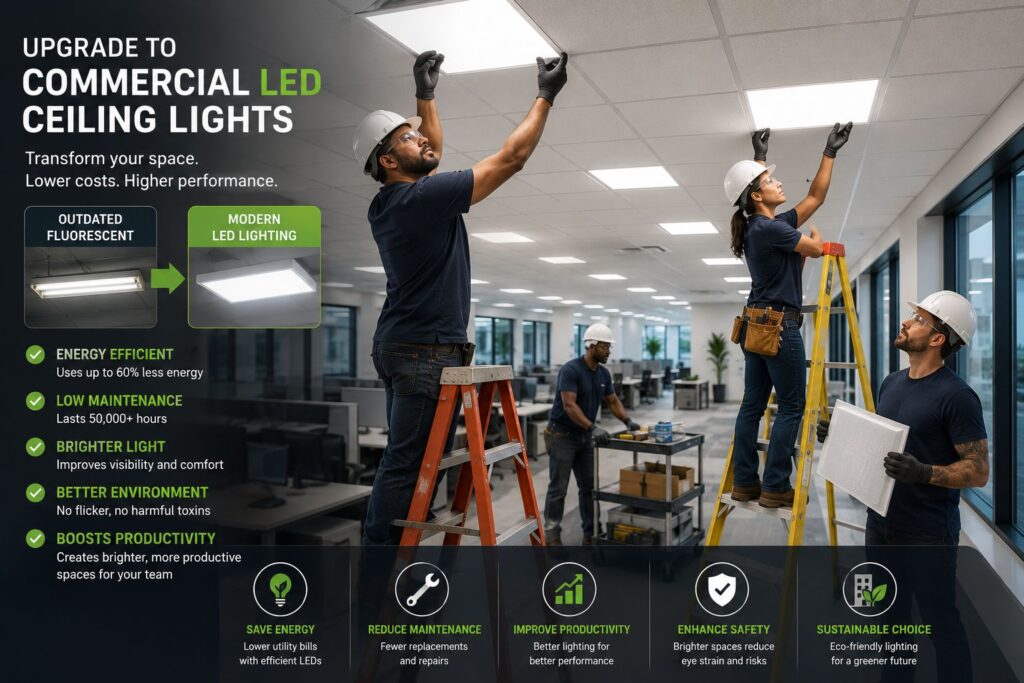
Successful commercial lighting installations begin with proper planning, quality fixtures, and professional coordination between electrical, architectural, and mechanical systems.
Planning a Commercial LED Lighting Installation?
Whether you’re upgrading an existing building or designing a new facility, proper planning can reduce installation time, improve lighting performance, and lower long-term operating costs.
Our lighting specialists can help you select the right fixtures, recommend lighting layouts, and support your installation with commercial-grade LED solutions designed for lasting performance.
📞 Call 1-844-533-7767 or explore our complete selection of Commercial LED Ceiling Lights.
Installation Begins with Proper Planning
Commercial lighting installation is much more than replacing one fixture with another. Every successful project starts with a clear understanding of the building, its occupants, and the lighting objectives for each space.
Before selecting fixtures or scheduling installation, evaluate:
- The existing ceiling system
- Ceiling heights
- Room dimensions
- Electrical capacity
- Occupancy patterns
- Natural daylight availability
- Future remodeling plans
- Energy efficiency goals
- Lighting control requirements
Answering these questions early helps avoid installation delays while ensuring the finished lighting system meets both operational and aesthetic expectations.
For many projects, the planning stage also includes a photometric lighting layout, which verifies fixture quantity, placement, and expected illumination levels before installation begins.
🛠️Design Insight
The most successful lighting installations are planned around how people use the space—not simply around where existing fixtures are located. A thoughtful lighting design often improves comfort and efficiency without increasing the number of fixtures.
Understanding Common Commercial Ceiling Systems
Commercial LED ceiling fixtures are designed to work with a variety of ceiling types, and understanding the existing construction helps determine which products are most appropriate.
Suspended (T-Bar) Ceilings
Suspended ceilings remain the most common ceiling system in offices, schools, healthcare facilities, and government buildings.
Their modular grid makes them ideal for:
LED flat panels
LED troffers
Lay-in architectural fixtures
Because these systems provide easy access above the ceiling, they simplify maintenance and future electrical upgrades.
Hard Ceilings
Buildings with drywall or plaster ceilings often require recessed downlights, surface-mounted fixtures, or specialized architectural lighting rather than lay-in fixtures.
These installations typically require more planning because fixture locations must be coordinated before the ceiling is finished.
Surface-Mounted Applications
Some facilities—including utility rooms, maintenance spaces, storage areas, and older commercial buildings—may not have suspended ceilings.
In these cases, surface-mounted LED ceiling fixtures provide an efficient solution while minimizing structural modifications.
Selecting fixtures that match the building’s construction helps streamline installation and maintain a clean, professional appearance.
Choosing the Right Fixture Before Installation
Proper installation starts with selecting fixtures that are appropriate for both the ceiling system and the intended application.
LED Flat Panels
Today, LED flat panels have become the preferred ceiling fixture for many commercial offices, schools, healthcare facilities, and professional buildings.
Their slim profile, uniform illuminated surface, and clean architectural appearance make them an excellent choice for modern interiors. Many models also offer field-selectable wattage and color temperature, giving installers greater flexibility during commissioning.
LED Troffers
LED troffers remain an outstanding solution for many commercial applications, particularly where center-basket optics, enhanced glare control, or compatibility with existing fluorescent layouts are priorities.
Government facilities, educational buildings, and administrative offices continue to specify troffers because of their comfortable light distribution and familiar appearance.
Recessed Downlights
Recessed downlights complement ambient ceiling lighting by providing focused illumination in:
- Reception areas
- Conference rooms
- Corridors
- Hospitality spaces
- Executive offices
Used strategically, they enhance visual interest while improving functionality in key areas.
Surface-Mounted Ceiling Fixtures
Surface-mounted fixtures are commonly installed in support spaces where suspended ceilings are not practical, including:
- Mechanical rooms
- Storage areas
- Utility spaces
- Stairwells
- Maintenance facilities
Modern LED surface-mounted fixtures offer excellent efficiency and long service life while providing dependable illumination in these environments.
📐 Specification Tip
Many of today’s best commercial lighting projects use a combination of flat panels, troffers, recessed downlights, and surface-mounted fixtures. Matching each fixture type to the function of the space produces better lighting performance than relying on a single fixture throughout the building.
Retrofit vs. New Construction Installation
Although the installation process may appear similar, retrofit projects and new construction present very different planning challenges.
Understanding these differences helps contractors, facility managers, and building owners choose the most efficient installation strategy while minimizing disruption.
LED Retrofit Projects
Many commercial lighting upgrades involve replacing aging fluorescent fixtures with modern LED technology while leaving the existing ceiling system intact.
This approach is common in:
- Office buildings
- Schools
- Healthcare facilities
- Government buildings
- Financial institutions
- Retail stores
Because the suspended ceiling grid and electrical infrastructure are already in place, retrofit installations are often completed quickly with minimal disruption to daily operations.
Benefits include:
- Lower installation costs
- Reduced labor time
- Minimal ceiling modifications
- Faster project completion
- Immediate energy savings
- Improved lighting quality
Many modern LED flat panels and LED troffers are designed specifically to fit existing 2×2 and 2×4 ceiling grids, making them excellent fluorescent replacement solutions.
New Construction Projects
New construction provides greater flexibility but also requires more coordination.
Rather than simply replacing fixtures, the lighting system becomes part of the overall building design.
Planning typically involves coordination between:
- Architects
- Electrical engineers
- Mechanical engineers
- General contractors
- Electrical contractors
- Interior designers
- Building owners
Lighting locations must be coordinated with:
- HVAC diffusers
- Fire sprinkler heads
- Smoke detectors
- Emergency lighting
- Ceiling access panels
- Data cabling
- Audio-visual systems
Early collaboration helps avoid field conflicts while producing a cleaner, more efficient installation.
🛠️ Design Insight
The easiest fixture to install is the one that doesn’t have to be relocated after construction begins. Coordinating lighting with other building systems during the design phase saves both time and money.
Electrical Planning Before Installation
Commercial LED fixtures consume significantly less energy than the fluorescent systems they replace, but electrical planning remains an important part of every project.
Before installation begins, verify:
- Existing branch circuits
- Circuit loading
- Available panel capacity
- Voltage requirements
- Emergency power circuits
- Existing control wiring
- Driver compatibility
- Dimming requirements
Many commercial LED fixtures are available in multiple voltage configurations, making them suitable for offices, schools, industrial facilities, healthcare buildings, and municipal projects.
Proper electrical planning also simplifies future maintenance and building expansions.
Integrating Lighting Controls
Modern commercial lighting systems are expected to do much more than simply turn on and off.
Many installations now incorporate intelligent lighting controls that improve energy efficiency while enhancing occupant comfort.
Popular control options include:
- Occupancy sensors
- Vacancy sensors
- Daylight harvesting
- 0–10V dimming
- Programmable scheduling
- Wireless lighting controls
- Building Management System (BMS) integration
Planning for these controls before installation reduces labor costs and simplifies commissioning once the building is occupied.
Controls should be coordinated with fixture locations, ceiling layouts, and occupancy patterns to maximize their effectiveness.
Emergency Lighting and Battery Backup
Many commercial buildings require emergency illumination that continues operating during a power outage.
Rather than adding separate emergency fixtures throughout the building, many LED ceiling lights are available with integrated emergency battery backup options.
Depending on the project, emergency lighting plans may include:
- Battery backup LED flat panels
- Emergency LED troffers
- Dedicated emergency fixtures
- Exit signs
- Emergency drivers
- Generator-supported circuits
These systems help maintain safe egress while supporting building code compliance.
Emergency lighting requirements vary depending on occupancy type, local regulations, and applicable life safety codes, making early planning especially important.
Coordinating with HVAC and Building Systems
Ceilings are shared by numerous building systems, making coordination essential for a clean installation.
Lighting layouts should account for:
- Air supply diffusers
- Return air grilles
- Fire sprinklers
- Smoke detectors
- Security cameras
- Public address speakers
- Ceiling-mounted sensors
- Access panels
Crowding these components into the same ceiling area can create installation conflicts, interfere with maintenance access, and detract from the finished appearance.
Professional coordination helps distribute ceiling components evenly while preserving both functionality and aesthetics.
📐 Specification Tip
Avoid treating lighting as an isolated system. Ceiling layouts should be reviewed alongside HVAC, fire protection, communications, and security plans to prevent costly field adjustments during installation.
Why Photometric Layouts Should Come First
One of the biggest installation mistakes is purchasing fixtures before verifying the lighting design.
A professional photometric lighting layout evaluates:
- Fixture quantity
- Fixture spacing
- Light distribution
- Foot-candle levels
- Uniformity
- Energy performance
- Potential glare
By validating the design before installation, photometric layouts reduce the likelihood of adding fixtures later, relocating installed fixtures, or discovering dark areas after occupancy.
This planning process also helps optimize fixture selection, ensuring the building receives the appropriate combination of LED flat panels, troffers, recessed downlights, and other ceiling fixtures.
For larger commercial projects, photometric analysis is one of the most valuable investments made before construction begins.
🏢 Project Spotlight
During the renovation of a three-story professional office building, the original plan called for a one-for-one replacement of fluorescent fixtures. A photometric study instead recommended a revised layout using high-efficacy LED flat panels in open office areas, recessed downlights in the lobby, and LED troffers in administrative workspaces where reduced glare was a priority. The redesigned installation improved lighting uniformity, reduced fixture count, shortened installation time, and lowered projected energy consumption.
Installation Best Practices for Long-Term Performance
A commercial LED lighting system should perform reliably for many years with minimal maintenance. Achieving that level of performance depends on more than selecting quality fixtures—it also requires proper installation practices.
Before the project is considered complete, installers should verify:
- Fixtures are securely mounted and properly supported.
- Electrical connections comply with applicable electrical codes.
- Drivers are accessible for future servicing where applicable.
- Fixture lenses and diffusers are clean and undamaged.
- Dimming functions operate correctly.
- Occupancy and daylight sensors are properly adjusted.
- Emergency battery systems are tested.
- Color temperatures and wattage selections are consistent throughout each space.
Taking time to complete these final checks helps prevent service calls while ensuring occupants experience the lighting system as intended.
Whether your project uses Commercial LED Ceiling Lights, LED Troffers, Commercial Recessed Downlights, or Architectural Indoor Lighting, consistent installation practices improve long-term reliability while reducing maintenance costs.
Commissioning the Lighting System
Installation is only one phase of the project. Before the building is occupied, the lighting system should be commissioned to verify that all components operate together correctly.
Commissioning typically includes:
- Confirming fixture operation
- Testing emergency lighting
- Verifying occupancy sensor settings
- Adjusting daylight harvesting controls
- Confirming dimming performance
- Reviewing lighting schedules
- Ensuring control zones operate properly
- Inspecting overall illumination uniformity
For larger commercial buildings, commissioning helps ensure that energy-saving features function correctly from day one rather than being disabled because of improper setup.
🛠️ Design Insight
A properly commissioned lighting system often delivers greater long-term energy savings than one with additional fixtures but poorly configured controls. Small adjustments during commissioning can significantly improve occupant comfort and building efficiency.
Common Installation Mistakes to Avoid
Even premium LED fixtures cannot compensate for poor installation practices. Avoiding a few common mistakes can improve system performance and reduce future maintenance.
Installing Fixtures Without a Lighting Plan
Replacing fixtures one-for-one without evaluating the lighting layout may leave areas overlit, underlit, or unevenly illuminated.
Mixing Color Temperatures
Installing fixtures with different color temperatures within the same open area creates an inconsistent appearance that is immediately noticeable to occupants.
Ignoring Lighting Controls
Failing to integrate occupancy sensors, daylight harvesting, or dimming controls may reduce opportunities for additional energy savings.
Poor Coordination with Ceiling Systems
Installing fixtures too close to HVAC diffusers, sprinkler heads, or access panels can complicate maintenance and detract from the finished appearance.
Skipping Emergency Lighting Verification
Emergency drivers and battery backup systems should always be tested before project completion to confirm proper operation during a power outage.
Overlooking Future Maintenance
Selecting fixtures that are difficult to access or service may increase maintenance costs over the life of the building.
Selecting the Wrong Fixture
Size Installing the wrong fixture dimensions can complicate installation and affect the finished appearance. Before ordering fixtures, compare the advantages of 1×4, 2×2, and 2×4 troffers in our LED Troffer Size Guide to determine which configuration best matches your ceiling grid and application.
📐 Specification Tip
Standardizing on one family of commercial LED ceiling fixtures—with consistent drivers, optics, and controls—can simplify maintenance, reduce spare parts inventory, and streamline future replacements.
When Professional Installation Makes Sense
While experienced electrical contractors routinely install commercial LED lighting systems, larger or more complex projects often benefit from additional lighting expertise.
Professional lighting specialists can provide valuable support when projects involve:
- Complete building renovations
- New commercial construction
- Photometric lighting analysis
- Advanced lighting controls
- Healthcare facilities
- Educational campuses
- Government buildings
- Large open office environments
- Multi-building facilities
- High-performance sustainability goals
Their involvement can help optimize fixture selection, lighting layouts, control strategies, and long-term operating efficiency.
For straightforward retrofit projects, a qualified commercial electrician may be all that’s required. However, when multiple fixture types, advanced controls, or specialized performance objectives are involved, consulting a lighting professional early in the project often reduces costly revisions later.
Planning for Future Maintenance
One of the greatest advantages of modern LED lighting is its long service life, but maintenance planning should still be considered during installation.
Facility managers should look for fixtures that offer:
- Easily replaceable drivers (where applicable)
- Standard dimming protocols
- Field-selectable wattage and color temperature
- Readily available replacement components
- High-quality LED arrays
- Long-life power supplies
- Clear product documentation
- Comprehensive manufacturer warranties
These features reduce downtime, simplify future upgrades, and lower the total cost of ownership over the life of the lighting system.
When selecting fixtures, it’s also worthwhile to standardize products within your Indoor Lighting strategy whenever possible. Using compatible drivers, optics, controls, and warranties across multiple ceiling fixture types simplifies inventory management and reduces long-term maintenance costs.
Warranty Matters
Not all commercial LED fixtures are backed by the same level of manufacturer support.
Many commercial-grade fixtures include a standard 5-year warranty, while premium products often offer 10-year warranties supported by higher-quality drivers, LED packages, thermal management systems, and electronic components.
When comparing products, consider more than the warranty duration alone. Also evaluate:
- Driver manufacturer
- LED chip quality
- Housing construction
- Thermal management
- Replacement part availability
- Technical support
- Product consistency across future orders
Investing in higher-quality fixtures may reduce maintenance expenses and provide greater confidence for long-term commercial installations.
🏢 Project Spotlight
During a phased renovation of a regional healthcare campus, the installation team standardized on premium LED flat panels with field-selectable wattage, emergency battery backup, and 10-year warranties for patient care areas. Administrative offices received LED troffers with center-basket optics to minimize glare at computer workstations, while recessed downlights highlighted reception spaces and waiting areas. The standardized approach simplified maintenance, reduced spare parts inventory, and created a consistent lighting experience across multiple buildings.
Energy Savings Continue for Years
One of the biggest advantages of a well-planned commercial LED lighting installation is that the savings don’t stop after commissioning.
Compared with older fluorescent systems, modern LED ceiling fixtures can provide:
- Lower electrical consumption
- Reduced cooling loads due to lower heat output
- Longer service life
- Fewer lamp replacements
- Reduced maintenance labor
- Improved occupant comfort
- Greater compatibility with modern lighting controls
When combined with occupancy sensors, daylight harvesting, and high-efficacy fixtures, these benefits continue to generate value throughout the life of the building.
💡 Energy Savings Snapshot
Many organizations recover a significant portion of their lighting investment through lower utility costs and reduced maintenance. Selecting high-efficacy LED fixtures, integrating intelligent controls, and commissioning the system properly helps maximize those savings year after year.
Commercial LED Ceiling Light Installation Checklist
Before beginning your commercial lighting project, use this checklist to help ensure a smooth installation and long-term performance.
✓ Evaluate the Building
Confirm the ceiling type (suspended, drywall, or surface-mounted).
Review ceiling heights and room dimensions.
Verify existing electrical capacity.
Identify areas requiring emergency lighting.
Evaluate opportunities for occupancy sensors and daylight harvesting.
Consider future tenant improvements or workspace reconfiguration.
✓ Select the Right Fixtures
Choose fixtures based on the function of each space rather than using a single fixture throughout the building.
Commercial LED Ceiling Lights for general office and commercial applications.
LED Flat Panels for modern offices, schools, healthcare facilities, and tenant improvement projects.
LED Troffers where center-basket optics and reduced glare are preferred.
Commercial Recessed Downlights for reception areas, conference rooms, and accent lighting.
Architectural Indoor Lighting for premium commercial interiors.
✓ Complete the Design Before Installation
Prior to ordering fixtures:
Verify fixture quantities.
Confirm lumen packages.
Select consistent color temperatures.
Review lighting controls.
Complete a professional Commercial Drop Ceiling Lighting Layout.
Confirm fixture sizes using our LED Troffer Size Guide where applicable.
✓ Verify Installation Readiness
Before installation begins:
Ceiling grid complete
HVAC rough-in complete
Fire protection coordinated
Electrical rough-in complete
Lighting controls installed
Emergency circuits identified
Fixture schedule confirmed
Commissioning plan prepared
💡 Pro Tip
Most commercial lighting installation issues can be prevented during the planning stage. Investing time in fixture selection, lighting layouts, and coordination with other building systems reduces change orders and improves overall project performance.
Inline Buyer Q&A
Can LED flat panels replace fluorescent ceiling fixtures?
Yes. Most commercial LED flat panels are designed to fit standard 2×2 or 2×4 suspended ceiling grids, making them excellent replacements for older fluorescent fixtures while delivering improved efficiency, light quality, and lower maintenance.
Do all commercial buildings use the same ceiling fixtures?
No. Many projects combine LED flat panels, LED troffers, recessed downlights, and architectural fixtures to provide the appropriate lighting for each space.
Should lighting controls be installed during the initial project?
Yes. Installing occupancy sensors, daylight harvesting controls, and dimming systems during construction is typically more cost-effective than adding them later.
Is a photometric layout necessary?
For most commercial projects, yes. A professional lighting layout verifies fixture quantity, spacing, illumination levels, and lighting uniformity before installation begins.
When should a lighting specialist be involved?
Lighting specialists add the greatest value during large renovations, new construction, campus projects, healthcare facilities, educational buildings, and installations involving multiple fixture types or advanced lighting controls.
Install with Confidence. Perform for Years
A successful commercial lighting installation is built on thoughtful planning, quality fixtures, and careful coordination. By selecting the right combination of LED flat panels, LED troffers, recessed downlights, and architectural fixtures, you can create lighting systems that improve occupant comfort, reduce energy consumption, and simplify maintenance for years to come.
At LED Pros WorldWide, we work with architects, engineers, electrical contractors, facility managers, and building owners to deliver commercial lighting solutions tailored to each project’s unique requirements. From fixture selection and photometric layouts to lighting controls and installation support, our team is here to help every step of the way.
Browse our complete selection of Commercial LED Ceiling Lights, or contact us today for expert guidance and a free commercial lighting consultation.
📞 Call 1-844-533-7767 to speak with a commercial lighting specialist.
Frequently Asked Questions
Can commercial LED ceiling lights be installed in existing suspended ceilings?
Yes. Most LED flat panels and LED troffers are designed for standard suspended ceiling systems, allowing many fluorescent fixtures to be replaced with minimal ceiling modifications.
Are LED flat panels replacing troffers?
In many commercial offices, schools, healthcare facilities, and tenant improvement projects, LED flat panels have become the preferred ceiling fixture because of their slim profile and modern appearance. However, LED troffers remain an excellent choice where center-basket optics, enhanced glare control, or compatibility with existing layouts are desired.
Should I replace every fixture with the same type?
Not necessarily. The best commercial lighting systems typically combine ambient, task, and accent lighting by using different fixture types throughout the building.
What should be completed before ordering fixtures?
Confirm fixture selection, ceiling compatibility, electrical requirements, lighting controls, emergency lighting, and a professional lighting layout before placing the order.
Can lighting controls significantly reduce operating costs?
Yes. Occupancy sensors, daylight harvesting, scheduling, and dimming controls can substantially reduce energy consumption while extending fixture life.
How long do commercial LED ceiling fixtures typically last?
High-quality commercial LED ceiling fixtures commonly provide 50,000 to 100,000 hours of rated life, depending on the product, operating environment, and driver quality. Premium fixtures backed by 10-year warranties often incorporate higher-quality components designed for demanding commercial applications.
Related Resources
Continue planning your commercial lighting project with these related guides:
Indoor Lighting – Explore complete indoor lighting solutions for commercial, educational, healthcare, and municipal facilities.
Commercial LED Ceiling Lights – Compare ceiling lighting solutions for offices, schools, healthcare facilities, retail spaces, and commercial buildings.
LED Troffers vs. LED Flat Panels – Understand the advantages of today’s two most popular commercial ceiling fixture types.
LED Troffer Size Guide – Compare 1×4, 2×2, and 2×4 troffers to determine the best fit for your ceiling layout.
Commercial Drop Ceiling Lighting Layout Guide – Learn how fixture spacing, photometric layouts, and lighting controls contribute to better lighting performance.
Commercial Recessed Downlights – Add task and accent lighting to reception areas, conference rooms, and executive spaces.
LED Architectural Indoor Lighting – Discover decorative and architectural fixtures that complement commercial ceiling lighting systems.