
Municipal streetscape lighting must accomplish more than illuminating a sidewalk or roadway. The fixtures become highly visible parts of the community during both the day and night, particularly in downtown districts, historic areas, civic centers, parks and pedestrian-oriented commercial corridors.
LED lantern post top fixtures can combine this architectural role with modern optical performance, controls and energy-efficient operation. But specifying them requires more than choosing a lantern style from a catalog.
A municipal project may need to coordinate the luminaire, decorative pole, mounting height, optical distribution, lumen output, color temperature, photometric performance, controls, electrical requirements, streetscape accessories and applicable project specifications.
The objective is a coordinated lighting system that supports the architectural identity of the streetscape while providing the illumination and long-term serviceability required by the municipality.
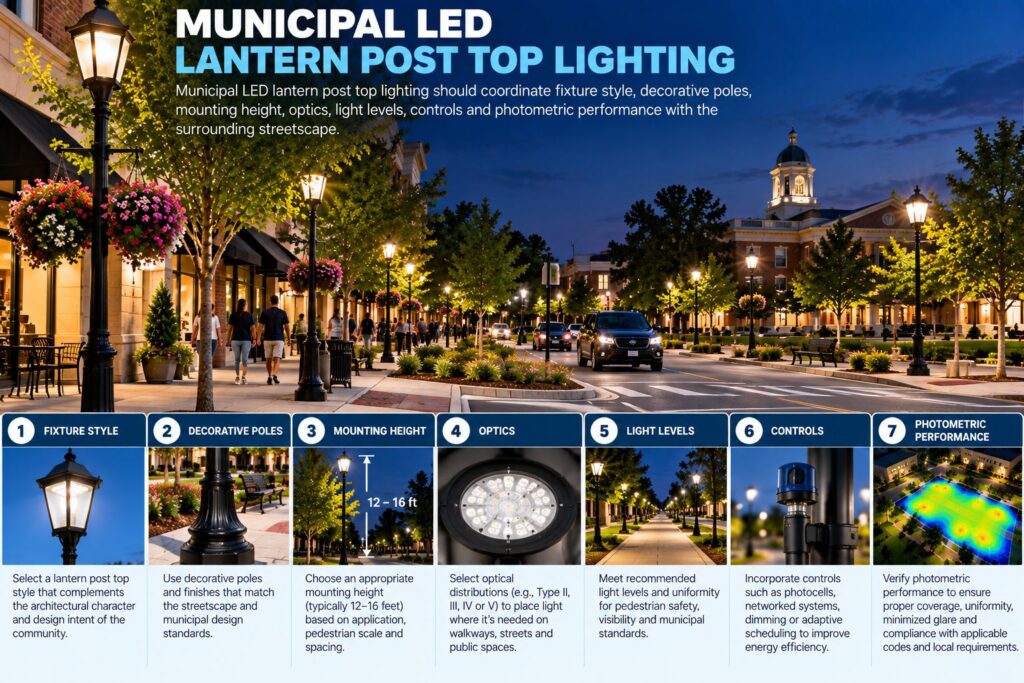
Municipal LED lantern post top lighting should coordinate fixture style, decorative poles, mounting height, optics, light levels, controls and photometric performance with the surrounding streetscape.
Planning a Municipal Lantern Lighting Project?
Municipal lantern lighting involves more than selecting an attractive fixture. Existing or proposed poles, mounting heights, streets and sidewalks, optical distribution, light levels, controls and project specifications should be evaluated before luminaires are ordered.
LED PROS WorldWide can help contractors, municipalities, engineers and project teams identify commercial LED post top lanterns for downtown streetscapes, parks, civic districts, pedestrian corridors and redevelopment projects.
For available fixture options, explore our LED Post Top Lanterns.
Call 844-533-7767 to discuss your project or request a quote.
Start With the Streetscape, Not the Fixture
A common mistake in decorative municipal lighting is beginning with the appearance of the luminaire.
Architectural appearance matters, but fixture selection should begin with the environment the lighting system must serve.
Review:
- Street and sidewalk widths
- Pedestrian areas
- Intersections and crossings
- Building setbacks
- Existing pole locations
- Proposed pole locations
- Landscaping and street trees
- Plazas and gathering spaces
- Adjacent properties
- Architectural character
- Required illumination
- Existing municipal infrastructure
- Maintenance practices
A lantern that performs well along a narrow pedestrian corridor may not be appropriate for a broad civic plaza or street requiring greater lateral coverage.
The fixture must fit both the architecture and the lighting task.
Define the Role of the Lantern Lighting
Municipal lanterns can perform different functions depending on the project.
They may provide:
Pedestrian lighting. Sidewalks, promenades, plazas and public gathering spaces.
Streetscape illumination. General lighting along downtown commercial corridors and municipal streets.
Architectural identity. A recognizable fixture and pole family that helps define a downtown or historic district.
Wayfinding. Visual continuity along pedestrian routes and public spaces.
Supplemental roadway lighting. Decorative luminaires may contribute to street illumination where their photometric performance is appropriate.
Public-space lighting. Parks, civic campuses, courthouses, libraries and municipal facilities.
Defining the primary function helps determine the required mounting height, lumen output, optical distribution and pole spacing.
Historic, Traditional or Contemporary Lantern Style?
Municipal lanterns are available in architectural styles ranging from traditional and colonial forms to simplified contemporary designs.
Historic downtowns may favor lanterns that complement existing masonry, storefronts, civic architecture and decorative poles. New mixed-use districts may use a modern interpretation of the lantern form while maintaining a pedestrian-scale streetscape.
The fixture should be evaluated with the complete streetscape rather than independently.
Consider:
- Fixture proportions
- Pole style
- Pole height
- Pole base
- Finish
- Lens or enclosure appearance
- Surrounding architecture
- Street furniture
- Signage and wayfinding
- Other municipal lighting fixtures
For projects where historic architectural character is the primary design consideration, see our Historic Lantern Post Lighting for Streetscapes & Public Spaces guide.
Coordinate the Lantern With the Decorative Pole
The luminaire and pole should be specified as a coordinated assembly.
Verify:
- Pole height
- Pole-top dimensions
- Tenon or fitter dimensions
- Fixture mounting method
- Fixture weight
- Pole material
- Pole diameter
- Base configuration
- Anchor-bolt requirements
- Finish
- Electrical access
- Handhole configuration
- Structural requirements
For retrofit projects, never assume a new lantern will fit an existing decorative pole simply because both are described as post top fixtures.
Existing pole dimensions and mounting configuration should be verified before the replacement luminaire is ordered.
ANSI C136 includes standards addressing roadway and area-lighting equipment, including post-top luminaires and luminaire attachment features. The applicable standard depends on the equipment and project rather than every decorative lantern being subject to one generic C136 requirement.
Select the Appropriate Mounting Height
Municipal post top lighting does not have one standard mounting height.
Lower and moderate mounting heights can maintain pedestrian scale, while taller poles may provide broader coverage across larger streetscape areas.
Our existing Post Top Lighting Pole Height Guide explains that mounting height influences distribution, spacing, illumination, uniformity, glare and architectural scale. Industrial Lighting
For municipal lantern projects, consider:
- Width of the illuminated area
- Fixture output
- Optical distribution
- Required illumination
- Pole spacing
- Pedestrian scale
- Architecture
- Glare
- Street trees and landscaping
- Maintenance access
A taller pole does not automatically provide a better lighting system, and a lower pole is not automatically more appropriate for pedestrians.
The selected fixture must perform correctly at the proposed mounting height.
Pole Proportion Matters
Photometric performance is only one consideration.
A large lantern mounted on a short, narrow pole can appear visually oversized. A small lantern placed high on a substantial decorative pole can appear undersized.
Municipal streetscape design should coordinate:
Fixture size + pole height + pole diameter + base + surrounding architectural scale
This becomes especially important when the same fixture family will be repeated for several blocks.
A proportion problem repeated once may be minor. Repeated dozens or hundreds of times along a streetscape, it becomes part of the district’s visual identity.
Determine Pole Spacing Through Photometric Performance
There is no universal spacing distance for municipal lanterns.
Pole spacing depends on:
- Mounting height
- Delivered lumens
- Optical distribution
- Sidewalk and street width
- Required illumination
- Uniformity
- Fixture orientation
- Landscaping
- Buildings
- Intersections
- Site geometry
Our Post Top Lighting Spacing Guide explains why mounting height provides only a starting point and why photometric performance should ultimately determine the layout. Industrial Lighting
This is especially important in municipal projects because poles may need to coordinate with trees, benches, curb ramps, hydrants, signs, utilities and other streetscape infrastructure.
Select the Correct Optical Distribution
Two lanterns with similar wattage and lumen output can illuminate a streetscape very differently.
Optical distribution determines where the lumens go.
Depending on the luminaire, available distributions may include:
| Distribution | General Design Characteristic | Potential Streetscape Application |
|---|---|---|
| Type II | Narrower lateral pattern | Narrow streets, pathways and elongated pedestrian areas |
| Type III | Broader lateral/forward distribution | Street edges, sidewalks and perimeter-oriented locations |
| Type IV | More forward-oriented distribution | Locations requiring stronger forward projection and reduced backlight |
| Type V | Broad symmetrical distribution | Plazas, squares and open areas with centrally located poles |
These are starting points, not guarantees of site performance.
The fixture’s actual photometric data should be evaluated for the proposed mounting height and location.
One Streetscape Can Use More Than One Distribution
A municipal project does not necessarily need one optical distribution everywhere.
For example:
- A sidewalk corridor may use one distribution.
- A street-edge pole may require another.
- An open civic plaza may benefit from Type V.
- A perimeter location near buildings may require tighter backlight control.
- An intersection may create different coverage requirements from the middle of a block.
Using different optics within the same architectural fixture family can maintain a consistent daytime appearance while adapting nighttime performance to different areas of the streetscape.
Specify Light Levels and Uniformity
A municipal lantern specification should identify the lighting performance required by the project rather than relying only on fixture wattage or lumens.
Depending on the application, the design may evaluate:
- Average illumination
- Minimum illumination
- Maximum illumination
- Uniformity
- Pedestrian areas
- Roadway areas
- Crosswalks
- Intersections
- Plazas
- Property boundaries
- Building entrances
Required criteria can vary according to the application, municipality, project specification and applicable lighting guidance.
Avoid using a universal foot-candle value for every streetscape.
Require Fixture-Specific Photometric Data
Photometric analysis is one of the most useful tools in municipal fixture selection.
An IES photometric file can model the performance of a specific luminaire configuration at the proposed mounting height and location.
A photometric plan can evaluate:
- Pole locations
- Pole spacing
- Mounting height
- Fixture output
- Optical distribution
- Average illumination
- Minimum illumination
- Maximum illumination
- Uniformity
- Spill light
- Property boundaries
This allows changes to be made before poles and fixtures are purchased.
It is considerably easier to change an optic or pole location during design than after a streetscape has been constructed.
Control Glare, Uplight and Light Trespass
Decorative appearance should not come at the expense of nighttime visual comfort.
Post top lanterns can be particularly sensitive to glare because the illuminated fixture is often within the normal field of view of pedestrians and drivers.
Evaluate:
- High-angle brightness
- Uplight
- Backlight
- Fixture output
- Mounting height
- Optical control
- Adjacent buildings
- Residential properties
- Roadways
- Driver viewing angles
BUG classifications can provide information about a luminaire’s Backlight, Uplight and Glare, but they are only one input into the overall site design. Our Commercial Outdoor Lighting BUG Ratings Explained guide discusses how BUG data applies to post top and municipal lighting.
Incorporate Responsible Outdoor Lighting Principles
Municipal projects increasingly consider how much light is used, where it goes and how long it operates.
DarkSky International’s responsible outdoor lighting principles emphasize lighting that is useful, targeted, no brighter than necessary, controlled and warmer-colored where appropriate. DarkSky International
For lantern streetscapes, this can translate into:
- Limiting unnecessary uplight
- Selecting appropriate lumen packages
- Controlling light beyond the intended area
- Avoiding excessive brightness
- Using shielding or controlled optics where needed
- Selecting appropriate CCT
- Dimming during lower-activity periods where appropriate
A decorative fixture should not automatically be considered Dark Sky-friendly because it uses LEDs or warm light.
Actual optical and site performance matter.
Select an Appropriate Color Temperature
Color temperature influences how a streetscape appears after dark but should not be confused with brightness, glare or optical distribution.
Historic and pedestrian-oriented districts may favor warmer CCTs, while other municipal applications may specify different values.
Consider:
- Surrounding architecture
- Existing municipal lighting
- Historic-district requirements
- Local ordinances
- Pedestrian environment
- Adjacent residential properties
- Project-wide lighting standards
Consistency can be particularly important when a new lantern system is being installed across multiple downtown blocks.
Specify Controls at the Beginning of the Project
Controls should be considered during fixture specification rather than added as an afterthought.
Potential strategies include:
- Photocells
- Dimming
- Scheduling
- Networked lighting controls
- Remote monitoring
- Adaptive output
- Compatible control receptacles
DOE’s municipal outdoor-lighting control guidance recognizes that networked systems can provide monitoring and control capabilities and potentially reduce energy and maintenance costs, while also emphasizing that cities and agencies should evaluate which capabilities actually provide value for their system.
Controls can reduce unnecessary operating hours or output.
They cannot correct poor optical distribution, inappropriate pole spacing or excessive fixture output.
NEMA Receptacles and Future Controls
Some municipal luminaires may be available with standardized receptacles for photocells or more advanced controls.
When a project requires a particular control interface, verify:
- Receptacle configuration
- Controller compatibility
- Luminaire wiring
- Dimming capability
- Control voltage
- Network requirements
- Required standards
- Future replacement compatibility
Do not specify a receptacle merely because it appears on a fixture option list.
The control architecture should determine what is required.
Understand ANSI C136 Requirements
ANSI C136 should not be treated as one universal municipal-lighting certification.
It is a family of standards addressing different aspects of roadway and area-lighting equipment. The ANSI catalog identifies standards covering components and luminaires, while current standards include subjects such as post-top luminaires, luminaire attachments and electrical transient immunity.
For a municipal project, determine which specific C136 requirements are actually referenced by the specification.
This is more precise than requesting a fixture that is simply described as “ANSI C136 compliant.”
Evaluate DLC Qualification Where Applicable
The DesignLights Consortium specifically recognizes Outdoor Pole/Arm-Mounted Decorative Luminaires, including in-town street lights, historical reproductions, acorns, post tops, lanterns and teardrops, as an eligible product category.
However, DLC qualification should be verified for the specific model and configuration being considered.
DLC states that products must qualify under their applicable Primary Use Designation, and qualification claims should correspond to the application under which the product was qualified.
DLC listing may be relevant when:
- Required by the project specification
- Required by a utility incentive program
- Used as part of municipal procurement criteria
- Requested by the engineer or owner
Do not assume every decorative lantern is DLC Listed or that DLC listing is required for every municipal project.
Specify Surge Protection and Electrical Requirements
Outdoor municipal luminaires operate in an environment where electrical transients can damage electronic components.
The project specification should address relevant electrical requirements such as:
- Input voltage
- Driver
- Dimming
- Surge protection
- Grounding
- Controls
- Electrical connections
ANSI C136.2-2023 addresses dielectric withstand and electrical transient immunity for roadway and area-lighting luminaires and control devices.
The appropriate surge requirements should come from the project specification and equipment requirements rather than assuming one universal kV rating for every municipality.
Consider Environmental Conditions
Municipal lighting may remain outdoors for decades, so fixture and pole construction should reflect the environment.
Review:
- Wet-location listing
- Ingress protection
- Ambient operating temperature
- Coastal exposure
- Salt air
- Humidity
- Snow and ice
- Wind
- Vibration
- Corrosion resistance
- Finish system
A lantern installed along an inland downtown sidewalk may face different environmental conditions from the same fixture installed in a coastal municipality.
Coordinate Banner Arms, Signage and Streetscape Accessories
Decorative poles frequently support more than luminaires.
Municipal streetscape plans may incorporate:
- Banner arms
- Hanging flower baskets
- Wayfinding signs
- Street-name signs
- Seasonal decorations
- Decorative bases
- Other approved accessories
These should be coordinated during pole specification.
Accessories add physical loads and can affect pole requirements. Their placement can also affect fixture access and maintenance.
Do not assume that a decorative lighting pole can accept banners, signs or other attachments merely because they are shown in a streetscape concept drawing.
The complete pole assembly should be evaluated for the intended configuration.
Coordinate Lighting With Street Trees and Landscaping
Street trees are one of the most common obstacles to effective decorative streetscape lighting.
A lantern may perform well when initially installed but become partially blocked as tree canopies mature.
Coordinate:
- Pole locations
- Tree locations
- Mature canopy dimensions
- Mounting heights
- Fixture distributions
- Maintenance practices
Lighting poles and trees should not be laid out independently.
Photometric planning should consider both existing and proposed landscaping whenever possible.
Plan for Maintenance and Replacement
Municipal lighting systems should be designed for long-term operation, not just initial installation.
Consider:
- Driver access
- Surge-device replacement
- Control replacement
- Lens or enclosure cleaning
- Fixture access
- Pole handholes
- Replacement parts
- Finish repair
- Standardization across the district
- Inventory requirements
Using a limited number of fixture families, optics, drivers and control configurations can simplify maintenance compared with installing many unrelated products.
New Construction vs. Existing Streetscape Retrofit
A new streetscape allows pole locations, electrical infrastructure and fixture selection to be developed together.
Retrofit projects have additional constraints.
Before replacing existing lanterns, document:
- Existing fixture
- Existing pole
- Pole condition
- Pole height
- Tenon or fitter dimensions
- Voltage
- Existing wattage
- Existing controls
- Existing spacing
- Existing light levels
- Existing electrical infrastructure
Existing decorative poles may sometimes be retained, but mounting, structural and electrical compatibility should be verified before replacement luminaires are ordered.
The live LED Post Top Lanterns page similarly recommends verifying pole dimensions, tenon/fitter size, fixture weight, mounting method and electrical requirements when reusing existing poles.
Municipal Lantern Lighting Specification Checklist
| Specification Item | Information to Verify |
|---|---|
| Application | Street, sidewalk, plaza, park, civic area or mixed-use district |
| Architectural style | Historic, traditional, transitional or contemporary |
| Fixture quantity | Total project requirement |
| Pole | Existing or new |
| Mounting height | Proposed fixture height |
| Mounting interface | Tenon, fitter or other mounting configuration |
| Voltage | Project electrical service |
| Lumen output | Required output/configuration |
| Optical distribution | Fixture-specific distribution |
| CCT | Project-required color temperature |
| Photometrics | IES file and site analysis |
| Glare/uplight | Project requirements and fixture performance |
| Controls | Photocell, dimming, networked or other |
| Control receptacle | If required |
| DLC qualification | Verify specific configuration if required |
| ANSI/NEMA requirements | Verify specific standards referenced by project |
| Surge protection | Project/manufacturer requirement |
| Environmental rating | Wet location, ingress and environmental conditions |
| Finish | Color and corrosion requirements |
| Pole accessories | Banner arms, signs, baskets or other attachments |
| Submittals | Cut sheets, photometrics, drawings and certifications |
| Delivery | Quantity, project schedule and required delivery date |
