
Solar bollard lights provide reliable pathway illumination for parks, campuses, commercial landscapes, and pedestrian walkways without requiring underground electrical infrastructure. These compact lighting fixtures integrate solar panels, LED luminaires, and battery storage into a self-contained lighting system designed for safe and efficient outdoor illumination.
Unlike traditional wired bollard lights that require trenching and electrical connections, solar bollard lights operate independently by collecting solar energy during the day and storing it in onboard batteries for nighttime lighting. This off-grid design makes solar bollards ideal for locations where electrical infrastructure is expensive, disruptive to install, or environmentally undesirable.
Solar bollard lighting is widely used in parks, corporate campuses, hospitality properties, pedestrian pathways, and waterfront developments where subtle ground-level lighting improves visibility while preserving the surrounding landscape.
For a broader overview of off-grid solar infrastructure lighting, explore our Solar Lighting Systems resource.
Solar Bollard Lighting
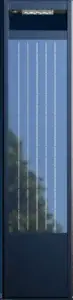
Terra
Brand: E-Lite
Solar Bollard with Vertical solar panels; rectangular silhouette; 42″ H; Prices start at $400.
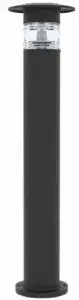
Titan-005
Brand: Beyond
Solar Lawn Light, Ground Mounting; LED Bollard; 43″ and 31″ H; Prices start at $400.
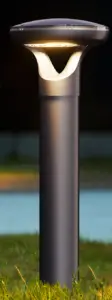
Hestia
Brand: Eco
Solar Lawn Light, LED Bollards; IK10 vandal-resistant construction; Bidirectional lighting; 35″ H; Prices start at $400.
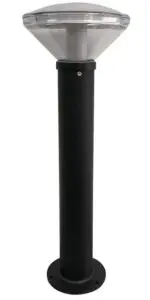
AVS
Brand: Beyond
Vandal Resistant Solar Bollards; IK10++ impact Rating; Dome Top;
Marine Grade Coating; dusk to dawn; 31.5″ H; Prices start at $300.
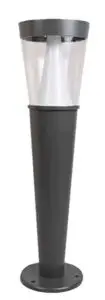
Titan
Brand: Beyond
Available in 5 different styles; 31.5″ to 39″ H; Works for 23 Hours; After 6 Hour Full Charge; polycarbonate diffuser; Prices start at $400.
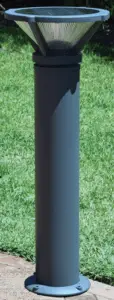
Lyra
Brand: Eco
Commercial grade solar bollard light; 350 lumens; dusk to dawn operation;39″ H;
Prices start at $400.
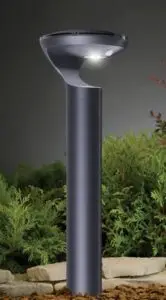
Eris
Brand: Eco
Premium grade solar bollard, asymmetrical lighting pattern; PIR motion sensor to save energy; Dark Sky compliant, 31.50″ Ht: 280 lumens,
Prices start at $400.
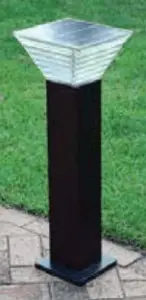
Andromeda
Brand: Eco
Commercial-grade solar bollard
light; powder coat satin black, polycarbonate diffuser; 350 lumens; 31.4″ Height; Prices start at $400.
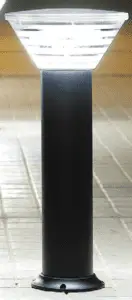
Orion
Brand: Eco
Vandal resistant, Remote controlled RGB, CCT color selection; 360 lumens; 35″ Height; Prices start at $400.
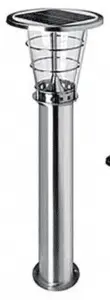
Sirius
Brand: Eco
solar bollard; Stainless steel; polycarbonate diffuser; 300 lumens;
Prices start at $450.
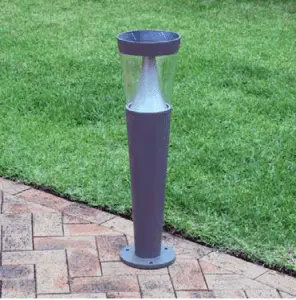
Gemini
Brand: Eco
solar powered bollard lights; 18 high-intensity LEDs; 200 lumen output;
Anti-corrosive aluminum body; polycarbonate diffuser; Prices start at $450.
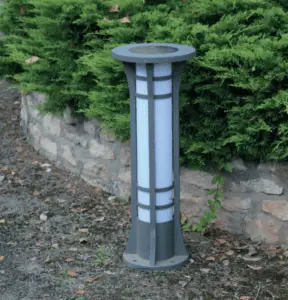
Antares
Brand: Eco
featuring opaque diffuser; dusk to dawn operation; Attractive modern design; powder coated to a satin
grey finish; Prices start at $450.
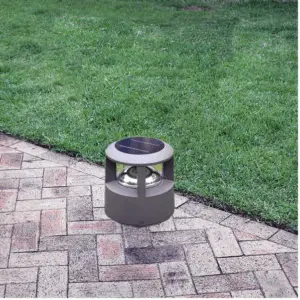
Taurus
Brand: Eco
aluminum and powder-coated to a satin grey or black finish; Commercial grade solar light; 200 lumens; H9.84″;
Prices start at $350.
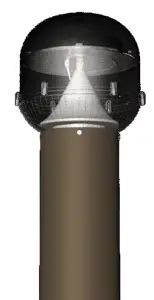
Sundial
Brand: SolTech
ideal for pedestrian lighting, commercial pathway lighting; choose from three heights; features a full 360 design to track full sunlight source; 300 lumens; ground, wall mount options; Prices start at $400.
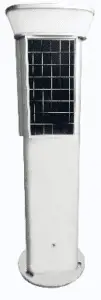
Mini Helios
Brand: Nomo
the triangle design maximizes the collection of the solar panel; 39″ Height; Super bright LED chips-over 280 pcs; 2,000 lumens; 70W;
Prices start at $450.
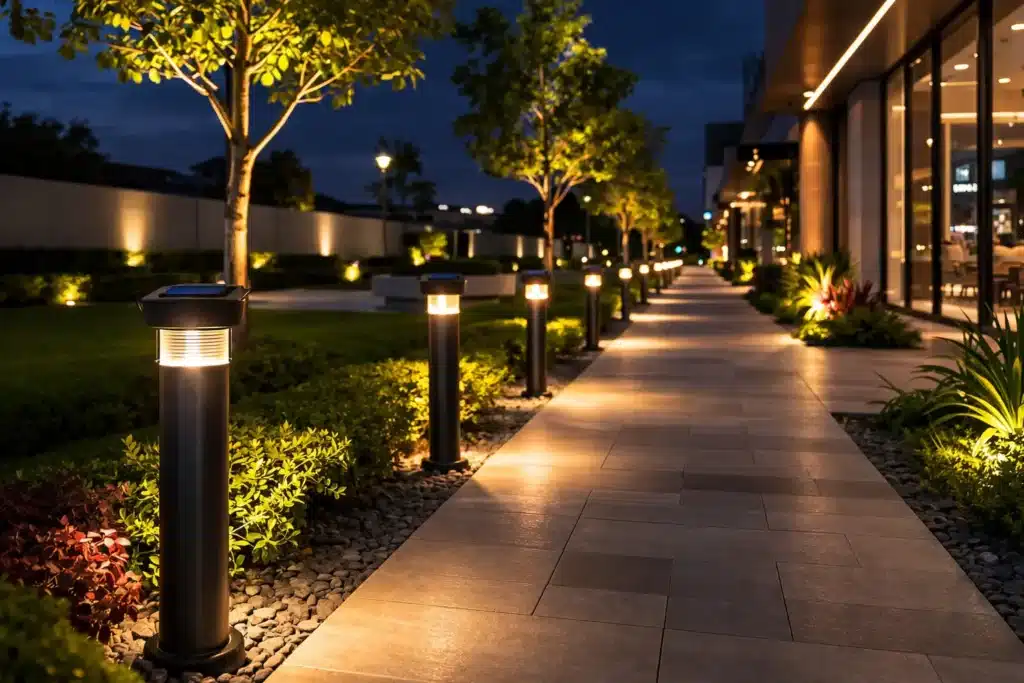
What Are Solar Bollard Lights?
Solar bollard lights are freestanding outdoor lighting fixtures designed to illuminate walkways, paths, and landscape areas using solar energy instead of grid electricity. These fixtures typically stand between two and four feet tall and are engineered to provide soft, evenly distributed illumination at pedestrian scale.
Many pathway lighting projects use solar bollard lights to guide pedestrians safely along walkways and landscaped outdoor spaces.
Solar bollard lights integrate several components into a single fixture:
• Photovoltaic solar panels
• High-efficiency LED light source
• Rechargeable battery storage
• Automatic dusk-to-dawn sensors
• Durable outdoor housing
During daylight hours, solar panels capture sunlight and convert it into electrical energy that is stored in the battery. When darkness falls, the LED light automatically activates, providing consistent pathway illumination throughout the night.
Interested in where commercial solar lighting is headed? Explore Solar Bollards: The Future of Outdoor Lighting to learn how advances in LED technology, battery systems, smart controls, and connected infrastructure are shaping the next generation of outdoor lighting.
Why Solar Bollard Lighting Is Growing in Popularity
Solar bollard lighting systems have become increasingly popular for pedestrian environments because they combine energy efficiency with simplified installation and long-term cost savings.
No Trenching or Electrical Wiring
Traditional bollard lighting requires trenching, conduit installation, and electrical infrastructure. Solar bollard lights eliminate these requirements because they operate independently using solar energy.
Improved Pedestrian Safety
Bollard lights are specifically designed to illuminate pathways and walking areas without producing excessive glare. Their low mounting height provides targeted illumination that helps pedestrians navigate safely at night.
Learn how commercial organizations are reducing installation costs while improving pedestrian safety in our guide to The Bright Future of Solar Powered Bollard Lights in Commercial Spaces.
Energy Efficiency
Solar bollard lights generate electricity using renewable solar energy, eliminating electrical consumption and reducing long-term operating costs.
Minimal Maintenance
Because solar bollard lighting systems use LED technology and rechargeable batteries, they require very little maintenance beyond occasional cleaning and battery replacement over time.
Key Components of Solar Bollard Lighting Systems
Solar Panels
Integrated photovoltaic panels capture sunlight and generate electricity for the lighting system.
LED Lighting Module
Energy-efficient LEDs provide bright, uniform illumination while consuming minimal energy.
Rechargeable Battery Storage
Rechargeable batteries store solar energy collected during the day and power the fixture at night.
Automatic Lighting Controls
Most solar bollard lights include automatic dusk-to-dawn sensors that activate the lighting system when daylight fades.
Applications for Solar Bollard Lights
Solar bollard lighting is commonly used in environments where pedestrian guidance lighting is needed.
Parks and Recreational Trails
Solar bollards provide pathway lighting in parks and nature trails without disturbing landscapes with electrical trenching.
Solar bollards are one element of a complete outdoor lighting strategy. Discover how they integrate with decorative post tops, pathway lighting, wall packs, and traffic safety systems in our guide to Commercial Solar Outdoor Lighting for Campuses, Communities & Public Spaces.
University Campuses
Campus walkways and pedestrian corridors frequently use bollard lighting to improve nighttime safety.
Resorts and Hospitality Properties
Hotels and resorts use solar bollard lighting to create elegant landscape illumination while reducing energy consumption.
For commercial landscapes requiring a compact decorative fixture, the Eco Hestia Solar Lawn Light provides up to 280 lumens in a premium solar-powered design for pathways, landscaped areas, campuses, parks, and other commercial outdoor spaces.Commercial and Corporate Campuses
Corporate campuses often install bollard lighting along walkways, entrances, and landscaped outdoor areas.
Commercial properties increasingly use solar pathway lighting to improve pedestrian safety while reducing installation costs. Learn more about the benefits in our article on revolutionizing commercial lighting with solar powered bollards.
Waterfront Developments and Boardwalks
Solar bollard lights provide reliable lighting for coastal pathways and waterfront promenades where electrical infrastructure may be difficult to install.
Additional Commercial Solar Bollard Options
For projects requiring different architectural styles and materials, additional options include the Sirius Range Solar Bollard, featuring commercial-grade 304 stainless-steel construction, and the Eco Hestia Solar Lawn Light, a compact decorative solar bollard for upscale pathways and landscaped areas.
Solar Pathway and Walkway Lighting with Bollard Fixtures
Solar bollard lights are one of the most widely used solutions for solar pathway lighting and pedestrian walkway illumination. Their low mounting height and directional optics make them ideal for guiding pedestrians safely along walkways, trails, plazas, and landscaped outdoor spaces.
Unlike overhead lighting fixtures that may create glare or uneven illumination, bollard lights provide consistent ground-level lighting that improves visibility without overwhelming the surrounding environment. This makes them particularly effective for pedestrian areas where subtle lighting improves safety while preserving the aesthetics of the landscape.
Solar pathway lighting systems using bollard fixtures are commonly installed in:
• public parks and recreational trails
• university campuses and school walkways
• commercial office campuses
• hospitality and resort properties
• waterfront boardwalks and promenades
• landscaped pedestrian plazas
Planning a commercial pathway or landscape project? Our Commercial Solar Bollard Lighting Guide covers fixture selection, spacing, battery runtime, applications, and design considerations for parks, campuses, HOA communities, and commercial properties.
Because solar bollard lighting systems operate independently from electrical infrastructure, they can be installed quickly without trenching or conduit installation. This makes them especially valuable for projects where preserving landscaping or minimizing construction disruption is a priority.
Solar powered bollards are increasingly used in parks, campuses, and commercial landscapes. For a deeper look at the technology and applications, read our article on solar bollards and the future of outdoor lighting.
In addition to walkway illumination, solar bollard lighting can be integrated with other off-grid solar lighting systems to provide comprehensive outdoor illumination for commercial and municipal properties.
Solar Bollard Lighting Design Considerations
Successful solar bollard lighting installations require careful planning to ensure reliable illumination.
Spacing and Layout
Bollard lights are typically spaced between 10 and 15 feet apart to create smooth lighting coverage along pathways.
Solar Exposure
Solar panels should receive unobstructed sunlight to ensure adequate energy generation.
Environmental Durability
Fixtures should be designed with weather-resistant materials capable of withstanding rain, humidity, and temperature fluctuations.
Light Distribution
Well-designed bollard fixtures provide downward illumination that minimizes glare and light pollution while guiding pedestrians safely.
Looking for inspiration beyond fixture specifications? Explore Lighting the Way: The Power of Solar Bollards in Outdoor Design to see how architects and landscape designers use bollard lighting to create safe, attractive outdoor environments.
Inline Buyer Q&A
Where are commercial solar bollard lights most useful?
Solar bollard lights are well suited to pedestrian-scale applications where extending electrical service may be difficult, disruptive, or expensive.
Common applications include walkways, pathways, parks, campuses, resorts, courtyards, landscaped commercial properties, HOA common areas, and municipal pedestrian spaces.
Available solar exposure, required illumination, operating schedule, fixture spacing, mounting configuration, and surrounding conditions should be considered before selecting a system.
Are solar bollard lights bright enough for commercial walkways?
They can provide appropriate pedestrian-scale illumination when properly selected and spaced for the application.
Required output depends on pathway width, fixture distribution, spacing, surrounding ambient light, property use, and applicable project requirements.
More output is not necessarily better. Excessive brightness can contribute to glare and undermine the visual character expected from pedestrian-scale lighting.
How far apart should solar bollard lights be installed?
There is no universal spacing appropriate for every project.
Fixture output, optical distribution, bollard height, pathway width, desired illumination, surrounding conditions, and site geometry all affect spacing.
Manufacturer photometric data or a lighting layout can help determine appropriate spacing for larger commercial projects.
Do solar bollard lights need direct sunlight?
Solar bollards perform best when their solar panels receive adequate solar exposure.
Trees, buildings, landscaping, walls, structures, and other obstructions can create shading that reduces available charging energy.
Solar exposure should be evaluated at the proposed fixture locations, including seasonal changes where relevant.
Can solar bollards operate from dusk to dawn?
They can when the system is designed to support the required operating schedule.
Nightly runtime depends on solar-panel capacity, battery storage, fixture load, controls, seasonal solar availability, temperature, shading, and charging conditions.
Some applications may also use scheduled dimming or motion-responsive controls to manage stored energy.
Can solar bollards be used instead of wired bollard lights?
Yes, in suitable applications.
Solar bollards can be particularly useful where trenching, conduit, wiring, or extending electrical service would be difficult or expensive.
Where electrical infrastructure is already readily available, wired and solar systems should be compared according to lighting performance, installation requirements, controls, maintenance, and long-term project objectives.
What information should I provide when selecting commercial solar bollard lights?
Useful project information includes:
- Project location
- Pathway or site dimensions
- Application and property type
- Required or desired illumination
- Proposed bollard locations
- Desired fixture spacing
- Nightly operating schedule
- Dimming or motion-control requirements
- Solar exposure and potential shading
- Temperature and environmental conditions
- Architectural requirements
- Dark Sky or light-trespass objectives
- Photographs, drawings, or site plans when available
These details help determine whether solar bollards are appropriate and how the fixtures should be configured.
Bring Off-Grid Lighting to Commercial Walkways and Landscapes
Solar bollard lighting combines pedestrian-scale illumination with independent solar power, making it particularly useful where extending electrical infrastructure would be costly or disruptive.
Fixture output, distribution, spacing, solar exposure, battery capacity, runtime, controls, architecture, and site conditions should all be considered when selecting a commercial system.
Our lighting specialists can help evaluate solar bollard lighting for pathways, campuses, parks, resorts, HOA properties, courtyards, and other commercial or municipal pedestrian environments.
Call 1-844-533-7767 to discuss your solar bollard lighting project.
Frequently Asked Questions About Solar Bollard Lights
What are solar bollard lights used for?
Solar bollard lights are commonly used for pedestrian-scale illumination along pathways, walkways, parks, campuses, courtyards, landscaped areas, entrances, and other commercial or municipal outdoor spaces.
Their low mounting height and architectural form make them different from pole-mounted area or roadway lighting.
Are solar bollard lights bright enough for pathways?
They can be when fixture output, distribution, spacing, and site conditions are appropriate for the application.
The objective is generally to provide useful pedestrian-scale illumination without excessive brightness or glare.
Specific illumination requirements should be determined according to the property and applicable project criteria.
Do solar bollard lights require electrical wiring?
Off-grid solar bollards do not require a conventional utility connection or underground branch wiring back to a grid-powered lighting circuit.
The fixture itself still contains electrical components and connections between the solar panel, battery, controller, LEDs, and other components according to its design.
Can solar bollard lights eliminate trenching?
In many applications, yes.
Because individual solar bollards can operate independently of grid power, they can avoid trenching and conduit required to extend conventional electrical service along a pathway or landscape area.
Foundation, mounting, and other site preparation may still be required.
How long do solar bollard lights operate at night?
Runtime depends on the system.
Battery capacity, solar-panel size, fixture load, operating profile, controls, solar exposure, seasonal conditions, temperature, and shading all influence nighttime operation.
Systems can be designed for dusk-to-dawn operation where the equipment and site conditions support that objective.
Do solar bollard lights work during cloudy weather?
They can continue operating using energy stored in their batteries during periods of reduced solar charging.
Available runtime depends on battery capacity, lighting load, controls, previous charging conditions, weather, temperature, and the system’s design.
Are solar bollard lights suitable for commercial properties?
Yes.
Commercial campuses, resorts, parks, HOA communities, hospitality properties, municipal spaces, courtyards, and other properties can use solar bollards where pedestrian-scale off-grid lighting is appropriate.
Commercial applications should use equipment suitable for the expected operating and environmental conditions.
Do solar bollard lights require maintenance?
Yes.
Depending on the system and environment, maintenance can include cleaning or inspecting solar panels, checking fixtures and mounting, evaluating batteries and controls, and trimming vegetation that begins to shade the solar panel.
Batteries and other components may eventually require replacement.
Are solar bollard lights Dark Sky friendly?
They can be selected and designed with Dark Sky objectives in mind, but solar power alone does not make a bollard Dark Sky friendly.
Fixture distribution, uplight, glare, output, shielding, color temperature, spacing, controls, and surrounding conditions should be considered as part of the lighting design.
Can motion sensors be used with solar bollard lights?
Yes, when supported by the selected fixture.
Motion-responsive operation, scheduled dimming, and other controls can reduce the lighting load during periods of limited activity and help manage stored battery energy.
The appropriate control strategy depends on how the pedestrian area is used.
Are solar bollards less expensive than wired bollard lighting?
Not necessarily.
Solar can reduce infrastructure costs where wired bollards would require substantial trenching, conduit, wiring, pavement or landscape restoration, and electrical service extensions.
Where electrical infrastructure already exists nearby, the comparison may be different.
Equipment, installation, maintenance, battery replacement, controls, and long-term operating requirements should all be considered.
Can solar bollards be used in landscaped areas with trees?
Potentially, but shading is an important consideration.
Trees and landscaping can reduce the solar energy available to the fixture, particularly as vegetation grows or seasonal conditions change.
Proposed locations should be evaluated for adequate solar exposure before installation.
How are solar bollards different from solar garden lights?
Commercial solar bollards are typically intended for more demanding pedestrian, commercial, institutional, hospitality, or municipal applications.
Solar garden lights can encompass a broader range of decorative and landscape products.
The appropriate product should be selected according to required illumination, construction, environmental exposure, operating profile, controls, and the demands of the installation.
Stay Connected with Our Lighting Resources
Add IndustrialLightingFixtures.org as a Preferred Source on Google to see more of our lighting guides and technical resources across Google Search experiences.

Related Solar Lighting Resources
- Solar Bollard Lighting Guide — Learn how solar exposure, fixture spacing, battery capacity, controls, and pedestrian-lighting requirements influence commercial solar bollard projects.
- Solar Lighting — Explore commercial off-grid lighting systems for pathways, parking areas, roadways, buildings, signs, and other exterior applications.
- Solar Garden Lights — Review solar landscape-lighting options for gardens, landscaped areas, pathways, and other outdoor environments.
- Solar Parking Lot Lights — Explore larger-scale pole-mounted solar systems for commercial parking areas and other open properties.
- Solar Flood Lights — Review directional off-grid solar lighting for selected outdoor areas, building surroundings, landscapes, and other commercial applications.