
Indoor tennis court lighting must provide consistent visibility across the playing surface and overhead ball path while controlling glare for players looking upward during serves, lobs, and overhead shots. Ceiling height, fixture mounting, optical distribution, light levels, and uniformity all influence how well the court performs.
LED indoor tennis lighting can be designed for tennis clubs, schools, universities, recreation centers, field houses, private clubs, and multi-court facilities. The lighting system should be planned around the building dimensions, court configuration, level of play, and existing structure rather than fixture wattage alone.
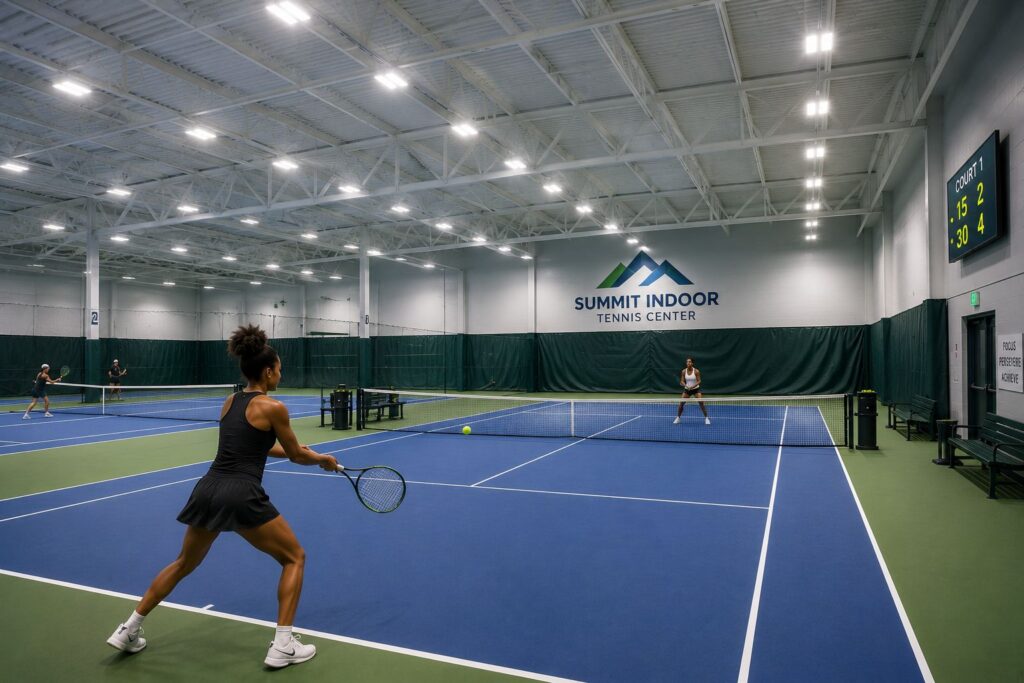
Indoor tennis court lighting requires coordinated fixture placement, mounting height, optics, and uniform illumination to maintain clear ball visibility across the playing surface.
Need Help With an Indoor Tennis Court Lighting Project?
Tell us the number of courts, building dimensions, ceiling or mounting height, existing fixtures, voltage, and intended level of play. We can help identify LED lighting fixtures and configurations for your indoor tennis facility.
Request a Quote or call 844-533-7767.
Explore our Commercial LED Sports Lighting Fixtures.
What Is Indoor Tennis Court Lighting?
Indoor tennis court lighting is designed to provide uniform illumination across the court while maintaining visibility of the ball throughout its flight. Because players frequently look upward, fixture placement and glare control are especially important.
Unlike outdoor courts, indoor facilities must work within the building structure. Ceiling height, roof trusses, fixture mounting locations, court spacing, wall and ceiling surfaces, and available electrical infrastructure can all influence the lighting design.
The objective is consistent visibility across the playing surface and overhead playing space without excessive glare, distracting shadows, or significant differences between bright and dark areas.
Indoor Tennis Court Lighting Levels & Foot-Candles
Indoor tennis court lighting levels should be established according to the intended level of play and applicable lighting requirements. Recreational clubs, schools, collegiate facilities, competitive venues, and tournament courts may require different illumination and uniformity.
Foot-candles measure the illumination reaching the playing surface, but average light level alone does not determine lighting quality. A successful indoor tennis lighting design should also consider:
-
Uniformity across the court
-
Ball visibility above the playing surface
-
Glare for players looking upward
-
Ceiling and fixture mounting height
-
Wall and ceiling reflectance
-
Fixture placement and optical distribution
-
Competition and video requirements, when applicable
The target maintained foot-candle level and uniformity should be established before fixtures are selected. A photometric layout can then evaluate whether the proposed fixtures, mounting locations, and optics will achieve those requirements throughout the courts.
Ceiling Height & Fixture Mounting
Ceiling height and building structure have a major influence on indoor tennis court lighting. Fixtures must provide adequate court coverage while remaining positioned to minimize glare and interference with the ball’s overhead flight path.
Important considerations include:
-
Ceiling and mounting height: Influences fixture output, beam distribution, spacing, and aiming.
-
Roof structure: Trusses, beams, mechanical equipment, and other obstructions can limit mounting locations.
-
Court configuration: Multi-court facilities require coordinated fixture placement to maintain consistent illumination between courts.
-
Player sightlines: Fixtures should be positioned and aimed to reduce direct glare when players serve or track high balls.
-
Maintenance access: Fixture locations should allow practical access for future service without unnecessarily disrupting court operations.
Fixture placement should be evaluated as part of the complete photometric design rather than determined solely by available ceiling locations.
Uplighting for Clear-Span Fabric Tennis Structures
Clear-span fabric tennis structures can use indirect uplighting, where fixtures are aimed toward the light-colored fabric ceiling rather than directly at the courts. The membrane reflects and distributes the light back toward the playing surface, creating broad, indirect illumination.
For tennis facilities, this approach can offer several advantages:
-
Reduced direct glare for players looking upward during serves and overhead shots
-
Broad, diffuse illumination across the playing area
-
Fewer bright fixture sources within normal player sightlines
-
Improved visual comfort in large clear-span facilities
The effectiveness of uplighting depends heavily on the reflectance and condition of the fabric membrane, mounting locations, fixture output, aiming, ceiling geometry, and distance between the luminaires and reflective surface.
Photometric modeling should account for the actual ceiling or membrane characteristics because an uplighting system relies on reflected light to achieve the required court-level illumination and uniformity.
Some indoor tennis facilities also combine indirect uplighting with direct lighting where additional illumination or more precise control is required.
🏟️Project Spotlight: Uplighting in a Clear-Span Fabric Sports Structure
We have worked on two indoor tennis court lighting projects involving clear-span fabric structures, where the reflective membrane ceiling became an important part of the lighting design.
Instead of relying entirely on fixtures aimed directly at the courts, uplighting can direct light toward the light-colored fabric membrane. The reflected light then provides broad, diffuse illumination across the playing area while reducing the number of high-intensity light sources directly within player sightlines.
These projects reinforced several factors that should be evaluated when designing this type of indoor tennis lighting system:
-
Reflectance and condition of the fabric membrane
-
Fixture mounting locations and available aiming angles
-
Distance between the fixtures and reflective surface
-
Required court-level illumination and uniformity
-
Player sightlines and glare control
-
Building dimensions and ceiling geometry
-
Photometric performance using the actual facility conditions
Project takeaway: A clear-span fabric tennis facility should not automatically be approached like a conventional steel-roof indoor court. The reflective ceiling can become part of the lighting strategy, making fixture selection, aiming, and project-specific photometric planning especially important.
Reflection & Interior Surfaces
Ceiling and wall surfaces can affect the performance of indoor tennis court lighting. Light-colored surfaces generally reflect more light into the space, while darker finishes absorb more light and may require additional fixture output to achieve the desired illumination.
Reflectance becomes particularly important in facilities using indirect uplighting, where the ceiling or fabric membrane is part of the lighting system. Its color, condition, and reflective characteristics should be included in the photometric design rather than assumed.
Interior finishes should therefore be considered along with fixture output, optics, mounting height, and placement when evaluating overall court illumination and visual comfort.
Indoor Tennis Court Lighting Layout & Uniformity
Indoor tennis court lighting layouts should distribute illumination consistently across the playing surface while keeping high-intensity fixture sources away from critical player sightlines.
For multi-court facilities, fixture placement should also account for court spacing, structural columns or roof members, divider curtains, and differences in mounting height across the building.
Good uniformity helps players track the ball as it moves between different areas of the court without repeatedly adjusting between bright and dark zones. A project-specific photometric layout can verify fixture locations, predicted light levels, uniformity, and potential glare before installation.
Single-Court vs Multi-Court Indoor Tennis Lighting
The number and arrangement of courts can significantly affect the lighting layout.
A single indoor court can be designed around one playing surface, allowing fixture locations and optics to be optimized specifically for that court.
In multi-court facilities, lighting should be coordinated across the entire playing area. Court spacing, divider curtains, structural elements, fixture mounting locations, and control zones can all influence the design.
Larger tennis centers especially benefit from complete photometric planning to maintain consistent light levels and uniformity from court to court rather than treating each court as an independent lighting installation.
Glare Control & Ball Visibility
Indoor tennis presents a unique glare challenge because players frequently look upward to serve and track high balls. Poorly positioned or overly bright fixtures can interfere with ball visibility even when court-level illumination is adequate.
Glare control depends on the relationship between fixture location, mounting height, optical distribution, aiming, and player sightlines. Light-colored ceilings and walls can also affect the visual environment through reflected light.
The objective is consistent visibility of the ball against the ceiling and background while avoiding distracting bright sources within normal lines of sight.
For facilities where glare or spill light requires additional attention, see our Sports Field Lighting Glare & Spill Light Control Guide.
Selecting the Right Color Temperature
Color temperature affects the appearance of an indoor tennis facility and should be considered along with light levels, glare, and color quality when selecting LED fixtures.
Neutral to cooler white LED lighting is commonly considered for sports facilities because it can provide a bright, clear visual environment. However, the appropriate color temperature depends on the facility, interior finishes, desired appearance, and any competition or broadcast requirements.
For retrofit projects, color temperature should also be evaluated before installation because changing from older metal halide or fluorescent lighting can noticeably change the appearance of the courts, walls, ceiling, and surrounding areas.
LED Retrofit Lighting for Indoor Tennis Courts
Older indoor tennis facilities may still use metal halide, fluorescent, or other legacy lighting systems. Upgrading these systems with modern industrial LED lighting fixtures can improve lighting quality while reducing energy use, maintenance requirements, and the time associated with lamp replacement.
A successful tennis court LED retrofit should consider more than replacing an existing fixture with a similar wattage. Existing mounting locations, ceiling height, court layout, fixture distribution, required light levels, and glare should all be evaluated.
For existing facilities, useful project information includes:
-
Current fixture type and wattage
-
Number and location of existing fixtures
-
Mounting or ceiling height
-
Available voltage
-
Number and dimensions of courts
-
Existing light levels, when available
-
Desired recreational or competitive level of play
Photometric modeling can help determine whether existing fixture locations can be reused or whether changes to fixture quantity, optics, positioning, or aiming would produce a better result.
Indoor Tennis Court Lighting Controls
Lighting controls can help indoor tennis facilities reduce energy use when courts are unoccupied and provide different lighting conditions for recreational play, training, competition, cleaning, or maintenance.
Depending on the lighting system, control options may include 0–10V dimming, occupancy sensors, scheduling, zoning, and wireless or networked controls. Multi-court facilities can also benefit from controlling individual courts or groups of courts independently.
Controls should be selected along with the LED fixtures and lighting design so that dimming, zoning, and switching requirements are compatible with the drivers and facility electrical system.
Indoor Tennis Court Lighting Buyer Checklist
Before requesting fixtures or a photometric layout for an indoor tennis facility, gather the basic project information that will influence fixture selection and placement:
-
Number of tennis courts
-
Court and building dimensions
-
Ceiling or fixture mounting height
-
Roof, truss, or clear-span building construction
-
Existing fixture locations, if this is a retrofit
-
Existing fixture type and wattage
-
Available voltage
-
Desired light levels and level of play
-
Direct lighting, indirect uplighting, or other mounting requirements
-
Dimming, zoning, or lighting control requirements
For retrofit projects, photographs of the existing courts and lighting system can also help identify mounting conditions and potential fixture replacement options.
Indoor Tennis Court Lighting Buyer Q&A
Can you recommend LED fixtures for an existing indoor tennis court?
Yes. Existing fixture type, wattage, mounting height, locations, voltage, court dimensions, and photographs of the facility can help determine suitable LED replacement options. For larger retrofits, a photometric layout may be recommended before final fixture selection.
Can existing fixture locations be reused for an LED retrofit?
Often they can, but it should not be assumed. LED fixtures can have different optical distributions and light output than older metal halide or fluorescent systems. Photometric modeling can help determine whether existing locations will provide the required light levels and uniformity or whether fixture placement should be modified.
Can you help with lighting for multiple indoor tennis courts?
Yes. Multi-court facilities should be evaluated as a complete lighting system. Court spacing, ceiling height, structural conditions, divider curtains, fixture locations, controls, and the desired level of play can all be considered when developing fixture recommendations.
Can you help with indirect uplighting for a fabric tennis structure?
Yes. Clear-span fabric structures and other facilities using reflected uplighting require different fixture selection and photometric considerations than conventional direct lighting. Ceiling or membrane characteristics, fixture mounting locations, aiming, reflectance, and required court-level illumination should be evaluated as part of the project.
Plan Your Indoor Tennis Court Lighting Project
Whether you are lighting a new indoor tennis facility, replacing an older metal halide or fluorescent system, or planning lighting for a multi-court or clear-span fabric structure, fixture selection should be based on the actual building and court requirements.
Send us your number of courts, building dimensions, ceiling or mounting height, voltage, existing fixture information, desired level of play, and any available plans or photographs. We can help evaluate LED fixture options and determine whether photometric planning is appropriate for your project.
Request a Quote or call 844-533-7767 to discuss your indoor tennis court lighting requirements.
Indoor Tennis Court Lighting FAQ
How much light is needed for an indoor tennis court?
The required illumination depends on the level of play, facility type, and applicable lighting requirements. Recreational, club, collegiate, and competitive courts may have different target light levels and uniformity requirements. A photometric layout can verify predicted foot-candles and uniformity before installation.
What is the best lighting for an indoor tennis court?
LED lighting is commonly used for indoor tennis facilities because fixtures can provide controlled optical distribution, high light output, dimming capability, and long service life. The appropriate fixture depends on ceiling height, court layout, mounting locations, required light levels, and glare-control requirements.
How does ceiling height affect indoor tennis court lighting?
Ceiling and mounting height affect fixture output requirements, beam distribution, spacing, and placement. Higher mounting heights may require greater fixture output or different optics, while lower installations require careful glare control because fixtures are closer to player sightlines.
How important is uniformity for indoor tennis lighting?
Uniformity is important because players must track a fast-moving ball across the entire court and through its overhead flight path. Large differences between bright and dark areas can make visual tracking more difficult even when the average light level appears adequate.
Can LED fixtures replace existing metal halide tennis court lights?
Yes, but LED replacements should not be selected by wattage alone. Existing fixture locations, mounting height, light levels, voltage, optical distribution, and court layout should be evaluated to determine the appropriate LED replacement and whether existing mounting locations can be reused.
Can uplighting be used in an indoor tennis facility?
Yes. Indirect uplighting can be particularly effective in clear-span fabric structures where fixtures illuminate a reflective ceiling or membrane that distributes light back toward the courts. Ceiling reflectance, fixture output, aiming, and photometric performance should be evaluated as part of the design.
What information is needed for an indoor tennis court lighting quote?
Useful information includes the number and dimensions of courts, building dimensions, ceiling or mounting height, voltage, existing fixture type and wattage for retrofit projects, desired level of play, and any available plans or photographs. These details help determine suitable fixture options and whether a photometric layout is recommended.
Stay Connected with Our Lighting Resources
Add IndustrialLightingFixtures.org as a Preferred Source on Google to see more of our lighting guides and technical resources across Google Search experiences.
Related Indoor Tennis Lighting Resources
-
Commercial LED Sports Lighting Fixtures — Explore LED lighting solutions for indoor and outdoor athletic facilities.
-
Outdoor Tennis Court Lighting Guide — Learn about outdoor tennis court layouts, pole heights, light levels, glare control, and lighting requirements.
-
Sports Field Lighting Guide — Review the fundamentals of commercial athletic field and sports facility lighting design.
-
Sports Field Lighting Glare & Spill Light Control Guide — Understand fixture placement, aiming, glare, and unwanted light control.
-
Sports Field LED Lighting Retrofit Guide — Learn what to evaluate when replacing older sports lighting systems with LED fixtures.
-
Sports Stadium & Athletic Complex High Mast Lighting Guide — Explore lighting considerations for larger athletic facilities and sports complexes.