
Warehouse aisles present unique lighting challenges that differ from open manufacturing floors and general storage areas. Tall storage racks, narrow aisle configurations, forklift traffic, and inventory picking operations require carefully planned lighting layouts that provide consistent illumination from floor level to the highest storage locations.
Proper warehouse aisle lighting design improves worker safety, inventory accuracy, operational efficiency, and overall facility performance while reducing energy consumption.
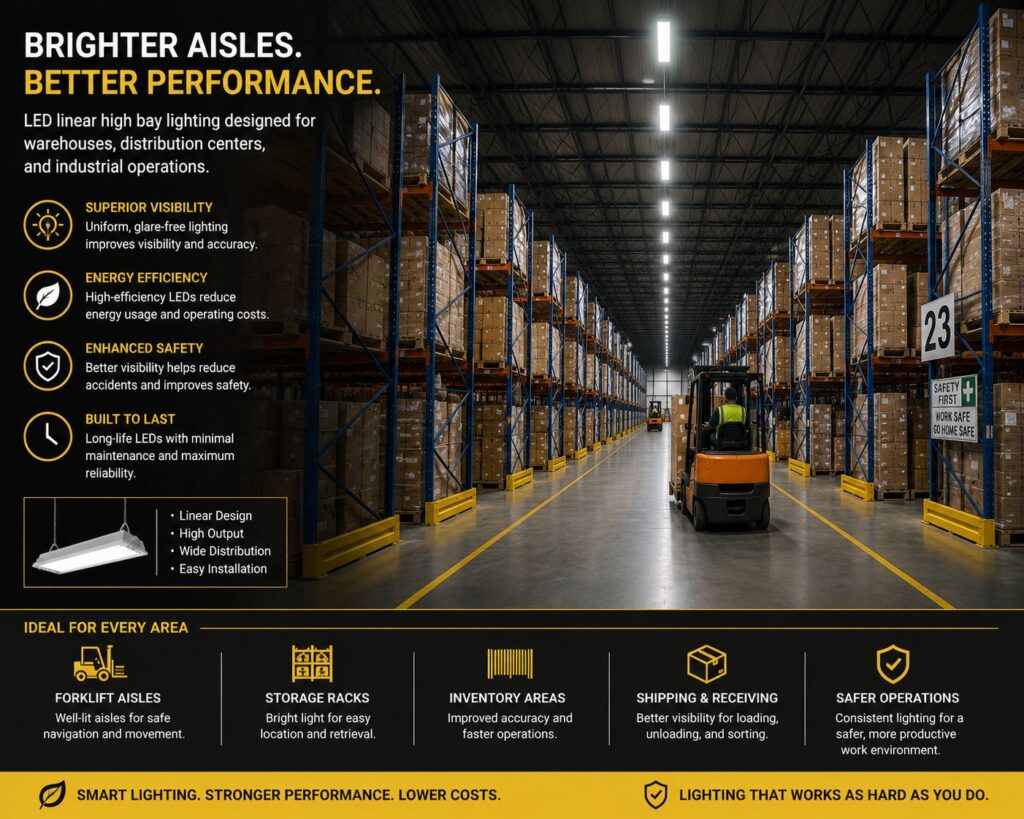
Warehouse aisle lighting design coordinates linear LED high bay fixtures, rack height, aisle width, mounting height, and beam distribution to provide consistent horizontal and vertical illumination for forklift travel, inventory picking, and rack visibility.
Need Help Designing Warehouse Aisle Lighting?
Effective aisle lighting depends on rack height, aisle width, ceiling height, fixture spacing, beam distribution, and required horizontal and vertical light levels. The right layout can improve rack visibility, picking accuracy, forklift safety, and overall warehouse efficiency.
Explore our Linear LED High Bay Lighting solutions for warehouse and racking applications.
Planning a new warehouse or lighting retrofit? Request a Quote or call 844-533-7767 for fixture selection, pricing, and photometric planning assistance.
What Is Warehouse Aisle Lighting Design?
Warehouse aisle lighting design focuses on delivering adequate illumination throughout storage aisles, rack systems, and material handling areas.
Unlike open warehouse spaces, aisle lighting must account for:
- Tall storage racks
- Narrow aisle widths
- Forklift operations
- Vertical inventory storage
- Picking and packing activities
- Rack shadows
- Uniform light distribution
The objective is to provide sufficient light on both horizontal and vertical surfaces throughout the warehouse.
Planning an entire warehouse lighting system? Review our Warehouse Lighting Layout Guide.
Why Warehouse Aisle Lighting Is Important
Poor aisle lighting can create:
- Dark storage locations
- Inventory identification errors
- Forklift visibility issues
- Employee safety concerns
- Reduced picking efficiency
- Increased shadows between racks
Well-designed lighting systems help employees locate products quickly while improving operational safety.
Whether you’re replacing metal halide fixtures or designing a new facility, the Industrial LED High Bay Lighting Guide provides practical recommendations for selecting energy-efficient LED lighting.
Common Warehouse Aisle Configurations
Storage facilities utilize various rack layouts.
Wide Aisle Warehouses
Typical aisle widths:
- 10 to 14 feet
Commonly used for:
- Standard forklifts
- General warehousing
- Distribution operations
Narrow Aisle Warehouses
Typical aisle widths:
- 8 to 10 feet
Designed to maximize storage density.
Very Narrow Aisle (VNA) Warehouses
Typical aisle widths:
- 5 to 7 feet
Used with specialized material handling equipment.
As aisle widths decrease, lighting design becomes increasingly important.
Designing facility-wide illumination? Review Industrial Facility Lighting Design.
Vertical vs Horizontal Illumination
Many warehouse lighting projects focus only on floor-level light measurements.
However, warehouses require both:
Horizontal Illumination
Supports:
- Walking surfaces
- Forklift travel lanes
- General visibility
Vertical Illumination
Supports:
- Product identification
- Barcode scanning
- Inventory selection
- Rack visibility
Vertical illumination is often one of the most important factors in warehouse aisle lighting design.
Recommended Foot Candle Levels
Lighting requirements vary based on warehouse operations.
Typical Warehouse Aisle Lighting Levels
| Area | Recommended Foot Candles |
|---|---|
| General Storage | 10-20 FC |
| Warehouse Aisles | 15-30 FC |
| Distribution Operations | 20-40 FC |
| Order Picking Areas | 20-40 FC |
| Packing Areas | 30-50 FC |
| Inspection Areas | 50-100 FC |
Lighting Level Note: These ranges are general planning references rather than requirements for every warehouse. Appropriate illumination depends on the visual task, inventory and label visibility, rack configuration, equipment movement, work-plane location, facility requirements, and applicable lighting recommendations.
Facilities with detailed picking operations typically require higher illumination levels.
Selecting the Right High Bay Fixture
Fixture selection depends on:
- Ceiling height
- Rack height
- Aisle width
- Desired foot candle levels
- Fixture spacing
Common Fixture Types
| Application | Recommended Fixture |
|---|---|
| Open Warehouse Areas | UFO High Bays |
| Rack Aisles | Linear High Bays |
| Distribution Centers | High Output Linear High Bays |
| Tall Storage Facilities | Narrow Distribution High Bays |
Linear fixtures often provide superior aisle coverage because their beam pattern aligns more effectively with rack layouts.
Selecting fixtures for tall ceilings? Learn more about LED High Bay Lighting.
Warehouse Aisle Design Factors
| Design Factor | Impact |
|---|---|
| Ceiling Height | Fixture Wattage Selection |
| Rack Height | Vertical Illumination Requirements |
| Aisle Width | Fixture Distribution Pattern |
| Inventory Density | Required Light Levels |
| Forklift Traffic | Visibility Requirements |
| Picking Operations | Task Illumination Needs |
Operating a fulfillment center? Explore Distribution Center Lighting.
Fixture Placement Strategies
Parallel Rack Layout
Fixtures mounted directly above aisles provide:
- Improved vertical illumination
- Better rack visibility
- Reduced shadows
Cross-Aisle Layout
Fixtures positioned perpendicular to rack rows may:
- Increase shadowing
- Reduce vertical light levels
- Require additional fixtures
Most high-rack facilities benefit from fixture layouts aligned with aisle orientation
Warehouse aisles and tall storage racks often benefit from fixtures and optics designed to direct light along narrow, rectangular spaces while improving illumination on rack faces. Explore Linear LED High Bay Lighting for high-ceiling warehouse and racking applications.
Common Warehouse Lighting Mistakes
Focusing Only on Foot Candles
High average foot candle levels do not guarantee effective warehouse lighting.
Ignoring Vertical Illumination
Products stored on upper racks still require adequate visibility.
Excessive Glare
Improper fixture selection can create discomfort for forklift operators.
Poor Fixture Spacing
Over-spaced fixtures often create dark zones between aisles.
Lighting Uniformity Matters
Uniformity is often as important as overall brightness.
Benefits include:
- Improved visibility
- Reduced shadows
- Better worker comfort
- Enhanced safety
- More consistent inventory identification
A professional photometric layout helps verify uniform lighting performance throughout the facility.
LED Controls for Warehouse Aisles
Many warehouses achieve additional savings using:
- Occupancy Sensors
- Motion Sensors
- Daylight Harvesting
- Zoned Controls
- Networked Lighting Systems
Because warehouse aisles often experience intermittent traffic, sensor controls can significantly reduce operating costs.
Looking to reduce operating costs? Visit Warehouse Lighting Energy Savings.
Benefits of Proper Warehouse Aisle Lighting
| Benefit | Operational Impact |
|---|---|
| Improved Visibility | Faster inventory retrieval |
| Better Safety | Reduced forklift incidents |
| Enhanced Accuracy | Improved order fulfillment |
| Reduced Shadows | Better rack illumination |
| Lower Energy Costs | Reduced utility expenses |
| Longer Fixture Life | Less maintenance |
For open warehouse areas, loading spaces, production floors, and other high-ceiling applications outside the aisles, compare our broader selection of industrial and commercial LED high bay lights.
Inline Buyer Q&A
Can UFO high bays be used in warehouse aisles?
Yes.
UFO high bays can provide effective aisle illumination when their output, optical distribution, mounting height, and spacing are appropriate for the rack configuration.
Linear high bays can also work particularly well in rack-oriented layouts because their form factor and available distributions can complement long, narrow aisles.
The better choice should be determined by the performance of the specific fixture within the actual aisle geometry.
Should fixtures be mounted directly above warehouse aisles?
Aligning fixtures with aisle orientation is often an effective approach because it can direct illumination into travel and picking areas while improving visibility on rack faces.
However, the appropriate placement depends on aisle width, rack height, fixture mounting height, optical distribution, spacing, obstructions, cross aisles, and other facility conditions.
Fixture alignment should therefore be evaluated as part of the complete lighting layout.
Is aisle lighting different from general warehouse lighting?
Yes.
Open warehouse areas may primarily require broad horizontal illumination, while racked aisles can require greater attention to vertical illumination, rack-face visibility, shadows, aisle uniformity, and inventory identification.
A warehouse lighting system should account for these different visual conditions rather than treating every area of the facility identically.
How does rack height affect aisle lighting?
As rack height increases, the storage system can block light from adjacent fixtures and create shadows on lower rack levels.
Fixture placement, mounting height, optical distribution, aisle width, and vertical illumination become increasingly important in high-rack environments.
The relationship between the fixture and the racks should be evaluated rather than considering ceiling height alone.
How do I choose the right optical distribution for warehouse aisles?
The appropriate distribution depends on aisle width, rack height, mounting height, fixture spacing, required illumination, and the areas where employees need to see inventory and labels.
Narrower or aisle-oriented distributions may be useful in some configurations, while other layouts can perform better with broader distributions.
Photometric data for the specific fixture should be evaluated against the actual aisle geometry.
Can occupancy sensors work effectively in warehouse aisles?
Yes. Aisles with intermittent traffic can be good candidates for occupancy-based lighting control.
Sensor selection and placement should account for mounting height, aisle length, racks, equipment movement, detection pattern, fixture grouping, desired response, and the type of activity being detected.
The controls should be designed around actual warehouse traffic patterns rather than simply adding a sensor to every fixture.
Should warehouse aisle lighting be evaluated with a photometric layout?
For larger or high-rack facilities, photometric analysis is highly recommended.
A model can evaluate predicted horizontal and vertical illumination, fixture spacing, mounting height, optical distribution, and uniformity using the proposed fixtures and warehouse geometry.
It can also help compare UFO and linear high bay layouts before equipment is ordered.
Need Help Designing Warehouse Aisle Lighting?
Rack height, aisle width, mounting height, fixture placement, optical distribution, vertical illumination, and controls all influence warehouse aisle lighting performance.
Whether you’re designing a new warehouse, upgrading a distribution center, or improving lighting in a high-rack storage facility, our lighting specialists can help evaluate fixture options and photometric layouts based on your warehouse configuration.
Call 1-844-533-7767 to discuss your warehouse aisle lighting project.
Frequently Asked Questions About Warehouse Aisle Lighting
What foot-candle level is recommended for warehouse aisles?
There is no single foot-candle level appropriate for every warehouse aisle.
The required illumination depends on the activities performed, inventory and label visibility, picking requirements, equipment movement, rack configuration, work-plane location, and applicable recommendations or facility requirements.
Different areas of the same warehouse may require different lighting conditions.
Are linear high bays better than UFO fixtures for aisles?
Not automatically.
Linear high bays can be particularly well suited to long, rectangular aisles because their form factor and available optical distributions can complement the geometry of the space.
UFO fixtures can also provide effective aisle lighting when properly selected and positioned.
Photometric performance within the actual rack and aisle configuration is more important than fixture shape alone.
Why is vertical illumination important in warehouse aisles?
Employees may need to identify products, labels, locations, and other information throughout the height of a rack system rather than only seeing the floor or a horizontal work plane.
Adequate vertical illumination can improve visibility on rack faces and stored materials, particularly in picking and inventory areas.
Do warehouse aisles require lighting layouts?
Not every project requires the same level of analysis, but photometric layouts are particularly useful for larger, high-rack, or complex warehouse environments.
They can predict illumination and uniformity based on fixture photometric data, mounting height, spacing, rack geometry, aisle dimensions, and other modeled conditions.
Can occupancy sensors save energy in warehouse aisles?
Yes. Occupancy-based controls can reduce unnecessary lighting operation in aisles that are intermittently occupied.
Actual savings depend on traffic patterns, operating hours, control settings, fixture power, sensor coverage, and how the lighting system is grouped and commissioned.
How does aisle width affect fixture selection?
Aisle width affects how light must be distributed between racks and onto the floor, work areas, and vertical rack surfaces.
Narrow aisles and wider travel aisles can require different fixture distributions, spacing, or mounting strategies.
Aisle width should therefore be included in the project information used for fixture selection and photometric analysis.
Can tall racks create dark areas in warehouse aisles?
Yes.
Racks can obstruct light from fixtures outside the aisle and can create shadows, particularly at lower rack levels.
Fixture alignment, optical distribution, mounting height, spacing, and vertical illumination should be evaluated to reduce these effects.
Should warehouse aisle fixtures be centered between the racks?
Centering fixtures over an aisle is a common approach, but it should not be treated as a universal rule.
Rack configuration, aisle width, fixture distribution, mounting conditions, obstructions, cross aisles, and required illumination can affect the best fixture position.
Does high bay mounting height affect rack-face illumination?
Yes.
Mounting height changes the relationship between the fixture, racks, aisle, and vertical surfaces. Fixture output and distribution must be appropriate for the distance and geometry involved.
Higher mounting does not automatically mean that more wattage is the correct solution.
Should warehouse aisle lighting use the same fixtures as open warehouse areas?
Not necessarily.
A facility may use one fixture or distribution in open storage or staging areas and another in narrow or high-rack aisles.
Using different lighting configurations can be appropriate when the areas have different geometry, visual tasks, or illumination requirements.
Stay Connected with Our Lighting Resources
Add IndustrialLightingFixtures.org as a Preferred Source on Google to see more of our lighting guides and technical resources across Google Search experiences.
Related Warehouse Aisle Lighting Resources
- Warehouse Lighting Layout Guide — Review the broader facility-level approach to fixture placement, mounting height, racks, work areas, illumination, and uniformity.
- LED Linear High Bay Lighting — Explore linear high bays for warehouse aisles, racking systems, production areas, and rectangular industrial layouts.
- UFO vs. Linear High Bay Lighting — Compare high bay form factors based on aisle geometry, mounting conditions, distribution, and lighting requirements.
- High Bay Mounting Height Guide — Learn how mounting height interacts with fixture output, distribution, spacing, and facility geometry.
- Distribution Center Lighting — Explore lighting for facilities combining racked storage with picking, packing, staging, shipping, receiving, and material handling.