
Why Upgrade Your Commercial Lighting?
Lighting is one of the largest ongoing operating expenses for many commercial buildings. Office complexes, retail centers, warehouses, hospitals, schools, manufacturing facilities, and municipal buildings often operate lighting systems for thousands of hours each year.
Many facilities continue using older lighting technologies that consume excessive electricity, require frequent maintenance, and produce inconsistent illumination. Others upgraded to early-generation LED fixtures years ago and are now discovering that today’s commercial LED technology delivers significantly higher performance and efficiency.
A professionally planned LED retrofit allows property owners to improve visibility, reduce maintenance, lower energy costs, and modernize their facilities without major building renovations.
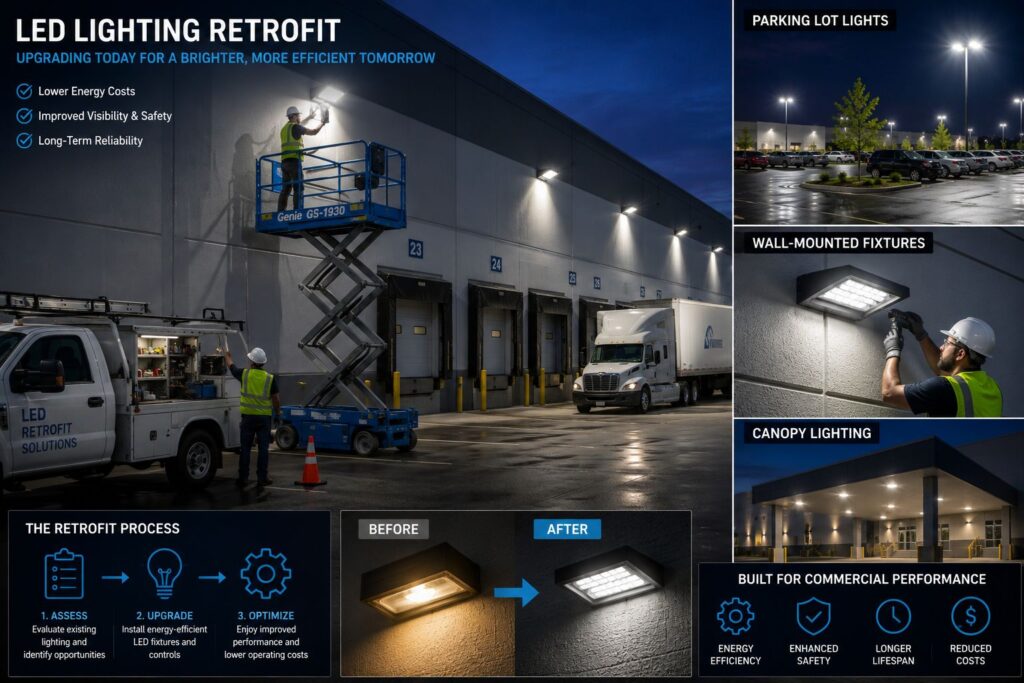
A professionally planned LED retrofit modernizes commercial buildings by improving lighting quality, reducing maintenance, lowering operating costs, and enhancing the property’s overall appearance.
Planning an LED Lighting Upgrade for Your Building?
An effective LED upgrade starts by evaluating your existing fixtures, light levels, operating hours, indoor and outdoor applications, controls, and energy and maintenance goals. Depending on the property, the right solution may include LED replacement lamps, new fixtures, or a combination of both.
Explore our Commercial LED Lighting solutions or call 844-533-7767 for help identifying practical LED upgrades for your building.
What Is a Commercial LED Lighting Retrofit?
A commercial lighting retrofit replaces outdated lighting technology with modern LED fixtures or retrofit systems while utilizing as much of the existing infrastructure as practical.
Depending on the project, a retrofit may include:
- Replacing existing luminaires
- Upgrading drivers and electrical components
- Reusing existing poles or mounting hardware
- Installing new lighting controls
- Improving fixture placement
- Updating emergency lighting
- Modernizing exterior architectural lighting
The objective is to improve lighting performance while minimizing installation costs and operational disruption.
Many retrofit projects improve both efficiency and appearance. See how parking lot lighting, façade lighting, bollards, and landscape lighting transform commercial properties in our Commercial Building Exterior Lighting Guide.
Signs Your Building Is Ready for an LED Retrofit
Many facility owners wait until fixtures begin failing before considering an upgrade. However, replacing aging lighting before major failures occur often results in lower maintenance costs and a smoother installation process.
Common indicators include:
- Frequent lamp replacements
- Ballast failures
- Increasing maintenance costs
- Uneven illumination
- Dark areas throughout the property
- Rising electrical bills
- Outdated lighting appearance
- Difficulty obtaining replacement lamps
- Customer or employee complaints about lighting quality
Even if your lighting system remains operational, these warning signs often indicate that a retrofit should be considered.
Selecting quality fixtures is only part of the design process. Our Commercial LED Building Lights Installation Guide explains where building-mounted lighting should be installed to improve safety, security, and appearance.
Retrofit or Complete Fixture Replacement?
One of the first decisions involves determining whether existing fixtures should be retrofitted or replaced entirely.
Retrofit Existing Fixtures
A retrofit may be appropriate when:
- Existing housings remain structurally sound
- Mounting systems are in good condition
- Budget limitations favor phased upgrades
- Existing fixture appearance is acceptable
Complete Fixture Replacement
Replacing the entire fixture is often the better long-term solution when:
- Fixtures are outdated
- Corrosion is present
- Optics are inefficient
- Better light distribution is desired
- Smart controls will be added
- Field-selectable technology is preferred
Modern commercial LED fixtures often provide substantially better performance than retrofit kits while simplifying future maintenance.
Replacing Legacy Lighting Technologies
Commercial retrofit projects commonly replace several older lighting technologies.
Metal Halide
Metal halide systems gradually lose light output as lamps age while requiring frequent lamp and ballast replacements.
Modern LED fixtures provide:
- Better optical control
- Improved visibility
- Instant-on operation
- Lower maintenance
- Reduced energy consumption
High Pressure Sodium (HPS)
HPS fixtures are known for their yellow-orange appearance and relatively poor color rendering.
LED lighting improves:
- Color accuracy
- Visibility
- Uniform illumination
- Customer experience
- Security camera performance
Fluorescent Lighting
Many commercial interiors still utilize fluorescent troffers and strip fixtures.
LED replacements eliminate:
- Flickering
- Ballast maintenance
- Reduced cold-weather performance
- Frequent lamp replacement
while providing cleaner, more consistent illumination.
Compact Fluorescent (CFL)
Although CFL fixtures represented an improvement over incandescent lighting, modern LED fixtures provide significantly longer service life, improved efficiency, and reduced maintenance requirements.
Selecting the proper replacement fixture is essential for a successful retrofit. Our Types of Commercial LED Lighting Fixtures guide compares today’s most popular commercial LED products and their ideal applications.
Why Upgrade Older LED Fixtures?
Many businesses assume that once they’ve converted to LED, another upgrade won’t provide meaningful benefits.
In reality, commercial LED technology has advanced dramatically during the past decade.
Early commercial LED fixtures commonly produced approximately:
90–120 lumens per watt
Today’s premium commercial luminaires frequently achieve:
170–200 lumens per watt
This improvement allows many facilities to reduce fixture wattage while maintaining—or even improving—overall illumination.
Modern fixtures also provide several features unavailable in earlier LED products.
Earlier LED Fixtures vs Today's Commercial LED Technology
| Earlier LED Fixtures | Modern Commercial LED Fixtures |
|---|---|
| Approximately 90–120 lumens per watt | Up to nearly 200 lumens per watt |
| Fixed wattage | Field-selectable wattage |
| Fixed color temperature | Field-selectable CCT |
| Basic reflector optics | Precision optical distributions |
| Limited control capability | Smart lighting controls |
| Standard drivers | Higher-efficiency drivers |
| Limited surge protection | Enhanced surge protection |
| Basic thermal management | Improved heat dissipation |
For many commercial buildings, upgrading first-generation LED fixtures provides additional energy savings while improving lighting quality and simplifying maintenance.
Delivered Light Matters More Than Lamp Lumens
Older lighting systems were often specified using lamp lumens, but that number does not represent the amount of usable light reaching the ground or work area.
Modern commercial lighting design focuses on delivered light rather than simply comparing lamp ratings.
Several factors influence usable illumination:
- Optical efficiency
- Fixture design
- Beam distribution
- Mounting height
- Lumen maintenance
- Dirt depreciation
- Pole spacing
- Photometric layout
Today’s LED luminaires use precision optics that direct light where it is needed instead of wasting light above or outside the target area.
As a result, many LED retrofit projects achieve equal or better illumination while using significantly lower wattages than the legacy lighting systems they replace.
Field-Selectable Wattage and Color Temperature
One of the biggest advances in commercial LED lighting is field-selectable technology.
Many modern fixtures include internal selector switches that allow installers to adjust:
- Fixture wattage
- Lumen output
- Color temperature (3000K / 4000K / 5000K)
during installation.
This flexibility allows contractors to stock fewer fixture models while fine-tuning illumination for different areas of a property.
For example:
| Setting | Typical Application |
|---|---|
| Lower Wattage | Walkways and smaller parking areas |
| Medium Wattage | Office buildings and retail centers |
| Higher Wattage | Large parking lots and industrial facilities |
Instead of replacing fixtures when lighting requirements change, many field-selectable luminaires can simply be reconfigured.
Typical Energy Savings
Although every project differs, commercial LED retrofits frequently produce substantial reductions in operating costs.
| Existing Lighting | Modern LED Retrofit |
|---|---|
| Higher electrical demand | Lower energy consumption |
| Frequent lamp replacement | Minimal maintenance |
| Ballast failures | Long-life LED drivers |
| Declining light output | Excellent lumen maintenance |
| Higher operating costs | Lower total cost of ownership |
Energy savings become even greater when LED fixtures are combined with occupancy sensors, photocells, scheduling controls, and dimming systems.
Smart Lighting Controls Maximize Retrofit Savings
Modern LED fixtures offer far more than lower energy consumption. Today’s lighting systems can be integrated with intelligent controls that automatically adjust lighting levels based on occupancy, daylight conditions, or operating schedules.
Common control options include:
- Photocells
- Occupancy sensors
- Motion sensors
- Time scheduling
- Networked lighting controls
- Automatic dimming
- Emergency override controls
- Building management system integration
These controls reduce unnecessary operating hours, improve energy efficiency, and help extend fixture life while maintaining appropriate illumination throughout the property.
For parking lots, warehouse yards, and low-traffic areas, dimming during periods of low occupancy can significantly reduce annual operating costs without compromising safety.
Planning a Phased LED Retrofit
Many commercial properties do not replace every fixture simultaneously.
A phased retrofit allows facility owners to prioritize areas with the greatest return while spreading project costs over several budget cycles.
A typical phased approach includes:
Phase 1
Highest operating cost fixtures
- Parking lots
- Area lighting
- High bays
- Exterior wall packs
Phase 2
Customer-facing areas
- Building entrances
- Canopies
- Façade lighting
- Sign lighting
Phase 3
Interior lighting
- Offices
- Hallways
- Warehouses
- Storage rooms
- Conference areas
Phase 4
Specialty lighting
- Emergency lighting
- Sports lighting
- Landscape lighting
- Aviation lighting
This strategy minimizes business disruption while producing immediate energy savings from the first phase of the project.
Return on Investment Extends Beyond Energy Savings
Electricity savings are only one part of the financial return.
Commercial LED retrofits also reduce:
- Lamp replacement costs
- Ballast replacement
- Maintenance labor
- Lift equipment rentals
- Emergency service calls
- Inventory of replacement lamps
- Downtime caused by lighting failures
Many businesses discover that maintenance savings equal or exceed electrical savings over the life of the lighting system.
When combined with longer fixture life and improved lighting quality, modern LED systems often provide an excellent long-term return on investment.
Upgrading your lighting system is only the beginning. Learn how preventive maintenance, smart controls, fixture inspections, and proper operation maximize long-term performance in our Commercial Lighting Best Practices guide.
Additional Benefits of Commercial LED Retrofits
Property owners frequently focus on energy savings, but LED retrofits provide many operational advantages as well.
Benefits include:
- Improved employee productivity through better visibility
- Enhanced customer experience
- Better surveillance camera performance
- Increased property value
- Improved nighttime appearance
- More consistent illumination
- Better color rendering
- Instant-on operation after power interruptions
- Lower environmental impact through reduced energy consumption
These improvements help create safer, more attractive commercial properties while reducing long-term operating expenses.
Common Commercial Retrofit Mistakes
A successful retrofit requires more than replacing fixtures.
Avoid these common mistakes:
- Selecting fixtures based only on wattage
- Ignoring photometric layouts
- Replacing fixtures one-for-one without evaluating lighting requirements
- Choosing residential-grade products for commercial applications
- Mixing different color temperatures
- Ignoring beam distribution
- Forgetting lighting controls
- Reusing damaged poles or mounting hardware
- Failing to plan for future expansion
Working with experienced lighting professionals helps ensure the retrofit achieves both performance and financial objectives.
Not every fixture belongs in every location. Our Where to Use Commercial LED Outdoor Lights guide helps determine the best lighting solutions for office buildings, retail centers, schools, healthcare facilities, industrial properties, hotels, and municipal applications.
Commercial Retrofit Buyer Checklist
Before requesting a quotation, gather the following information:
✓ Property type
✓ Existing fixture types
✓ Fixture quantities
✓ Mounting heights
✓ Pole locations (if applicable)
✓ Existing voltage
✓ Operating hours
✓ Current maintenance costs
✓ Areas requiring improved illumination
✓ Utility provider
✓ Existing site drawings or aerial photographs
Providing this information allows lighting specialists to recommend the most effective retrofit strategy.
Inline Buyer Q&A
Should I retrofit my fixtures or replace them completely?
If existing housings remain in good condition, a retrofit may be appropriate. However, complete fixture replacement often provides better optics, higher efficiency, improved reliability, and access to modern features such as field-selectable wattage and smart controls.
Can older LED fixtures still be upgraded?
Yes. Commercial LED technology has advanced significantly. Modern fixtures frequently deliver nearly twice the lumens per watt of early-generation LEDs while providing improved optics, controls, and longer service life.
How disruptive is a commercial LED retrofit?
Many retrofit projects can be completed in phases or during off-hours, minimizing disruption to employees, customers, and facility operations.
Are lighting controls worth the investment?
For many facilities, absolutely. Occupancy sensors, photocells, scheduling, and dimming controls further reduce operating costs while extending fixture life.
Will a retrofit improve building appearance?
Yes. Modern LED fixtures provide cleaner, more uniform illumination that enhances parking lots, building entrances, architectural features, and pedestrian areas.
Upgrade Your Building with Confidence
A commercial LED lighting retrofit is one of the most effective investments a business can make to improve safety, reduce operating expenses, modernize its facilities, and enhance overall property appearance. By replacing outdated lighting technologies with today’s high-performance LED fixtures, organizations benefit from lower energy consumption, reduced maintenance, improved lighting quality, and greater flexibility through features such as field-selectable wattage, selectable color temperature, and intelligent lighting controls.
Whether your project involves a single building or an entire commercial campus, careful planning and the right LED products can deliver measurable benefits for many years to come.
Ready to Modernize Your Commercial Lighting?
Our lighting specialists can help evaluate your existing system, recommend the most effective retrofit strategy, and select commercial LED fixtures that improve performance while reducing long-term operating costs.
Explore our complete selection of Commercial Lighting Fixtures and let us help you plan your next successful LED retrofit project.
Frequently Asked Questions
How long does a commercial LED retrofit typically last?
Quality commercial LED fixtures are designed for many years of service, significantly reducing maintenance compared to legacy lighting technologies.
Can existing light poles usually remain?
In many projects, yes. Structurally sound poles and mounting hardware can often be reused, reducing installation costs.
Is a photometric lighting layout recommended?
Yes. Professional lighting layouts verify illumination levels, fixture spacing, and uniformity before installation begins.
Can LED retrofits reduce maintenance?
Absolutely. Longer fixture life, improved drivers, and reduced lamp replacements significantly lower maintenance expenses.
Are field-selectable fixtures better for retrofit projects?
In many applications, yes. Adjustable wattage and color temperature simplify installation while allowing future lighting modifications without replacing the fixture.