Outdoor lighting plays an important role in pedestrian safety, wayfinding, and property appearance, but it also contributes to long-term operating expenses. As facility owners, municipalities, schools, healthcare providers, and property managers seek to reduce utility costs, LED bollard lighting has become an increasingly attractive solution.
Modern LED bollards provide efficient pathway illumination while consuming significantly less energy than older lighting technologies. Combined with longer service life and reduced maintenance requirements, LED bollards can help lower the total cost of ownership for outdoor lighting systems.
This guide explains how LED bollards generate energy savings and why many organizations are replacing older outdoor lighting systems with LED technology.
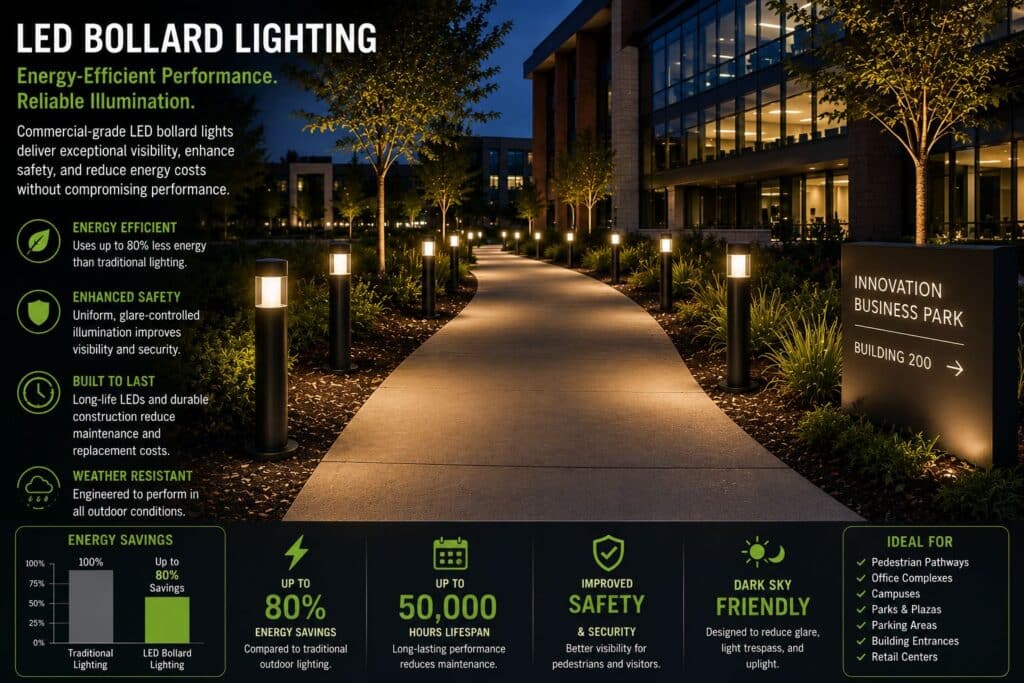
LED bollard lights reduce energy consumption while improving pathway visibility and outdoor lighting performance.
Looking to reduce outdoor lighting operating costs?
Speak with a Lighting Specialist for LED bollard retrofit recommendations and energy-saving solutions.
Why LED Bollards Use Less Energy
LED technology converts electrical energy into visible light more efficiently than many older lighting technologies.
Benefits include:
- Lower wattage requirements
- Improved optical efficiency
- Reduced wasted light
- Longer operating life
- Lower maintenance costs
Because LEDs direct light more effectively, many projects can achieve similar or improved illumination levels using less energy.
Common Outdoor Lighting Technologies Compared
| Technology | Typical Efficiency |
|---|---|
| Incandescent | Low |
| Halogen | Low |
| Compact Fluorescent | Moderate |
| Metal Halide | Moderate |
| High Pressure Sodium | Moderate |
| LED Bollards | High |
LED systems provide significantly higher lighting efficiency than many legacy outdoor lighting technologies.
Typical LED Bollard Wattages
| Application | Typical LED Wattage |
| Residential Pathway | 10–20 Watts |
| HOA Walkway | 15–25 Watts |
| Commercial Sidewalk | 20–40 Watts |
| Campus Pathway | 20–50 Watts |
| Public Park | 20–50 Watts |
| Healthcare Facility | 20–50 Watts |
Actual wattage requirements depend on fixture design, spacing, and project objectives.
For layout recommendations, review our Bollard Light Spacing Guide.
Where Energy Savings Come From
Reduced Power Consumption
LED bollards generally require fewer watts to produce effective pathway illumination.
Improved Optical Control
Modern optics direct light where it is needed rather than wasting energy through uncontrolled light distribution.
Lower Maintenance Requirements
Long-life LED systems reduce lamp replacement costs and maintenance labor.
Longer Fixture Life
LED bollards can provide years of operation before major component replacement becomes necessary.
Energy Savings Example
Consider a pathway lighting project operating:
- 20 fixtures
- 12 hours per day
- 365 days per year
Legacy System
- 50 Watts per fixture
- Total connected load: 1,000 Watts
LED System
- 20 Watts per fixture
- Total connected load: 400 Watts
Energy Reduction
- 600 Watts saved
- Approximately 60% reduction in connected load
Actual savings vary by application and operating schedule.
Maintenance Savings Matter Too
Many property owners focus only on utility costs.
However, maintenance savings often contribute significantly to long-term ROI.
Reduced maintenance can include:
- Fewer lamp replacements
- Lower labor costs
- Reduced service calls
- Less equipment rental
- Lower inventory requirements
These savings are particularly important for campuses, parks, healthcare facilities, and large commercial properties.
LED Bollards and Dark Sky Goals
Energy efficiency and responsible lighting design often work together.
Properly designed LED bollards can:
- Reduce glare
- Reduce uplight
- Minimize light trespass
- Improve visual comfort
- Support Dark Sky initiatives
Projects pursuing environmentally responsible lighting should review our Dark Sky Bollard Lighting Guide.
Applications with the Greatest Savings Potential
Educational Campuses
Large pathway networks can benefit from substantial utility and maintenance reductions.
Multifamily Communities
Property managers often seek lower operating expenses while improving resident safety.
Healthcare Facilities
Reduced maintenance helps minimize disruptions throughout healthcare campuses.
Parks and Recreation Areas
Municipalities frequently prioritize long-term operating cost reductions.
Commercial Properties
Businesses can improve property appearance while lowering energy expenses.
Additional application examples can be found in our Bollard Lighting Applications Guide.
Typical Benefits Beyond Energy Savings
| Benefit | Impact |
| Lower Utility Costs | High |
| Reduced Maintenance | High |
| Improved Visibility | High |
| Longer Service Life | High |
| Reduced Glare | Moderate |
| Better Appearance | High |
| Dark Sky Support | Moderate |
LED vs Traditional Lighting Comparison
| Feature | Traditional Lighting | LED Bollards |
| Energy Efficiency | Moderate | High |
| Maintenance Requirements | Higher | Lower |
| Lamp Replacements | Frequent | Infrequent |
| Optical Control | Limited | Excellent |
| Service Life | Shorter | Longer |
| Operating Costs | Higher | Lower |
Commercial Energy Savings Considerations
Commercial properties often evaluate:
- Utility reduction
- Maintenance reduction
- ROI
- Facility appearance
- Lighting performance
Many organizations discover that maintenance savings are nearly as significant as energy savings over the life of the project.
For commercial-specific recommendations, visit our Commercial LED Bollard Lighting Guide.
Residential Energy Savings Considerations
Homeowners often appreciate:
- Lower utility bills
- Improved aesthetics
- Reduced maintenance
- Longer fixture life
Additional recommendations are available in our Residential Bollard Lighting Guide.
Inline Buyer Q&A
How much energy do LED bollard lights save?
Many projects experience energy reductions of 40% to 70% compared to older outdoor lighting technologies.
Do LED bollards reduce maintenance costs?
Yes. Long-life LED systems typically require less maintenance and fewer replacements.
Are LED bollards worth the investment?
Many organizations find that lower operating and maintenance costs help justify the upgrade.
Do LED bollards improve lighting quality?
Modern optics often provide better visibility and improved lighting uniformity.
Can LED bollards support sustainability goals?
Yes. Reduced energy consumption and lower maintenance requirements contribute to sustainability initiatives.
Turn Bollard Lighting Upgrades into Long-Term Energy Savings
Replacing older bollard lighting with LED can reduce energy use and maintenance requirements while improving the performance of pathway and pedestrian lighting systems. The actual savings depend on the existing fixtures, wattage, operating hours, replacement system, and use of lighting controls.
Whether you’re upgrading a commercial property, campus, healthcare facility, HOA or multifamily community, park, hospitality property, or pedestrian area, our lighting specialists can help evaluate:
- LED bollard fixture selection
- Existing bollard retrofit opportunities
- Replacement wattage and light output
- Bollard spacing and placement
- Photometric layouts
- Dimming and lighting controls
- Energy-saving opportunities
- New and retrofit outdoor lighting projects
Explore our LED Bollard Lights for commercial pathway, pedestrian, landscape, and site-lighting applications.
For retrofit projects, have your existing fixture wattage, quantity, operating hours, photographs, and available site information ready when possible.
Call 1-844-533-7767 to discuss your LED bollard lighting project.
Frequently Asked Questions
Do LED bollard lights use less electricity?
Yes. LED bollards are significantly more energy efficient than many older lighting technologies.
How long do LED bollard lights last?
Commercial-grade LED bollards can provide many years of operation with minimal maintenance.
Are maintenance savings significant?
For larger properties and campuses, maintenance savings can represent a substantial portion of total project savings.
Do LED bollards qualify for utility incentives?
Some utility providers offer incentives for qualifying energy-efficient lighting upgrades.
Can LED bollards improve Dark Sky performance?
Yes. Many modern fixtures utilize full-cutoff optics and improved light control.
Stay Connected with Our Lighting Resources
Add IndustrialLightingFixtures.org as a Preferred Source on Google to see more of our lighting guides and technical resources across Google Search experiences.
