Commercial lighting is more than selecting fixtures. It is a coordinated system of illumination designed to enhance safety, improve visibility, support operational efficiency, and strengthen the visual identity of a property. Whether lighting a retail center, parking structure, campus, fueling station, or mixed-use development, successful commercial lighting design requires careful planning, proper mounting strategies, code awareness, and long-term performance considerations.
Modern LED technology has transformed commercial lighting from high-maintenance, high-wattage systems into energy-efficient, durable, and strategically layered illumination solutions. However, specifying commercial lighting correctly still requires understanding how exterior and interior zones interact, how light distribution affects safety, and how different fixture categories serve distinct functional purposes.
This guide provides a structured overview of commercial lighting systems, applications, planning considerations, and upgrade strategies to support informed specification decisions.
Every commercial LED fixture depends on a properly engineered driver to deliver stable electrical power, consistent illumination, and long-term reliability. Our Commercial LED Driver Guide explains why driver quality is one of the most important factors when evaluating commercial lighting systems.
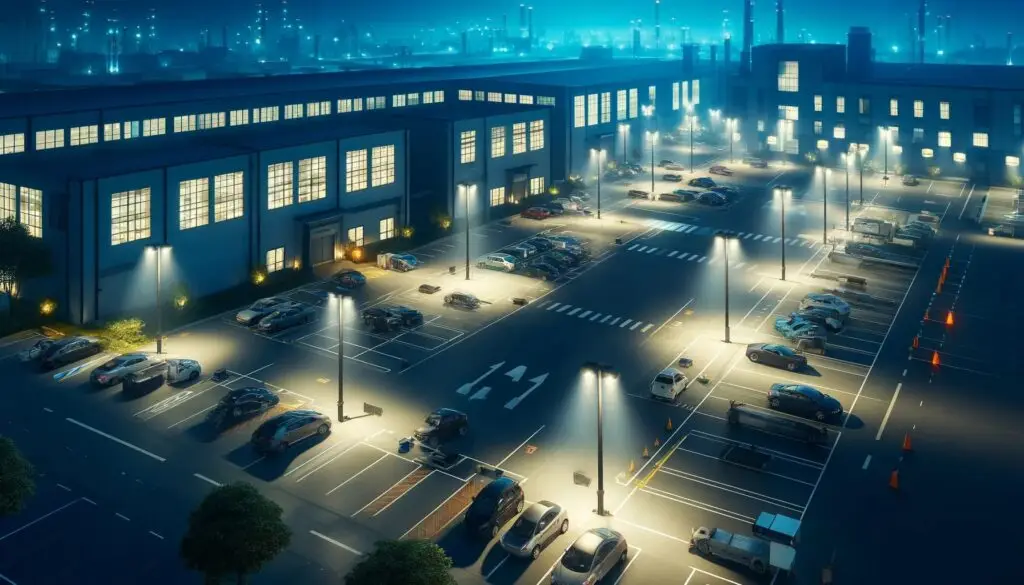
High-output LED area lighting and wall-mounted fixtures providing uniform nighttime visibility across an industrial facility parking area.
Understanding Commercial Lighting Classifications
Commercial lighting systems are typically categorized by application, mounting strategy, and functional intent.
Interior vs Exterior Commercial Lighting
Interior commercial lighting focuses on task visibility, merchandising presentation, and occupant comfort within buildings. Retail environments may also upgrade refrigerated display systems with specialized LED cooler door retrofit lighting solutions to improve product visibility and efficiency.
Exterior commercial lighting addresses property safety, wayfinding, vehicle movement, and architectural presence.
Exterior lighting often includes parking areas, pedestrian pathways, entry points, building facades, and perimeter zones. Certain legacy fixtures may be modernized using high-output LED corn cob light bulbs compatible with existing socket configurations.
Area Lighting vs Accent Lighting
Area lighting delivers broad, uniform illumination for vehicle and pedestrian movement. Accent lighting emphasizes architectural features, signage, or landscape elements.
A parking lot luminaire provides area coverage. A façade fixture provides accent illumination.
Both are essential in a complete commercial lighting plan.
Safety vs Aesthetic Lighting
Some lighting applications are primarily safety-driven — such as perimeter security or garage lighting. Others are aesthetic-driven — such as architectural façade lighting or landscape highlights.
Effective commercial lighting balances both objectives.
Exterior Commercial Lighting Applications
Exterior lighting represents one of the most visible and safety-critical aspects of commercial design. Each application serves a distinct purpose within the overall property ecosystem.
Parking Lot Lighting
Parking lot illumination provides wide-area coverage for vehicle movement and pedestrian safety. Pole-mounted luminaires distribute light across open spaces, minimizing shadowing and supporting surveillance systems.
Modern LED parking lot lighting systems emphasize uniform distribution, reduced glare, and energy efficiency.
Large open vehicle areas rely on properly spaced LED parking lot lighting systems to deliver balanced illumination and maintain safe nighttime visibility.
Parking Garage Lighting
Enclosed and semi-enclosed parking structures require uniform ceiling-mounted illumination that supports visibility in low-ceiling environments. LED parking garage lighting systems prioritize glare control, consistent output, and compatibility with occupancy sensors.
Garage lighting should integrate with exterior area lighting to create a seamless transition from outdoor to indoor spaces.
Enclosed parking structures require uniform, glare-controlled coverage often achieved through engineered LED parking garage lighting systems.
Canopy & Covered Area Lighting
Covered exterior spaces — such as walkways, entrances, and fuel station canopies — require downward-focused, glare-controlled luminaires. These fixtures enhance visibility in sheltered environments while protecting occupants from shadowed zones.
Canopy lighting design must consider mounting height, reflectance surfaces, and uniformity across entry points.
Covered entryways and service zones benefit from dedicated commercial LED canopy lighting designed to provide downward-focused illumination without excessive glare.
Fueling facilities and forecourts often incorporate specialized LED gas station canopy lighting systems engineered for high-traffic petroleum environments.
Perimeter & Security Lighting
Security-focused lighting prioritizes high-contrast visibility around property edges, loading zones, and entry gates. Properly designed security lighting reduces dark spots, supports surveillance systems, and deters unauthorized activity.
Layering security fixtures with broader area lighting enhances overall site coverage.
Building-mounted LED wall pack lighting provides vertical surface illumination and reinforces security along exterior perimeters.
Pedestrian Path & Bollard Lighting
Low-level lighting along walkways and landscaped areas improves pedestrian guidance and enhances architectural aesthetics. Bollard luminaires distribute light laterally, offering comfortable nighttime visibility without excessive glare.
These fixtures often complement pole-mounted area lights for layered illumination.
Low-level pedestrian guidance is often achieved through strategically spaced commercial LED bollard lights along walkways and landscaped zones.
Architectural & Facade Lighting
Facade lighting highlights building materials, textures, and brand presence. Carefully selected optics provide controlled wall-wash effects that enhance nighttime curb appeal without excessive spill light.
Architectural lighting is often integrated with signage and perimeter systems to create a cohesive exterior presentation.
Architectural elements and vertical surfaces are highlighted using precision LED façade lighting systems that enhance building presence at night.
Structural & Mounting Considerations
Lighting performance depends not only on fixture selection but also on mounting strategy and structural support.
Mounting height directly impacts light distribution and uniformity. Pole-mounted fixtures provide wide-area coverage, while wall-mounted luminaires support close-range visibility. Canopy fixtures must balance ceiling height with glare control.
Commercial light poles serve as the structural backbone for exterior area lighting systems. Engineered for wind load and environmental exposure, properly specified poles ensure safe and stable operation over time.
Ground-level safety and hardware protection may be enhanced with durable clam shell pole base covers that conceal anchor bolts and mounting assemblies.
At ground level, accessories such as base covers protect anchor hardware and improve safety presentation.
Proper mounting height and distribution are achieved using engineered commercial light poles designed to withstand environmental loads and ensure structural stability.
Uniformity, Visibility & Safety Standards
Effective commercial lighting is not defined by brightness alone. It is defined by uniformity, contrast control, and visibility performance across functional zones. Over-lighting certain areas while leaving others dim creates visual imbalance and safety concerns.
Footcandles & Illumination Levels
Lighting levels are commonly measured in footcandles (fc), which quantify light intensity on a surface. Different commercial applications require varying illumination levels:
-
Open parking areas: moderate, evenly distributed levels
-
Parking garages: consistent, glare-controlled coverage
-
Pedestrian walkways: comfortable, balanced illumination
-
Security zones: enhanced contrast for camera clarity
Designing to recommended illumination levels helps reduce dark spots and improve overall visual comfort.
Uniformity Ratios
Uniformity refers to how evenly light is distributed across a surface. It is typically expressed as a ratio between the brightest and darkest points in a given area.
Poor uniformity creates:
-
Harsh brightness contrasts
-
Visual fatigue
-
Reduced surveillance clarity
-
Increased perceived safety risk
Proper pole spacing, mounting height, and optic selection are critical to achieving balanced uniformity in parking lots and perimeter zones.
Glare Control
Glare negatively impacts driver visibility, pedestrian comfort, and camera performance. Modern LED luminaires use precision optics and shielding to direct light downward and outward without creating excessive brightness at viewing angles.
In commercial settings, glare control is especially important in:
-
Parking garages
-
Fuel canopies
-
Entry drives
-
Mixed-use developments
Selecting fixtures with controlled distribution enhances both safety and aesthetics.
Light Trespass & Dark-Sky Considerations
Commercial properties must balance illumination with environmental responsibility. Light trespass — unwanted spill into adjacent properties — can create compliance issues and community concerns.
Shielded luminaires, proper aiming, and full cut-off optics help:
-
Minimize upward light
-
Reduce neighborhood impact
-
Improve energy efficiency
-
Maintain regulatory compliance
Strategic design ensures lighting enhances property performance without creating external disruption.
Energy Codes & Efficiency Standards
Energy performance is a central consideration in modern commercial lighting design. LED systems provide dramatic reductions in wattage compared to legacy HID and fluorescent systems, but compliance standards still apply.
DLC Certification
The DesignLights Consortium (DLC) establishes performance criteria for commercial LED products. DLC-listed fixtures often qualify for utility rebates and ensure minimum efficacy and longevity standards.
IECC & ASHRAE Standards
Energy codes such as the International Energy Conservation Code (IECC) and ASHRAE 90.1 regulate lighting power density, control requirements, and efficiency thresholds.
These standards may require:
-
Occupancy sensors
-
Daylight harvesting controls
-
Automatic shutoff
-
Reduced wattage per square foot
Understanding code requirements during planning prevents costly redesigns.
Utility Rebates & Incentives
Many municipalities offer incentives for upgrading to LED systems. Projects involving:
-
Parking lot retrofits
-
Garage lighting modernization
-
Canopy conversions
-
Interior lighting upgrades
may qualify for financial rebates when fixtures meet certification standards.
Evaluating rebate eligibility during project planning improves ROI projections.
When Retrofit Makes Sense
Retrofit kits are ideal when:
-
Existing housings are structurally sound
-
Mounting infrastructure is reusable
-
Budget constraints limit full replacement
-
Installation downtime must be minimized
Retrofit solutions convert legacy fixtures to LED technology while preserving existing enclosures. When existing housings remain structurally sound, upgrading with commercial LED retrofit kits can significantly improve energy efficiency without full fixture replacement.
When Full Replacement Is Recommended
Full fixture replacement is often preferred when:
-
Housings are corroded or outdated
-
Optical performance is inadequate
-
Structural mounting requires redesign
-
Energy code upgrades require integrated controls
New luminaires often provide improved optics, better thermal management, and longer lifecycle performance compared to adapted systems.
Layered Lighting Strategy
High-performing commercial properties rarely rely on a single fixture type. Instead, they implement layered lighting systems that combine multiple luminaire categories.
Portable lighting plays an important role alongside permanent lighting systems for maintenance, inspections, emergency response, and temporary operations. Explore our Commercial LED Work Lights Guide for application-specific recommendations.
Parking Lot + Bollard Lighting
Pole-mounted area luminaires provide broad vehicle coverage, while bollards guide pedestrian movement along sidewalks and landscaped pathways.
This layering ensures:
-
Vehicle safety
-
Pedestrian clarity
-
Balanced site aesthetics
Canopy + Wall Pack Integration
Covered areas such as entry drives and pump islands benefit from downward canopy lighting, while wall-mounted luminaires enhance perimeter visibility and vertical surface illumination.
Together, they provide seamless coverage from structure to building façade.
Garage + Security Coordination
Interior parking structures often transition directly to exterior perimeter zones. Coordinating garage fixtures with security luminaires ensures consistent visibility from entry to exit.
Layered security lighting reduces shadowed zones and supports camera performance.
Properties frequently supplement area lighting with dedicated LED outdoor security lighting to enhance surveillance clarity and perimeter protection.
Facade + Sign Illumination
Architectural wall wash fixtures highlight building features, while sign lighting reinforces brand presence and wayfinding.
When integrated thoughtfully, these systems elevate nighttime curb appeal without over-lighting.
Exterior branding and wayfinding benefit from integrated commercial LED sign lighting that reinforces nighttime visibility.
Specifying Commercial Lighting Correctly
Successful lighting projects begin with structured evaluation.
Step 1: Site Assessment
-
Property layout
-
Mounting locations
-
Existing infrastructure
-
Electrical capacity
Understanding the physical environment prevents installation conflicts.
Step 2: Determine Illumination Goals
Clarify:
-
Safety priorities
-
Aesthetic goals
-
Security needs
-
Operational hours
Lighting must support real-world usage patterns.
Step 3: Mounting & Structural Planning
Evaluate:
-
Pole height
-
Wall mounting conditions
-
Ceiling clearances
-
Wind load requirements
Structural integrity is as important as optical performance.
Step 4: Photometric Analysis
Professional lighting plans use photometric layouts to model:
-
Footcandle distribution
-
Uniformity ratios
-
Glare impact
-
Pole spacing
Photometric planning ensures predicted performance before installation.
Step 5: Control & Automation Integration
Modern commercial systems may integrate:
-
Occupancy sensors
-
Motion sensors
-
Daylight harvesting
-
Timers
-
Networked controls
Smart control systems reduce energy use while maintaining safety.
Final Considerations: Long-Term Performance & Maintenance
LED technology significantly reduces maintenance cycles compared to traditional lighting systems. However, proper fixture selection, environmental rating verification, and installation quality directly influence long-term reliability.
Commercial lighting should be evaluated based on:
-
Lifespan
-
Warranty
-
Environmental durability
-
Driver performance
-
Surge protection
Investing in quality components protects both operational budgets and property reputation.
Getting the best performance from a commercial lighting system involves more than choosing efficient fixtures. Fixture selection, placement, controls, operating schedules, maintenance, and the requirements of each space all influence long-term lighting performance. Explore our guide to getting the most out of your commercial lighting for additional planning and optimization considerations.
Inline Buyer Q&A
How do I choose the right commercial lighting for a property?
Start with the activities performed in each area rather than selecting fixtures by building type alone.
Consider:
- Indoor and outdoor spaces
- Required illumination
- Mounting height
- Fixture spacing
- Pedestrian and vehicle activity
- Visual tasks
- Ceiling or structural conditions
- Environmental exposure
- Glare and light control
- Existing electrical system
- Controls
- Energy requirements
- Maintenance access
- Architectural appearance
A commercial property often requires several fixture types working together rather than one lighting solution throughout the site.
Should a commercial LED retrofit use replacement fixtures or retrofit kits?
It depends on the existing lighting system and project goals.
LED retrofit kits can allow suitable existing housings to remain in service, while complete fixture replacement can provide new housings, optics, drivers, controls, mounting components, and other updated features.
Before choosing either approach, evaluate the condition of the existing equipment, labor requirements, electrical compatibility, lighting performance, maintenance objectives, and total project cost.
How do I determine how many commercial light fixtures are needed?
Fixture quantity should not be determined from square footage alone.
Mounting height, fixture output, optical distribution, required illumination, spacing, room or site geometry, reflectance, obstructions, work areas, pedestrian and vehicle activity, and uniformity can all affect quantity.
For larger or more complex projects, photometric analysis can help compare fixture layouts before installation.
Should commercial lighting be designed differently for different areas of the property?
Usually.
Parking areas, offices, warehouses, entrances, walkways, loading areas, garages, retail spaces, façades, and other zones can have different visual tasks and operating conditions.
A coordinated commercial lighting system can use different fixture types, outputs, distributions, mounting methods, and controls while maintaining appropriate illumination across the property.
What information should I provide when requesting a commercial lighting quote?
Useful project information includes:
- Property or facility type
- Areas being illuminated
- Dimensions
- Mounting or ceiling heights
- Existing fixture types and wattages
- Existing fixture quantity and spacing
- Voltage
- Operating hours
- Required illumination or project criteria
- Desired controls
- Indoor or outdoor environmental conditions
- New construction or retrofit
- Drawings, photographs, or existing lighting schedules
The more complete the project information, the easier it is to evaluate appropriate fixture options.
When is a photometric lighting plan useful for a commercial project?
Photometric analysis is especially useful for parking lots, warehouses, large interior spaces, commercial sites, garages, sports areas, high-bay applications, and projects with defined illumination or uniformity criteria.
A photometric model can predict how a proposed fixture layout may perform based on the supplied design information.
It supports lighting decisions but does not by itself establish code compliance, safety, or actual field performance.
Plan the Commercial Lighting System Before Selecting the Fixtures
A successful commercial lighting project coordinates fixture selection with the way the property is actually used.
Indoor and outdoor spaces, mounting conditions, required illumination, optical distribution, controls, environmental exposure, energy use, maintenance, architecture, and existing electrical infrastructure should all be considered.
Our lighting specialists can help evaluate commercial LED lighting for offices, retail properties, parking facilities, multifamily properties, campuses, warehouses, service areas, commercial sites, and other business environments.
Call 1-844-533-7767 to discuss your commercial lighting project.
Frequently Asked Questions About Commercial Lighting
What is commercial lighting?
Commercial lighting refers to lighting systems used in business, institutional, multifamily, hospitality, retail, office, parking, and other nonresidential properties.
Commercial lighting can include both interior and exterior systems designed around visual tasks, property use, illumination requirements, energy performance, maintenance, controls, and architectural objectives.
Industrial lighting overlaps with commercial lighting but often involves additional operating conditions such as high ceilings, heavy equipment, extreme temperatures, moisture, dust, hazardous locations, or specialized manufacturing processes.
What are the main types of commercial lighting?
Commercial properties can use many fixture types, including:
- Ceiling lights
- Troffers and panels
- Recessed downlights
- Linear fixtures
- High bays and low bays
- Parking lot and area lights
- Parking garage fixtures
- Canopy lights
- Wall packs
- Bollards
- Post-top fixtures
- Floodlights
- Architectural lighting
- Sign and façade lighting
The appropriate combination depends on the property and the activities within each area.
What are the main types of commercial exterior lighting?
Common exterior systems include parking lot and area lights, canopy fixtures, wall-mounted luminaires, bollards, post-top fixtures, floodlights, parking garage lighting, architectural lighting, façade lighting, and sign lighting.
Different fixture types can be combined to address vehicle, pedestrian, building, landscape, and architectural zones.
What are the main types of commercial indoor lighting?
Common indoor commercial lighting includes troffers, panels, recessed downlights, ceiling fixtures, linear lighting, strip fixtures, high bays, low bays, and architectural luminaires.
Fixture selection depends on ceiling construction, mounting height, visual tasks, space configuration, controls, appearance, and required illumination.
How bright should commercial lighting be?
There is no single brightness level appropriate for all commercial spaces.
Required illumination depends on the activity, visual task, property type, applicable requirements, mounting conditions, surrounding light levels, and project objectives.
More light is not automatically better. Excessive illumination can increase energy use and contribute to glare and unwanted light.
How bright should commercial parking lot lighting be?
Parking lot illumination should be evaluated according to property use, applicable requirements, pedestrian and vehicle activity, mounting height, fixture distribution, surrounding conditions, and project criteria.
Lighting design generally considers both illumination levels and uniformity rather than maximizing fixture output.
A photometric model can help evaluate a proposed parking lot layout before installation.
What is a uniformity ratio in commercial lighting?
Uniformity describes how illumination varies across a defined area.
Depending on the design criteria being used, a uniformity ratio may compare maximum-to-minimum or average-to-minimum measured or calculated illumination.
Lower contrast between excessively bright and dark areas can support more consistent visibility, but the appropriate criteria depend on the application.
What is the difference between a commercial LED retrofit and full fixture replacement?
A retrofit modifies suitable existing equipment to incorporate LED components, while full fixture replacement installs a new luminaire.
Retrofits can preserve existing housings and mounting infrastructure in appropriate applications.
Complete replacement can provide new optics, housings, drivers, controls, and other fixture features.
Cost and performance should be evaluated for the actual project rather than assuming one approach is always less expensive.
Can LED fixtures replace HID or fluorescent lighting one-for-one?
Sometimes, but one-for-one replacement should not be assumed.
The proposed LED fixture’s output, optical distribution, mounting, spacing, voltage, controls, and required illumination should be compared with the existing system.
A lower-wattage LED can sometimes replace a higher-wattage legacy fixture, but wattage alone does not establish equivalency.
Are commercial LED lights energy efficient?
LED systems can provide substantial energy advantages over many older HID and fluorescent systems.
Actual savings depend on the existing equipment, replacement fixture wattage, operating hours, controls, layout, and project conditions.
Energy savings should be calculated from the specific existing and proposed systems rather than applying a universal percentage.
How long does commercial LED lighting last?
There is no universal lifespan for commercial LED luminaires.
Many LED products are designed for long operating life, but actual and rated performance depends on the LEDs, driver, thermal management, operating temperature, electrical conditions, operating hours, environmental exposure, and manufacturer’s lifetime methodology.
See our Commercial LED Lifespan Guide for a closer look at the factors affecting LED fixture life.
What role does the LED driver play in commercial lighting?
The driver converts and regulates electrical power for the LED system.
Driver quality, compatibility, thermal conditions, dimming requirements, surge exposure, and other electrical characteristics can affect fixture performance and reliability.
See our Commercial LED Drivers Guide for additional information.
Do commercial lighting systems require permits?
Requirements vary by jurisdiction and project.
Electrical work, new poles, structural modifications, exterior lighting, signs, and other installations may be subject to permits, inspections, energy codes, zoning requirements, lighting ordinances, or other local requirements.
Verify applicable requirements before installation.
Do commercial lighting projects qualify for utility rebates?
Some do.
Rebate availability depends on the utility or program, location, fixture type, product eligibility, project type, installation requirements, and program dates.
Some programs require qualifying product listings or preapproval before equipment is purchased or installed.
Check the applicable program requirements before assuming a project will receive an incentive.
What lighting controls are used in commercial buildings?
Depending on the application, controls can include:
- Occupancy sensors
- Vacancy sensors
- Photocells
- Dimming
- Scheduling
- Daylight-responsive controls
- Bi-level operation
- Networked lighting controls
Control requirements and opportunities vary by building, operating schedule, applicable energy requirements, and fixture compatibility.
What is layered commercial lighting?
Layered commercial lighting uses different fixture types or lighting functions to address different areas and visual needs.
For example, a commercial property might combine pole-mounted area lights for parking, bollards or post tops for pedestrian areas, canopy fixtures beneath entrances, wall-mounted lighting around the building, and architectural lighting on façades.
Indoors, general, task, accent, and architectural lighting can likewise be coordinated according to the space.
What is the difference between commercial and industrial lighting?
The categories overlap, but industrial lighting often addresses more demanding operating conditions.
Industrial facilities can involve high mounting heights, heavy equipment, manufacturing processes, extreme temperatures, moisture, dust, vibration, food-processing requirements, or hazardous classified locations.
Commercial lighting covers a broader range of business and nonresidential environments where those specialized industrial requirements may not apply.
What should be evaluated before specifying commercial exterior lighting?
Consider mounting height, fixture placement, optical distribution, illumination, uniformity, glare, light trespass, environmental exposure, controls, poles or mounting structures, electrical infrastructure, pedestrian and vehicle activity, architecture, and applicable local requirements.
What should be evaluated before specifying commercial indoor lighting?
Consider ceiling type, mounting height, room dimensions, visual tasks, required illumination, fixture distribution, glare, controls, daylight, electrical conditions, emergency-lighting requirements where applicable, maintenance, and architectural objectives.
Is the highest-output commercial fixture the best choice?
No.
A higher-output fixture can create excessive illumination, glare, poor visual comfort, or unnecessary energy consumption if it is not appropriate for the application.
The goal is to provide suitable lighting performance for the space, not simply maximize lumens.
When should commercial lighting be evaluated with a photometric layout?
Photometric analysis is particularly valuable for larger spaces, parking lots, commercial sites, warehouses, high-bay facilities, garages, and projects with specific illumination or uniformity criteria.
It can help compare fixture quantity, placement, mounting height, output, and optical distribution before installation.
Stay Connected with Our Lighting Resources
Add IndustrialLightingFixtures.org as a Preferred Source on Google to see more of our lighting guides and technical resources across Google Search experiences.

Related Commercial Lighting Resources
- Commercial Lighting Fixtures — Explore the primary commercial lighting category covering indoor, outdoor, architectural, parking, and specialized fixture solutions.
- Indoor Lighting — Review commercial interior lighting categories for offices, retail spaces, common areas, facilities, and other indoor applications.
- Outdoor LED Lighting Guide — Learn how fixture selection, mounting, optics, controls, glare, and environmental conditions affect commercial exterior lighting.
- Commercial Site Lighting Design Guide — Plan coordinated lighting across parking, pedestrian, building, canopy, and other exterior property zones.
- LED Canopy Lighting — Explore overhead LED lighting for entrances, breezeways, covered walkways, loading areas, and other commercial canopy applications.