
A parking lot can meet its target light levels and still create problems if fixtures produce excessive glare or send unnecessary light beyond the property.
Drivers may encounter bright luminaires within their field of view. Nearby properties may receive unwanted illumination. Poorly controlled fixtures can also send light toward roadways, building windows or areas that do not need to be illuminated.
Controlling parking lot lighting glare and light trespass requires coordinating fixture optics, lumen output, mounting height, pole location, orientation, shielding and photometric design.
The objective is not simply to make a parking lot darker. It is to place useful light where it is needed while limiting unwanted light where it is not.
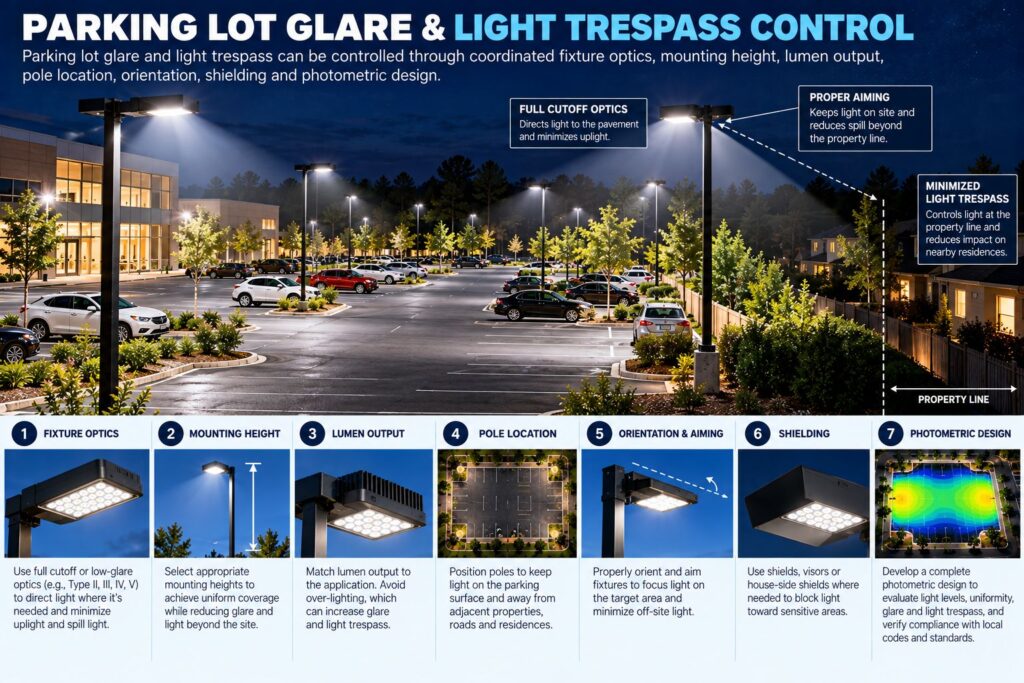
Parking lot glare and light trespass can be controlled through coordinated fixture optics, mounting height, lumen output, pole location, orientation, shielding and photometric design.
Need Better Control of Parking Lot Glare and Spill Light?
Increasing fixture output does not necessarily improve a parking lot and can make glare or property-line problems worse.
LED PROS WorldWide can help evaluate LED parking lot lights, optical distributions, mounting conditions, shielding, fixture output and photometric requirements for commercial and industrial properties.
Explore our LED Parking Lot Lights or call 844-533-7767 with your site plan, pole locations, mounting heights and project requirements.
What Is Parking Lot Lighting Glare?
Glare occurs when excessive brightness within the field of view causes visual discomfort or interferes with the ability to see effectively.
In a parking lot, the luminaire itself can become a significant source of glare because LED area lights are often mounted where drivers and pedestrians can see them from a distance.
Glare can be influenced by:
-
Fixture brightness
-
Optical design
-
Mounting height
-
Fixture orientation
-
Viewing direction
-
Pole location
-
Lumen output
-
Shielding
-
Surrounding light levels
Glare therefore cannot be evaluated from fixture wattage alone.
What Is Light Trespass?
Light trespass generally refers to unwanted light extending beyond the area or property where the lighting is intended.
For a parking lot, this can include illumination reaching:
-
Adjacent residential properties
-
Neighboring commercial properties
-
Building windows
-
Roadways
-
Sidewalks outside the intended area
-
Undeveloped neighboring land
Property boundaries are therefore an important consideration when selecting and positioning parking lot fixtures.
Glare and Light Trespass Are Different Problems
Glare and light trespass are related but should not be treated as the same condition.
Glare concerns excessive brightness viewed by a person.
Light trespass concerns unwanted illumination reaching an area where it is not intended.
A fixture can create glare without producing a significant property-line light level.
A lighting system can also produce unwanted illumination on neighboring property without the luminaire appearing excessively bright from every viewing direction.
Each condition should be evaluated separately.
Spill Light and Light Trespass
The terms spill light and light trespass are sometimes used interchangeably, but they can describe slightly different ideas.
Spill light generally refers to illumination falling outside the primary intended area.
When that unwanted illumination extends onto neighboring property or another sensitive location, it can become a light-trespass concern.
Some spill around the edges of an illuminated area may be unavoidable.
The design objective is to control it according to the site conditions and applicable project requirements.
Why Brighter Parking Lot Lights Can Increase Glare
Installing a higher-output fixture may increase measured illumination, but it can also increase the apparent brightness of the luminaire.
This is especially important when fixtures are mounted relatively low or positioned where drivers approach them directly.
If a parking lot has dark areas, the solution should not automatically be to increase wattage.
The underlying problem may instead involve:
-
Incorrect optical distribution
-
Excessive pole spacing
-
Poor fixture orientation
-
Inadequate mounting height
-
Poorly positioned poles
Correcting the distribution problem can be more effective than simply increasing fixture output.
Pole Location Affects Glare and Light Trespass
Where a pole is located relative to the parking area and property boundary strongly influences how the fixture should distribute light.
A perimeter pole generally needs to direct most of its useful illumination into the property.
An interior pole may need broader coverage around its location.
Poles near entrances and exits require additional attention because drivers may approach the luminaires directly.
Pole location should therefore be considered before the optical distribution is selected.
Mounting Height and Glare
Mounting height affects both coverage and the apparent position of the fixture within a person’s field of view.
Lower-mounted high-output fixtures can appear especially intense because they are closer to typical viewing angles.
Higher mounting heights can provide broader coverage, but the appropriate height depends on fixture output, pole spacing, optics, site conditions and structural considerations.
The objective is to coordinate mounting height with the lighting layout rather than assuming that higher or lower is always better.
Our Area Lighting Pole Height Guide explains these relationships in more detail.
Optical Distribution Helps Control Unwanted Light
LED area lights can be offered with Type II, Type III, Type IV and Type V distributions.
For perimeter locations, a directional distribution can help place more useful illumination into the parking lot rather than behind the pole.
Interior poles may require broader coverage.
Choosing an appropriate distribution can reduce wasted light, but the distribution designation alone does not establish glare or property-line performance.
Our Parking Lot Light Distribution Guide explains how the common distribution types relate to different pole locations.
Type IV Distribution and Property Edges
Type IV distributions are often strongly forward-oriented.
That characteristic can make them useful in some perimeter applications where the fixture needs to project light into the parking area while limiting illumination behind the pole.
However, a Type IV label does not guarantee acceptable property-line performance.
Fixture-specific photometry, mounting height, setback, lumen output and orientation still need to be considered.
Backlight and Property Boundaries
Backlight is light directed behind the luminaire relative to its intended forward orientation.
For a pole located near a property line, excessive backlight can contribute to unwanted illumination beyond the site.
Selecting optics with appropriate backlight characteristics can help.
Pole setback, fixture orientation, mounting height and shielding can also influence how much light reaches the boundary.
What Are BUG Ratings?
BUG stands for:
Backlight — Uplight — Glare
The BUG rating system provides a standardized way of describing how much light a luminaire emits into defined angular zones.
It can help compare outdoor luminaires and evaluate characteristics associated with unwanted backlight, uplight and glare.
BUG ratings are useful, but they do not replace a site-specific photometric analysis.
Our Commercial Outdoor Lighting BUG Ratings Explained guide provides a detailed explanation of the system and how the individual B, U and G components should be interpreted.
A Lower BUG Rating Is Not Automatically the Best Fixture
A lower numerical rating in one BUG component does not automatically make a luminaire the best choice for a parking lot.
A fixture still has to provide the required illumination across the intended area.
Overly restricting distribution without considering the layout could contribute to poor coverage or require additional fixtures.
BUG ratings should therefore be considered alongside:
-
Site geometry
-
Pole location
-
Mounting height
-
Fixture output
-
Optical distribution
-
Required light levels
-
Uniformity
-
Property-line requirements
The objective is appropriate performance, not simply the lowest possible rating.
Uplight and Parking Lot Fixtures
Uplight is light emitted above the luminaire into defined upper zones.
Many modern parking lot area lights are designed to minimize direct uplight when installed in their intended orientation.
This can support projects with Dark Sky or outdoor-lighting requirements.
However, fixture orientation matters.
Tilting or aiming a luminaire upward can change where the fixture sends light and may affect its installed performance.
Keep Parking Lot Area Lights Properly Oriented
Many parking lot area lights are intended to operate in a relatively level orientation.
Unnecessary upward tilt can send more light toward distant areas or the sky and can increase fixture visibility.
Adjustable mounting can be valuable when a project requires it, but aiming should be based on the intended photometric result rather than simply tilting the fixture until the parking lot appears brighter.
Fixture installation should also follow the manufacturer’s mounting requirements.
Shielding Parking Lot Lights
Shielding can be used in some applications to reduce light in an unwanted direction.
Depending on the fixture family, shielding options may include:
-
House-side shields
-
Backlight shields
-
Internal optical shields
-
External shields
These can be useful near residences, property boundaries, roadways or other sensitive areas.
However, shielding removes or redirects part of the fixture’s light distribution.
Its effect on parking-lot coverage should therefore be included in the photometric evaluation.
House-Side Shields
A house-side shield is commonly used to reduce light behind a fixture.
This can be particularly useful when a parking lot borders residential property.
A shield should not be treated as a universal fix for poor fixture placement.
Where possible, fixture distribution, output, pole position and shielding should work together.
Avoid Solving Every Boundary Problem With Shields
If every perimeter fixture requires aggressive shielding, the underlying fixture selection or layout may deserve another look.
A more appropriate optical distribution or lower lumen package may provide better performance without blocking large portions of the emitted light.
Shielding is one design tool rather than a substitute for appropriate optics.
Property-Line Light Levels
Some projects or jurisdictions establish limits on illumination at property boundaries.
Where such requirements apply, the photometric plan can calculate illumination along the property line.
This allows the proposed design to be evaluated before installation.
The applicable limits should come from the project specifications, local ordinance, zoning requirements or other governing criteria rather than from a universal parking-lot value.
Nearby Residential Properties
Parking lots next to homes, apartments, hotels or other residential uses can require greater control of boundary illumination.
Important considerations include:
-
Distance from poles to residences
-
Fixture mounting height
-
Window locations
-
Optical distribution
-
Fixture output
-
Backlight
-
Shielding
-
Hours of operation
-
Dimming controls
A photometric plan can help identify whether proposed fixtures send significant illumination toward neighboring properties.
Parking Lot Lighting Near Roadways
Parking-lot fixtures near public roads should be evaluated from the driver’s perspective.
Bright luminaires facing approaching traffic can create unwanted visual conditions even if the parking surface itself is properly illuminated.
Fixture orientation, mounting height, optics and output should therefore be coordinated around entrances, exits and roadway-facing property edges.
Glare and Parking Lot Entrances
Entrances and exits deserve particular attention because drivers are transitioning between different lighting environments while watching traffic, pedestrians and other vehicles.
Fixtures should provide useful illumination without unnecessarily placing intense light sources directly in the primary approach direction.
Photometric calculations can evaluate pavement illumination, but visual review of fixture orientation and mounting is also important.
Uniformity Can Affect Perceived Glare
Glare and uniformity are different metrics, but they can interact perceptually.
A very bright fixture surrounded by relatively dark pavement can appear more intense because of the contrast.
Improving the overall lighting design may therefore involve both reducing excessive brightness and improving the distribution of useful light.
Our Parking Lot Lighting Uniformity Guide explains how hot spots, dark areas and fixture overlap affect consistency across the site.
Do Not Reduce Glare by Creating Dark Areas
Reducing fixture output can decrease brightness, but simply lowering output everywhere may create inadequate illumination.
The better approach is to coordinate:
output + optics + mounting height + pole spacing + orientation + shielding
The objective is to maintain useful parking-lot illumination while reducing unnecessary visual brightness and spill.
Glare and LED Parking Lot Retrofits
Retrofits can introduce glare problems when high-output LED fixtures are installed on existing low poles without evaluating the new photometric distribution.
An LED fixture can direct light differently from the HID luminaire it replaces.
That can be an advantage, but only if the new optic is appropriate for the existing pole locations and mounting heights.
Our LED Parking Lot Lighting Retrofit Guide explains why existing infrastructure should be evaluated before replacement fixtures are selected.
Dark Sky Considerations
Dark Sky-oriented design seeks to reduce unnecessary nighttime light and limit light emitted where it is not needed.
For parking lots, relevant considerations can include:
-
Minimizing direct uplight
-
Controlling light beyond the site
-
Avoiding excessive illumination
-
Selecting appropriate CCT where requiredUsing controls to reduce unnecessary illumination during low-activity periods
-
Dark Sky considerations should be coordinated with the actual parking lot requirements rather than treated as a single fixture specification.
A luminaire with no direct uplight can still create excessive illumination, glare or light trespass if its output, distribution or placement is inappropriate for the site.
Likewise, selecting a warmer CCT does not by itself solve glare or spill-light problems.
Dark Sky-oriented design works best when uplight, light levels, distribution, controls, glare and property boundaries are considered together.
CCT and Glare Are Not the Same Thing
Correlated color temperature describes the apparent color of the light produced by the source.
It does not directly describe fixture brightness, optical distribution or glare.
A lower CCT may be required or preferred for certain projects, particularly where local ordinances, Dark Sky objectives or environmental considerations apply.
However, changing from a higher CCT to a lower CCT does not automatically correct excessive glare or light trespass.
Those conditions still depend heavily on fixture output, optics, mounting height, orientation and site geometry.
Controls Can Reduce Unnecessary Nighttime Light
Parking lots do not always require full lighting output throughout the entire night.
Depending on occupancy, operating hours and project requirements, controls can reduce output during low-activity periods.
Potential strategies include:
-
Scheduling
-
Bi-level dimming
-
Occupancy sensing
-
Networked lighting controls
-
Photocells combined with time-based or occupancy-based control
Reducing output when full illumination is unnecessary can reduce energy use and unnecessary nighttime illumination.
Controls should not be used to compensate for poor optics, excessive fixture output or inappropriate pole placement.
Photometric Analysis for Glare and Light Trespass
Photometric analysis is one of the most useful tools for evaluating how a proposed parking lot lighting system interacts with the property.
A photometric plan can calculate illumination across the parking surface and at selected locations beyond it.
Depending on the project, the analysis can examine:
-
Parking-area light levels
-
Minimum and maximum illumination
-
Uniformity
-
Property-line illumination
-
Building facades
-
Adjacent pedestrian areas
-
Roadway-facing boundaries
-
Effects of different optical distributions
-
Effects of shields or reduced lumen packages
Fixture-specific IES files should be used so the analysis reflects the actual luminaire and optical configuration being considered.
Add Calculation Points Along Sensitive Boundaries
When light trespass is a concern, photometric calculations should not stop at the edge of the parking stalls.
Calculation points can be placed along relevant property lines and other sensitive locations.
For example, a project adjacent to residential property may benefit from calculation points along the shared boundary.
The results can then be compared with applicable project or local requirements.
This provides substantially better information than assuming a fixture is acceptable simply because it is described as full cutoff, shielded or Dark Sky-oriented.
Review the Photometric Plan Visually
Calculated numbers are important, but the overall pattern should also be reviewed.
Look for:
-
High illumination near perimeter poles
-
Abrupt changes at property boundaries
-
Hot spots near entrances
-
Dark areas created by excessive shielding
-
Light extending beyond the intended area
-
Fixtures oriented toward roadways or residences
-
Poor overlap between adjacent fixtures
The objective is a coordinated design rather than solving one metric while creating another problem elsewhere.
Glare, Trespass and Parking Lot Uniformity Must Work Together
Glare reduction, light-trespass control and uniformity are interconnected design considerations.
For example, heavily shielding a perimeter fixture may reduce illumination behind the pole but also create a darker area within the parking lot.
Reducing fixture output may lower property-line illumination but affect minimum light levels.
Changing to a more directional optic may improve boundary control while also changing coverage between poles.
These tradeoffs are why parking lot lighting should be evaluated as a complete system.
Parking Lot Glare & Light Trespass Design Checklist
| Variable | What to Evaluate |
|---|---|
| Pole location | Relationship to property lines, roads and entrances |
| Mounting height | Coverage and fixture visibility |
| Fixture output | Required illumination without excessive brightness |
| Optical distribution | Direction of useful light |
| Backlight | Illumination behind perimeter fixtures |
| Uplight | Light emitted into upper zones |
| Glare | Luminaire brightness from relevant viewing directions |
| Fixture orientation | Direction and tilt of the luminaire |
| Shielding | Reduction of unwanted light in specific directions |
| Property lines | Applicable illumination limits |
| Adjacent properties | Residential or other sensitive uses |
| Roadways | Driver approach and fixture visibility |
| CCT | Project, ordinance or Dark Sky requirements |
| Controls | Reduction of unnecessary nighttime output |
| Photometric analysis | Verification of installed lighting performance |
Inline Buyer Q&A
How do I reduce glare from LED parking lot lights?
Evaluate fixture output, mounting height, optical distribution, pole location, fixture orientation and shielding. Simply reducing wattage may lower brightness but can also create inadequate illumination if the underlying layout problem is not addressed.
How can I keep parking lot light off neighboring property?
Directional optics, appropriate lumen output, pole placement, mounting height, fixture orientation and shielding can all help. A photometric plan can calculate illumination along the property boundary before fixtures are installed.
Are Type IV fixtures good for controlling parking lot spill light?
Type IV distributions can be useful for some perimeter locations because they typically provide strong forward-oriented coverage. The actual fixture photometry still needs to be evaluated for the specific pole location and property boundary.
Will a house-side shield eliminate light trespass?
It can reduce light behind a fixture, but it does not guarantee that all unwanted illumination will be eliminated. The shield’s effect on both the property boundary and parking-lot coverage should be evaluated.
Does zero uplight mean a fixture will not cause light pollution?
No. Direct uplight is only one consideration. Excessive illumination, glare, backlight and light extending beyond the intended area can still be concerns.
Does a warmer CCT reduce glare?
Not automatically. CCT describes the apparent color of the light. Glare also depends on luminance, output, optics, mounting height, orientation, viewing direction and surrounding conditions.
Can photometrics show light trespass?
Yes. Calculation points can be placed along property lines and other sensitive locations to estimate illumination from the proposed fixtures.
Need Help Controlling Parking Lot Glare & Light Trespass?
LED PROS WorldWide can help identify LED parking lot lighting options based on pole locations, mounting heights, fixture output, optical distribution, shielding, property boundaries and photometric requirements.
For projects near residences, roadways or other sensitive properties, send a site plan showing the parking area, pole locations and relevant boundaries when available.
For retrofit projects, existing fixture information and photographs can also help determine suitable replacement options.
Call 844-533-7767 to discuss your parking lot lighting project or request a quote.
Frequently Asked Questions About Parking Lot Glare & Light Trespass
What causes glare from parking lot lights?
Glare can result from excessive fixture brightness, high lumen output, low mounting heights, inappropriate optics, poor orientation or fixtures positioned within important viewing directions.
What is the difference between spill light and light trespass?
Spill light generally describes light falling outside the primary intended area. Light trespass commonly refers to unwanted illumination reaching neighboring property or another area where it is not intended.
Can LED parking lot lights cause more glare than older fixtures?
They can if the replacement fixtures have excessive output or inappropriate optics, mounting or orientation. LED technology also provides precise optical-control options that can reduce unwanted light when fixtures are properly selected.
Should parking lot fixtures be tilted upward?
Not automatically. Many area lights are designed for relatively level installation. Tilting a fixture can change its photometric distribution and potentially increase distant spill light or uplight. Follow the manufacturer’s mounting requirements and the project’s photometric design.
What is a BUG rating?
BUG stands for Backlight, Uplight and Glare. The system classifies luminaire output within defined angular zones. It is useful for comparing fixtures but does not replace site-specific photometric analysis.
Are lower BUG ratings always better?
No. A fixture still needs to illuminate the intended area effectively. BUG ratings should be considered with distribution, output, pole location, mounting height and the site’s performance requirements.
Can controls help reduce light pollution?
Yes. Dimming or reducing lighting during low-activity periods can decrease unnecessary nighttime illumination and energy use. Controls do not correct poor fixture optics or placement.
How do I know whether my parking lot meets local light-trespass requirements?
Review the applicable zoning ordinance, project specifications or other governing requirements and compare them with site-specific photometric calculations. There is no universal property-line value appropriate for every parking lot.
Stay Connected with Our Lighting Resources
Add IndustrialLightingFixtures.org as a Preferred Source on Google to see more of our lighting guides and technical resources across Google Search experiences.

Parking Lot Glare, Light Trespass & Outdoor Lighting Design Resources
-
LED Parking Lot Lights — commercial LED area-lighting fixtures and available optical configurations.
-
Parking Lot Light Distribution Guide — Type II, III, IV and V optical distributions.
-
Parking Lot Lighting Uniformity Guide — hot spots, dark areas, fixture overlap and photometric uniformity.
-
LED Parking Lot Lighting Retrofit Guide — evaluating existing poles, mounting heights, optics and replacement fixtures.
-
Parking Lot Foot-Candle Requirements for Commercial Properties — illumination levels, uniformity and photometric planning.
-
Commercial Outdoor Lighting BUG Ratings Explained — Backlight, Uplight and Glare classifications for outdoor luminaires.
-
Area Lighting Pole Height Guide — mounting height, coverage, optics and spacing.
-
Parking Lot Security Lighting Guide — visibility, pedestrian areas, entrances and security-oriented lighting considerations.