Understanding Industrial Lighting Technologies
Industrial lighting has changed dramatically over the past several decades. Facilities that once relied on incandescent lamps, mercury vapor fixtures, fluorescent systems, and metal halide lighting are now transitioning to highly efficient LED technology.
Today’s industrial lighting systems provide brighter, more uniform illumination while reducing electricity consumption, maintenance expenses, and operational downtime.
Understanding how each lighting technology performs helps facility owners make informed decisions when planning new construction projects or LED retrofit programs.
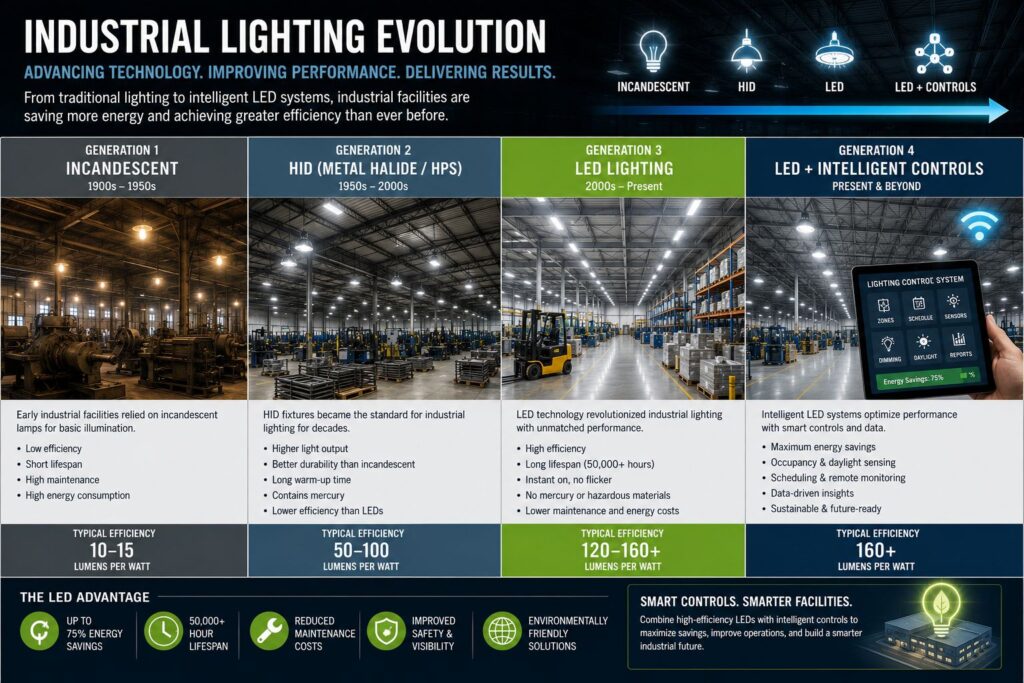
Industrial lighting technologies have evolved from incandescent, fluorescent, and HID systems to energy-efficient LED fixtures, offering industrial facilities improved lighting performance, reduced maintenance, and greater flexibility through compatible lighting controls.
Upgrading from HID or Fluorescent Lighting to LED?
Replacing outdated metal halide, high-pressure sodium, mercury vapor, or fluorescent lighting with properly selected industrial LED fixtures can reduce energy consumption, maintenance requirements, and long-term operating costs.
Explore our Industrial Lights and LED Lighting Systems for warehouses, manufacturing plants, distribution centers, and demanding industrial environments.
Planning a retrofit or new installation? Request a Quote or call 844-533-7767 for fixture recommendations, pricing, and application assistance.
The Evolution of Industrial Lighting
Industrial lighting technology has progressed through several generations.
Incandescent Lighting
One of the earliest lighting technologies, incandescent lamps produced acceptable illumination but consumed large amounts of electricity and had relatively short operating lives.
Common characteristics:
- High energy consumption
- Short lamp life
- Significant heat generation
- Limited industrial applications today
Mercury Vapor Lighting
Mercury vapor fixtures became popular for outdoor industrial lighting and warehouses because of their long operating life compared to incandescent lamps.
However, they offered:
- Poor color rendering
- Slow warm-up
- High energy consumption
- Declining light output over time
Metal Halide Lighting
Metal halide fixtures became a common choice for warehouses, manufacturing facilities, gymnasiums, and aircraft hangars.
Advantages included:
- Higher light output
- Improved color quality
- Better large-area illumination
Limitations included:
- Long warm-up periods
- Frequent lamp replacement
- High maintenance costs
- Significant energy consumption
High Pressure Sodium Lighting
High pressure sodium (HPS) lighting gained popularity in outdoor industrial environments because of its efficiency and long service life.
Typical applications included:
- Roadways
- Industrial yards
- Parking lots
- Security lighting
Its primary drawback was poor color rendering, making object identification more difficult.
Fluorescent Lighting
Fluorescent lighting became common in manufacturing plants, workshops, offices, and warehouse spaces.
Benefits included:
- Better efficiency than HID
- Lower operating temperatures
- Good light quality
Challenges included:
- Ballast failures
- Reduced cold-weather performance
- Frequent lamp replacement
LED Lighting
LED technology has become the preferred lighting solution for nearly every industrial application.
Advantages include:
- Exceptional energy efficiency
- Long operating life
- Instant-on operation
- Excellent color rendering
- Minimal maintenance
- Smart control compatibility
New to industrial lighting? Read What Is Industrial Lighting? for an introduction to industrial lighting systems and their applications.
Comparing Industrial Lighting Technologies
| Technology | Energy Efficiency | Service Life | Warm-Up Time | Maintenance |
|---|
| Incandescent | Low | Very Short | Instant | High |
| Mercury Vapor | Low | Moderate | Long | High |
| Metal Halide | Moderate | Moderate | Long | High |
| High Pressure Sodium | Moderate | Moderate | Long | High |
| Fluorescent | Good | Moderate | Instant | Moderate |
| LED | Excellent | Excellent | Instant | Very Low |
Comparison Note: These ratings are general characteristics rather than universal performance specifications. Actual efficiency, operating life, light quality, and maintenance requirements vary by lamp type, ballast or driver, fixture design, operating environment, and application. Lighting technologies should be compared using complete system performance rather than lamp characteristics alone.
Modern LED lighting offers significant operational advantages, but proper fixture selection remains essential. Our Industrial LED Lighting Pros and Cons guide explains what facility owners should know before upgrading.
Why LED Has Become the Industry Standard
Industrial facilities increasingly select LED lighting because it offers measurable advantages over previous technologies.
Benefits include:
Reduced Energy Consumption
Industrial LED lighting can substantially reduce electricity consumption when replacing older metal halide, mercury vapor, high-pressure sodium, or fluorescent systems.
Actual energy savings depend on existing fixture wattage, ballast losses, replacement LED wattage, operating hours, lighting controls, and required illumination levels. Facilities should compare complete system power consumption and verify that replacement fixtures provide appropriate lighting performance.
For a more detailed evaluation, see our Industrial LED Energy Savings Guide.
Longer Fixture Life
Industrial LED fixtures generally offer longer service life and reduced maintenance requirements compared with many traditional lighting technologies.
However, rated LED lifetime depends on product design, operating temperature, driver reliability, and manufacturer specifications. Lumen-maintenance ratings such as L70 describe projected light-output depreciation rather than guaranteeing that the entire fixture will operate without failure for a specified number of hours.
Improved Light Quality
LED lighting provides:
- Better color rendering
- Uniform illumination
- Reduced glare
- Improved visibility
Lower Maintenance
LED systems require fewer lamp replacements, reducing labor costs and minimizing disruptions to facility operations.
Smart Controls
Modern LED fixtures integrate easily with:
- Occupancy sensors
- Daylight harvesting
- Wireless lighting controls
- Centralized building management systems
Proper installation is just as important as selecting the right fixture. The Industrial Lighting Installation Guide explains how planning improves lighting performance and long-term reliability.
Emerging Industrial Lighting Technologies
Industrial lighting continues to evolve through intelligent lighting systems.
New technologies include:
- Wireless lighting controls
- Bluetooth mesh networks
- IoT-enabled lighting
- Remote monitoring
- Predictive maintenance
- Automated scheduling
- Energy monitoring dashboards
- Integrated emergency lighting
These systems help facility managers optimize lighting performance while reducing operating costs.
Choosing the Right Lighting Technology
Several factors influence technology selection.
Consider:
- Building height
- Operating hours
- Environmental conditions
- Maintenance accessibility
- Utility costs
- Existing infrastructure
- Lighting quality requirements
- Long-term operating expenses
For most industrial facilities, LED technology provides the best combination of efficiency, performance, and long-term value.
Interested in where LED technology performs best? Explore Industrial LED Lighting Applications for practical examples across industrial environments.
Technology Comparison by Application
| Facility Type | Recommended Technology |
| Warehouse | LED High Bays |
| Manufacturing | LED High Bays & Task Lighting |
| Distribution Center | LED Linear High Bays |
| Food Processing | LED Vapor Tight Fixtures |
| Cold Storage | LED Vapor Tight Fixtures |
| Aircraft Hangar | LED High Bays |
| Outdoor Industrial Yard | LED Flood Lights |
| Hazardous Locations | LED Explosion Proof Fixtures |
Application Note: These fixture recommendations represent common industrial applications rather than universal requirements. Actual selection depends on mounting height, environmental exposure, sanitation requirements, operating temperature, required illumination, and applicable electrical classifications. Food processing and hazardous locations may require fixtures with specific certifications or environmental ratings.
Looking for fixture recommendations? Visit Industrial Lighting Fixtures and Their Uses to compare today’s most common industrial lighting products.
The Future of Industrial Lighting
Industrial lighting technology will continue moving toward greater efficiency and automation.
Future systems will increasingly incorporate:
- Adaptive lighting controls
- Occupancy-based automation
- Wireless communication
- Artificial intelligence
- Energy analytics
- Predictive maintenance
- Integrated facility management
Facilities investing in modern LED lighting can improve current operating performance while preparing for future control and automation capabilities. Selecting fixtures with compatible drivers, control interfaces, and upgrade options can help reduce future integration challenges.
Ready to design a complete lighting system? The Industrial Lighting Guide provides comprehensive guidance on selecting fixtures, planning layouts, and optimizing industrial lighting performance.
Inline Buyer Q&A
Why are facilities replacing metal halide lighting with LED?
LED fixtures provide higher efficiency, longer operating life, improved light quality, and significantly lower maintenance requirements.
Is fluorescent lighting still used in industrial facilities?
Some facilities continue using fluorescent lighting, but many are replacing it with LED systems due to improved efficiency and lower operating costs.
What is the newest industrial lighting technology?
LED lighting combined with intelligent controls, occupancy sensors, wireless networking, and IoT connectivity represents the latest generation of industrial lighting technology.
Ready to Upgrade Your Industrial Lighting Technology?
Replacing outdated industrial lighting requires more than selecting a lower-wattage LED fixture. Proper fixture selection should account for existing lighting conditions, mounting heights, required illumination, voltage, environmental exposure, and long-term operating requirements.
LED PROS WorldWide supplies industrial LED lighting solutions for warehouses, manufacturing plants, distribution centers, production facilities, and specialized industrial environments.
Explore our Industrial Lights and LED Lighting Systems and send us your existing fixture types, quantities, mounting heights, voltage requirements, and project specifications.
Request a Quote or call 844-533-7767 for pricing and application assistance.
Frequently Asked Questions
Which lighting technology is most energy efficient?
LED lighting is widely recognized as the most energy-efficient technology currently available for industrial applications.
Is LED better than metal halide?
For most industrial applications, LED provides better efficiency, longer service life, improved visibility, lower maintenance, and instant-on performance.
Can older industrial lighting systems be upgraded?
Yes. Many existing industrial facilities can retrofit older HID and fluorescent fixtures with modern LED lighting systems.
Do intelligent lighting controls improve energy savings?
Yes. Occupancy sensors, daylight harvesting, and automated controls help reduce unnecessary lighting operation and further improve efficiency.
Related Industrial Lighting Resources
- Industrial Lights — Explore commercial and industrial LED lighting fixtures for warehouses, manufacturing plants, distribution centers, and facilities upgrading from older lighting technologies.
- Industrial Lighting Guide — Review fixture selection, mounting heights, illumination requirements, environmental conditions, and industrial lighting project planning.
- Industrial LED Energy Savings Guide — Understand the factors influencing electricity consumption, maintenance expenses, operating costs, and potential savings from industrial LED retrofits.
- Industrial Lighting Fixtures and Their Uses — Compare industrial fixture categories and learn how different lighting configurations serve manufacturing, warehousing, and specialized applications.
- Industrial Lighting Controls Guide — Learn how occupancy sensors, daylight harvesting, and compatible lighting controls can reduce unnecessary operating hours.
- Industrial Facility Lighting Design — Explore fixture placement, mounting heights, photometric performance, uniformity, and industrial lighting system design.