
Proper heliport lighting is essential for safe helicopter operations during nighttime and low-visibility conditions. Whether serving a rooftop hospital heliport, commercial helicopter facility, offshore platform, public safety landing zone, or private helipad, lighting systems provide pilots with critical visual references that improve landing accuracy, situational awareness, and operational safety.
Modern heliport lighting standards focus on creating a highly visible landing environment that allows pilots to quickly identify the landing area, determine wind conditions, recognize boundaries, and safely complete approach, landing, and departure procedures.
Today’s LED heliport lighting systems offer improved performance, reduced maintenance requirements, and enhanced reliability while supporting the operational needs of modern helicopter facilities.
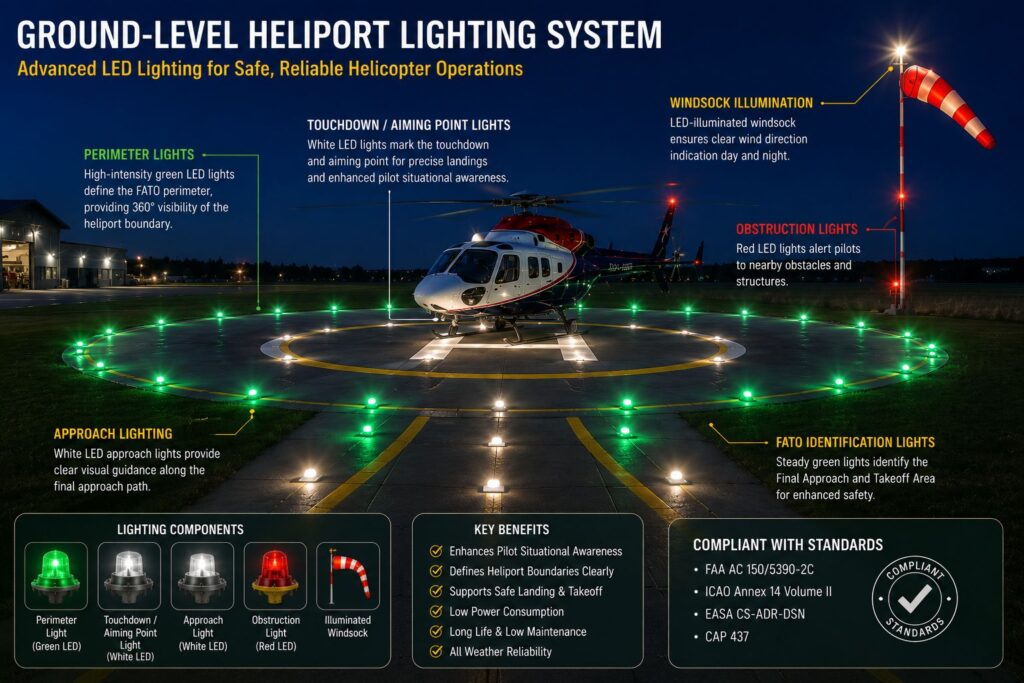
Modern heliport lighting systems utilize perimeter lights, windsock lighting, and visual guidance systems to improve helicopter operational safety.
Need FAA-Compliant Heliport Lighting?
Our aviation lighting specialists can help identify perimeter lights, touchdown area lighting, windsock lighting, floodlights, and complete heliport lighting systems for hospital, commercial, emergency response, and offshore applications.
Why Heliport Lighting Standards Matter
Unlike fixed-wing airports, heliports often operate in compact environments surrounded by buildings, equipment, utility infrastructure, or natural obstacles.
Proper lighting standards help ensure that pilots can quickly identify:
- Landing areas
- Facility boundaries
- Wind conditions
- Approach orientation
- Potential obstacles
- Operational surfaces
These visual references help reduce risk while supporting safe and efficient helicopter operations.
Core Objectives of Heliport Lighting
Effective heliport lighting systems are designed to accomplish several key goals.
Primary Objectives
| Objective | Benefit |
|---|---|
| Landing Area Identification | Faster Facility Recognition |
| Boundary Definition | Improved Pilot Awareness |
| Wind Condition Visibility | Safer Approach Decisions |
| Obstacle Awareness | Reduced Operational Risk |
| Night Operations Support | Expanded Facility Availability |
These objectives influence the design and layout of virtually every heliport lighting system.
Need detailed compliance guidance? Review FAA Heliport Lighting Requirements for rooftop hospital and commercial helicopter landing facilities.
Perimeter Lighting Standards
Perimeter lighting serves as the foundation of most heliport lighting systems.
These fixtures outline the landing area and help pilots identify heliport boundaries during approach and landing.
Benefits of Perimeter Lighting
- Improved landing area recognition
- Enhanced pilot orientation
- Increased landing accuracy
- Better nighttime visibility
- Safer operations in low-light conditions
Common Applications
| Facility Type | Perimeter Lighting Use |
| Hospitals | Emergency Medical Flights |
| Commercial Heliports | Corporate Aviation |
| Offshore Platforms | Crew Transport |
| Public Safety Facilities | Emergency Response |
Perimeter lighting remains one of the most important visual aids available to helicopter pilots.
Comparing visual guidance systems? Explore Heliport Perimeter vs Approach Lights to understand the purpose of each lighting type.
Touchdown and Lift-Off Area (TLOF) Lighting
The Touchdown and Lift-Off Area, often referred to as the TLOF, is the designated landing surface used by helicopters.
Proper lighting helps pilots:
- Identify the touchdown area
- Confirm landing alignment
- Improve landing precision
- Maintain visual references
Clearly visible touchdown zones contribute significantly to operational safety.
Windsock Lighting Standards
Wind information is essential for helicopter operations.
An illuminated windsock allows pilots to quickly determine:
- Wind direction
- Wind speed trends
- Landing conditions
- Departure conditions
Benefits of Windsock Lighting
| Benefit | Operational Impact |
| Wind Visibility | Improved Decision Making |
| Better Approach Planning | Increased Safety |
| Enhanced Situational Awareness | Reduced Pilot Workload |
| Night Operations Support | Improved Reliability |
Windsock lighting is particularly valuable for rooftop hospital heliports, offshore facilities, and emergency response operations.
Designing wind indication systems? Review Heliport Windsock Requirements for placement, visibility, and illumination considerations.
Floodlighting Standards
Floodlighting may be used to illuminate surrounding operational areas.
Typical applications include:
- Access roads
- Equipment zones
- Safety areas
- Ground support operations
Floodlighting should be carefully designed to avoid creating glare that could interfere with pilot visibility.
Rooftop Hospital Heliport Lighting Considerations
Hospital heliports often support emergency medical transportation twenty-four hours per day.
Lighting systems should emphasize:
- Reliability
- Visibility
- Low maintenance
- Emergency operation capability
- Clear landing area identification
Hospital Lighting Priorities
| Priority | Purpose |
| Perimeter Lighting | Landing Area Recognition |
| Windsock Lighting | Wind Visibility |
| Backup Power | Emergency Operation |
| LED Fixtures | Reliability |
These facilities frequently operate under demanding conditions where lighting reliability is critical.
Looking for operational advantages? Read Benefits of Heliport Lighting to learn how lighting improves safety and efficiency.
Commercial Heliport Lighting Considerations
Commercial helicopter facilities often prioritize:
- Operational efficiency
- Reduced maintenance
- Long fixture life
- Consistent visibility
Typical applications include:
- Corporate campuses
- Hotels
- Resorts
- Business centers
- Transportation facilities
Modern LED lighting systems help facility owners reduce operating costs while maintaining high levels of performance.
Focusing on landing area visibility? Explore Heliport Perimeter Lighting Guide for perimeter lighting best practices.
Offshore Helideck Lighting Standards
Offshore environments present unique challenges due to:
- Salt exposure
- Wind
- Moisture
- Corrosive conditions
Lighting systems used on offshore platforms must be durable and dependable.
Offshore Lighting Benefits
- Improved pilot visibility
- Better landing area recognition
- Enhanced crew transport safety
- Reduced maintenance requirements
Durable LED fixtures are often preferred for these demanding environments.
LED Lighting and Modern Heliport Design
LED technology has become the preferred choice for heliport lighting systems.
LED vs Traditional Lighting
| Feature | LED Lighting | Traditional Lighting |
| Energy Consumption | Low | Higher |
| Fixture Life | Long | Shorter |
| Maintenance | Minimal | Frequent |
| Reliability | Excellent | Moderate |
| Operating Costs | Lower | Higher |
| Visibility | Consistent | Variable |
LED systems provide long-term performance advantages that benefit both facility owners and pilots.
Typical Components of a Heliport Lighting System
| Component | Function |
| Perimeter Lights | Define Landing Area |
| TLOF Lights | Identify Touchdown Zone |
| Windsock Lighting | Display Wind Conditions |
| Floodlighting | Illuminate Operational Areas |
| Control Systems | Manage Lighting Operation |
| Backup Power | Emergency Operation Capability |
Together, these components create a comprehensive visual guidance system for helicopter operations.
Inline Buyer Q&A
What is the most important heliport lighting component?
Perimeter lighting is often considered the primary visual aid because it clearly defines the landing area.
Why is windsock lighting important?
Pilots rely on illuminated windsocks to evaluate wind conditions before landing and departure.
Are LED heliport lights better than traditional lighting?
Yes. LED systems provide lower operating costs, longer service life, and reduced maintenance requirements.
Why do hospitals require specialized heliport lighting?
Hospital heliports frequently support emergency medical operations and require reliable lighting systems that function around the clock.
Can existing heliports upgrade to LED lighting?
Many older systems can be upgraded using modern LED heliport lighting solutions.
Improve Helicopter Safety with Modern Heliport Lighting
Whether you operate a hospital heliport, emergency response facility, offshore platform, commercial helicopter landing area, or private helipad, properly designed lighting systems improve visibility, support safer operations, and enhance pilot awareness.
Our team can help identify FAA-compliant heliport lighting solutions including perimeter lights, windsock lighting, touchdown area lighting, floodlighting, and complete heliport lighting systems.
Explore Heliport Lighting Solutions
https://industriallightingfixtures.org/heliport-lighting/
Visit Our Home Page
Frequently Asked Questions
What is heliport lighting?
Heliport lighting consists of visual aids that help pilots identify landing areas and safely conduct helicopter operations.
What are perimeter lights used for?
Perimeter lights define the boundaries of the landing area and improve pilot visibility.
Why are windsocks illuminated?
Illuminated windsocks provide critical wind information during nighttime operations.
Are heliport lights energy efficient?
Modern LED heliport lights are highly energy efficient and require minimal maintenance.
What types of facilities use heliport lighting?
Hospitals, commercial heliports, offshore platforms, emergency response facilities, and private helipads commonly utilize heliport lighting systems.