
Heliport lighting plays a critical role in aviation safety, pilot visibility, and nighttime landing operations. Whether designing a rooftop hospital heliport, private corporate landing area, offshore platform, or commercial aviation facility, understanding FAA heliport lighting requirements is essential for safe and compliant operations.
Modern LED heliport lighting systems improve visibility while reducing maintenance, energy consumption, and fixture downtime. Properly designed systems help pilots identify touchdown zones, approach paths, perimeter boundaries, wind direction, and operational status during nighttime or low-visibility conditions.
This guide explains FAA heliport lighting requirements, recommended fixture types, operational considerations, and LED lighting solutions commonly used in modern heliport environments.
FAA guidance addresses individual lighting components, but successful heliports depend on an integrated system. Learn how perimeter lights, approach lighting, windsocks, and touchdown lighting work together in our Helipad Lighting Systems Guide.
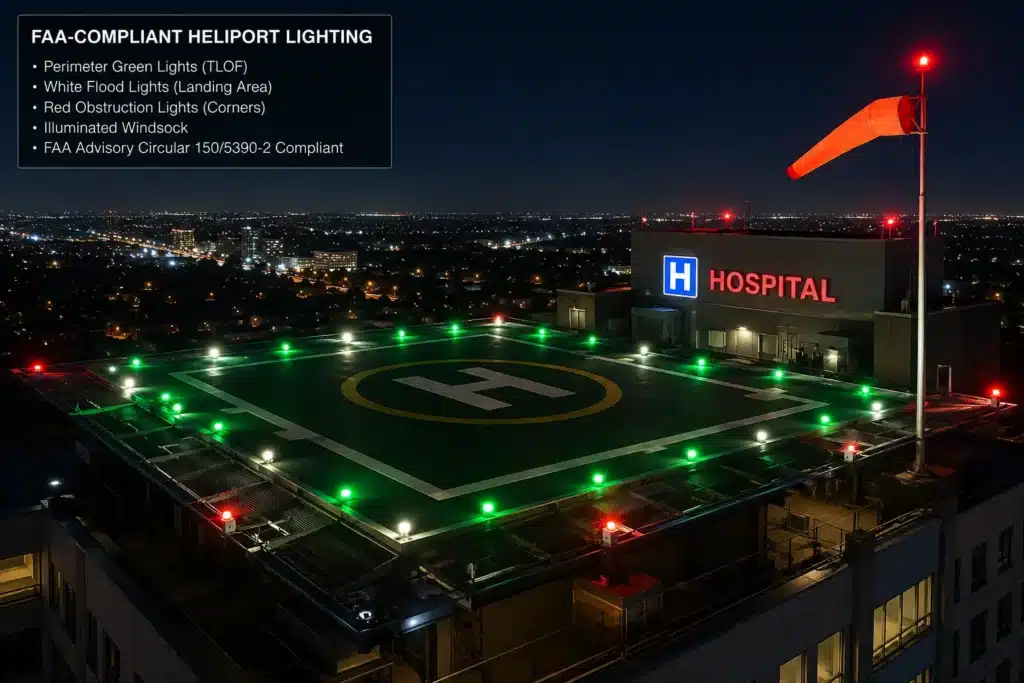
FAA heliport lighting requirements help define TLOF and FATO perimeter lighting, approach guidance, wind direction indicators, obstruction lighting, and other visual aids for safe helicopter operations.
Need FAA-Compliant Heliport Lighting Equipment?
LED PROS supplies LED heliport and helipad lighting for rooftop, hospital, commercial, industrial, and other helicopter landing facilities. Available solutions include inset and elevated perimeter lights, FATO and aiming-point lights, windsocks, floodlights, beacons, approach guidance, and lighting controls.
Explore LED Heliport Lighting Systems or Request a Quote for help matching lighting equipment to your project requirements.
Call 1-844-533-7767 for heliport lighting assistance.
What Are FAA Heliport Lighting Requirements?
Federal Aviation Administration heliport lighting requirements establish minimum visibility and safety standards for helicopter landing facilities operating at night or during reduced visibility conditions.
These requirements help ensure:
- Safe helicopter approach and departure
- Clear pilot visual guidance
- Proper landing zone identification
- Obstruction awareness
- Rooftop and elevated structure visibility
- Reliable emergency operations
FAA heliport lighting standards are commonly referenced for:
- Hospital heliports
- Emergency medical service (EMS) heliports
- Police and public safety heliports
- Offshore heliports
- Corporate heliports
- Industrial facility heliports
- Military support landing areas
- Elevated rooftop heliports
Understanding the differences between heliport perimeter and approach lights helps improve pilot visibility and rooftop landing safety.
FAA Guidance for Heliport Lighting
FAA heliport lighting recommendations are commonly referenced from:
- FAA Advisory Circular AC 150/5390-2
- FAA Engineering Briefs
- ICAO heliport guidance
- Local aviation authority requirements
- State and municipal aviation regulations
These standards address:
- Perimeter lighting
- Final approach and takeoff area (FATO)
- Touchdown and lift-off area (TLOF)
- Floodlighting
- Windsock illumination
- Obstruction lighting
- Approach lighting
- Elevated heliport visibility
Rooftop heliport lighting systems require careful fixture placement, glare control, and perimeter visibility to support safe helicopter operations
Primary FAA Heliport Lighting Components
LED Heliport Perimeter Lighting
Perimeter lighting defines the edges of the landing surface and provides pilots with clear visual orientation during approach and landing operations.
Common heliport perimeter lighting characteristics include:
-
Green perimeter fixtures
-
Omni-directional visibility
-
Low-profile design
-
Elevated or inset mounting
-
Weather-resistant construction
-
Corrosion-resistant materials
Modern LED perimeter lights are preferred because they:
-
Reduce maintenance requirements
-
Improve fixture lifespan
-
Lower energy consumption
-
Enhance visibility consistency
-
Minimize lamp replacement frequency
Typical applications include:
-
Rooftop hospital heliports
-
Elevated parking structure heliports
-
Offshore platforms
-
Ground-level heliports
Heliport windsock systems help pilots identify rooftop wind conditions during nighttime helicopter operations and emergency landings.
Touchdown and Lift-Off Area (TLOF) Lighting
The TLOF is the designated landing and takeoff area for helicopters. FAA lighting recommendations help ensure pilots can clearly identify this operational zone during nighttime operations.
TLOF lighting systems may include:
- Green perimeter lighting
- Inset lighting fixtures
- Elevated edge fixtures
- Non-glare optical systems
- Flush-mounted rooftop lighting
Proper TLOF lighting design helps:
- Improve pilot depth perception
- Reduce landing uncertainty
- Increase operational safety
- Support emergency medical operations
Looking to understand heliport lighting requirements? This guide explains the key standards that support safe helicopter operations.
Final Approach and Takeoff Area (FATO) Lighting
The FATO surrounds the TLOF and supports safe helicopter maneuvering during approach and departure procedures.
FAA heliport lighting systems for FATOs may include:
- Perimeter identification fixtures
- Floodlighting
- Obstruction visibility systems
- Reflective markings
- Supplemental directional guidance lighting
LED systems are commonly selected for FATOs because they provide:
- Instant illumination
- Improved reliability
- Reduced heat output
- Better cold-weather performance
Heliport Flood Lighting Requirements
Floodlighting may be used to illuminate:
- Parking areas
- Access routes
- Fueling zones
- Safety equipment
- Maintenance areas
- Rooftop access pathways
However, excessive floodlighting can create glare and negatively impact pilot visibility.
FAA lighting design considerations typically focus on:
- Controlled beam distribution
- Reduced glare
- Proper aiming angles
- Uniform illumination
- Minimal upward light spill
Looking to improve helicopter landing visibility? This guide explains how heliport perimeter lighting enhances safety and pilot awareness.
From Heliport Lighting Requirements to Equipment Selection
Once the heliport layout and applicable requirements are established, the lighting system can be specified around the TLOF and FATO boundaries, perimeter lighting, approach or aiming-point guidance, wind direction indication, floodlighting, obstruction marking, power, and controls.
Explore LED Heliport & Helipad Lighting Systems for available inset and elevated perimeter lights, FATO and aiming-point fixtures, windsocks, floodlights, beacons, visual guidance equipment, and controls.
Windsock Lighting Requirements
Heliport windsocks provide critical wind direction and velocity information for pilots during landing and departure operations.
FAA heliport lighting guidance commonly recommends:
- Illuminated windsocks for night operations
- Adequate visibility from all approach directions
- Elevated mounting locations
- Reliable operation during adverse weather
Typical windsock lighting systems include:
- LED floodlights
- Internal illumination systems
- Pole-mounted directional fixtures
For facilities requiring an illuminated wind direction indicator for nighttime operations, the HLLW LED illuminated heliport windsock offers both internal and external LED illumination configurations for rooftop, hospital, commercial, and other heliport applications.
For rooftop heliports, proper windsock pole height and visibility positioning are especially important to avoid interference from nearby structures.
Evaluating rooftop hospital heliport requirements? This article provides an overview of today’s most common heliport lighting systems.
Rooftop Heliport Lighting Requirements
Rooftop heliports present additional lighting design challenges due to:
- Elevated installation heights
- Nearby building structures
- Wind exposure
- Limited mounting space
- Pilot depth perception considerations
Evaluating rooftop hospital heliport lighting? Learn how perimeter lights help define landing area boundaries and support emergency operations.
FAA rooftop heliport lighting systems often prioritize:
- Low-profile fixtures
- Flush-mounted lighting
- High wind resistance
- Corrosion-resistant construction
- Reduced glare optics
Hospital rooftop heliports frequently use:
- Green LED perimeter lights
- Elevated obstruction lighting
- Illuminated windsocks
- Emergency backup power systems
Evaluating rooftop hospital heliport lighting? Learn how perimeter lights, windsock illumination, and touchdown area lighting support helicopter operations.
Obstruction Lighting Requirements
Nearby structures, antennas, HVAC systems, and rooftop equipment may require obstruction lighting to improve pilot awareness.
Common obstruction lighting applications include:
- Rooftop mechanical systems
- Communication towers
- Crane structures
- Adjacent tall buildings
- Utility poles
LED obstruction lighting systems provide:
- Long operating life
- High visibility
- Reduced maintenance
- Improved reliability
LED Heliport Lighting Advantages
Modern LED heliport lighting systems offer major advantages compared to older halogen or incandescent technologies.
| Feature | LED Heliport Lighting | Traditional Lighting |
|---|---|---|
| Energy Efficiency | Excellent | Moderate |
| Maintenance Frequency | Low | Higher |
| Fixture Lifespan | Long | Shorter |
| Cold Weather Performance | Excellent | Moderate |
| Visibility Consistency | Excellent | Variable |
| Startup Time | Instant | Delayed |
LED lighting is especially valuable for:
- Hospitals
- Emergency response facilities
- Offshore platforms
- High-use heliports
- Remote installations
Review LED Aircraft Warning Lights for elevated structures and aviation obstruction visibility.
Environmental and Durability Considerations
Heliport lighting fixtures are commonly exposed to:
- Rain
- Snow
- Salt air
- UV exposure
- High winds
- Extreme temperatures
- Rotor wash vibration
Commercial-grade LED heliport lighting systems often feature:
- Marine-grade finishes
- Corrosion-resistant housings
- Sealed optical chambers
- Impact-resistant lenses
- IP-rated weather protection
FAA Heliport Lighting Design Considerations
FAA heliport lighting systems are commonly installed at:
- Hospitals
- Trauma centers
- Corporate campuses
- Offshore drilling platforms
- Industrial facilities
- Police departments
- Fire and rescue facilities
- Military operations
- Private aviation facilities
Applications for FAA Heliport Lighting Systems
Proper heliport lighting design should evaluate:
- Pilot visibility angles
- Mounting height limitations
- Fixture spacing
- Electrical infrastructure
- Emergency power requirements
- Maintenance accessibility
- Rooftop structural conditions
Lighting layouts should also minimize:
- Glare
- Shadowing
- Reflections
- Excessive brightness
- Visual confusion during approach
Comparing ICAO vs FAA heliport standards helps facility operators understand international and U.S. aviation lighting practices.
Choosing Commercial LED Heliport Lighting
When selecting heliport lighting fixtures, important considerations include:
- FAA compatibility
- Fixture profile height
- Corrosion resistance
- Optical performance
- Wind resistance
- Emergency power compatibility
- LED lifespan
- Maintenance accessibility
Facilities operating in coastal or industrial environments often prioritize marine-grade construction and sealed fixture designs for long-term reliability.
Inline Buyer Q&A
What information is needed to determine the lighting for a heliport project?
Start with the type and configuration of the heliport rather than selecting individual fixtures first.
Useful project information includes:
- Heliport type and intended use
- Hospital, commercial, private, or other facility
- Rooftop or ground-level installation
- TLOF and FATO dimensions
- Approach and departure paths
- Nighttime operating requirements
- Existing or proposed windsock location
- Nearby structures and potential obstructions
- Available voltage and control system
- Elevated or inset fixture requirements
- Applicable FAA guidance and project specifications
- Local or jurisdictional requirements
Site drawings and heliport plans are particularly useful when evaluating a complete lighting system.
Does every heliport require the same lighting system?
No.
Lighting depends on the heliport type, layout, operating conditions, applicable design guidance, and project requirements.
Perimeter lights, floodlighting, windsock illumination, approach guidance, obstruction lighting, identification systems, and other components should not be assumed necessary in the same configuration at every facility.
Should I use elevated or inset heliport perimeter lights?
The appropriate configuration depends on the heliport design and fixture location.
Elevated fixtures can be suitable where their physical profile is compatible with the operating environment, while inset fixtures can be useful where minimizing projections above the surface is important.
Fixture selection should be coordinated with the heliport layout, operational area, structural conditions, applicable guidance, and project specifications.
Are rooftop hospital heliports different from ground-level commercial heliports?
They can be.
Rooftop facilities can introduce additional considerations involving limited space, building edges, surrounding structures, wind, access, mounting, electrical infrastructure, obstruction identification, maintenance, and visibility from approach paths.
Hospital heliports can also have operational requirements related to emergency medical transportation.
The lighting system should be designed for the actual heliport rather than transferred from a standard ground-level layout.
Can an existing halogen heliport lighting system be converted to LED?
Often, but a one-for-one fixture replacement should not automatically be assumed.
Evaluate the existing fixture locations, photometric characteristics, color, electrical system, controls, mounting, physical dimensions, environmental conditions, and applicable project requirements before selecting replacement LED equipment.
What information should I provide when requesting heliport lighting?
For a new system or retrofit, provide as much of the following as possible:
- Heliport plans or drawings
- TLOF and FATO dimensions
- Rooftop or ground-level location
- Existing fixture information
- Fixture quantity and locations
- Required lighting functions
- Voltage
- Control requirements
- Windsock information
- Approach-lighting requirements
- Obstruction information
- Environmental conditions
- Applicable specifications or agency requirements
This allows the lighting system to be evaluated as a coordinated aviation application rather than as a collection of individual fixtures.
Coordinate the Heliport Lighting with the Facility Design
Heliport lighting should be specified around the landing facility, operating environment, applicable guidance, and project requirements.
TLOF and FATO configuration, perimeter lighting, windsock illumination, approach guidance, floodlighting, obstruction considerations, fixture profile, controls, electrical infrastructure, and environmental exposure can all affect equipment selection.
Our aviation lighting specialists can help evaluate LED heliport lighting for hospitals, rooftop facilities, commercial heliports, industrial sites, and other helicopter landing facilities.
Call 1-844-533-7767 to discuss your heliport lighting project.
Frequently Asked Questions About FAA Heliport Lighting
What are FAA heliport lighting requirements?
FAA guidance addresses the design and visual aids used for heliports, including lighting and marking considerations for applicable facilities.
The appropriate lighting configuration depends on factors such as heliport type, layout, intended operations, and project conditions.
FAA guidance should be considered together with applicable project specifications and requirements from other authorities having jurisdiction.
Does the FAA require the same lighting for every heliport?
No.
Hospital, general aviation, transport, rooftop, ground-level, and other heliport applications can have different design and operational considerations.
The required or recommended visual aids should be determined for the specific facility.
What color are heliport perimeter lights?
Green is commonly used for TLOF perimeter lighting under applicable U.S. heliport guidance.
However, heliport lighting includes multiple lighting functions, and color requirements depend on the particular light and system being specified.
Do not assume every perimeter, approach, obstruction, or identification light uses the same color.
What is TLOF lighting?
TLOF stands for Touchdown and Liftoff Area.
TLOF lighting helps visually define the area intended for helicopter touchdown and liftoff during applicable nighttime operations.
Fixture configuration, spacing, color, installation, and other characteristics should follow the applicable heliport design criteria.
What is FATO lighting?
FATO stands for Final Approach and Takeoff Area.
The FATO is associated with the final phase of approach and the beginning of takeoff.
Lighting or visual identification of the FATO depends on the heliport design and applicable guidance and should not be assumed to use the same arrangement as the TLOF.
Are TLOF and FATO lights the same thing?
No.
The TLOF and FATO identify different operational areas of a heliport.
Depending on the facility design, their lighting and marking can have different purposes and configurations.
What lighting is used on rooftop heliports?
Depending on the design and applicable requirements, a rooftop heliport can incorporate systems such as:
- TLOF lighting
- FATO lighting or visual aids
- Windsock illumination
- Floodlighting
- Approach guidance
- Heliport identification lighting
- Obstruction lighting where applicable
- Lighting controls
The exact combination should be determined from the particular heliport design rather than treated as a universal rooftop equipment list.
Do hospital heliports require special lighting?
Hospital heliports can have design and operational considerations associated with emergency medical transportation, frequent nighttime use, rooftop locations, surrounding structures, and approach paths.
Applicable heliport guidance and project requirements should determine the lighting and visual aids for the facility.
Why is windsock lighting important at a heliport?
An illuminated windsock can allow pilots to observe wind direction and general wind conditions during nighttime operations.
Its location, visibility, illumination, and installation should be coordinated with the heliport design and applicable requirements.
Does every heliport require obstruction lights?
Not necessarily.
Obstruction lighting depends on the structures, objects, location, height, surrounding environment, and applicable aviation requirements.
It should not be assumed that every object near a heliport automatically requires an obstruction light.
Are approach lights required at every heliport?
No.
Approach-lighting or approach-guidance systems depend on the heliport design, intended operations, site conditions, and applicable requirements.
They should be specified when appropriate for the particular facility rather than automatically included with every heliport.
Why are low-profile heliport lights used?
Low-profile or inset fixtures can help minimize physical projections within areas where fixture height and clearance are important.
The appropriate fixture profile depends on its location, heliport design, structural conditions, operational considerations, and applicable guidance.
Low profile by itself does not establish that a fixture is suitable for a particular heliport.
Are inset heliport lights better than elevated lights?
Neither is universally better.
Inset fixtures can be useful where minimizing projections above the surface is important.
Elevated fixtures can be appropriate in other locations and can offer different installation and maintenance characteristics.
The heliport design should determine which configuration is appropriate.
Are LED heliport lights better than halogen lights?
LED heliport lighting can provide advantages such as reduced power consumption, long rated operating life, reduced relamping requirements, and compatibility with modern control systems.
However, suitability depends on the performance, certification or approval requirements, optical characteristics, environmental ratings, electrical system, and application of the particular fixture.
LED technology alone does not make a fixture appropriate for heliport use.
How long do LED heliport lights last?
There is no universal service life for LED heliport fixtures.
Rated and actual performance depends on the specific product, LEDs, drivers, electronics, thermal management, operating hours, electrical conditions, environmental exposure, and maintenance.
Use manufacturer-specific lifetime and warranty information when evaluating equipment.
Can heliport lights operate in severe weather?
Fixtures designed for aviation applications can be available with construction suitable for demanding outdoor environments.
Actual suitability for rain, snow, ice, salt air, high winds, temperature extremes, or other conditions is product-specific.
Verify environmental ratings, operating-temperature range, materials, mounting, and project requirements for the installation location.
Are heliport lights waterproof?
Environmental protection varies by fixture.
Ingress-protection ratings and other environmental specifications should be verified for the exact product and installation.
An IP rating alone does not establish compliance with heliport lighting requirements.
Can heliport lighting be used in coastal environments?
Some fixtures can be suitable for coastal environments, but corrosion resistance should be evaluated separately from aviation-lighting performance.
Materials, finishes, hardware, seals, salt exposure, maintenance, and manufacturer specifications should be considered for coastal or marine installations.
Can existing heliport fixtures be replaced one-for-one with LED fixtures?
Potentially.
Before a one-for-one retrofit, verify fixture function, color, photometric performance, mounting, dimensions, electrical characteristics, controls, environmental suitability, and applicable requirements.
Physical compatibility alone does not establish that the replacement is appropriate.
How are heliport lights controlled?
Control methods vary by facility and system.
Depending on the heliport and equipment, lighting can use local controls, remote controls, automated systems, pilot-controlled functions, or other arrangements.
Control requirements should be coordinated with the complete heliport lighting design and applicable guidance.
Can solar lighting be used at a heliport?
Solar-powered aviation lighting can be appropriate for some heliport or aviation applications, particularly where conventional electrical infrastructure is difficult to provide.
Suitability depends on the specific lighting function, equipment performance, solar resource, battery capacity, required operating profile, environmental conditions, and applicable project requirements.
Solar power should not be assumed appropriate for every required heliport light.
Do heliport lighting projects require professional design review?
Heliport projects involve aviation operations, site design, electrical systems, structural conditions, applicable guidance, and jurisdictional requirements.
Lighting equipment should be coordinated with the qualified professionals responsible for the heliport design and approval process.
Product selection alone does not establish that the complete heliport complies with applicable requirements.
Stay Connected with Our Lighting Resources
Add IndustrialLightingFixtures.org as a Preferred Source on Google to see more of our lighting guides and technical resources across Google Search experiences.
Related Heliport Lighting Resources
- LED Heliport Lighting — Explore the primary heliport lighting category for TLOF/FATO lights, approach systems, windsocks, floodlights, controls, and other commercial heliport equipment.
-
HL-50 LED Heliport Perimeter Inset Light — Review the flush-mounted perimeter fixture for low-profile TLOF and FATO boundary lighting.
- Heliport Perimeter vs. Approach Lighting — Understand the different functions of perimeter and approach lighting within a heliport visual-aid system.
- Heliport Windsock Requirements — Review windsock placement, visibility, illumination, and selection considerations for helicopter landing facilities.