
Heliport lighting systems are designed to improve pilot visibility, define landing zones, and support safe helicopter operations during nighttime or low-visibility conditions. Two of the most important components of modern heliport lighting systems are perimeter lights and approach lights.
Although both systems improve aviation safety, they serve different operational purposes. Perimeter lighting defines the boundaries of the landing area, while approach lighting helps guide pilots toward the heliport during final approach procedures.
Modern LED heliport lighting systems provide improved visibility, reduced maintenance, enhanced energy efficiency, and greater operational reliability for hospitals, commercial aviation facilities, offshore platforms, military applications, and rooftop heliports.
This guide compares heliport perimeter lights and approach lights, explains their operational roles, and explores modern LED and infrared-compatible aviation lighting technologies.
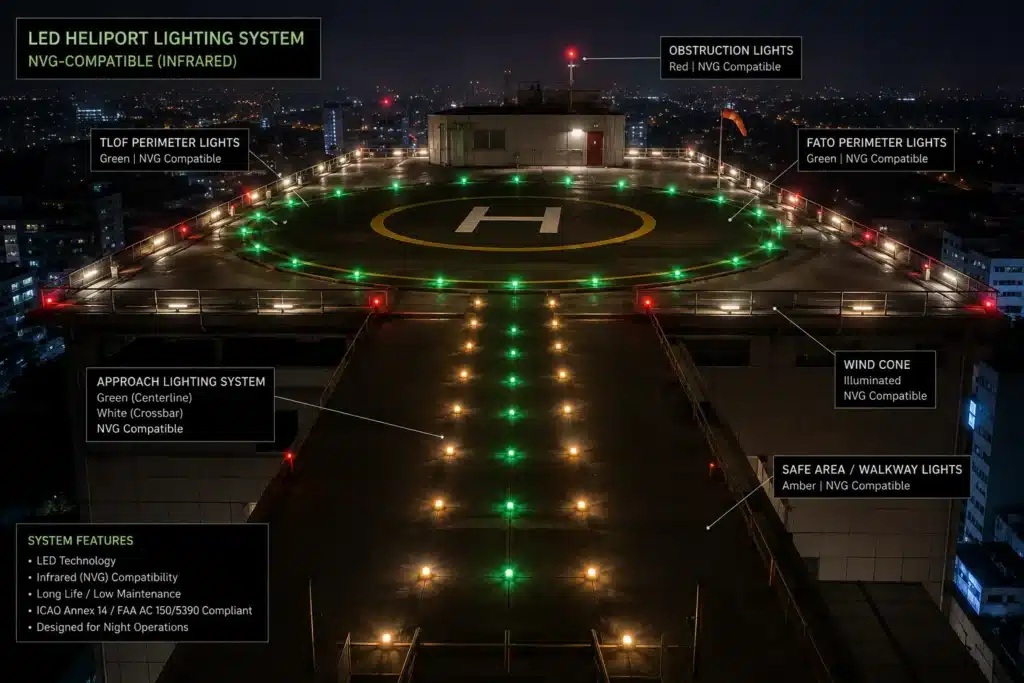
Heliport perimeter lights define the TLOF and FATO landing-area boundaries, while approach lights provide visual guidance for helicopter alignment and approach.
Need Heliport Perimeter or Approach Lighting Equipment?
LED PROS supplies heliport and helipad lighting for rooftop, hospital, commercial, industrial, and other helicopter landing facilities. Available equipment includes flush and elevated perimeter lights, approach and visual guidance lights, FATO and aiming-point fixtures, windsocks, floodlights, beacons, and controls.
Explore LED Heliport Lighting Systems or Request a Quote for help selecting equipment for your project.
Call 1-844-533-7767 for heliport lighting assistance.
What Are Heliport Perimeter Lights?
Heliport perimeter lights define the outer boundaries of the landing area and help pilots visually identify the usable landing surface.
These lighting systems are commonly installed around:
- Touchdown and lift-off areas (TLOF)
- Final approach and takeoff areas (FATO)
- Rooftop heliports
- Ground-level landing pads
- Offshore platforms
- Hospital emergency heliports
For heliports where a low-profile installation is preferred, the HL-50 flush heliport perimeter inset light provides omnidirectional green LED illumination for marking TLOF and FATO edge areas while extending only 15 mm above grade after installation.
Perimeter lights are typically:
- Green LED fixtures
- Omni-directional
- Low-profile
- Elevated or inset-mounted
- Weather resistant
Their primary purpose is to improve landing zone visibility and spatial orientation during helicopter operations.
Windsock visibility is often integrated with heliport perimeter and approach lighting systems to support safer nighttime aviation operations.
Selecting Heliport Perimeter Lighting Equipment
Perimeter lighting can use elevated or inset fixtures depending on the heliport configuration, operating surface, clearance requirements, and applicable project standards. Elevated fixtures provide visible boundary definition and straightforward service access, while inset fixtures minimize projection above the landing surface.
For low-profile TLOF and FATO perimeter applications, the HL-50 LED 8″ Flush Heliport Perimeter Inset Light provides an inset LED option for marking landing-area boundaries.
View HL-50 Specifications | Explore Heliport Lighting Systems
What Are Heliport Approach Lights?
Heliport approach lights help guide pilots during the final approach phase before landing.
Approach lighting systems assist with:
- Landing alignment
- Approach path visibility
- Pilot orientation
- Reduced visibility operations
- Nighttime navigation
These systems are commonly installed:
- Along helicopter approach corridors
- Near landing path thresholds
- On elevated structures
- Adjacent to rooftop heliports
- In offshore aviation facilities
Approach lights may include:
- Directional LED fixtures
- Sequenced lighting systems
- Elevated lighting arrays
- Flashing guidance lights
- Supplemental visual approach indicators
Where a heliport requires pilots to follow a defined approach axis, a SAGA heliport visual azimuth guidance system can provide synchronized directional guidance for restricted approach corridors, rooftop facilities, offshore platforms, and other sites where precise final-approach alignment is important.
For heliports requiring enhanced visual guidance along the final approach path, the AH-HP-L heliport approach flashing light provides a high-intensity flashing signal designed to improve approach-path identification and pilot orientation.
FAA and ICAO guidance both address perimeter lighting and approach lighting visibility for helicopter landing operations.
Primary Difference Between Perimeter and Approach Lights
| Feature | Heliport Perimeter Lights | Heliport Approach Lights |
|---|---|---|
| Primary Purpose | Define landing area boundaries | Guide helicopter during approach |
| Typical Color | Green | White or directional aviation colors |
| Fixture Placement | Around landing zone edges | Along approach path |
| Visibility Function | Landing zone identification | Pilot alignment and guidance |
| Common Mounting | Inset or low-profile | Elevated or directional |
| Operational Focus | Touchdown visibility | Approach navigation |
Both systems work together to improve pilot awareness and landing safety.
Planning a heliport upgrade project? Learn how modern perimeter lighting, windsock illumination, and touchdown area lighting support safer helicopter operations.
FAA Heliport Lighting Considerations
Federal Aviation Administration heliport lighting guidance commonly addresses:
- Landing area visibility
- Pilot approach guidance
- Fixture spacing
- Mounting height
- Glare reduction
- Obstruction awareness
- Rooftop safety considerations
Lighting systems should provide clear visibility without creating excessive glare or visual confusion during approach and landing operations.
LED Heliport Perimeter Lighting Advantages
Modern LED perimeter lights offer significant advantages compared to older halogen systems.
Benefits include:
- Long operating life
- Reduced maintenance
- Improved energy efficiency
- Instant startup
- Better vibration resistance
- Consistent illumination
LED perimeter fixtures are commonly used for:
- Hospital rooftop heliports
- Emergency response facilities
- Offshore aviation platforms
- Commercial heliports
- Private aviation facilities
Low-profile LED fixtures are especially important for rooftop heliports where rotor clearance and safety are critical.
Comparing heliport lighting configurations? Explore our LED Heliport Lighting systems for perimeter, approach, flood, inset, and visual guidance options.
LED Heliport Approach Lighting Advantages
LED approach lighting systems improve pilot guidance and operational visibility during final approach procedures.
Advantages include:
- Enhanced directional visibility
- Improved weather resistance
- Reduced maintenance requirements
- Reliable nighttime operation
- Better cold-weather performance
- Improved optical control
Approach lighting is particularly valuable for:
- Rooftop hospital heliports
- Elevated urban heliports
- Offshore platforms
- Remote landing zones
- Tactical aviation facilities
Review LED Aircraft Warning Lights for aviation obstruction visibility systems.
Rooftop Heliport Lighting Applications
Rooftop heliports commonly use both perimeter and approach lighting systems to support safe nighttime operations.
Typical rooftop lighting configurations include:
- Green perimeter lights
- Directional approach lights
- Windsock lighting
- Obstruction lighting
- Floodlighting
- Emergency backup systems
Proper rooftop lighting design helps reduce:
- Pilot disorientation
- Glare
- Shadowing
- Landing uncertainty
Hospital Heliport Lighting Systems
Hospital heliports frequently operate during nighttime emergency transport missions where reliable lighting is critical.
Hospital rooftop heliport systems commonly include:
- LED perimeter lighting
- LED approach guidance lighting
- Illuminated windsocks
- Obstruction visibility lighting
- Emergency backup power systems
These systems help improve:
- Emergency response readiness
- Pilot visibility
- Landing accuracy
- Operational reliability
Offshore and Industrial Heliport Lighting
Offshore platforms and industrial facilities often require durable heliport lighting systems capable of operating in harsh environments.
Common environmental challenges include:
- Salt air
- High winds
- Rain exposure
- Vibration
- Corrosion
- Extreme temperatures
Commercial-grade aviation lighting systems frequently feature:
- Marine-grade finishes
- Sealed optical chambers
- Corrosion-resistant housings
- High IP weather protection ratings
Infrared LED Compatible for NVG (Night Vision Goggles)
Night Vision Goggles compatible heliport lighting systems are increasingly used in military, tactical, and specialized aviation operations.
Infrared-compatible LED heliport lighting allows helicopters equipped with NVG systems to identify landing zones while minimizing visible light signatures.
These systems may include:
- Infrared LED perimeter lights
- IR-compatible approach lights
- Dual-mode visible and infrared fixtures
- Tactical rooftop heliport lighting
- Remote landing zone illumination
Infrared aviation lighting is commonly used for:
- Military helicopter operations
- Tactical response teams
- Law enforcement aviation units
- Remote landing zones
- Offshore tactical operations
Benefits of infrared-compatible heliport lighting include:
- Reduced visible light detection
- Enhanced covert operational capability
- Improved nighttime pilot visibility through NVGs
- Flexible visible/IR switching capability
Many advanced systems use dual-mode lighting that allows operators to alternate between:
- Standard visible aviation lighting
- Infrared-only operational modes
Infrared LED wavelengths are designed to work with compatible night vision aviation equipment while remaining minimally visible to the unaided eye.
Infrared Radiation plays an important role in modern military and tactical aviation lighting systems.
For facilities requiring both conventional visible lighting and night-vision capability, the HL-100 LED flush heliport FATO and aiming point light is available with an NVG-compatible configuration combining normal-color LEDs with infrared LEDs for operations with or without night vision goggles.
Environmental Durability Considerations
Heliport lighting systems are exposed to:
- Rain
- Snow
- Salt air
- Rotor wash vibration
- UV exposure
- High wind conditions
Commercial aviation-grade LED fixtures often feature:
- Impact-resistant lenses
- Sealed housings
- Corrosion-resistant coatings
- Marine-grade materials
- High vibration tolerance
Heliport Lighting Design Considerations
Effective heliport lighting layouts should evaluate:
- Pilot visibility angles
- Rooftop geometry
- Landing path alignment
- Obstruction visibility
- Fixture spacing
- Wind exposure
- Electrical infrastructure
- Maintenance accessibility
Lighting systems should provide:
- Clear landing zone definition
- Reliable approach guidance
- Reduced glare
- Uniform illumination patterns
Applications for Heliport Perimeter & Approach Lighting
These systems are commonly installed at:
- Hospitals
- Trauma centers
- Offshore platforms
- Military facilities
- Corporate heliports
- Public safety facilities
- Industrial sites
- Remote aviation operations
Modern LED systems improve operational reliability across both commercial and tactical aviation environments.
Choosing Commercial LED Heliport Lighting
When selecting heliport perimeter or approach lighting systems, important considerations include:
- FAA compatibility
- Fixture profile height
- IR/NVG compatibility
- Corrosion resistance
- Wind resistance
- Optical performance
- Emergency backup integration
- Maintenance accessibility
Facilities operating in harsh environments often prioritize sealed marine-grade aviation fixtures for long-term durability.
Learn more about FAA Heliport Lighting Requirements for rooftop and commercial helicopter landing facilities.
Inline Buyer Q&A
What is the main difference between heliport perimeter lights and approach lights?
Perimeter lights visually define a designated heliport area, such as the TLOF, according to the applicable heliport design.
Approach lights serve a different function. Where used, they provide additional visual guidance associated with the approach to the landing area.
The two systems should not be treated as interchangeable.
Does every heliport need both perimeter and approach lighting?
No.
Perimeter lighting and approach guidance have different purposes, and the appropriate system depends on the heliport type, layout, intended operations, applicable aviation guidance, site conditions, and project requirements.
Approach lighting should not automatically be added simply because a heliport operates at night.
Should heliport perimeter lights be elevated or inset?
Either configuration can be appropriate depending on the heliport design and fixture location.
Inset fixtures minimize projections above the landing surface, which can be useful where fixture profile is an important consideration.
Elevated fixtures can be appropriate in other locations and can provide different installation and maintenance characteristics.
The choice should be coordinated with the heliport layout, surface construction, operational area, applicable guidance, and maintenance requirements.
How do I determine the correct approach-light configuration?
Begin with the approved heliport design and applicable aviation guidance rather than selecting a standard number of fixtures.
Consider the intended approach path, heliport type, surrounding structures, visual environment, operating conditions, available space, electrical infrastructure, and project requirements.
Approach-light configurations are project-specific.
Can perimeter and approach lights use the same control system?
Potentially.
A coordinated heliport control system can operate multiple lighting functions, but control architecture depends on the equipment, facility, operating requirements, and project design.
Perimeter lights, approach lights, floodlights, windsock illumination, and other systems can require different circuits, intensities, or control functions.
What information should I provide when requesting perimeter or approach lights?
Useful information includes:
- Heliport type and intended use
- Rooftop or ground-level installation
- TLOF and FATO dimensions
- Approach and departure paths
- Existing or proposed fixture locations
- Elevated or inset requirements
- Voltage
- Control requirements
- Nighttime operating requirements
- NVG requirements, if applicable
- Environmental conditions
- Site drawings
- Applicable FAA, ICAO, or project specifications
Need Perimeter, Approach or Complete Heliport Lighting?
The appropriate heliport lighting configuration depends on the landing-area layout, TLOF and FATO boundaries, approach requirements, fixture mounting, power and controls, environmental conditions, and applicable aviation requirements.
Send LED PROS your project specifications, drawings, fixture schedule, or available requirements and we’ll help identify appropriate heliport lighting equipment.
Request a Quote or call 1-844-533-7767.
Frequently Asked Questions About Heliport Perimeter and Approach Lights
What are heliport perimeter lights?
Heliport perimeter lights visually define a designated landing-area boundary according to the applicable heliport design.
For example, TLOF perimeter lighting helps pilots identify the touchdown and liftoff area during applicable nighttime operations.
Fixture color, spacing, configuration, and installation should follow the requirements or guidance applicable to the facility.
What are heliport approach lights?
Approach lights provide visual guidance associated with the approach toward a heliport or landing area where such a system is used.
Their purpose differs from perimeter lighting, which defines an area on the heliport itself.
Approach-light configuration depends on the heliport design and applicable aviation guidance.
Are perimeter lights and approach lights interchangeable?
No.
They perform different functions.
Perimeter lights identify the boundaries of a designated heliport area, while approach lights provide visual guidance associated with the approach to the facility.
One system should not be substituted for the other solely because the fixtures appear similar.
Are heliport approach lights required for all heliports?
No.
Whether approach lighting is appropriate or required depends on the heliport type, design, intended operations, applicable aviation guidance, site conditions, and project requirements.
A nighttime heliport does not automatically require the same approach-light system as every other nighttime facility.
What color are heliport perimeter lights?
Green is commonly associated with TLOF perimeter lighting under applicable U.S. heliport guidance.
Other heliport areas and visual aids can use different colors and configurations.
Color should be selected according to the function of the light and applicable heliport criteria.
What color are heliport approach lights?
Approach-light colors and configurations depend on the particular system and aviation framework being applied.
Do not select approach fixtures by color alone.
The complete configuration, optical characteristics, location, and applicable requirements should be considered.
What are inset heliport lights?
Inset heliport lights are installed substantially within the landing surface so that only a low-profile portion of the fixture is exposed above the surface.
They can be useful where minimizing projections is important.
Their suitability depends on structural design, drainage, installation, loading, maintenance access, optical requirements, and the particular heliport application.
What are elevated heliport lights?
Elevated heliport lights are mounted above the installation surface rather than recessed into it.
They can simplify installation or maintenance in some applications, but their location and physical profile must be appropriate for the heliport design and operational environment.
Are inset heliport lights better than elevated fixtures?
Neither configuration is universally better.
Inset lights can minimize projections, while elevated fixtures can offer installation and maintenance advantages in appropriate locations.
The decision should be based on the landing-area design, fixture location, structural conditions, operational considerations, applicable guidance, and maintenance requirements.
Are rooftop heliport lights different from ground-level systems?
Rooftop heliports can create different installation conditions, but this does not mean every rooftop facility requires an entirely different class of fixture.
Building edges, structural limitations, surrounding obstructions, wind exposure, maintenance access, mounting conditions, approach paths, and electrical infrastructure can influence equipment selection.
The specific heliport design should determine the fixture configuration.
Do hospital heliports require approach lighting?
Not automatically.
Hospital heliports can have demanding nighttime operating requirements, but approach-lighting needs should be determined from the facility design, applicable aviation guidance, surrounding environment, and project requirements.
Can heliport lighting systems use backup generators?
Yes, heliport lighting can potentially be supplied by facility emergency or standby power systems when the electrical design and applicable requirements provide for it.
The appropriate power arrangement depends on the facility, heliport operation, electrical system, transfer equipment, controls, and applicable requirements.
Do not assume every heliport system is connected to a generator.
What happens to heliport lighting during a power failure?
That depends on the facility’s electrical design.
Where continued operation is required during loss of normal power, an appropriate emergency or standby power arrangement may be incorporated into the heliport system.
Power-source and transfer requirements should be coordinated with the electrical and heliport design.
What is NVG-compatible heliport lighting?
NVG-compatible lighting is designed to support operations involving specified night-vision equipment without creating unacceptable interference with that equipment.
Depending on the application, specialized visible, infrared, filtered, or dual-mode lighting technologies may be used.
Compatibility should be evaluated against the specific night-vision system and operational requirements rather than assuming any infrared LED fixture is automatically NVG-compatible.
Is infrared heliport lighting invisible to the unaided eye?
Some infrared emissions are outside normal human visual sensitivity, but the characteristics of a particular aviation fixture depend on its design and operating mode.
Infrared capability should not be generalized as completely invisible or automatically suitable for covert operations.
Verify the exact equipment specifications and operational requirements.
Do commercial heliports need NVG-compatible lighting?
Not generally.
NVG capability is application-specific and can be relevant to military, law-enforcement, emergency-response, medical, or other specialized operations.
It should be specified only when required by the intended aircraft operations and project criteria.
What are omnidirectional heliport lights?
Omnidirectional fixtures distribute their specified aviation-light output across a broad horizontal viewing range.
They can be used where the visual aid must be observable from multiple approach directions.
Actual beam characteristics and required coverage depend on the particular fixture and its aviation function.
Why is corrosion resistance important for heliport lighting?
Heliport fixtures can be exposed to rain, moisture, UV, temperature changes, and other outdoor conditions.
Coastal, offshore, and marine environments can add salt exposure and accelerated corrosion concerns.
Materials, finishes, hardware, seals, and environmental ratings should therefore be evaluated for the actual installation.
Are standard outdoor-rated fixtures suitable for heliport perimeter lighting?
No, not simply because they are outdoor rated.
Heliport lights perform specialized aviation visual functions.
The fixture must provide the appropriate color, optical characteristics, visibility, physical configuration, environmental performance, and other characteristics required for its intended heliport function.
Can LED heliport lights reduce maintenance requirements?
They can.
LED systems can reduce lamp-replacement requirements compared with some older halogen or incandescent systems.
Actual maintenance depends on fixture design, drivers and electronics, environmental exposure, seals, wiring, controls, physical damage, operating hours, and other system components.
How long do LED perimeter and approach lights last?
There is no universal service life for heliport LED fixtures.
Use manufacturer-specific lifetime and warranty information for the exact product.
LEDs, drivers, electronics, thermal conditions, electrical characteristics, weather exposure, and maintenance can all affect long-term performance.
Can perimeter and approach lights be retrofitted to LED?
Often, but a one-for-one conversion should be evaluated carefully.
Verify the function of each existing fixture, optical performance, color, location, mounting, dimensions, voltage, controls, environmental suitability, and applicable project requirements.
Physical compatibility alone does not establish that an LED replacement is appropriate.
Do heliport perimeter and approach lighting systems require regular maintenance?
Yes.
Inspection and maintenance can include checking fixture operation, lenses, seals, mounting, physical damage, corrosion, wiring, controls, power systems, and visibility.
Maintenance procedures should follow the equipment manufacturer’s instructions and applicable facility requirements.
Stay Connected with Our Lighting Resources
Add IndustrialLightingFixtures.org as a Preferred Source on Google to see more of our lighting guides and technical resources across Google Search experiences.
Related Heliport Lighting Resources
-
HL-50 LED Heliport Perimeter Inset Light — Review the flush-mounted perimeter fixture for low-profile TLOF and FATO boundary lighting.
- LED Heliport Lighting — Explore the primary heliport lighting category for perimeter lights, approach systems, windsocks, floodlights, controls, and related aviation equipment.
- FAA Heliport Lighting Requirements — Review FAA-focused lighting considerations for rooftop, hospital, commercial, and other helicopter landing facilities.
- Heliport Windsock Requirements — Learn how windsock location, visibility, illumination, and installation fit into the overall heliport visual-aid system.