
Heliport windsocks provide pilots with a visual indication of wind direction and general wind conditions near a helicopter landing facility.
For rooftop hospitals, commercial heliports, emergency facilities, offshore installations, and other helicopter landing sites, windsock location and visibility are especially important. The wind indicator should be positioned where it provides useful wind information without creating an obstruction or being excessively affected by nearby buildings, equipment, or other airflow disturbances.
Heliports intended for nighttime operations also require appropriate wind-indicator illumination so the windsock remains visible after dark.
This guide explains heliport windsock requirements and considerations for placement, nighttime illumination, rooftop installations, mounting, and equipment selection.
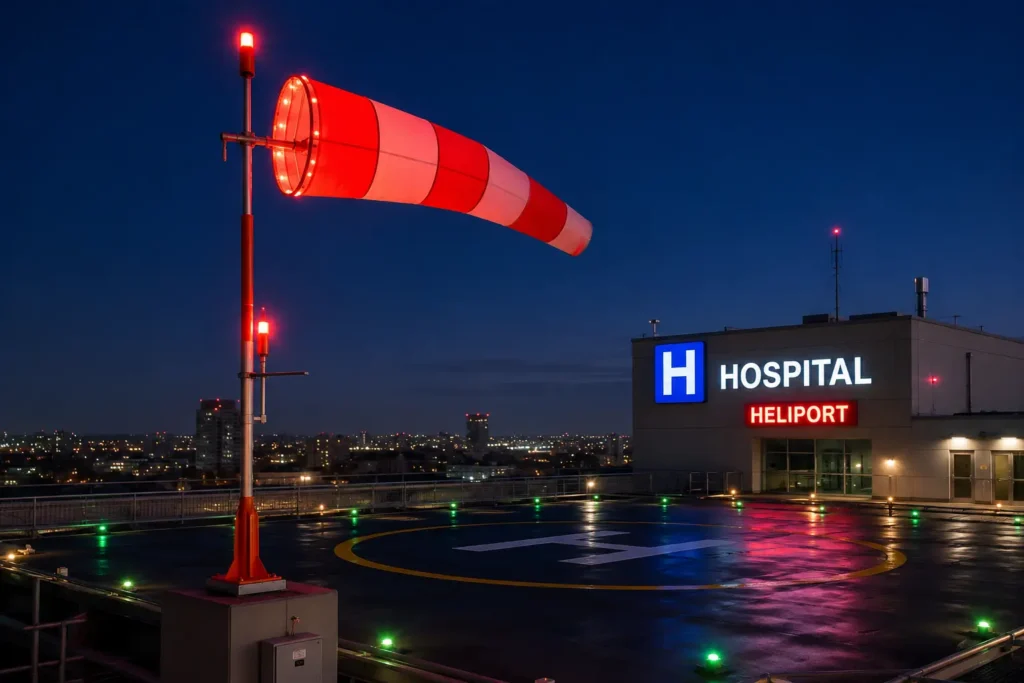
An illuminated heliport windsock provides pilots with a visual indication of wind direction and general wind conditions during nighttime helicopter operations.
Need a Heliport Windsock or Complete Heliport Lighting System?
LED PROS supplies illuminated windsocks and heliport lighting equipment for rooftop, hospital, commercial, industrial, and other helicopter landing facilities.
Explore Heliport Lighting Equipment | Request a Quote | 1-844-533-7767
What Is a Heliport Windsock?
A heliport windsock, also called a wind direction indicator or wind cone, provides pilots with a visual indication of wind direction and general wind conditions near the helicopter landing area.
The direction of the windsock indicates the direction of airflow, while its extension and movement can provide a general visual indication of changing wind conditions. A windsock should not be treated as a precision wind-speed instrument.
Heliport windsocks are used at facilities including hospital and rooftop heliports, commercial helicopter landing sites, public-safety facilities, industrial sites, offshore installations, and other helicopter operating areas.
For nighttime heliport operations, the wind direction indicator should remain appropriately visible after dark.
Looking to understand modern heliport lighting technology? This guide explains how LED heliport lighting systems improve safety, reliability, and operational efficiency.
FAA Heliport Windsock Guidance
FAA heliport guidance recommends a wind direction indicator that provides pilots with useful wind information near the landing facility.
Important siting considerations include:
-
Visibility from the approach and landing areas
-
Exposure to representative local wind conditions
-
Separation from objects that can interfere with airflow
-
Avoiding inappropriate obstruction hazards
-
Appropriate color contrast with the surrounding background
-
Illumination when the heliport is intended for nighttime operations
At heliports located among buildings or in environments where wind conditions can vary significantly across the facility, additional wind indicators may be appropriate.
The FAA’s current specification for wind cone assemblies is AC 150/5345-27F, FAA Specification for Wind Cone Assemblies.
Windsock visibility and obstruction awareness are important considerations under both ICAO and FAA heliport guidance.
How to Select a Heliport Windsock
- Heliport type
- Rooftop or ground-level installation
- Windsock/wind-cone size if specified
- Internal vs external illumination
- Nighttime operation
- Pole/mounting requirements
- Voltage
- Visibility requirements
- Surrounding buildings/equipment
- Environmental exposure
- Wind loading
- Applicable project specifications
Rooftop Heliport Windsock Requirements
Rooftop heliports create unique installation challenges for windsock systems due to:
- Elevated building structures
- Wind turbulence
- Limited installation space
- HVAC equipment
- Rooftop obstructions
- Rotor wash effects
Rooftop heliport windsock systems commonly use:
- Elevated poles
- LED illumination systems
- Corrosion-resistant hardware
- Reinforced mounting systems
- High-visibility aviation fabrics
Proper rooftop windsock placement helps ensure pilots can clearly identify wind conditions during final approach procedures.
Heliport Windsock Pole Height Considerations
Windsock pole height plays an important role in visibility and operational effectiveness.
Proper pole height helps:
- Improve pilot visibility
- Reduce obstruction interference
- Minimize rooftop turbulence effects
- Increase approach visibility angles
Pole height requirements vary depending on:
- Rooftop geometry
- Nearby structures
- Heliport elevation
- Wind exposure
- Building equipment locations
For rooftop heliports, windsocks are often mounted above nearby rooftop equipment to maximize visibility from multiple approach directions.
Planning a heliport lighting upgrade? Understanding perimeter lighting is essential for improving nighttime helicopter operations.
Illuminated Heliport Windsock Systems
Heliports intended for nighttime operations need a wind direction indicator that remains visible after dark. Depending on the windsock assembly, illumination may be provided internally or externally.
Internally illuminated windsocks incorporate lighting within or as part of the wind-cone assembly.
Externally illuminated windsocks use one or more fixtures positioned to illuminate the windsock from outside the assembly.
Neither method is universally better. Selection should consider nighttime visibility, glare, maintenance access, electrical requirements, pole configuration, environmental exposure, and project specifications.
The HLLW LED Illuminated Heliport Windsock is available with internal or external LED illumination for rooftop, hospital, commercial, offshore, and other heliport applications.
An illuminated windsock is one element of a complete aviation lighting system. See how it integrates with perimeter and approach lighting in our Helipad Lighting Systems Guide.
Offshore & High-Wind Environment Considerations
Coastal, offshore, and exposed installations may require additional attention to corrosion resistance, wind loading, ingress protection, mounting hardware, fabric durability, and maintenance access. Verify the environmental ratings and construction of the specific windsock assembly rather than assuming all aviation windsocks provide the same protection.
Heliport Windsock Materials & Construction
Commercial heliport windsock systems commonly use:
- UV-resistant fabrics
- Reinforced stitching
- Corrosion-resistant poles
- Aviation-grade mounting hardware
- Weather-resistant lighting systems
High-quality materials help extend system lifespan and improve visibility under demanding operating conditions.
Inline Buyer Q&A
How do I choose the correct windsock for a heliport?
Start with the heliport design, operating conditions, and applicable aviation guidance.
Important considerations include:
- Heliport type and intended use
- Rooftop or ground-level installation
- Windsock location
- Visibility from approach and landing areas
- Windsock size
- Pole height
- Internal or external illumination
- Mounting configuration
- Nighttime operations
- Surrounding structures and equipment
- Local airflow conditions
- Environmental exposure
- Available electrical power
- Applicable FAA or other project requirements
The windsock should be selected and positioned as part of the overall heliport visual-aid system.
Should I choose internal or external windsock illumination?
Either can be appropriate depending on the system and application.
Internal illumination places the light source within or as part of the windsock assembly, while external systems illuminate the windsock from separately positioned fixtures.
Compare nighttime visibility, glare control, maintenance access, environmental exposure, pole configuration, electrical requirements, and applicable project specifications.
What should I consider for a rooftop heliport windsock?
Rooftop installations can introduce additional considerations involving:
- Building height
- Parapets
- Mechanical equipment
- Nearby structures
- Airflow disturbance
- Approach visibility
- Structural mounting
- Wind loading
- Electrical routing
- Maintenance access
- Corrosion exposure
The windsock location should be coordinated with the complete rooftop heliport design.
I already have a heliport drawing or windsock specification. Can you quote from it?
Useful project information includes:
- Heliport type
- Rooftop or ground-level installation
- Windsock size if specified
- Proposed pole height
- Internal or external illumination preference
- Voltage
- Mounting requirements
- Environmental conditions
- Coastal or offshore exposure
- Site drawings or photographs
- Applicable FAA or project specifications
For available configurations, see the HLLW LED Illuminated Heliport Windsock.
Need an Illuminated Windsock for a Heliport Project?
A heliport windsock is most useful when its location, size, mounting height, illumination, and environmental construction are coordinated with the landing facility.
Rooftop conditions, surrounding structures, airflow, approach visibility, nighttime operations, mounting, corrosion exposure, and applicable aviation guidance should all be considered.
Send us the heliport type, rooftop or ground-level installation, specified windsock size, pole or mounting requirements, internal or external illumination preference, voltage, environmental conditions, quantity, and project drawings or specifications when available.
Request a Quote | Call 1-844-533-7767 to discuss your heliport windsock requirements.
Frequently Asked Questions About Heliport Windsocks
Why are windsocks used at heliports?
Windsocks provide pilots with a visual indication of wind direction and general wind conditions near the landing facility.
They should be positioned so they are appropriately visible while representing local wind conditions as effectively as practical for the heliport.
Do all heliports require a windsock?
Wind-direction indicators are an important component of heliport design, but the specific requirements for a particular facility should be determined from the applicable aviation guidance, project documents, and authority requirements.
Do not assume that every heliport uses the same windsock size, location, pole, or illumination system.
What is an internally illuminated heliport windsock?
An internally illuminated windsock system incorporates lighting within or as part of the windsock assembly to illuminate the wind indicator.
This can provide a compact lighting arrangement, but performance, maintenance access, electrical requirements, and environmental suitability depend on the specific product.
Does a heliport windsock measure wind speed?
A windsock is primarily a visual wind-direction indicator and can provide a general indication of wind conditions based on its extension and movement.
It should not be treated as a precision wind-speed instrument.
Where precise wind measurements are required, appropriate meteorological instrumentation serves a different function.
Can nearby rooftop equipment affect a windsock?
Yes.
Mechanical equipment, parapets, walls, rooftop structures, and adjacent buildings can disturb airflow around the windsock.
The location should be evaluated so the indicator provides useful wind information while remaining appropriately visible from the heliport operating environment.
Should the windsock be coordinated with the rest of the heliport lighting system?
Yes.
Windsock location and illumination should be considered alongside perimeter lighting, approach guidance, floodlighting, obstruction considerations, controls, and other visual aids.
The goal is a coordinated heliport system rather than independently selected components.
Stay Connected with Our Lighting Resources
Add IndustrialLightingFixtures.org as a Preferred Source on Google to see more of our lighting guides and technical resources across Google Search experiences.
Related Heliport Lighting Resources
-
HL-50 LED Heliport Perimeter Inset Light — Review the flush-mounted perimeter fixture for low-profile TLOF and FATO boundary lighting.
- LED Heliport Lighting — Explore the primary heliport lighting category for perimeter lights, approach systems, windsocks, floodlights, controls, and related equipment.
- FAA Heliport Lighting Requirements — Review FAA-focused lighting and visual-aid considerations for hospital, rooftop, commercial, and other helicopter landing facilities.
- Heliport Perimeter vs. Approach Lights — Understand how perimeter and approach lighting perform different functions within the heliport visual-aid system.
- ICAO vs. FAA Heliport Lighting — Compare U.S. FAA and ICAO frameworks when planning heliport visual aids for domestic and international projects.