
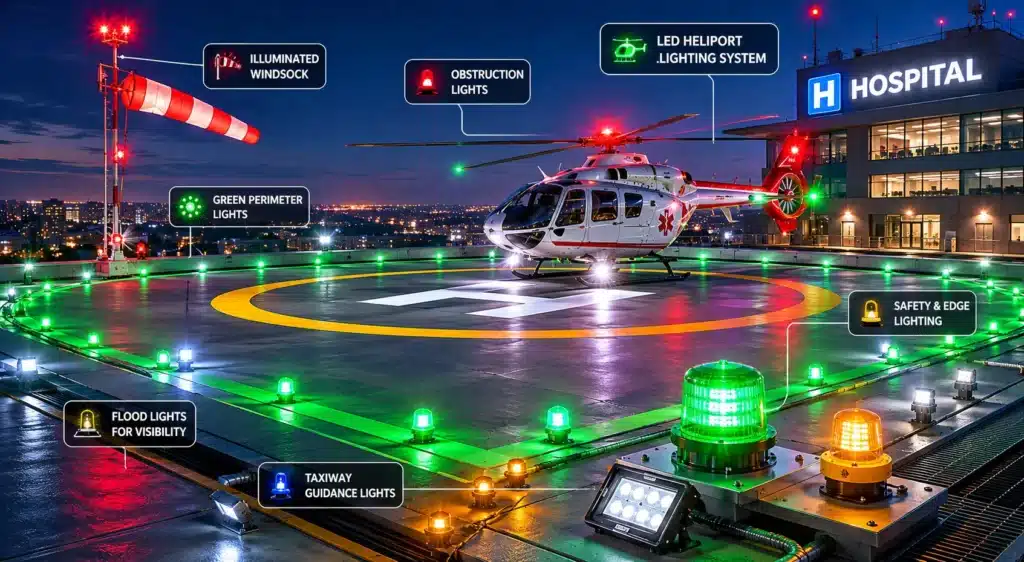
Rooftop heliports require specialized lighting systems designed to support safe nighttime helicopter operations in complex elevated environments. From hospital emergency transport facilities to commercial aviation rooftops, proper rooftop heliport lighting improves pilot visibility, landing accuracy, and operational safety.
Modern LED rooftop heliport lighting systems provide long operating life, reduced maintenance, improved energy efficiency, and enhanced visibility compared to older lighting technologies. Properly designed systems help define landing areas, improve approach visibility, illuminate windsocks, and increase awareness of rooftop obstructions.
This guide explains rooftop heliport lighting systems, FAA design considerations, recommended fixture types, and key factors involved in planning safe helicopter landing environments on elevated structures.
What Is Rooftop Heliport Lighting?
Rooftop heliport lighting refers to aviation lighting systems installed on elevated helicopter landing facilities located on:
- Hospitals
- Medical centers
- Commercial buildings
- Parking structures
- Industrial facilities
- Offshore platforms
- Public safety buildings
These systems help pilots safely identify:
- Landing zones
- Perimeter boundaries
- Wind direction
- Rooftop obstacles
- Approach paths
- Touchdown areas
Rooftop heliport lighting systems typically include:
- LED perimeter lighting
- Windsock lighting
- Floodlighting
- Obstruction lighting
- Emergency backup lighting
- Elevated or inset fixtures
Rooftop heliports may incorporate lighting systems designed to support both domestic and international aviation operational environments.
Why Rooftop Heliport Lighting Is Critical
Unlike ground-level heliports, rooftop facilities create additional operational challenges due to:
- Elevated structures
- Nearby buildings
- Wind turbulence
- Limited landing space
- Visual depth perception issues
- Rooftop equipment obstacles
Proper rooftop heliport lighting helps improve:
- Pilot situational awareness
- Nighttime visibility
- Landing precision
- Emergency response operations
- Overall aviation safety
For hospital and trauma centers, reliable rooftop heliport lighting is especially important because emergency medical flights frequently operate during nighttime conditions.
Rooftop heliports frequently use both perimeter lighting and directional approach lighting systems for nighttime operations.
FAA Rooftop Heliport Lighting Considerations
Federal Aviation Administration rooftop heliport lighting guidance commonly addresses:
- Perimeter lighting visibility
- Fixture spacing
- Windsock illumination
- Obstruction identification
- Glare reduction
- Mounting height limitations
- Pilot line-of-sight considerations
Rooftop heliports often require specialized fixture placement to minimize interference from:
- HVAC equipment
- Antennas
- Elevator structures
- Rooftop mechanical systems
- Safety railings
Rooftop heliports commonly use illuminated windsock systems alongside perimeter and obstruction lighting for improved pilot visibility.
LED Rooftop Heliport Perimeter Lighting
Perimeter lighting defines the edges of the landing area and helps pilots identify the operational boundaries of the heliport.
Typical rooftop heliport perimeter lighting systems include:
- Green LED perimeter lights
- Omni-directional fixtures
- Low-profile lighting
- Inset-mounted fixtures
- Elevated edge fixtures
LED perimeter lights are preferred because they:
- Reduce maintenance requirements
- Improve visibility consistency
- Lower energy consumption
- Resist vibration damage
- Provide instant startup
Low-profile fixtures are commonly used to reduce risks associated with rotor wash and helicopter clearance limitations.
Learn more about FAA Heliport Lighting Requirements for rooftop and commercial heliport facilities.
Low-Profile Heliport Lighting Systems
Rooftop heliports frequently use low-profile lighting systems to minimize physical hazards near helicopter landing zones.
Benefits of low-profile heliport fixtures include:
- Reduced rotor interference
- Lower impact risks
- Improved aircraft clearance
- Better rooftop safety
- Reduced maintenance exposure
These systems are especially important for:
- Hospital rooftop heliports
- Compact rooftop landing pads
- Urban aviation environments
- Elevated emergency response facilities
Explore Rooftop Heliport Lighting Guide for elevated hospital and emergency heliport applications.
Rooftop Heliport Windsock Lighting
Windsocks provide pilots with critical wind direction and velocity information during approach and departure procedures.
Rooftop windsock lighting systems commonly include:
-
LED floodlights
-
Pole-mounted lighting
-
Internal illumination systems
-
Directional visibility fixtures
Proper rooftop windsock placement should:
-
Maximize pilot visibility
-
Avoid nearby structural obstructions
-
Remain visible from multiple approach angles
-
Minimize glare
Many rooftop heliports use elevated windsock poles positioned away from rooftop mechanical equipment for improved visibility.
Rooftop Obstruction Lighting
Obstruction lighting helps pilots identify nearby rooftop hazards and elevated structures during nighttime operations.
Common rooftop obstruction lighting applications include:
-
Mechanical equipment
-
HVAC systems
-
Antennas
-
Elevator housings
-
Communication towers
-
Crane structures
LED obstruction lights are commonly selected because they:
-
Require minimal maintenance
-
Provide long operating life
-
Improve visibility reliability
-
Operate efficiently in harsh weather
Rooftop Heliport Flood Lighting
Floodlighting may be used to illuminate:
-
Rooftop access paths
-
Safety zones
-
Maintenance areas
-
Equipment locations
-
Emergency access routes
However, excessive brightness or poorly aimed floodlights can negatively impact pilot visibility.
Proper rooftop floodlighting design focuses on:
-
Glare reduction
-
Controlled beam angles
-
Uniform illumination
-
Reduced reflections
-
Minimal upward light spill
For rooftop heliports requiring supplemental TLOF/FATO surface illumination, the HL-200 LED heliport floodlight provides elevated white-light illumination with a glare-reducing lens hood designed to help limit direct glare to pilots and ground personnel.
Emergency Backup Lighting Systems
Many rooftop heliports require emergency lighting systems capable of operating during power outages or critical emergencies.
Backup systems may include:
- Generator-supported lighting
- Battery backup systems
- Emergency circuit integration
- Redundant power supplies
Hospital heliports frequently prioritize emergency backup lighting to maintain continuous operational readiness for medical transport helicopters.
Environmental Challenges for Rooftop Heliport Lighting
Rooftop lighting systems are exposed to harsh environmental conditions including:
- High winds
- Rain
- Snow
- Salt air
- UV exposure
- Rotor wash vibration
- Extreme temperature changes
Commercial aviation-grade LED fixtures often feature:
- Corrosion-resistant housings
- Marine-grade finishes
- Sealed optical systems
- Impact-resistant lenses
- High IP weather protection ratings
LED Rooftop Heliport Lighting Advantages
| Feature | LED Rooftop Heliport Lighting | Traditional Lighting |
|---|---|---|
| Maintenance Requirements | Low | Higher |
| Fixture Lifespan | Long | Shorter |
| Energy Efficiency | Excellent | Moderate |
| Startup Speed | Instant | Slower |
| Cold Weather Operation | Excellent | Moderate |
| Vibration Resistance | Excellent | Lower |
LED systems are particularly valuable for rooftop heliports because maintenance access may be difficult or operationally disruptive
Rooftop Heliport Lighting Design Considerations
Successful rooftop heliport lighting layouts should evaluate:
- Building height
- Rooftop geometry
- Pilot visibility angles
- Fixture spacing
- Wind exposure
- Electrical infrastructure
- Maintenance access
- FAA guidance requirements
Lighting designers often prioritize:
- Clear landing zone definition
- Reduced visual clutter
- Minimal glare
- Consistent illumination patterns
Applications for Rooftop Heliport Lighting
Rooftop heliport lighting systems are commonly used at:
- Hospitals
- Trauma centers
- Corporate buildings
- Public safety facilities
- Offshore platforms
- Industrial facilities
- Emergency response centers
These systems are critical for facilities requiring reliable nighttime helicopter access.
Review LED Aircraft Warning Lights for rooftop obstruction and aviation safety lighting applications
Choosing Commercial Rooftop Heliport Lighting
When selecting rooftop heliport lighting systems, important considerations include:
- Applicable FAA guidance and design requirements
- Fixture profile height
- Wind resistance
- Corrosion resistance
- Optical performance
- Backup power integration
- Maintenance accessibility
- Environmental durability
Facilities in coastal or industrial environments often prioritize marine-grade construction and sealed LED optical systems for long-term reliability.
Inline Buyer Q&A
What makes rooftop heliport lighting different from a ground-level installation?
Rooftop heliports can introduce additional design considerations involving building height, edges and parapets, surrounding structures, wind exposure, structural mounting, electrical routing, maintenance access, nearby mechanical equipment, approach paths, and local airflow.
The lighting system should therefore be coordinated with the actual rooftop facility rather than copied from a standard ground-level layout.
What lighting systems should be considered for a rooftop heliport?
Depending on the heliport design and applicable requirements, systems can include:
- TLOF perimeter lighting
- FATO lighting or visual aids
- Approach guidance
- Illuminated windsocks
- Heliport floodlighting
- Identification lighting
- Obstruction lighting where applicable
- Lighting controls
- Emergency or standby power where required
Not every rooftop heliport requires every system in the same configuration.
Should rooftop heliport lights be elevated or inset?
Either can be appropriate depending on the fixture location and heliport design.
Inset fixtures minimize projections above the landing surface and can be useful where fixture profile is an important consideration.
Elevated fixtures can be appropriate in other locations and may offer different installation and maintenance characteristics.
Selection should consider the heliport layout, structural conditions, operational area, applicable guidance, drainage, mounting, and maintenance access.
How should rooftop wind and weather exposure affect fixture selection?
Evaluate the environmental conditions at the actual fixture location.
Building elevation can expose equipment to significant wind, precipitation, temperature changes, UV, moisture, and—in coastal locations—salt and corrosion.
Review fixture construction, mounting, environmental ratings, operating-temperature range, corrosion resistance, and other manufacturer specifications for the project.
How should rooftop obstructions be addressed?
Nearby structures, antennas, mechanical equipment, parapets, penthouses, and other rooftop objects should be evaluated as part of the heliport design.
Whether an object requires marking, lighting, relocation, or another treatment depends on its location and the applicable aviation and project requirements.
Do not assume every rooftop object requires an aircraft obstruction light.
What information should I provide when requesting rooftop heliport lighting?
Useful project information includes:
- Heliport drawings
- Building and rooftop plans
- TLOF and FATO dimensions
- Heliport elevation
- Approach and departure paths
- Existing or proposed fixture locations
- Elevated or inset requirements
- Windsock location
- Nearby structures and rooftop equipment
- Voltage
- Lighting controls
- Emergency or standby power requirements
- Environmental conditions
- Applicable FAA or project specifications
Design the Lighting Around the Rooftop Environment
A rooftop heliport combines aviation-lighting requirements with the physical constraints of an elevated building environment.
TLOF/FATO configuration, fixture profile, approach visibility, windsock location, glare control, rooftop obstructions, structural mounting, wind exposure, electrical infrastructure, controls, maintenance access, and applicable aviation guidance should be considered as a coordinated system.
Our aviation lighting specialists can help evaluate LED lighting systems for hospital, trauma-center, commercial, industrial, public-safety, and other rooftop helicopter landing facilities.
Call 1-844-533-7767 to discuss your rooftop heliport lighting project.
Frequently Asked Questions About Rooftop Helipad Lights
What is rooftop heliport lighting?
Rooftop heliport lighting consists of the visual lighting systems used to support applicable helicopter operations at an elevated landing facility.
Depending on the design, these can include TLOF perimeter lighting, FATO visual aids, approach guidance, windsock illumination, floodlighting, identification lighting, obstruction lighting where applicable, and associated controls.
The exact system is project-specific.
What is TLOF lighting on a rooftop heliport?
TLOF stands for Touchdown and Liftoff Area.
TLOF lighting helps visually define the area intended for helicopter touchdown and liftoff during applicable operations.
Its configuration, color, spacing, and installation should follow the heliport design and applicable aviation guidance.
What is FATO lighting on a rooftop heliport?
FATO stands for Final Approach and Takeoff Area.
The FATO relates to the area over which the final phase of approach and beginning of takeoff are conducted.
FATO and TLOF are different operational areas and should not automatically be assumed to use identical lighting configurations.
What color are rooftop heliport perimeter lights?
Green is commonly associated with TLOF perimeter lighting under applicable U.S. heliport guidance.
Other heliport visual aids can use different colors and configurations.
Color should therefore be specified according to the particular lighting function and applicable project criteria.
Why are low-profile fixtures used on rooftop heliports?
Low-profile and inset fixtures can minimize projections above the installation surface where fixture height is an important consideration.
However, low profile by itself does not make a fixture appropriate for heliport use.
Optical performance, physical configuration, mounting, environmental suitability, electrical characteristics, and applicable aviation requirements also need to be evaluated.
Are inset lights better for rooftop heliports?
Not universally.
Inset fixtures can minimize projections and provide a low-profile installation, while elevated fixtures can offer different installation and maintenance advantages.
The appropriate choice depends on fixture location, structural design, drainage, loading, maintenance access, heliport configuration, and applicable guidance.
Do rooftop heliports require approach lights?
Not every rooftop heliport requires the same approach-lighting system.
Approach guidance depends on the heliport design, intended operations, approach environment, surrounding structures, available space, applicable aviation guidance, and project requirements.
Do rooftop heliports require obstruction lighting?
Not automatically.
Building features, antennas, rooftop equipment, nearby structures, and other objects should be evaluated according to their location and applicable aviation requirements.
Some objects may require marking or lighting, while others may not.
The determination should be based on the heliport and aviation environment rather than simply the presence of rooftop equipment.
Are aircraft warning lights the same as heliport perimeter lights?
No.
Aircraft warning or obstruction lights identify structures or objects that can affect aviation.
Heliport perimeter lights perform a different visual function by defining a designated heliport area.
The systems should not be treated as interchangeable.
Why is windsock placement important on a rooftop heliport?
The windsock should be appropriately visible to pilots while providing useful information about local wind conditions.
Parapets, mechanical equipment, walls, adjacent buildings, and other structures can affect both visibility and airflow.
Location and pole height should therefore be coordinated with the rooftop heliport design.
Do rooftop heliport windsocks need illumination?
Where nighttime operations require the wind indicator to remain visible, appropriate illumination may be required or specified.
Internal or external illumination can be available depending on the windsock system.
The applicable heliport requirements should determine the configuration.
Why is glare control important on rooftop heliports?
Poorly selected, positioned, or aimed lighting can create unwanted brightness within pilot viewing directions.
Heliport floodlights, nearby building lighting, rooftop equipment lighting, signage, and other exterior fixtures should be considered as part of the overall nighttime visual environment.
Can surrounding building lights interfere with heliport operations?
Potentially.
Bright façade lighting, floodlights, signage, rooftop fixtures, and other nearby sources can contribute to glare or visual clutter.
The surrounding lighting environment should be considered when planning the heliport visual aids.
Do rooftop heliports require emergency or standby power?
Power requirements depend on the facility, intended operations, electrical design, applicable codes, aviation guidance, and project requirements.
Hospital and emergency-response facilities can incorporate emergency or standby power for heliport systems, but the required arrangement should be determined for the specific project.
Can rooftop heliport lights be connected to a building generator?
Potentially.
Integration with a building emergency or standby power system depends on the electrical design, transfer equipment, lighting controls, operational requirements, and applicable project criteria.
Generator compatibility should be evaluated as part of the electrical system rather than assumed from the lighting fixture alone.
Are LED heliport lights better than traditional lighting systems?
LED aviation lighting can offer advantages such as reduced electrical consumption, reduced relamping requirements, and long rated operating life compared with some older technologies.
Actual performance and maintenance depend on the fixture, drivers and electronics, thermal conditions, operating profile, environment, and system design.
LED technology alone does not establish suitability for a heliport application.
How long do rooftop LED heliport lights last?
There is no universal service life.
Use manufacturer-specific rated-life and warranty information for the exact fixture.
LEDs, drivers, electronics, temperature, moisture, electrical conditions, operating hours, vibration, and environmental exposure can all affect long-term performance.
Are rooftop heliport lights weather resistant?
Aviation fixtures can be designed for demanding outdoor environments, but environmental suitability is product-specific.
Verify operating-temperature range, ingress protection, materials, corrosion resistance, wind exposure, mounting requirements, and other relevant specifications for the installation.
Do coastal rooftop heliports need corrosion-resistant fixtures?
Coastal locations can expose equipment to salt, moisture, wind, and accelerated corrosion.
Materials, finishes, fasteners, seals, electrical components, and maintenance requirements should be evaluated for the actual environment.
A generic “marine-grade” description should not replace review of the product specifications.
Can existing rooftop heliport lighting be converted to LED?
Often, but a one-for-one replacement should not automatically be assumed.
Verify each fixture’s function, optical characteristics, color, physical dimensions, mounting, voltage, controls, environmental suitability, and applicable project requirements before selecting an LED replacement.
Can rooftop heliport lighting support NVG operations?
Specialized heliport lighting can be available for operations involving night-vision equipment.
Compatibility depends on the particular lighting technology, operating mode, night-vision equipment, and operational requirements.
Do not assume a standard LED aviation fixture is automatically NVG-compatible.
What maintenance considerations are especially important on rooftop heliports?
Rooftop access can make maintenance more difficult than at some ground-level facilities.
Inspection planning should consider fixture operation, lenses, seals, mounting, corrosion, wiring, controls, windsock condition, power systems, physical damage, and safe access to equipment.
Maintenance procedures should follow manufacturer instructions and applicable facility requirements.
Should rooftop heliport lighting be professionally coordinated?
Yes.
A rooftop heliport combines aviation operations with structural, electrical, architectural, environmental, and life-safety considerations.
Lighting equipment should be coordinated with the qualified professionals responsible for the heliport design, electrical system, structural design, and applicable approval process.
Stay Connected with Our Lighting Resources
Add IndustrialLightingFixtures.org as a Preferred Source on Google to see more of our lighting guides and technical resources across Google Search experiences.
Related Rooftop Heliport Lighting Resources
- FAA Heliport Lighting Requirements — Review FAA-focused lighting considerations for hospital, rooftop, commercial, and other helicopter landing facilities.
- Heliport Perimeter vs. Approach Lights — Understand how perimeter and approach lighting perform different visual functions within a heliport system.
- Heliport Windsock Requirements — Review windsock location, pole height, illumination, visibility, and environmental considerations for heliports.
- LED Heliport Lighting — Explore commercial heliport perimeter lights, approach systems, windsocks, floodlights, controls, and related equipment.
- Aviation Lighting Guide — Review the broader aviation-lighting environment, including heliports, aircraft obstruction lighting, and specialized aviation visual aids.