
Good Lighting Begins with Proper Fixture Placement
One of the most common mistakes in commercial lighting is focusing solely on the fixture instead of where that fixture should be installed.
A successful exterior lighting system uses multiple fixture types positioned strategically around the building to illuminate entrances, service areas, walkways, architectural features, and security-sensitive locations.
Rather than installing brighter fixtures, proper placement improves visibility, reduces glare, minimizes light trespass, and creates a safer, more attractive commercial property.
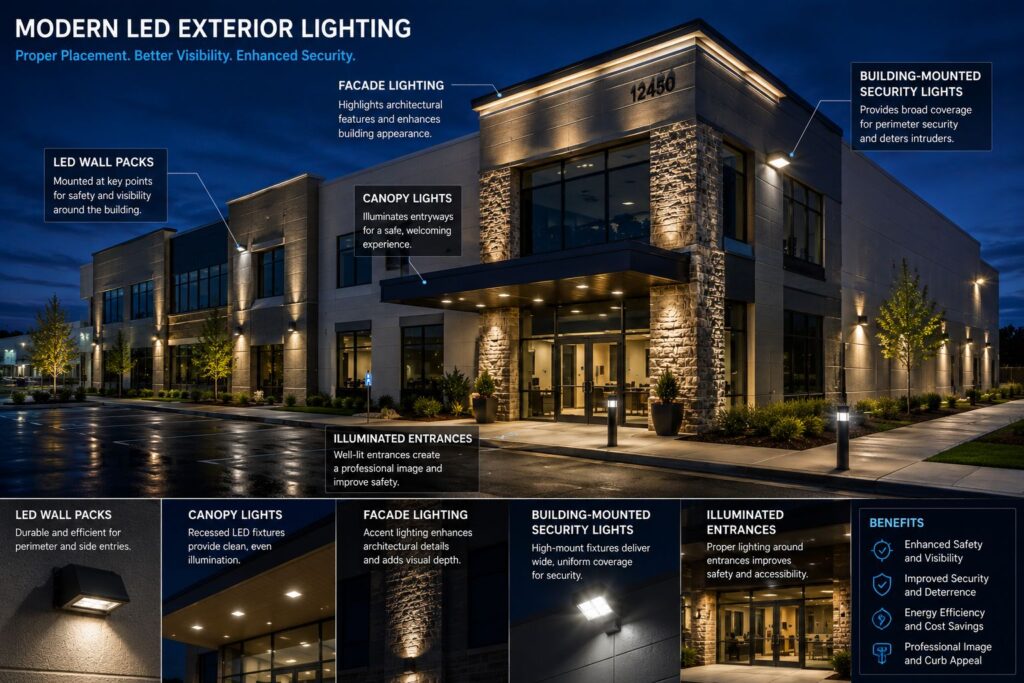
Proper placement of commercial LED building lights improves safety, security, navigation, and architectural appearance while reducing energy consumption and maintenance costs.
Planning an exterior lighting upgrade?
Our commercial lighting specialists can recommend the ideal fixture types, mounting locations, beam distributions, and lighting layouts for your building and property.
Request a Commercial Lighting Consultation – – https://industriallightingfixtures.org/
Why Building-Mounted Lighting Matters
Building-mounted lighting performs several important functions beyond simply illuminating the exterior walls.
Properly installed LED fixtures help:
- Improve customer safety
- Guide visitors to entrances
- Support security cameras
- Eliminate dark areas
- Enhance architectural appearance
- Improve employee security
- Reduce maintenance
- Lower operating costs
- Strengthen brand image
The most effective commercial lighting systems combine parking lot lighting with strategically positioned building-mounted fixtures.
If you’re replacing older wall packs, canopy lights, or exterior HID fixtures, our Commercial LED Lighting Retrofit Guide explains how to modernize your building with today’s high-performance LED technology.
Main Building Entrances
The primary entrance often receives the highest volume of pedestrian traffic and should provide bright, uniform illumination without excessive glare.
Recommended fixtures include:
- LED Canopy Lights
- LED Wall Packs
- LED Façade Lighting
- Decorative Architectural Fixtures
Well-lit entrances create positive first impressions while improving visitor safety and nighttime navigation.
Secondary Employee Entrances
Employee entrances frequently receive less attention than public entrances, yet they are often used during early morning and evening hours.
Proper lighting should illuminate:
- Doorways
- Sidewalks
- Access control systems
- Employee parking connections
- Emergency exits
Consistent illumination improves employee security while reducing accident risks.
Building Corners
Corners frequently become dark zones where surveillance cameras perform poorly.
Installing fixtures near building corners helps:
- Eliminate blind spots
- Improve camera visibility
- Increase perimeter security
- Improve pedestrian safety
- Create more uniform lighting around the structure
Corner lighting should overlap with adjacent fixtures to eliminate shadows.
Loading Docks and Receiving Areas
Loading docks remain active throughout the day and often during overnight operations.
Lighting should provide clear visibility for:
- Truck drivers
- Forklift operators
- Dock personnel
- Delivery vehicles
- Shipping activities
Recommended fixtures include:
- LED Canopy Lights
- Building-mounted Flood Lights
- Wall-mounted Area Lights
Proper illumination reduces accidents while improving operational efficiency.
Service Doors and Utility Areas
Rear entrances often receive deliveries, maintenance personnel, and service contractors.
Lighting should illuminate:
- Door hardware
- Walkways
- Service equipment
- Access control panels
- Mechanical rooms
Providing dependable lighting discourages unauthorized access while improving employee safety.
Dumpster and Waste Collection Areas
Waste collection areas are frequently overlooked during lighting projects.
Proper illumination improves:
- Employee safety
- Waste collection efficiency
- Security
- Pest management inspections
- Surveillance camera performance
Fixtures should provide adequate illumination without producing unnecessary glare toward adjacent properties.
Mechanical Equipment Areas
Commercial buildings often contain valuable rooftop or ground-mounted mechanical equipment.
Outdoor lighting supports maintenance personnel working around:
- HVAC equipment
- Backup generators
- Electrical service equipment
- Utility connections
- Mechanical enclosures
Maintenance personnel benefit from dependable illumination during scheduled service and emergency repairs.
Architectural Façades
Façade lighting transforms a commercial building after dark by highlighting architectural details while strengthening the property’s visual identity.
Common architectural features include:
- Columns
- Stonework
- Brick textures
- Glass curtain walls
- Entry canopies
- Corporate logos
Professional façade lighting creates an inviting appearance while reinforcing brand recognition.
Once your building lighting has been installed, ongoing maintenance, inspections, and lighting controls help maximize long-term performance. Read our Commercial Lighting Best Practices guide for additional recommendations.
Building Identification and Signage
Business signs represent one of the most important wayfinding elements on commercial properties.
Proper sign lighting helps:
- Improve business visibility
- Reinforce branding
- Guide visitors
- Increase nighttime recognition
- Enhance curb appeal
Building-mounted sign lighting should complement the surrounding architectural lighting without overpowering nearby fixtures.
Matching Fixtures to Building Applications
| Building Location | Recommended LED Fixture |
|---|
| Main Entrances | LED Canopy Lights |
| Employee Entrances | LED Wall Packs |
| Loading Docks | LED Canopy or Flood Lights |
| Building Corners | LED Wall Packs |
| Service Doors | LED Security Lights |
| Architectural Façades | LED Façade Lighting |
| Building Signage | LED Sign Lighting |
| Sidewalk Connections | LED Bollard Lights |
For entrance lighting, explore LED Canopy Lighting. Building perimeters are commonly illuminated using LED Wall Packs, while architectural features benefit from LED Façade Lighting. Business identification is enhanced with LED Sign Lighting, and pedestrian pathways connecting buildings are often illuminated using LED Bollard Lights.
Coordinate Building Lighting with Site Lighting
Building-mounted fixtures should not operate independently from parking lot lighting.
Instead, both systems should work together to create continuous illumination across the property.
Proper coordination considers:
- Pole locations
- Building entrances
- Sidewalk connections
- Parking areas
- Landscape features
- Security camera coverage
- Pedestrian circulation
- Vehicle traffic
When building lighting and site lighting are planned together, the result is improved safety, better visibility, and a more professional nighttime appearance.
Proper fixture placement is only one part of creating an attractive commercial property. Learn how layered lighting improves curb appeal, customer experience, and property value in our Commercial Building Exterior Lighting Guide.
Parking Garage Entrances
Parking garage entrances require carefully balanced lighting that allows drivers to transition safely between daylight and interior lighting conditions.
Recommended lighting objectives include:
- Improve driver visibility
- Illuminate entry lanes
- Highlight clearance signs
- Reduce harsh shadows
- Improve pedestrian awareness
- Support security cameras
LED canopy lighting and wall-mounted fixtures often provide the best combination of uniform illumination and energy efficiency.
Walkways and Pedestrian Corridors
Sidewalks connecting parking areas to building entrances should remain consistently illuminated throughout the property.
Lighting should help visitors easily identify:
- Building entrances
- Crosswalks
- Stairways
- Ramps
- Accessible routes
- Outdoor gathering areas
Rather than creating isolated pools of light, pedestrian lighting should provide continuous illumination that improves comfort and safety.
LED bollards, wall-mounted fixtures, and canopy lighting frequently work together to achieve this objective.
Building Perimeters
Exterior building walls often become security-sensitive areas after business hours.
Proper perimeter lighting helps:
- Eliminate dark zones
- Improve surveillance camera performance
- Discourage unauthorized access
- Support routine security patrols
- Improve employee safety
Rather than installing fixtures only above doors, lighting should provide overlapping coverage along the entire building perimeter.
Outdoor Storage Areas and Equipment Yards
Many commercial properties contain valuable outdoor assets requiring dependable nighttime illumination.
Typical locations include:
- Equipment storage
- Material yards
- Fleet parking
- Utility compounds
- Maintenance yards
- Generator enclosures
Lighting should allow employees to safely access equipment while supporting security personnel and surveillance cameras.
Lighting for Security Cameras
One of the most overlooked aspects of commercial lighting is how it affects security camera performance.
Brighter lighting does not automatically produce better video.
Poorly positioned fixtures can actually reduce image quality by creating:
- Hot spots
- Lens flare
- Deep shadows
- High contrast scenes
- Glare entering the camera lens
Instead, lighting should provide uniform illumination across the camera’s field of view.
Recommended practices include:
- Avoid mounting fixtures directly in front of cameras.
- Position fixtures slightly outside the camera viewing angle.
- Eliminate deep shadows around entrances.
- Use overlapping beam patterns.
- Maintain consistent illumination across parking and pedestrian areas.
Well-designed lighting allows cameras to capture clearer images while improving facial recognition and vehicle identification.
Prevent Building Shadows and Blind Spots
Buildings naturally create shadows.
If fixtures are installed too far apart or only above entrances, dark areas often develop around:
- Building corners
- Rear service doors
- Utility areas
- Mechanical yards
- Stair towers
- Loading docks
Professional lighting layouts intentionally overlap fixture coverage to eliminate these blind spots.
The result is:
- Better pedestrian visibility
- Improved camera performance
- Enhanced security
- More comfortable navigation around the property
Controlling Spill Light and Glare
Modern commercial lighting is designed to illuminate the intended area—not neighboring properties.
Excessive spill light may:
- Disturb nearby residences
- Reduce driver visibility
- Create glare
- Generate complaints
- Waste energy
- Contribute to sky glow
Professional lighting design balances illumination with lighting control.
The goal is to deliver light where it is needed while minimizing unwanted light beyond the property line.
Why Beam Distribution Is More Important Than Wattage
Many property owners assume higher wattage automatically produces better lighting.
In reality, beam distribution often has a much greater impact.
Commercial LED fixtures are available with several optical distributions designed for specific applications.
| Building Application | Typical Distribution |
|---|---|
| Narrow Walkways | Type II |
| Building Perimeters | Type III |
| Parking Lot Edges | Type III or IV |
| Large Open Areas | Type V |
| Loading Docks | Type IV |
| Building Entrances | Type III |
Selecting the proper optical distribution produces:
- Better illumination
- Improved uniformity
- Reduced glare
- Less spill light
- Lower wattage requirements
Instead of increasing fixture wattage, choosing the correct optic often provides the greatest improvement.
House-Side Shields Improve Lighting Control
Many commercial parking lot fixtures and building-mounted luminaires are available with optional house-side shields, backlight shields, or full-cutoff shielding.
These accessories help prevent light from projecting toward:
- Adjacent homes
- Apartment communities
- Hotels
- Schools
- Churches
- Neighboring businesses
- Environmentally sensitive areas
House-side shields are particularly valuable for fixtures installed near property lines where controlling light trespass is essential.
Combined with proper optics, shielding allows businesses to maintain excellent illumination while respecting neighboring properties.
Wall Packs vs. Flood Lights
Although both fixture types are building mounted, they serve different purposes.
| Wall Packs | Flood Lights |
|---|---|
| Uniform wall illumination | Directional lighting |
| Building perimeters | Large open areas |
| Doorways | Equipment yards |
| Walkways | Loading docks |
| General security | Architectural accents |
Selecting the appropriate fixture improves efficiency while reducing unnecessary glare.
Common Building Lighting Mistakes
Avoid these common design errors:
- Installing fixtures only above entrances
- Ignoring building corners
- Under-lighting loading docks
- Creating shadows near service doors
- Selecting incorrect beam distributions
- Mounting fixtures too high
- Mixing different color temperatures
- Ignoring security camera placement
- Failing to coordinate building lighting with parking lot lighting
- Omitting house-side shields where appropriate
Professional lighting layouts help eliminate these issues before installation begins.
Commercial Building Lighting Buyer Checklist
Before requesting a quotation, gather:
✓ Building dimensions
✓ Mounting heights
✓ Existing fixture locations
✓ Existing voltage
✓ Operating hours
✓ Building elevations
✓ Security camera locations
✓ Pole locations
✓ Architectural goals
✓ Property boundaries
✓ Adjacent buildings
✓ Existing site plans
This information allows lighting specialists to recommend the proper fixture types, optics, mounting locations, and lighting controls.
Inline Buyer Q&A
Where should commercial building lights be installed first?
Main entrances, employee entrances, loading docks, building corners, and primary pedestrian routes should generally receive the highest priority.
Are wall packs or flood lights better?
Neither is universally better. Wall packs provide broad, uniform building illumination, while flood lights are better suited for directional applications such as equipment yards, loading docks, or architectural accents.
Should building-mounted lighting overlap parking lot lighting?
Yes. Coordinating both systems eliminates dark transition areas between parking lots and building entrances.
Why are beam angles so important?
Proper beam distributions place light where it is needed while reducing glare, improving uniformity, and minimizing spill light beyond the property.
When should house-side shields be used?
House-side shields are recommended whenever fixtures are installed near property boundaries or adjacent to residential neighborhoods and other light-sensitive areas.
Illuminate Every Side of Your Building with Confidence
The most effective commercial lighting systems begin with proper fixture placement. By installing LED building lights in the right locations, selecting the appropriate optics, controlling spill light, and coordinating building lighting with site lighting, property owners can improve safety, strengthen security, enhance architectural appearance, and reduce long-term operating costs.
Whether you’re upgrading an existing building or designing a new commercial property, careful planning and professional lighting design ensure that every entrance, loading dock, walkway, service area, and building façade receives the illumination it needs.
Ready to Upgrade Your Commercial Building Lighting?
Our lighting specialists can help you select the ideal wall packs, canopy lights, façade lighting, sign lighting, and building-mounted LED fixtures for your application.
Explore our complete selection of Commercial Lighting Fixtures and let us help you design a safer, more efficient, and more attractive commercial property.
Frequently Asked Questions
What mounting height is best for building-mounted fixtures?
The ideal mounting height depends on the application, fixture output, beam distribution, and desired illumination levels. Professional photometric layouts help determine the optimal installation height.
Can existing wall packs be replaced with LED fixtures?
Yes. Many commercial buildings upgrade older HID or fluorescent wall packs with modern LED fixtures that provide improved efficiency and lower maintenance.
Should all building fixtures have the same color temperature?
For most commercial properties, maintaining a consistent color temperature across exterior fixtures creates a more professional appearance.
Can building-mounted lighting improve security?
Absolutely. Proper fixture placement eliminates shadows, improves surveillance camera performance, and increases visibility around entrances and building perimeters.
Is a photometric lighting layout recommended?
Yes. Photometric lighting plans verify fixture placement, illumination levels, beam distributions, and lighting uniformity before installation.