Modern manufacturing facilities require lighting systems that support production efficiency, worker safety, quality control, and operational reliability. From assembly lines and fabrication shops to processing plants and industrial production facilities, properly designed LED manufacturing plant lighting helps improve visibility while reducing energy and maintenance costs.
Industrial facilities often operate multiple shifts, making lighting one of the most critical infrastructure investments within the plant.
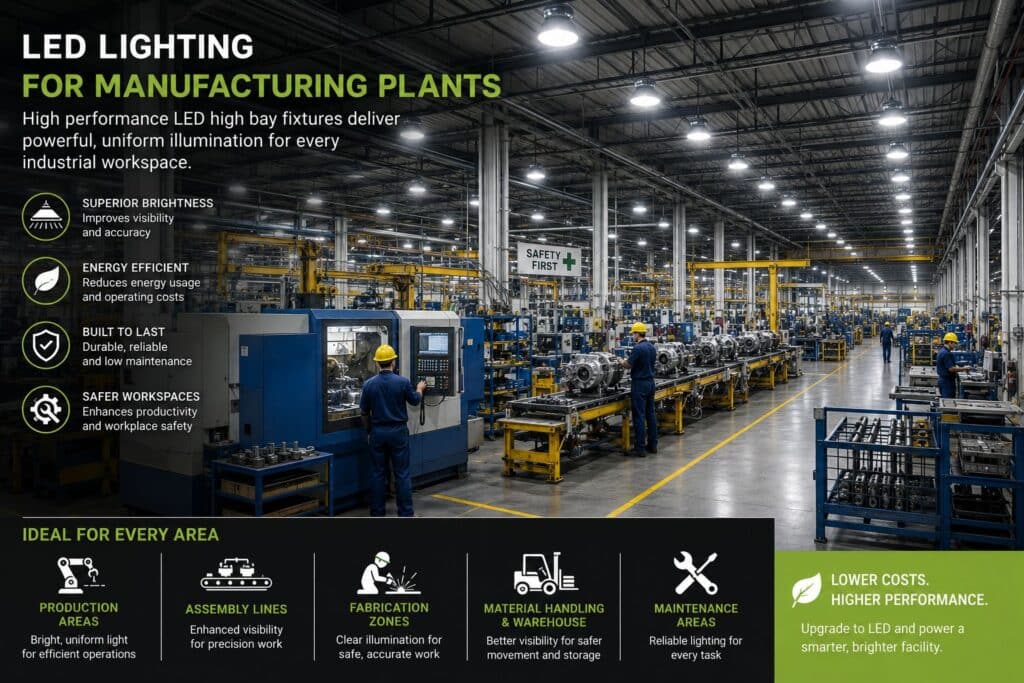
LED manufacturing plant lighting provides consistent illumination across production floors, assembly lines, fabrication areas, and industrial workstations, with fixture selection based on mounting height, operating conditions, and required light levels.
Need LED Lighting for Your Manufacturing Facility?
Manufacturing plants require lighting that supports production accuracy, employee visibility, equipment operation, and reliable performance. Fixture selection depends on mounting height, production layout, environmental conditions, and the illumination required for each work area.
Explore our industrial LED lighting fixtures for manufacturing and production environments.
Planning a new installation or LED retrofit? Request a Quote or call 844-533-7767 for product selection and pricing assistance.
What Is Manufacturing Plant Lighting?
Manufacturing plant lighting refers to lighting systems specifically designed for facilities where products are fabricated, assembled, processed, packaged, or inspected.
Unlike warehouses that primarily store inventory, manufacturing facilities require lighting that supports detailed visual tasks and production operations.
Typical manufacturing applications include:
- Assembly plants
- Fabrication facilities
- Industrial processing plants
- Packaging operations
- Food production facilities
- Electronics manufacturing
- Automotive manufacturing
- Metalworking facilities
- Machine shops
Lighting systems must provide consistent illumination throughout production areas while minimizing shadows, glare, and maintenance requirements.
Whether your project involves a retail store, office building, warehouse, or production facility, Commercial vs Industrial Lighting explains which lighting approach best supports long-term performance and energy efficiency.
Learn how industrial lighting systems are planned across multiple facility types in Industrial Facility Lighting Design.
Why LED Lighting Is Ideal for Manufacturing Facilities
Older manufacturing facilities often rely on metal halide, fluorescent, or HID fixtures that produce uneven illumination and require frequent maintenance.
LED technology offers several advantages.
Improved Worker Visibility
Proper lighting helps employees:
- Identify components
- Read labels and instructions
- Operate equipment safely
- Perform assembly tasks accurately
- Reduce visual fatigue
Increased Productivity
Better visibility can improve:
- Production accuracy
- Inspection performance
- Workflow efficiency
- Employee comfort
Reduced Maintenance
Many industrial facilities operate continuously.
LED fixtures often provide:
- 100,000+ hour lifespans
- Fewer lamp replacements
- Reduced lift rentals
- Lower maintenance costs
Lower Energy Consumption
Most facilities experience energy reductions of 50% to 75% after converting from metal halide lighting systems.
Review fixture placement and photometric planning strategies in Warehouse Lighting Layout Guide.
Recommended Foot Candle Levels
Different manufacturing processes require different illumination levels.
Typical Manufacturing Lighting Requirements
| Production Area | Recommended Foot Candles |
|---|---|
| General Manufacturing | 20-30 FC |
| Assembly Operations | 30-50 FC |
| Machine Shops | 30-50 FC |
| Packaging Areas | 30-50 FC |
| Quality Control Areas | 50-100 FC |
| Precision Assembly | 75-150 FC |
| Inspection Stations | 100+ FC |
Facilities performing detailed visual work typically require higher illumination levels than standard storage environments.
Explore lighting solutions for fulfillment and storage environments in Distribution Center Lighting.
Typical Manufacturing Facility Ceiling Heights
Recommended Fixtures by Mounting Height
| Ceiling Height | Recommended Fixture |
|---|---|
| 12-20 Feet | Low Bay Fixtures |
| 20-30 Feet | UFO LED High Bays |
| 30-40 Feet | High Output High Bays |
| 40-60 Feet | Linear High Bay Fixtures |
| 60+ Feet | High Mast Industrial Fixtures |
Fixture selection should always be verified through a photometric lighting layout.
Before replacing older metal halide lighting, review the Manufacturing Facility High Bay Lighting Guide to understand fixture selection, mounting heights, and lighting layout considerations.
Common Manufacturing Lighting Challenges
Manufacturing environments often present unique conditions that impact fixture selection.
Dust and Debris
Facilities such as woodworking plants, cement operations, and fabrication shops may require:
- Sealed fixtures
- High IP ratings
- Easy-to-clean housings
Heat
Manufacturing processes can generate elevated temperatures.
Facilities may require:
- High-temperature-rated fixtures
- Enhanced thermal management
- Industrial-grade components
Moisture and Washdown Areas
Food processing and certain manufacturing facilities may require:
- NSF-rated fixtures
- Vapor-tight luminaires
- Corrosion-resistant construction
Before selecting lighting for wet or dusty environments, review What Are Vapor Proof Light Fixtures? to understand how sealed fixture construction improves long-term reliability.
Vibration
Equipment vibration can affect traditional lighting systems.
LED fixtures generally perform better in high-vibration environments than fluorescent or HID fixtures.
Whether you’re replacing fluorescent strip lights or designing a new industrial facility, The #1 Benefit of Vapor Tight LED Lighting demonstrates how sealed LED fixtures improve long-term performance.
Common Manufacturing Lighting Applications
| Facility Area | Primary Lighting Objective |
|---|---|
| Production Floor | Employee Visibility |
| Assembly Lines | Product Accuracy |
| Machine Shops | Equipment Operation |
| Packaging Areas | Workflow Efficiency |
| Quality Control Labs | Detailed Inspection |
| Material Handling Areas | Safety and Visibility |
| Maintenance Areas | Equipment Serviceability |
Lighting Uniformity Matters
High foot candle levels alone do not guarantee a quality lighting system.
Proper lighting design focuses on:
- Uniform illumination
- Reduced shadows
- Controlled glare
- Improved visual comfort
- Consistent light distribution
Uniformity is especially important around machinery, assembly lines, and production workstations.
LED Controls and Smart Manufacturing
Modern manufacturing facilities increasingly utilize:
- Occupancy Sensors
- Daylight Harvesting
- Zoned Lighting Controls
- Networked Lighting Systems
- Energy Monitoring Platforms
These systems help reduce energy consumption while maintaining appropriate illumination levels throughout production areas.
Discover how LED retrofits reduce operating expenses in Warehouse Lighting Energy Savings.
Manufacturing LED Upgrade Example
| Existing Lighting | New LED Lighting | Energy Savings |
|---|---|---|
| 400W Metal Halide | 150W LED High Bays | 62.5% |
Actual savings vary based on operating hours, utility rates, fixture counts, and control strategies.
Benefits of LED Manufacturing Plant Lighting
| Benefit | Operational Impact |
|---|---|
| Improved Visibility | Increased worker productivity |
| Better Uniformity | Reduced shadows and dark areas |
| Lower Energy Costs | Reduced utility expenses |
| Longer Fixture Life | Less maintenance downtime |
| Instant-On Performance | No warm-up delays |
| Smart Controls | Additional energy savings |
Frequently Asked Questions
What lighting is best for manufacturing facilities?
LED high bay fixtures are commonly used because they provide excellent illumination, energy efficiency, and long operating life.
How many foot candles are recommended in a manufacturing plant?
Most production areas require between 20 and 50 foot candles, while inspection and precision assembly areas often require higher levels.
Can LED lighting improve manufacturing productivity?
Improved visibility, reduced glare, and more uniform illumination can help employees work more efficiently and accurately.
How much energy can manufacturing plants save with LED lighting?
Many facilities achieve energy reductions between 50% and 75% when upgrading from older HID systems.
Are lighting controls beneficial in manufacturing facilities?
Yes. Occupancy sensors, daylight harvesting, and networked controls often provide additional energy savings.
Planning a Manufacturing Plant Lighting Upgrade?
Whether you’re upgrading an assembly plant, fabrication facility, machine shop, or industrial processing operation, selecting the right LED lighting requires careful consideration of mounting heights, production activities, environmental conditions, and required illumination levels.
LED PROS WorldWide helps contractors, facility managers, and industrial buyers identify suitable lighting fixtures for manufacturing environments, including high bay, linear, vapor-tight, high-temperature, and specialized industrial applications.
Explore our industrial lighting solutions and send us your facility dimensions, mounting heights, fixture quantities, voltage requirements, and project specifications.
Request a Quote or call 844-533-7767 for pricing and application assistance.
Inline Buyer Q&A
Q: Are UFO high bays suitable for manufacturing plants?
A: Yes. UFO LED high bays are one of the most common lighting solutions for facilities with ceilings between 20 and 40 feet.
Q: Do manufacturing facilities need lighting layouts?
A: Absolutely. Photometric layouts help verify foot candle levels, fixture spacing, and lighting uniformity.
Q: What is most important—brightness or uniformity?
A: Both matter, but uniform lighting often has a greater impact on worker comfort, safety, and productivity.
Related Manufacturing & Industrial Lighting Resources
- Industrial Lights & LED Lighting Systems — Explore industrial LED lighting fixtures for manufacturing plants, warehouses, production areas, and demanding operating environments.
- LED High Bay Lighting — Review high bay fixture options for production floors and other high-ceiling manufacturing spaces.
- Manufacturing Facility High Bay Lighting — Learn which manufacturing environments commonly require high bay lighting and what factors influence fixture selection.
- Industrial Facility Lighting Design — Understand how mounting height, equipment layout, light levels, uniformity, controls, and photometrics affect facility-wide lighting design.
- Industrial Lighting Planning & Specification Guide — Review the broader technical considerations involved in specifying an industrial lighting system.
- Industrial LED Energy Savings Guide — Evaluate energy use, maintenance requirements, controls, and operating-cost considerations when upgrading existing industrial lighting.