Modern distribution centers operate around the clock, requiring lighting systems that support employee productivity, inventory accuracy, forklift safety, and energy efficiency. Whether the facility handles e-commerce fulfillment, retail distribution, third-party logistics (3PL), or regional warehousing, properly designed LED distribution center lighting can significantly improve visibility while reducing operating costs.
At LED Pros WorldWide, we help facility managers, warehouse operators, and logistics professionals select high-performance LED lighting systems engineered for large distribution environments.
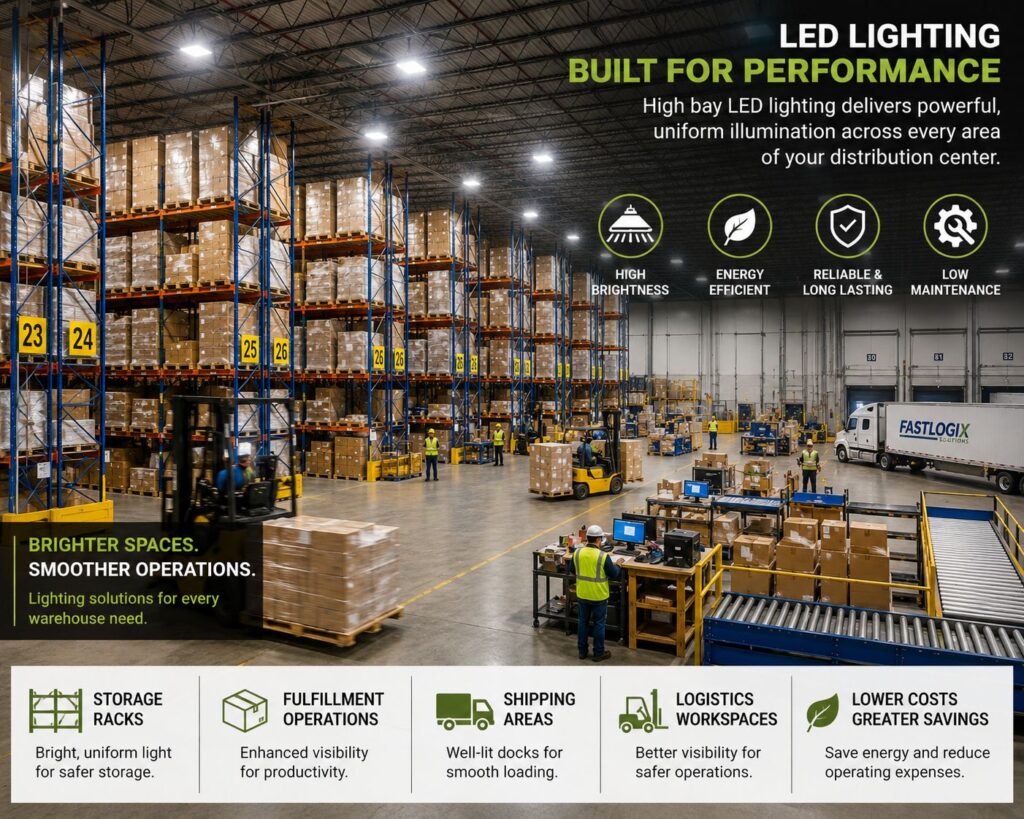
LED distribution center lighting provides consistent illumination across high-rack storage aisles, picking and packing areas, material-handling zones, and shipping docks, with fixture selection based on mounting height, rack configuration, and operational requirements.
Need LED Lighting for Your Distribution Center?
Distribution centers require lighting that supports high-rack storage, order picking, packing stations, forklift traffic, and shipping operations. Fixture selection depends on mounting height, rack configuration, aisle width, required illumination, and operating schedules.
Explore our industrial LED lighting fixtures and LED high bay lighting for warehouses, fulfillment centers, and logistics facilities.
Planning a new installation or LED retrofit? Request a Quote or call 844-533-7767 for fixture recommendations and pricing.
What Is Distribution Center Lighting?
Distribution center lighting refers to lighting systems specifically designed for facilities that receive, store, process, and ship products. Unlike traditional warehouses that primarily store inventory, distribution centers experience constant movement of goods, personnel, forklifts, conveyors, and automated systems.
Lighting systems must provide:
- Uniform illumination throughout storage areas
- Clear visibility in high-rack aisles
- Safe navigation for forklifts and employees
- Adequate light levels for picking and packing operations
- Reliable performance in 24/7 operating environments
- Reduced maintenance requirements
Common fixture types include:
- LED High Bay Fixtures
- Linear High Bay Fixtures
- Dock Lighting
- Outdoor Area Lighting
- Emergency Lighting
- Occupancy-Controlled Lighting Systems
Learn how fixture spacing, mounting heights, and photometric calculations affect warehouse illumination in our Warehouse Lighting Layout Guide.
Why LED Lighting Is Ideal for Distribution Centers
Many older facilities still operate with metal halide, fluorescent, or HID fixtures that create inconsistent illumination and require frequent maintenance.
LED technology provides significant advantages:
Improved Visibility
Higher-quality illumination improves:
- Product identification
- Barcode scanning
- Inventory accuracy
- Order fulfillment speed
- Forklift operator visibility
Lower Energy Costs
LED systems typically reduce lighting energy consumption by:
- 50% to 75% compared to metal halide systems
- 30% to 50% compared to older fluorescent systems
Discover how LED retrofits reduce utility expenses in our Warehouse Lighting Energy Savings guide.
Reduced Maintenance
LED fixtures can operate for 100,000+ hours, minimizing:
- Lamp replacements
- Lift rentals
- Maintenance labor
- Operational disruptions
Instant-On Performance
Unlike HID systems, LEDs reach full brightness immediately after power interruptions.
Recommended Foot Candle Levels
Lighting requirements vary based on facility operations.
Typical Distribution Center Lighting Levels
| Area | Recommended Foot Candles |
|---|---|
| Bulk Storage Areas | 10-20 FC |
| Warehouse Aisles | 15-30 FC |
| Order Picking Areas | 20-40 FC |
| Packing Stations | 30-50 FC |
| Shipping & Receiving Docks | 20-30 FC |
| Quality Inspection Areas | 50-100 FC |
Higher illumination levels may be required for facilities utilizing detailed picking operations, automated inventory systems, or high-speed fulfillment processes.
High-rack storage facilities often require specialized lighting layouts that maximize visibility throughout warehouse aisles. Learn more in our Warehouse Aisle Lighting Design guide.
Typical Mounting Heights
Distribution centers commonly utilize high ceilings to maximize storage capacity.
Recommended Fixture Types by Ceiling Height
| Ceiling Height | Recommended Fixture |
|---|---|
| 15-20 Feet | Low Bay or Small High Bay |
| 20-30 Feet | LED UFO High Bay |
| 30-40 Feet | High Output UFO High Bay |
| 40-60 Feet | High Power Linear High Bay |
| 60+ Feet | Specialty High Mast Indoor Fixtures |
Proper photometric planning helps ensure uniform illumination throughout rack systems and aisle spaces.
If your facility includes production operations, see Manufacturing Plant Lighting for recommendations specific to manufacturing environments.
High-Rack Warehouse Lighting Considerations
Many distribution centers utilize storage racks exceeding 30 feet in height.
Key design considerations include:
Vertical Illumination
Light must reach:
- Lower shelving
- Mid-level inventory
- Upper rack positions
Aisle Visibility
Narrow aisle operations require:
- Reduced shadows
- Uniform lighting patterns
- Enhanced visibility for forklift operators
Rack Orientation
Fixture placement should align with:
- Rack layouts
- Picking zones
- Travel lanes
- Conveyor systems
A professional lighting layout can significantly improve light distribution while minimizing fixture counts.
Looking to reduce maintenance while improving lighting quality? The Industrial LED High Bay Lighting Guide explains how modern LED fixtures outperform traditional industrial lighting technologies.
Dock and Shipping Area Lighting
Shipping and receiving operations require reliable lighting for:
- Trailer loading
- Package handling
- Forklift traffic
- Vehicle movement
- Safety inspections
Lighting should minimize glare while maintaining clear visibility throughout loading dock operations.
Common Distribution Center Applications
| Facility Area | Primary Lighting Objective |
|---|---|
| Storage Racking | Inventory Visibility |
| Picking Areas | Accuracy & Productivity |
| Packing Stations | Task Illumination |
| Shipping Docks | Vehicle & Personnel Safety |
| Conveyor Systems | Product Identification |
| Quality Control Areas | Detailed Inspection |
| Forklift Lanes | Safe Navigation |
Review broader facility planning considerations in Industrial Facility Lighting Design.
Distribution Center LED Upgrade Example
| Existing Lighting | New LED Lighting | Energy Savings |
|---|---|---|
| 400W Metal Halide | 150W LED High Bays | 62.5% |
This example demonstrates how distribution centers can dramatically reduce lighting operating expenses through LED retrofits.
Benefits of Professional Lighting Layouts
A lighting layout helps determine:
- Fixture quantity
- Mounting height
- Fixture spacing
- Foot candle levels
- Uniformity ratios
- Energy consumption
Proper layouts often reduce fixture counts while improving overall illumination quality.
Manufacturing environments demand different lighting solutions than warehouses or offices. Our Manufacturing Facility High Bay Lighting Guide helps facility managers choose fixtures that improve productivity, safety, and energy efficiency.
Selecting the wrong fixture can affect lighting quality, energy efficiency, and worker comfort. Learn how to choose the appropriate lighting system in High Bay vs Low Bay Lighting.
Inline Buyer Q&A
How should lighting be designed for the different areas of a distribution center?
Distribution centers should not necessarily be treated as one uniform lighting environment.
Receiving docks, staging areas, storage aisles, picking zones, packing stations, conveyor areas, shipping areas, offices, and equipment routes can involve different visual tasks and operating conditions.
Fixture type, output, distribution, placement, controls, and illumination should be evaluated according to how each area is used.
What fixture is best for high-rack storage areas?
There is no single fixture that is best for every high-rack facility.
Linear high bays can work particularly well with long aisles and rack-oriented layouts, while UFO high bays can also provide effective illumination when their output and optical distribution suit the application.
Rack height, aisle width, mounting height, vertical illumination, fixture spacing, and obstructions should be considered when selecting fixtures.
Can existing metal halide or fluorescent lighting be converted to LED?
Yes, many distribution centers can be upgraded from HID or fluorescent lighting to LED.
Existing mounting locations, wiring, voltage, controls, circuit conditions, fixture spacing, and supporting infrastructure should be evaluated before determining the retrofit approach.
A one-for-one replacement is not always the most effective design because LED fixtures can have substantially different output and optical distributions from the equipment being replaced.
Are photometric layouts necessary for large distribution centers?
For large or complex distribution facilities, photometric analysis is highly recommended.
A layout can predict illumination and uniformity using the proposed fixtures, mounting heights, spacing, rack configuration, equipment, and facility geometry.
It can also help compare fixture types, quantities, outputs, distributions, and retrofit strategies before equipment is ordered.
How should lighting controls be used in a distribution center?
Controls should reflect how different parts of the facility are occupied.
Storage aisles or reserve inventory areas may experience intermittent activity, while packing, sorting, shipping, and receiving areas may remain continuously active for long periods.
Occupancy sensing, dimming, scheduling, daylight-responsive controls, and networked systems can be considered according to operating schedules, traffic patterns, available daylight, fixture compatibility, and facility requirements.
How do conveyors and material-handling equipment affect lighting design?
Conveyors, racks, mezzanines, sortation equipment, ductwork, cranes, and other equipment can obstruct light or create shadows.
Lighting layouts should account for major equipment and work areas so illumination is directed where employees perform tasks rather than evaluating an empty building shell.
Can different high bay fixtures be used within the same distribution center?
Yes.
A large distribution facility may benefit from different fixtures, distributions, outputs, or control strategies in open storage, high-rack aisles, packing areas, staging zones, and other operational areas.
The objective is to match the lighting system to the requirements of each space while maintaining a coordinated facility-wide design.
Planning a Distribution Center Lighting Project?
Whether you’re upgrading a regional distribution warehouse, e-commerce fulfillment center, or large logistics facility, selecting the right LED lighting requires careful consideration of rack heights, aisle configurations, material-handling equipment, operating schedules, and required illumination levels.
LED PROS WorldWide helps contractors, facility managers, and logistics operators identify suitable high bay, linear high bay, and specialized industrial lighting fixtures for their applications.
Explore our industrial lighting solutions and send us your facility dimensions, mounting heights, rack layout, fixture quantities, voltage requirements, and project specifications.
Request a Quote or call 844-533-7767 for pricing and application assistance.
Frequently Asked Questions About Distribution Center Lighting
What is the recommended lighting level for a distribution center?
There is no single illumination level appropriate for every distribution center.
Storage aisles, picking areas, packing stations, loading docks, staging zones, shipping and receiving areas, inspection points, and circulation spaces can involve different visual tasks.
Appropriate illumination should be determined according to the activity, work plane, facility conditions, and applicable recommendations or requirements.
Are UFO high bays suitable for distribution centers?
Yes. UFO high bays can be used effectively in many distribution-center applications when their output and optical distribution are appropriate for the mounting conditions and facility geometry.
Linear high bays may also be appropriate, particularly in aisle-oriented and rectangular layouts.
Neither fixture type should be selected solely from a general ceiling-height range.
How do racks affect distribution center lighting?
Tall storage racks can block light from adjacent fixtures and create shadows on lower rack levels.
Rack height, aisle width, fixture placement, mounting height, optical distribution, and vertical illumination should therefore be considered during lighting design.
Why is vertical illumination important in distribution centers?
Employees may need to read labels, locate products, identify storage positions, and perform picking tasks throughout the height of a rack system.
Evaluating vertical surfaces can therefore be important in addition to measuring or modeling horizontal illumination at the floor or work plane.
How much energy can LED lighting save?
LED lighting can reduce energy consumption compared with many older metal halide, high-pressure sodium, and fluorescent systems, but there is no universal savings percentage.
Actual savings depend on existing and replacement wattage, fixture quantities, operating hours, controls, required illumination, electricity costs, and other project conditions.
Do distribution centers need lighting controls?
Not every area requires the same control strategy, but distribution centers can offer substantial opportunities for lighting controls because occupancy patterns often vary throughout the facility.
Occupancy sensing, dimming, scheduling, daylight-responsive controls, and networked systems can be considered according to the application and operating schedule.
How long do commercial LED high bays last?
Commercial LED high bays can provide operating lives measured in tens of thousands of hours.
Published lifetime ratings vary by fixture, manufacturer, components, thermal management, and testing methodology. Actual service life can also be affected by operating hours, ambient temperature, electrical conditions, controls, and the operating environment.
Can existing fixture locations be reused during an LED retrofit?
Often, but existing locations should be evaluated rather than automatically duplicated.
Older HID or fluorescent fixtures may have different outputs and distributions from the proposed LED fixtures. Photometric analysis can help determine whether existing spacing remains appropriate.
Should loading docks and staging areas use the same lighting as storage aisles?
Not necessarily.
Loading docks, staging areas, storage aisles, picking zones, and packing stations involve different geometry, activities, equipment, and visual conditions.
Fixture selection and illumination should reflect the work performed in each area.
Can occupancy sensors work in high-rack aisles?
Yes, provided the sensor and control strategy are suitable for the application.
Mounting height, racks, aisle length, equipment movement, detection pattern, fixture grouping, and desired response should be considered when selecting and positioning sensors.
Stay Connected with Our Lighting Resources
Add IndustrialLightingFixtures.org as a Preferred Source on Google to see more of our lighting guides and technical resources across Google Search experiences.
Related Distribution Center Lighting Resources
- Industrial Lights & LED Lighting Systems — Explore industrial LED fixtures for distribution centers, warehouses, fulfillment operations, and demanding facilities.
- LED High Bay Lighting — Review commercial high bay lighting solutions for large distribution and logistics facilities.
- Warehouse Lighting Layout Guide — Understand fixture spacing, mounting heights, photometric layouts, and lighting uniformity.
- Warehouse Aisle Lighting Design — Explore rack-oriented lighting, vertical illumination, aisle widths, and fixture placement.
- LED Linear High Bay Lighting — Review linear high bay fixtures for warehouse aisles, racking systems, and rectangular spaces.
- High Bay Mounting Height Guide — Learn how mounting height, fixture output, beam distribution, and spacing affect lighting performance.