LED bollard lighting is one of the most versatile outdoor lighting solutions available today. By providing low-level illumination close to the walking surface, bollards improve pedestrian visibility, support wayfinding, enhance safety, and contribute to the overall appearance of outdoor environments.
Unlike parking lot lights and area lighting systems that illuminate large spaces from elevated mounting heights, bollards focus on pedestrian-scale lighting where people walk, gather, and interact.
This guide explores the most common bollard lighting applications and explains how different environments benefit from properly designed bollard lighting systems.
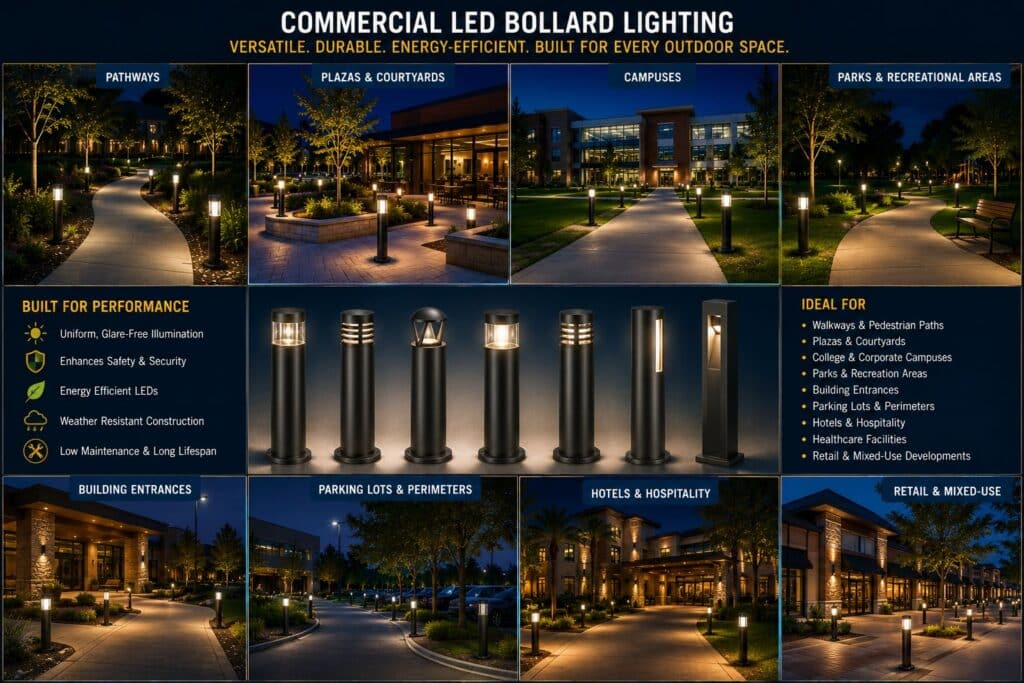
LED bollards are used across a wide range of outdoor lighting applications including pathways, campuses, parks, healthcare facilities, and commercial properties.
Need help selecting bollard lighting for your project?
Speak with a Lighting Specialist for fixture recommendations, photometric layouts, and application-specific guidance.
Why Bollard Lighting Is Used in So Many Applications
Bollard fixtures provide several advantages over traditional outdoor lighting systems:
- Pedestrian-scale illumination
- Reduced glare
- Improved wayfinding
- Architectural enhancement
- Lower mounting heights
- Better visual comfort
- Reduced light trespass
- Improved pathway safety
Because of these benefits, bollards are commonly used in both commercial and residential environments.
Across campuses, parks, healthcare facilities, and commercial properties, LED bollards help reduce long-term operating expenses. Review our LED Bollard Energy Savings Guide.
Pathway Lighting Applications
Pathways represent the most common bollard lighting application.
Bollards help:
- Define walking routes
- Improve nighttime visibility
- Reduce trip hazards
- Support pedestrian navigation
Common pathway installations include:
- Sidewalks
- Trails
- Community pathways
- Campus walkways
- Building access routes
Proper spacing is critical to achieving consistent illumination. Additional recommendations can be found in our Bollard Light Spacing Guide.
Campus Lighting Applications
Educational facilities frequently utilize bollards to illuminate pedestrian corridors between buildings, parking areas, dormitories, and recreational facilities.
Benefits include:
- Improved student safety
- Better nighttime navigation
- Reduced glare
- Architectural consistency
Typical campus applications include:
| Campus Area | Typical Use |
|---|---|
| Walkways | Pedestrian guidance |
| Courtyards | Gathering spaces |
| Dormitories | Building access |
| Student Centers | Wayfinding |
| Recreational Areas | Safety lighting |
For broader campus planning recommendations, visit our Campus Pathway Lighting Guide.
Healthcare Facility Applications
Hospitals and healthcare campuses require reliable pedestrian lighting that supports visitors, staff, and patients.
Common bollard locations include:
- Building entrances
- Emergency access routes
- Courtyards
- Visitor pathways
- Parking lot walkways
Healthcare facilities often prioritize visual comfort and low-glare illumination to improve the visitor experience.
HOA and Community Applications
Homeowner associations frequently utilize bollards throughout community spaces.
Typical applications include:
- Sidewalks
- Parks
- Clubhouses
- Pool areas
- Walking trails
- Community entrances
Bollards help improve safety while preserving neighborhood aesthetics.
Additional planning recommendations can be found in our HOA Lighting Design Guide.
Multifamily Housing Applications
Apartment communities, condominiums, and senior living facilities often install bollards to improve resident safety and navigation.
Common installation areas include:
- Courtyards
- Sidewalks
- Outdoor gathering spaces
- Mail kiosk areas
- Dog parks
- Recreational amenities
Property managers can learn more in our Multifamily Site Lighting Guide.
Park and Recreation Applications
Public parks and recreational facilities frequently utilize bollard lighting because it provides pathway illumination without the visual impact of taller poles.
Typical park applications include:
- Walking trails
- Nature paths
- Picnic areas
- Playgrounds
- Sports facility access routes
- Waterfront promenades
Many municipalities choose bollards because they support pedestrian visibility while maintaining the character of outdoor spaces.
Hotel and Hospitality Applications
Hotels, resorts, and hospitality properties often incorporate bollard lighting into landscape and architectural lighting designs.
Common applications include:
- Guest pathways
- Courtyards
- Pool decks
- Outdoor dining areas
- Building entrances
- Garden walkways
Bollards help create attractive nighttime environments while guiding guests throughout the property.
Corporate Campus Applications
Large office campuses frequently utilize bollards to create pedestrian-friendly environments.
Benefits include:
- Improved employee safety
- Enhanced wayfinding
- Reduced glare
- Consistent architectural appearance
Corporate campuses often combine bollards with decorative post top fixtures and area lighting systems.
Additional design recommendations can be found in our Decorative Post Top Lighting Guide.
Retail and Mixed-Use Developments
Retail centers and mixed-use properties use bollards to improve pedestrian circulation between parking areas, storefronts, and public gathering spaces.
Common installation areas include:
- Sidewalks
- Outdoor plazas
- Dining areas
- Public walkways
- Building entrances
These environments often require a balance between safety, aesthetics, and durability.
Municipal and Civic Applications
Municipal facilities frequently install bollard lighting in:
- Government buildings
- Civic plazas
- Libraries
- Public transit facilities
- Community centers
These projects often emphasize long service life, vandal resistance, and Dark Sky compliance.
Most Common Bollard Applications
| Application | Usage Frequency |
| Pathways | Very High |
| Campuses | High |
| Multifamily Communities | High |
| Parks | High |
| Healthcare Facilities | Moderate |
| Hotels | Moderate |
| Corporate Campuses | Moderate |
| Municipal Facilities | Moderate |
Choosing the Right Bollard for the Application
Several factors influence fixture selection:
Height
Different applications require different fixture heights.
For height recommendations, review our LED Bollard Height Guide.
Optics
Directional, shielded, and full-cutoff optics influence lighting performance.
Construction
Public environments may require vandal-resistant construction and tamper-resistant hardware.
Dark Sky Compliance
Many municipalities now encourage or require reduced uplight and glare.
Projects seeking environmentally responsible lighting should review our Dark Sky Bollard Lighting Guide.
Inline Buyer Q&A
Where are bollard lights most commonly used?
Pathways, campuses, parks, multifamily communities, healthcare facilities, hotels, and commercial properties.
Can bollards replace parking lot lights?
No. Bollards provide pedestrian-scale illumination while parking lot lights illuminate larger vehicle areas.
Are bollards suitable for parks?
Yes. Parks are one of the most common applications for bollard lighting.
Can bollards be used in healthcare facilities?
Yes. They provide low-glare pathway illumination that supports patient and visitor navigation.
Are bollards appropriate for commercial properties?
Absolutely. Commercial campuses, office complexes, retail centers, and hospitality properties frequently utilize bollards.
Bollard Lighting Solutions for Every Outdoor Environment
From pathways and parks to healthcare campuses and hospitality properties, bollard lighting continues to be one of the most versatile outdoor lighting solutions available. By combining pedestrian safety, wayfinding, architectural appeal, and low-glare illumination, bollards help create safer and more attractive outdoor environments.
For assistance selecting LED bollards, planning outdoor lighting layouts, or evaluating application-specific requirements, visit our Industrial Lighting Fixtures Home Page and speak with a lighting specialist today.
Frequently Asked Questions
What are bollard lights used for?
Bollard lights are used for pathway illumination, wayfinding, pedestrian safety, and architectural enhancement.
Are bollards only used for pathways?
No. They are also used in plazas, courtyards, parks, healthcare facilities, campuses, and commercial developments.
Which industries use bollard lighting?
Education, healthcare, hospitality, retail, municipal, multifamily, and commercial property sectors all commonly use bollards.
Can bollards support Dark Sky initiatives?
Yes. Many modern bollards are designed with full-cutoff optics and reduced glare.
What is the most common bollard application?
Pathway lighting remains the most common use for bollard fixtures.