
Heliport windsocks are essential aviation safety components used to provide pilots with real-time wind direction and approximate wind speed information during helicopter approach, landing, takeoff, and departure operations.
Whether installed on a rooftop hospital heliport, offshore platform, emergency response facility, or commercial aviation site, properly positioned and illuminated windsocks help improve pilot awareness and landing safety during daytime and nighttime operations.
Modern heliport windsock systems commonly incorporate LED lighting, corrosion-resistant materials, elevated mounting structures, and high-visibility aviation fabrics designed for demanding environmental conditions.
This guide explains heliport windsock requirements, FAA placement considerations, lighting recommendations, rooftop installation challenges, and best practices for modern aviation operations.
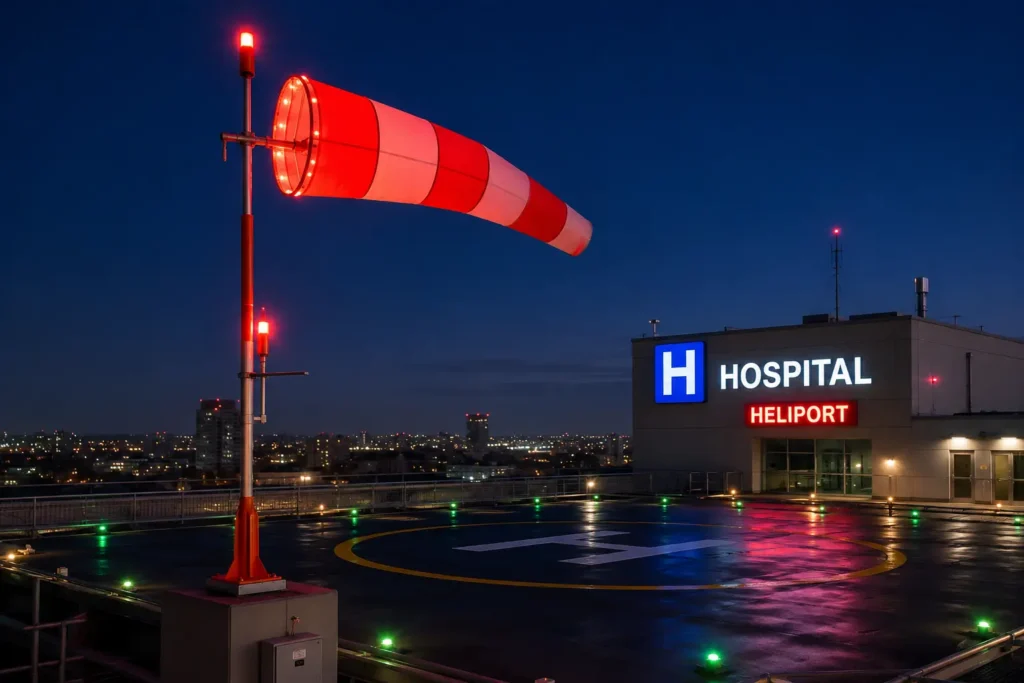
An illuminated heliport windsock provides pilots with a clear visual indication of wind direction and approximate wind conditions during approach, landing, and departure operations..
Need a Heliport Windsock or Complete Heliport Lighting System?
LED PROS supplies illuminated windsocks and heliport lighting equipment for rooftop, hospital, commercial, industrial, and other helicopter landing facilities.
Explore Heliport Lighting Equipment | Request a Quote | 1-844-533-7767
What Is a Heliport Windsock?
A heliport windsock is a visual wind direction indicator designed to help helicopter pilots quickly assess:
- Wind direction
- Approximate wind speed
- Gust patterns
- Surface airflow conditions
Heliport windsocks are commonly installed at:
- Hospital heliports
- Rooftop landing pads
- Offshore aviation facilities
- Public safety heliports
- Industrial heliports
- Military helicopter facilities
- Commercial helicopter operations
These systems are especially important during:
- Nighttime operations
- Reduced visibility conditions
- High-wind environments
- Emergency medical flights
- Rooftop landing procedures
Looking to understand modern heliport lighting technology? This guide explains how LED heliport lighting systems improve safety, reliability, and operational efficiency.
Why Heliport Windsocks Are Important
Helicopters are highly sensitive to wind conditions during landing and takeoff procedures.
Properly positioned windsocks help pilots:
- Align landing approaches
- Evaluate crosswind conditions
- Improve landing safety
- Reduce operational uncertainty
- Identify rooftop wind turbulence
- Monitor gust conditions
For rooftop heliports, windsocks are particularly important because surrounding buildings and elevated structures may create unpredictable airflow patterns.
Planning a new heliport project? Understanding the benefits of heliport lighting can help improve safety and long-term performance.
FAA Heliport Windsock Guidance
Federal Aviation Administration heliport guidance commonly recommends windsocks that are:
- Clearly visible from all approach directions
- Positioned away from obstructions
- Properly illuminated for nighttime operations
- Elevated for improved visibility
- Installed to avoid rotor wash interference
FAA recommendations generally prioritize:
- Pilot visibility
- Accurate wind indication
- Rooftop safety
- Operational reliability
Windsocks should remain visible during all intended operational periods, including nighttime emergency transport operations.
Windsock visibility and obstruction awareness are important considerations under both ICAO and FAA heliport guidance.
Rooftop Heliport Windsock Requirements
Rooftop heliports create unique installation challenges for windsock systems due to:
- Elevated building structures
- Wind turbulence
- Limited installation space
- HVAC equipment
- Rooftop obstructions
- Rotor wash effects
Rooftop heliport windsock systems commonly use:
- Elevated poles
- LED illumination systems
- Corrosion-resistant hardware
- Reinforced mounting systems
- High-visibility aviation fabrics
Proper rooftop windsock placement helps ensure pilots can clearly identify wind conditions during final approach procedures.
Heliport Windsock Pole Height Considerations
Windsock pole height plays an important role in visibility and operational effectiveness.
Proper pole height helps:
- Improve pilot visibility
- Reduce obstruction interference
- Minimize rooftop turbulence effects
- Increase approach visibility angles
Pole height requirements vary depending on:
- Rooftop geometry
- Nearby structures
- Heliport elevation
- Wind exposure
- Building equipment locations
For rooftop heliports, windsocks are often mounted above nearby rooftop equipment to maximize visibility from multiple approach directions.
Planning a heliport lighting upgrade? Understanding perimeter lighting is essential for improving nighttime helicopter operations.
Illuminated Heliport Windsock Systems
Nighttime helicopter operations commonly require illuminated windsock systems to maintain visibility during reduced lighting conditions.
LED windsock lighting systems may include:
- External floodlighting
- Internal illumination
- Pole-mounted LED fixtures
- Low-glare aviation lighting
- Weather-resistant luminaires
For commercial heliports requiring nighttime wind-direction visibility, the HLLW LED illuminated heliport windsock is available with either external or internal LED illumination, allowing the system to be configured for rooftop hospitals, commercial heliports, offshore facilities, and other nighttime aviation applications.
Modern LED systems are preferred because they provide:
- Long operating life
- Reduced maintenance
- Improved energy efficiency
- Instant startup
- Better cold-weather performance
Illuminated windsocks are especially important for:
- Hospital emergency flights
- Rooftop heliports
- Offshore platforms
- Public safety aviation operations
An illuminated windsock is one element of a complete aviation lighting system. See how it integrates with perimeter and approach lighting in our Helipad Lighting Systems Guide.
LED Heliport Windsock Lighting Advantages
| Feature | LED Windsock Lighting | Traditional Lighting |
|---|---|---|
| Energy Efficiency | Excellent | Moderate |
| Maintenance Requirements | Low | Higher |
| Startup Speed | Instant | Slower |
| Fixture Lifespan | Long | Shorter |
| Weather Resistance | Excellent | Moderate |
| Vibration Resistance | Excellent |
Lower
|
LED lighting systems improve long-term reliability in demanding aviation environments.
Offshore & High-Wind Environment Considerations
Offshore heliports and coastal installations frequently experience:
- High wind exposure
- Salt air corrosion
- Moisture intrusion
- Extreme weather conditions
Commercial aviation-grade windsock systems often feature:
- Marine-grade finishes
- Stainless steel hardware
- UV-resistant windsock fabrics
- Corrosion-resistant poles
- Reinforced mounting systems
These features help improve long-term operational reliability in harsh environments.
Rooftop Wind Turbulence Considerations
Large buildings and rooftop structures can create complex airflow patterns that impact helicopter operations.
Common rooftop airflow challenges include:
- Wind shear
- Turbulence
- Crosswinds
- Downdrafts
- Recirculating airflow
Proper windsock positioning helps pilots identify these airflow conditions before touchdown.
Wind Direction visibility is especially important for elevated urban heliports surrounded by tall structures.
Heliport Windsock Materials & Construction
Commercial heliport windsock systems commonly use:
- UV-resistant fabrics
- Reinforced stitching
- Corrosion-resistant poles
- Aviation-grade mounting hardware
- Weather-resistant lighting systems
High-quality materials help extend system lifespan and improve visibility under demanding operating conditions.
Emergency & Hospital Heliport Applications
Hospital rooftop heliports frequently rely on illuminated windsock systems for:
- Emergency medical transport
- Trauma response operations
- Nighttime helicopter landings
- Adverse weather operations
Reliable windsock visibility is critical during emergency aviation procedures where pilot awareness and rapid landing decisions are essential.
Review Heliport Perimeter vs Approach Lights for pilot guidance and landing zone visibility systems
Heliport Windsock Placement Considerations
Successful windsock installations should evaluate:
- Pilot visibility angles
- Rooftop obstructions
- Lighting glare
- Wind exposure
- Maintenance accessibility
- Structural mounting conditions
- Rotor wash effects
Proper placement helps maximize visibility while minimizing operational interference.
Applications for Heliport Windsock Systems
Heliport windsocks are commonly installed at:
- Hospitals
- Rooftop heliports
- Offshore platforms
- Industrial facilities
- Public safety aviation centers
- Military helicopter facilities
- Commercial aviation operations
Reliable windsock visibility improves operational safety across a wide range of aviation environments.
Inline Buyer Q&A
How do I choose the correct windsock for a heliport?
Start with the heliport design, operating conditions, and applicable aviation guidance.
Important considerations include:
- Heliport type and intended use
- Rooftop or ground-level installation
- Windsock location
- Visibility from approach and landing areas
- Windsock size
- Pole height
- Internal or external illumination
- Mounting configuration
- Nighttime operations
- Surrounding structures and equipment
- Local airflow conditions
- Environmental exposure
- Available electrical power
- Applicable FAA or other project requirements
The windsock should be selected and positioned as part of the overall heliport visual-aid system.
Does a heliport windsock need to be illuminated?
Where the heliport operates at night and the wind indicator must remain visible during those operations, appropriate illumination may be required or specified.
The exact requirement depends on the facility, applicable aviation guidance, and project criteria.
Do not assume that every windsock installation requires the same lighting arrangement.
Should I choose internal or external windsock illumination?
Either can be appropriate depending on the system and application.
Internal illumination places the light source within or as part of the windsock assembly, while external systems illuminate the windsock from separately positioned fixtures.
Compare nighttime visibility, glare control, maintenance access, environmental exposure, pole configuration, electrical requirements, and applicable project specifications.
How should windsock pole height be determined?
Pole height should provide appropriate visibility while accounting for the heliport layout, surrounding structures, approach views, mounting location, physical clearances, local airflow, maintenance access, and applicable guidance.
A taller pole is not automatically better.
The windsock should be positioned where it can provide useful wind information without creating an inappropriate obstruction or being excessively affected by nearby structures.
What should I consider for a rooftop heliport windsock?
Rooftop installations can introduce additional considerations involving:
- Building height
- Parapets
- Mechanical equipment
- Nearby structures
- Airflow disturbance
- Approach visibility
- Structural mounting
- Wind loading
- Electrical routing
- Maintenance access
- Corrosion exposure
The windsock location should be coordinated with the complete rooftop heliport design.
What information should I provide when requesting an illuminated heliport windsock?
Useful project information includes:
- Heliport type
- Rooftop or ground-level installation
- Windsock size if specified
- Proposed pole height
- Internal or external illumination preference
- Voltage
- Mounting requirements
- Environmental conditions
- Coastal or offshore exposure
- Site drawings or photographs
- Applicable FAA or project specifications
For available configurations, see the HLLW LED Illuminated Heliport Windsock.
Make the Wind Indicator Visible from the Heliport Operating Area
A heliport windsock is most useful when its location, size, mounting height, illumination, and environmental construction are coordinated with the landing facility.
Rooftop conditions, surrounding structures, airflow, approach visibility, nighttime operations, mounting, corrosion exposure, and applicable aviation guidance should all be considered.
Our aviation lighting specialists can help evaluate internally and externally illuminated windsock systems for hospitals, rooftop heliports, commercial facilities, industrial sites, offshore applications, and other helicopter landing facilities.
Call 1-844-533-7767 to discuss your heliport windsock requirements.
Frequently Asked Questions About Heliport Windsocks
Why are windsocks used at heliports?
Windsocks provide pilots with a visual indication of wind direction and general wind conditions near the landing facility.
They should be positioned so they are appropriately visible while representing local wind conditions as effectively as practical for the heliport.
Do all heliports require a windsock?
Wind-direction indicators are an important component of heliport design, but the specific requirements for a particular facility should be determined from the applicable aviation guidance, project documents, and authority requirements.
Do not assume that every heliport uses the same windsock size, location, pole, or illumination system.
Do rooftop heliports require illuminated windsocks?
Nighttime heliport operations can require the wind indicator to remain visible after dark.
Whether illumination is required and how it should be provided depends on the heliport design and applicable requirements.
Rooftop location alone should not be used as the only criterion.
What type of lighting is used for heliport windsocks?
Depending on the windsock system, illumination can be provided internally or externally.
LED technology is commonly available for both configurations.
The lighting should make the wind indicator appropriately visible without creating unnecessary glare or interfering with other heliport visual aids.
What is an internally illuminated heliport windsock?
An internally illuminated windsock system incorporates lighting within or as part of the windsock assembly to illuminate the wind indicator.
This can provide a compact lighting arrangement, but performance, maintenance access, electrical requirements, and environmental suitability depend on the specific product.
What is an externally illuminated heliport windsock?
An externally illuminated system uses one or more fixtures positioned to illuminate the windsock from outside the assembly.
Fixture placement and aiming are important so the windsock remains visible without excessive glare or unwanted light.
Is internal windsock illumination better than external illumination?
Neither is universally better.
The appropriate choice depends on windsock construction, pole configuration, visibility requirements, maintenance access, electrical infrastructure, environmental exposure, glare considerations, and project specifications.
What color are heliport windsocks?
Windsock color and markings should provide appropriate conspicuity against the surrounding background and meet the applicable heliport requirements.
High-visibility colors and contrasting color combinations are commonly used.
The required configuration should be verified for the particular project rather than selected solely from appearance.
Does a heliport windsock measure wind speed?
A windsock is primarily a visual wind-direction indicator and can provide a general indication of wind conditions based on its extension and movement.
It should not be treated as a precision wind-speed instrument.
Where precise wind measurements are required, appropriate meteorological instrumentation serves a different function.
Why is windsock location important?
The windsock needs to be visible to pilots while providing a useful indication of local wind conditions.
Buildings, parapets, rooftop mechanical equipment, trees, towers, and other structures can affect visibility and airflow.
Siting therefore matters as much as the windsock itself.
Why is windsock pole height important?
Pole height affects visibility, clearance, airflow exposure, structural loading, and maintenance.
The correct height depends on the heliport layout and surrounding environment.
Simply mounting the windsock higher than every nearby object is not a universal design rule.
Can nearby rooftop equipment affect a windsock?
Yes.
Mechanical equipment, parapets, walls, rooftop structures, and adjacent buildings can disturb airflow around the windsock.
The location should be evaluated so the indicator provides useful wind information while remaining appropriately visible from the heliport operating environment.
Can windsock lighting create glare for pilots?
Poorly selected, positioned, or aimed lighting can contribute to glare.
External illumination in particular should be arranged to illuminate the windsock without unnecessarily directing light toward approach paths or pilot viewing directions.
The complete visual environment should be considered.
Are rooftop windsock systems different from ground-level systems?
The basic purpose is the same, but rooftop installations can create different structural and environmental requirements.
Wind exposure, mounting, building vibration, airflow disturbance, surrounding structures, maintenance access, electrical routing, and approach visibility can influence the system design.
Are heliport windsocks weather resistant?
Commercial aviation windsock systems can be designed for demanding outdoor conditions, but environmental performance is product-specific.
Verify materials, wind-loading information, UV resistance, corrosion protection, operating conditions, mounting hardware, and lighting-system ratings for the installation.
Why is corrosion resistance important for heliport windsocks?
Windsock poles, frames, hardware, electrical components, and lighting equipment are continuously exposed to outdoor conditions.
Moisture, salt air, industrial contaminants, and other environmental factors can accelerate corrosion.
Materials and protective finishes should therefore be selected for the actual environment.
Do offshore heliports need corrosion-resistant windsock systems?
Offshore environments can create severe corrosion exposure from salt, moisture, wind, and weather.
Windsock systems used in these environments should have materials, finishes, hardware, electrical components, and maintenance provisions appropriate for those conditions.
A generic “marine-grade” description should not replace evaluation of the actual product specifications.
Do heliport windsocks move in light winds?
Response to low wind conditions depends on the windsock’s fabric, dimensions, weight, construction, bearings or support assembly, and the specific product design.
Use manufacturer performance information when low-wind response is an important project consideration.
How does windsock size affect visibility?
Windsock dimensions influence how readily the indicator can be seen from the relevant viewing locations.
The appropriate size depends on the heliport design, viewing distance, installation location, applicable guidance, and project specifications.
Larger should not automatically be assumed better.
Can LED lighting reduce windsock maintenance?
LED illumination can reduce lamp-replacement requirements compared with some older lighting technologies.
However, the complete windsock system still requires maintenance of the fabric, pole, frame, bearings or rotating components, mounting hardware, wiring, lighting equipment, and corrosion protection.
How long does an LED windsock lighting system last?
There is no universal service life.
LEDs, drivers, electrical components, environmental exposure, operating hours, temperature, moisture, vibration, and maintenance can all affect performance.
Use manufacturer-specific lifetime and warranty information for the exact system.
What maintenance is required for a heliport windsock?
Maintenance can include inspection of:
- Windsock fabric and seams
- Frame and rotating assembly
- Pole and mounting hardware
- Lighting equipment
- Electrical connections
- Corrosion protection
- Physical damage
- Windsock movement
- Nighttime visibility
Maintenance intervals should follow the equipment manufacturer’s instructions and applicable facility requirements.
Should the windsock be coordinated with the rest of the heliport lighting system?
Yes.
Windsock location and illumination should be considered alongside perimeter lighting, approach guidance, floodlighting, obstruction considerations, controls, and other visual aids.
The goal is a coordinated heliport system rather than independently selected components.
Stay Connected with Our Lighting Resources
Add IndustrialLightingFixtures.org as a Preferred Source on Google to see more of our lighting guides and technical resources across Google Search experiences.
Related Heliport Lighting Resources
-
HL-50 LED Heliport Perimeter Inset Light — Review the flush-mounted perimeter fixture for low-profile TLOF and FATO boundary lighting.
- LED Heliport Lighting — Explore the primary heliport lighting category for perimeter lights, approach systems, windsocks, floodlights, controls, and related equipment.
- FAA Heliport Lighting Requirements — Review FAA-focused lighting and visual-aid considerations for hospital, rooftop, commercial, and other helicopter landing facilities.
- Heliport Perimeter vs. Approach Lights — Understand how perimeter and approach lighting perform different functions within the heliport visual-aid system.
- ICAO vs. FAA Heliport Lighting — Compare U.S. FAA and ICAO frameworks when planning heliport visual aids for domestic and international projects.