Sports fields require powerful lighting capable of illuminating large playing surfaces from substantial mounting heights and distances. Without proper optical control, however, some of that light can create glare for athletes and spectators or travel beyond the athletic facility into neighboring properties.
Effective sports lighting therefore involves two related objectives:
Put enough light where the game is being played—and control light where it is not needed.
Modern LED sports fixtures provide much greater optical control than older floodlighting systems, but LED technology alone does not guarantee good glare or spill-light performance.
Pole height, fixture location, beam distribution, aiming, shielding, lumen output, controls, site geometry, and photometric design all influence the result.
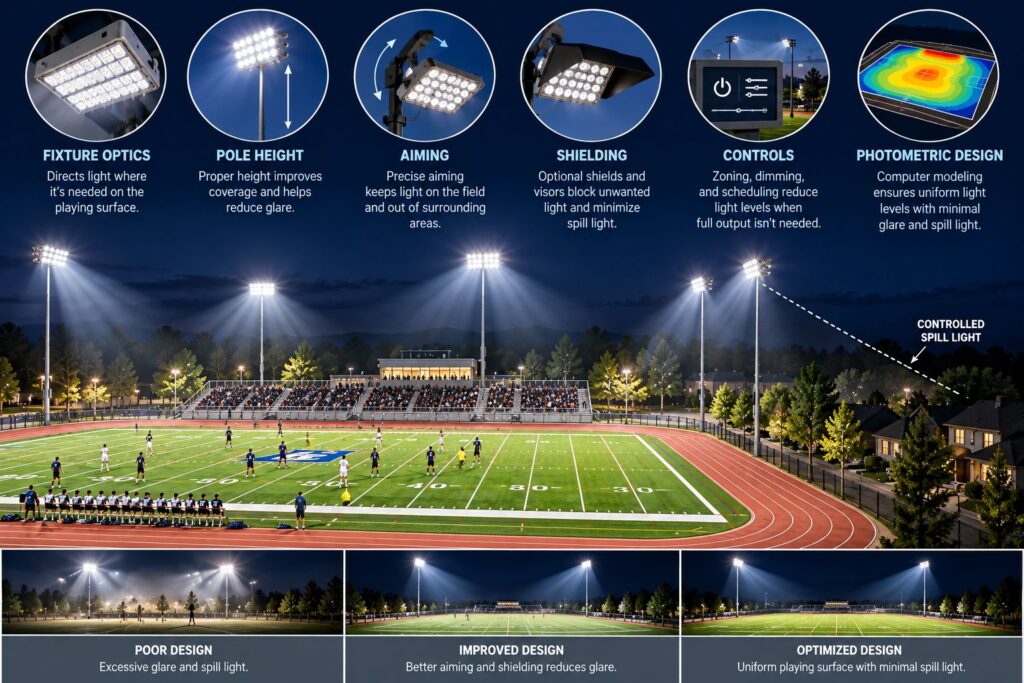
Sports field glare and spill light can be controlled through coordinated fixture optics, pole height, aiming, shielding, controls, and photometric design.
Control Sports Lighting at the Fixture and Site Level
Glare and spill light should be addressed during the lighting design—not after neighboring properties or athletes begin reporting problems.
A well-designed system evaluates where each fixture sends its light and how the combined system performs across the entire site.
Important variables include fixture optics, pole height and placement, pole setback, fixture aiming, lumen output, shielding, and playing-surface requirements. The design should also account for property boundaries, nearby residences, roads, spectator locations, controls, and operating hours.
For fixtures designed specifically for athletic fields and competition areas, explore our LED Sports Lighting Fixtures.
What Is Glare in Sports Lighting?
Glare occurs when brightness within the visual field interferes with comfortable or effective vision.
Sports facilities create challenging glare conditions because athletes frequently look upward.
Examples include:
-
Football players tracking passes
-
Baseball and softball players following fly balls
-
Soccer players watching airborne balls
-
Tennis players following serves and lobs
-
Track-and-field athletes facing different directions
-
Spectators looking across the field toward opposing poles
A fixture can provide excellent playing-surface illumination while still creating objectionable glare if its intensity is poorly controlled from important viewing directions.
What Is Spill Light
Spill light is illumination that extends outside the area intended to be illuminated.
At a sports complex, this can include light reaching:
- Residential properties
- Adjacent businesses
- Roads
- Parking areas
- Other athletic fields
- School buildings
- Natural areas
- Property boundaries
Not every lumen outside the painted lines of a playing field is automatically a problem.
Athletic facilities also require illumination for sidelines and other activity areas.
The concern is uncontrolled light extending into areas where it is unnecessary, unwanted, or restricted.
What Is Spill Light?
Spill light is illumination that extends outside the area intended to be illuminated.
At a sports complex, this can include light reaching:
- Residential properties
- Adjacent businesses
- Roads
- Parking areas
- Other athletic fields
- School buildings
- Natural areas
- Property boundaries
Not every lumen outside the painted lines of a playing field is automatically a problem.
Athletic facilities also require illumination for sidelines and other activity areas.
The concern is uncontrolled light extending into areas where it is unnecessary, unwanted, or restricted.
Spill Light vs. Light Trespass
The terms are related but not identical.
Spill light generally describes light extending outside the primary target area.
Light trespass typically refers to unwanted light reaching another property or a location where it is objectionable or restricted.
For example, illumination beyond a soccer touchline may be necessary for player and official activity.
Light reaching bedroom windows across the property boundary is a different issue.
This distinction is important when evaluating a photometric plan.
Why Sports Fields Are Challenging
Sports lighting must often deliver useful illumination hundreds of feet from the fixture.
That requires:
- High lumen output
- Precise optics
- Significant mounting heights
- Long aiming distances
- Multiple beam distributions
At the same time, many athletic facilities are located close to neighborhoods.
High schools, municipal parks, colleges, and community sports complexes may have residential properties only a short distance beyond the field.
The design must therefore reconcile two competing demands:
Long-distance illumination within the site
and
tight control at the site’s boundaries.
LED Helps—but LED Alone Does Not Solve Glare
LED sports lighting provides designers with tools that were more difficult to achieve with older broad-beam floodlights.
Modern luminaires can offer:
- Precisely engineered optics
- Multiple beam distributions
- Better cutoff characteristics
- Individual fixture aiming
- Shielding options
- Dimming
- Zoning
- Instant switching
But a poorly selected or poorly aimed LED fixture can still create severe glare.
The words “LED sports light” do not tell you where the fixture actually sends its light.
Photometric performance does.
Pole Height and Glare Control
Pole height strongly affects sports-lighting geometry.
Higher mounting positions can sometimes place luminaires farther above common athlete viewing angles and provide more favorable aiming toward distant targets.
But taller poles do not automatically eliminate glare.
Glare still depends on:
- Fixture intensity
- Beam distribution
- Aiming angle
- Pole setback
- Player location
- Player viewing direction
- Fixture shielding
Our Sports Field Lighting Pole Height Guide explains how mounting height interacts with fixture aiming, optics, coverage, and uniformity.
Pole Height and Spill Light
It is tempting to assume that taller poles automatically create more light spill.
That is not necessarily true.
A taller mounting position combined with well-controlled optics can sometimes allow light to reach the target from a more favorable angle.
Conversely, a lower pole may require aggressive upward aiming to reach distant portions of a field, potentially increasing high-angle light.
The important question is not simply:
How tall is the pole?
It is:
Where does the complete pole-fixture-optical system send the light?
Fixture Aiming Is Critical
Sports luminaires are frequently aimed rather than mounted straight downward.
That makes aiming one of the most important variables in controlling unwanted light.
If a fixture is aimed too aggressively, portions of its beam may extend beyond the intended target.
If it is aimed too conservatively, the far side of the playing surface may not receive enough illumination.
The correct aiming strategy balances:
- Target coverage
- Uniformity
- Glare
- Spill light
- Vertical illumination
- Pole location
- Beam distribution
This balance should be established through photometric modeling rather than visual guesswork in the field.
Beam Distribution and Optical Control
Sports-lighting projects frequently combine several beam distributions.
A pole may carry:
Narrow-beam fixtures aimed toward distant areas.
Medium-beam fixtures serving intermediate areas.
Wider-beam fixtures illuminating nearby targets.
Using the same distribution everywhere can create inefficient overlap, bright spots, dark areas, or unnecessary spill.
The correct optical combination allows each fixture to perform a defined task within the overall lighting system.
Why More Lumens Can Make the Problem Worse
When a field appears too dark, simply installing higher-output fixtures may seem like the obvious solution.
But additional lumens do not correct poor optical design.
More output combined with inappropriate optics can increase:
- Glare
- Spill light
- Property-line illumination
- Bright spots
- Energy consumption
A better solution may involve changing:
- Beam distribution
- Aiming
- Fixture location
- Pole height
- Fixture quantity
- Uniformity strategy
The objective is usable illumination, not maximum lumen output.
Shielding Sports Lighting Fixtures
Shielding can help restrict light in particular directions.
Depending on the fixture and project, shielding may include:
- Visors
- External shields
- Internal optical control
- House-side shields
- Custom accessories
Shielding can be particularly useful where a field is close to:
- Residential property
- Roads
- Sensitive neighboring uses
- Adjacent fields
However, adding a shield changes the fixture’s distribution.
That means shielding should ideally be included in the photometric model rather than added after installation without evaluating its effect on field illumination.
Glare for Athletes
Athlete glare deserves special attention because players frequently look directly toward the upper visual field.
Different sports create different viewing conditions.
Football
Receivers, defensive backs, returners, and kickers may look upward while tracking the ball.
Baseball and Softball
Outfielders and infielders must track high fly balls against the night sky.
Soccer
Players regularly look upward for headers, goal kicks, and airborne passes.
Tennis
Players frequently track serves and lobs against the background above the court.
Track & Field
Athletes face many different directions around the facility, making glare control from multiple viewpoints important.
Sports-lighting design should therefore consider the athlete’s visual experience—not only measurements on the playing surface.
Glare for Spectators
Spectators can also experience glare.
Bleachers may face directly toward lighting poles on the opposite side of the field.
Unlike athletes, spectators may remain in roughly the same viewing position for several hours.
Fixture locations and aiming should therefore consider major spectator sight lines.
This is particularly important in stadiums where large seating areas face high-output sports luminaires.
Glare for Nearby Drivers
Athletic facilities located near public roads require another consideration.
Bright sports fixtures should not create distracting visual conditions for drivers.
Potential issues depend on:
- Road location
- Elevation
- Pole location
- Fixture aiming
- Beam intensity
- Viewing direction
Photometric analysis and appropriate optical control can help identify and reduce these concerns during design.
Residential Properties and Sports Field Lighting
Neighboring homes are one of the most common reasons sports-lighting spill becomes a project concern.
The lighting design should identify residential property boundaries early.
Important questions include:
- How close are homes to the field?
- Are homes behind goal lines or sidelines?
- Are properties above or below field elevation?
- Where are bedroom windows relative to the poles?
- What local limits apply?
- What time does field lighting shut off?
This information can influence fixture optics, pole placement, aiming, shielding, and controls.
Property-Line Photometric Analysis
A sports-lighting photometric study should not stop at the edge of the playing surface.
Where spill light is a concern, calculation points can be placed:
- Along property lines
- At nearby residences
- Along roads
- Near adjacent facilities
- At other sensitive locations
This allows designers to estimate illumination outside the intended sports area before the system is installed.
If the model indicates excessive light, the design can be adjusted.
BUG Ratings and Sports Lighting
BUG stands for:
B — Backlight
U — Uplight
G — Glare
BUG ratings classify portions of a luminaire’s light distribution and can provide useful information when comparing outdoor fixtures.
Our Commercial Outdoor Lighting BUG Ratings Explained guide examines the system in detail.
However, sports lighting requires careful interpretation.
Sports fixtures are often mounted high and intentionally aimed toward distant target areas. Changing fixture orientation changes where the emitted light travels relative to the site.
A BUG rating should therefore not be treated as a complete prediction of athlete glare or property-line spill from an installed sports-lighting system.
The actual layout and photometric model remain critical.
Uplight and Sports Fields
Controlling direct uplight is important, but sports lighting can present unique geometry because fixtures are aimed across large distances.
A fixture that performs well when mounted in one orientation may behave differently when tilted.
For this reason, the installed orientation matters.
Reducing unnecessary high-angle light can help address:
- Skyglow
- Neighbor concerns
- Glare
- Local outdoor-lighting requirements
But these objectives must be balanced with the illumination required for safe athletic activity.
Dark Sky Considerations
Sports fields are challenging Dark Sky applications because they require substantial illumination during nighttime events.
Responsible sports-lighting design can still reduce unnecessary nighttime impact through:
- Precise optical control
- Appropriate aiming
- Shielding where practical
- Limiting spill beyond the facility
- Dimming
- Scheduling
- Automatic shutoff
- Using only the light necessary for the activity
A sports field does not need to remain illuminated at competition levels when no competition is taking place.
Controls therefore become an important part of responsible outdoor-lighting design.
Controls Can Reduce More Than Energy Use
LED sports-lighting controls are often discussed as an energy-saving feature.
They also help control the duration of nighttime light.
A school or sports complex might establish modes for:
- Competition
- Practice
- Recreational use
- Maintenance
- Cleaning
- Security
- Field shutdown
After an event, the system can transition from full sports illumination to lower levels or switch off appropriate zones.
This reduces unnecessary operating hours and can help address neighboring-property concerns.
Practice vs. Competition Lighting
Not every use of an athletic field requires maximum output.
Where permitted by applicable requirements, dimming can provide lower-output modes for practice and other activities.
This can reduce:
- Energy use
- Unnecessary brightness
- Neighborhood impact
The appropriate lighting level should still provide safe and suitable visibility for the activity.
Retrofit Projects and Existing Glare Problems
An LED retrofit provides an opportunity to correct problems in an older sports-lighting system.
Existing metal-halide installations may have:
- Broad uncontrolled distributions
- Significant spill light
- Poor uniformity
- Limited shielding
- No dimming
- Fixed operating modes
Replacing those fixtures with LED technology can improve control—but only if the new system is designed around appropriate optics and aiming.
A one-for-one fixture replacement does not automatically correct the deficiencies of the old layout.
Replacing older HID fixtures with LED also provides an opportunity to correct existing glare and spill-light problems. See our Sports Field LED Lighting Retrofit Guide for integrating optical improvements with the overall conversion.
Can Existing Poles Limit Glare-Control Options?
Yes.
Retrofit projects are often constrained by existing:
- Pole locations
- Pole heights
- Setbacks
- Crossarms
If the original pole geometry is poor, fixture optics and shielding may have to compensate.
In some cases, modifying pole locations or mounting configurations may provide a better long-term result than forcing new fixtures into an unsuitable layout.
Photometric Design for Glare and Spill Control
Photometric modeling allows the project team to evaluate both the intended playing surface and surrounding areas.
A useful sports-field model can examine:
- Average field illumination
- Minimum illumination
- Maximum illumination
- Uniformity
- Fixture aiming
- Beam distributions
- Pole locations
- Pole heights
- Property-line illumination
- Spill-light patterns
- Sensitive surrounding locations
The model can then be adjusted before installation.
That is substantially easier than trying to correct a glare or neighborhood-lighting problem after poles and fixtures have already been installed.
Information Needed to Evaluate Glare and Spill Light
|
Project Information |
Why It Matters |
|
Field dimensions |
Defines the primary target |
|
Sport |
Determines visual requirements |
|
Pole locations |
Establishes lighting geometry |
|
Pole heights |
Affects aiming and glare |
|
Fixture photometrics |
Shows actual distribution |
|
Property boundaries |
Establishes spill-light evaluation area |
|
Nearby residences |
Identifies sensitive locations |
|
Nearby roads |
Helps evaluate driver exposure |
|
Site elevations |
Can change viewing angles |
|
Bleacher locations |
Important for spectator glare |
|
Operating hours |
Influences neighborhood impact |
|
Local requirements |
May establish limits |
Inline Buyer Q&A
Can LED sports lights still create glare?
Yes. LED provides excellent optical-control capabilities, but a high-output LED sports fixture can still create glare if the optics, mounting height, location, or aiming are inappropriate.
Will taller poles reduce glare?
They can improve aiming geometry and place fixtures higher above some viewing angles, but pole height alone does not determine glare. Optics, intensity, aiming, and viewing direction also matter.
Can shields stop sports-field light from reaching nearby homes?
Shielding can help restrict light in selected directions, but it should be evaluated as part of the complete optical system. Fixture distribution, aiming, pole location, and mounting height also affect property-line illumination.
Does a BUG rating tell me whether a sports light will create glare?
Not by itself. BUG ratings provide useful luminaire-distribution information, but installed sports fixtures may be aimed at significant angles. Project-specific photometric analysis is necessary to evaluate the complete system.
Can existing sports-field lighting be retrofitted to reduce spill light?
Often. Modern LED fixtures with more precise optics, appropriate aiming, shielding, and controls may substantially improve light control compared with older systems. Existing pole geometry still needs to be evaluated.
Planning a Sports Lighting Project Near Homes or Property Boundaries?
LED PROS WorldWide can help contractors, schools, municipalities, facility operators, and project teams evaluate LED sports-lighting fixtures for athletic fields where glare, spill light, or neighboring properties are important considerations.
Fixture selection can be coordinated with pole height, optical distribution, aiming, shielding, controls, and photometric planning.
Call 844-533-7767 to discuss your sports-lighting project or request assistance selecting commercial LED sports lighting fixtures.
Frequently Asked Questions About Sports Lighting Glare and Spill Light
What causes glare from sports field lights?
Glare can result from high fixture intensity within important viewing directions, inappropriate optics, aggressive aiming, pole location, mounting height, and insufficient shielding or optical control.
How do you reduce sports-field light spill?
Common strategies include precise fixture optics, appropriate aiming, pole placement, mounting height, shielding, dimming, zoning, and photometric evaluation of surrounding areas.
What is light trespass from an athletic field?
Light trespass generally refers to unwanted illumination reaching neighboring property or another location where it is not intended.
Can LED sports lighting reduce light pollution?
A properly designed LED system can provide substantially greater optical and operational control than many older lighting systems. Results depend on fixture distribution, aiming, mounting, output, controls, and operating hours.
Should sports-field lighting be shielded?
Shielding can be useful when light must be restricted in specific directions, but the appropriate solution depends on the fixture and project. Shields should be incorporated into the lighting design whenever possible.
How do photometrics help control spill light?
A photometric model predicts illumination across the playing surface and surrounding site. Calculation points can be placed along property boundaries and other sensitive locations to evaluate the proposed design before installation.
Can sports lights be dimmed after games?
Many modern LED sports systems can incorporate dimming, zoning, scheduling, or centralized controls, allowing facilities to reduce or switch off lighting after activities end.
Does U0 mean a sports fixture will not cause skyglow?
Not necessarily. Direct uplight is only one contributor to skyglow. Light reflected from the playing surface and surrounding environment can also travel upward, and fixture orientation must be considered.
Stay Connected with Our Lighting Resources
Add IndustrialLightingFixtures.org as a Preferred Source on Google to see more of our lighting guides and technical resources across Google Search experiences.

Sports Lighting Glare, Pole Height & Design Resources
- LED Sports Lighting Fixtures — commercial LED fixtures for athletic fields, stadiums, courts, and sports facilities.
- Sports Field Lighting Pole Height Guide — how mounting height affects optics, aiming, uniformity, glare, and spill light.
- Sports Field Lighting Guide — broader athletic-field lighting design considerations.
- LED Track & Field Lighting Guide — track, infield, glare, pole-placement, and photometric considerations.
- High School Athletic Field Lighting Guide — sports-lighting design for school football, soccer, baseball, softball, and track facilities.
- Commercial Outdoor Lighting BUG Ratings Explained — detailed explanation of Backlight, Uplight, and Glare classifications.
- Sports Stadium & Athletic Complex High Mast Lighting Guide — site lighting for parking, entrances, circulation, and surrounding athletic-complex areas.