Industrial facility lighting design is the process of planning, selecting, and positioning lighting systems to support safe, efficient, and productive operations. Whether the facility is a manufacturing plant, warehouse, distribution center, processing facility, maintenance building, or industrial campus, lighting plays a critical role in worker safety, operational performance, and energy management.
A properly designed lighting system improves visibility throughout the facility while reducing energy consumption and maintenance costs.
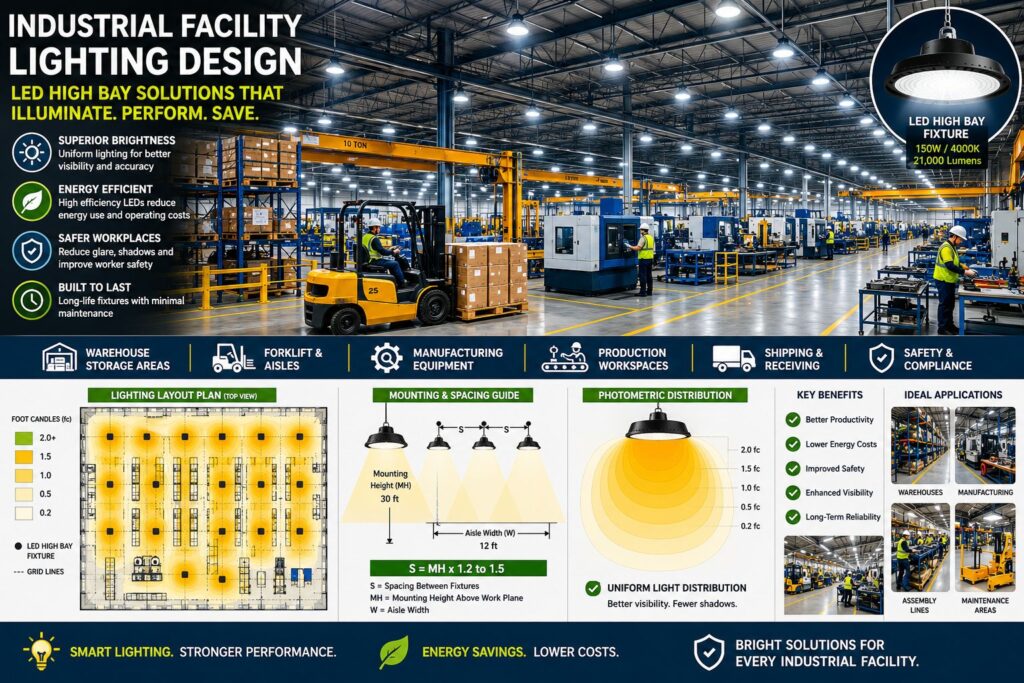
Industrial facility lighting design coordinates fixture selection, mounting height, spacing, light levels, uniformity, and controls to provide safe, efficient illumination throughout warehouses, manufacturing plants, distribution centers, and other industrial facilities.
Planning an Industrial Facility Lighting Project?
Effective industrial lighting design starts with the facility itself. Ceiling height, work areas, required light levels, fixture placement, uniformity, environmental conditions, controls, and energy goals should all be evaluated before fixtures are selected.
Explore our Industrial LED Lighting solutions or call 844-533-7767 for help with fixture selection, photometric layouts, and lighting design for your facility.
What Is Industrial Facility Lighting Design?
Industrial facility lighting design involves developing a comprehensive lighting plan that addresses:
- Facility operations
- Worker safety
- Equipment visibility
- Task requirements
- Energy efficiency
- Maintenance considerations
- Regulatory compliance
High bay lighting plays a critical role in large industrial buildings. Our Industrial LED High Bay Lighting Guide compares fixture styles, mounting heights, and lighting design considerations.
The goal is to provide the right amount of light in the right locations while minimizing operational expenses.
Unlike residential or office lighting, industrial lighting systems must perform reliably in demanding environments that often include dust, moisture, vibration, temperature extremes, and continuous operation.
Designing high-rack storage illumination? Visit Warehouse Aisle Lighting Design.
Why Lighting Design Matters
Poor lighting design can contribute to:
- Workplace accidents
- Reduced productivity
- Equipment operation errors
- Increased maintenance costs
- Employee fatigue
- Higher energy consumption
Proper lighting design helps create a safer and more efficient work environment.
Planning a production facility? The Manufacturing Facility High Bay Lighting Guide explains how to select the right LED high bay fixtures based on ceiling height, manufacturing processes, and lighting performance requirements.
Key Benefits
| Benefit | Operational Impact |
|---|---|
| Improved Visibility | Better task performance |
| Enhanced Safety | Reduced workplace hazards |
| Better Uniformity | Consistent lighting conditions |
| Lower Energy Costs | Reduced utility expenses |
| Reduced Maintenance | Lower operating costs |
| Improved Productivity | More efficient workflows |
Whether you’re replacing metal halide, HID, or fluorescent fixtures, the Industrial LED Energy Savings Guide demonstrates how LED retrofits improve efficiency across warehouses, manufacturing plants, and distribution centers.
Types of Industrial Facilities
Industrial lighting requirements vary significantly by application.
Warehouses
Focus on:
- Storage visibility
- Forklift safety
- Rack illumination
Distribution Centers
Focus on:
- Picking accuracy
- Shipping operations
- High-rack visibility
Manufacturing Plants
Focus on:
- Production visibility
- Assembly operations
- Quality control
Processing Facilities
Focus on:
- Equipment operation
- Maintenance access
- Specialized environmental requirements
Maintenance Buildings
Focus on:
- Equipment servicing
- Repair activities
- Detailed visual tasks
From production floors to loading docks, Industrial LED Lighting Applications helps facility managers understand where LED lighting delivers the greatest return on investment.
Operating a warehouse or fulfillment center? Explore Distribution Center Lighting
Understanding Foot Candle Requirements
Different industrial environments require different illumination levels.
Typical Industrial Lighting Recommendations
| Area | Recommended Foot Candles |
|---|---|
| General Storage | 10-20 FC |
| Warehouse Aisles | 15-30 FC |
| Manufacturing Areas | 20-50 FC |
| Packing Operations | 30-50 FC |
| Maintenance Areas | 30-75 FC |
| Quality Control Stations | 50-100 FC |
| Precision Inspection Areas | 100+ FC |
The required light level should always be based on the visual demands of the task being performed.
Designing storage facility lighting? Review Self Storage Facility Lighting.
Selecting the Right Industrial Fixtures
Fixture selection depends on several factors.
Ceiling Height
| Ceiling Height | Recommended Fixture Type |
|---|---|
| 12-20 Feet | Low Bay Fixtures |
| 20-30 Feet | UFO High Bays |
| 30-40 Feet | High Output High Bays |
| 40-60 Feet | Linear High Bays |
| 60+ Feet | High Mast Industrial Fixtures |
Environmental Conditions
Industrial facilities may require fixtures designed for:
- High temperatures
- Cold storage environments
- Washdown conditions
- Corrosive atmospheres
- Dusty environments
- Hazardous locations
Planning production floor illumination? Visit Manufacturing Plant Lighting.
Key Components of Industrial Lighting Design
| Design Component | Purpose |
|---|---|
| Fixture Selection | Deliver required illumination |
| Photometric Layout | Verify lighting performance |
| Uniformity Analysis | Reduce shadows and dark areas |
| Controls Strategy | Improve energy efficiency |
| Environmental Evaluation | Ensure fixture durability |
| Maintenance Planning | Reduce long-term costs |
If you’re planning a new building or retrofit, Commercial vs Industrial Lighting explains which lighting systems provide the best performance for different facility types.
The Importance of Lighting Uniformity
Average foot candle levels alone do not determine lighting quality.
Uniformity measures how evenly light is distributed throughout a facility.
Benefits include:
- Reduced shadows
- Better visibility
- Improved worker comfort
- Enhanced safety
- More consistent working conditions
Many successful industrial lighting projects focus equally on foot candle levels and uniformity.
Whether you’re replacing fluorescent fixtures or upgrading metal halide lighting, the Industrial Lighting Technologies Guide provides valuable insight into selecting the best technology for your application
Photometric Lighting Layouts
A photometric lighting layout predicts how a lighting system will perform before installation.
Photometric reports typically include:
- Fixture locations
- Average foot candles
- Minimum foot candles
- Maximum foot candles
- Uniformity ratios
- Light distribution maps
These reports help facility managers make informed decisions before purchasing equipment.
Creating a photometric lighting plan? See Warehouse Lighting Layout Guide.
Energy Efficiency Considerations
Energy efficiency is often a primary objective of industrial lighting projects.
Common Energy-Saving Strategies
- LED Fixture Upgrades
- Occupancy Sensors
- Motion Sensors
- Daylight Harvesting
- Zoned Lighting Controls
- Smart Lighting Systems
Many industrial facilities achieve energy reductions of 50% to 75% after upgrading from older HID technologies.
Looking to reduce operating costs? Explore Warehouse Lighting Energy Savings.
Common Industrial Lighting Design Mistakes
Choosing Fixtures Without a Layout
Fixture selection should be based on photometric analysis rather than wattage alone.
Ignoring Facility Operations
Different tasks require different lighting levels.
Overlooking Uniformity
Uneven lighting can create visibility and safety concerns.
Focusing Only on Initial Cost
The lowest-cost fixture may not provide the best long-term value.
Not Considering Maintenance
Industrial facilities benefit from fixtures that minimize future service requirements.
If your facility performs frequent washdowns or operates under strict sanitation procedures, the NSF Certified Lighting Guide helps explain when NSF-certified lighting should be considered.
Benefits of LED Industrial Lighting
| Benefit | Facility Advantage |
|---|---|
| Lower Energy Consumption | Reduced operating costs |
| Longer Fixture Life | Less maintenance |
| Improved Light Quality | Better visibility |
| Instant-On Operation | No warm-up time |
| Smart Controls Compatibility | Greater efficiency |
| Reduced Downtime | Improved reliability |
LED construction lighting improves both safety and efficiency. Learn how to select the right lighting system in the Construction Site Lighting Guide.
Frequently Asked Questions
What is industrial facility lighting design?
Industrial facility lighting design is the process of planning fixture placement, light levels, controls, and lighting performance throughout an industrial building.
Why are photometric layouts important?
Photometric layouts verify expected lighting performance before installation.
How many foot candles do industrial facilities need?
Requirements vary by application, typically ranging from 10 foot candles in storage areas to over 100 foot candles in inspection environments.
Can LED lighting reduce operating costs?
Yes. Most industrial facilities experience significant energy and maintenance savings after upgrading to LED systems.
Do industrial facilities benefit from smart lighting controls?
Absolutely. Controls often provide substantial additional savings beyond the LED fixture upgrade itself.
Planning an Industrial Facility Lighting Project?
Successful industrial lighting design requires more than selecting fixtures by wattage or lumen output. Facility dimensions, mounting heights, work areas, environmental conditions, required illumination levels, and lighting controls all influence system performance.
LED PROS WorldWide helps contractors, facility managers, and industrial buyers identify suitable lighting solutions for manufacturing plants, warehouses, distribution centers, and specialized industrial environments.
Explore our industrial LED lighting fixtures and send us your facility dimensions, mounting heights, fixture quantities, voltage requirements, and project specifications for assistance with product selection and pricing.
Request a Quote or call 844-533-7767 for industrial lighting recommendations and application assistance.
Inline Buyer Q&A
Q: Should every industrial project include a lighting layout?
A: Yes. A photometric layout helps ensure the lighting system achieves the desired performance while avoiding over-lighting or under-lighting.
Q: Is brightness the most important design factor?
A: No. Uniformity, visibility, glare control, and fixture placement are equally important.
Q: Can one fixture type work throughout an entire facility?
A: Some facilities use multiple fixture types to address different operational areas and lighting requirements.
Related Industrial Lighting Design Resources
- Industrial Lights & LED Lighting Systems — Explore industrial lighting fixtures and product options.
- Industrial Lighting Planning & Specification Guide — Comprehensive guidance on industrial lighting specifications.
- Warehouse Lighting Layout Guide — Fixture spacing, mounting heights, and photometric layouts.
- Manufacturing Plant Lighting — Lighting requirements for production and assembly facilities.
- Distribution Center Lighting — Lighting considerations for logistics and fulfillment operations.