What Is the Difference Between Commercial and Industrial Lighting?
Although the terms commercial lighting and industrial lighting are often used interchangeably, they serve different purposes and are engineered for different environments.
Commercial lighting is designed to provide comfortable, visually appealing illumination in businesses that serve employees, customers, and the public. Examples include offices, retail stores, schools, restaurants, hotels, and healthcare facilities.
Industrial lighting, on the other hand, is designed for facilities where production, manufacturing, storage, and logistics take place. These environments demand higher light output, greater durability, longer operating life, and fixtures capable of performing under challenging conditions such as dust, moisture, vibration, extreme temperatures, and continuous operation.
Looking for practical examples of where LED lighting can be installed? Our Industrial LED Lighting Applications guide explores the most common industrial environments and recommends the best lighting solutions for each.
Understanding these differences helps facility owners select lighting systems that improve safety, productivity, and long-term operating costs.
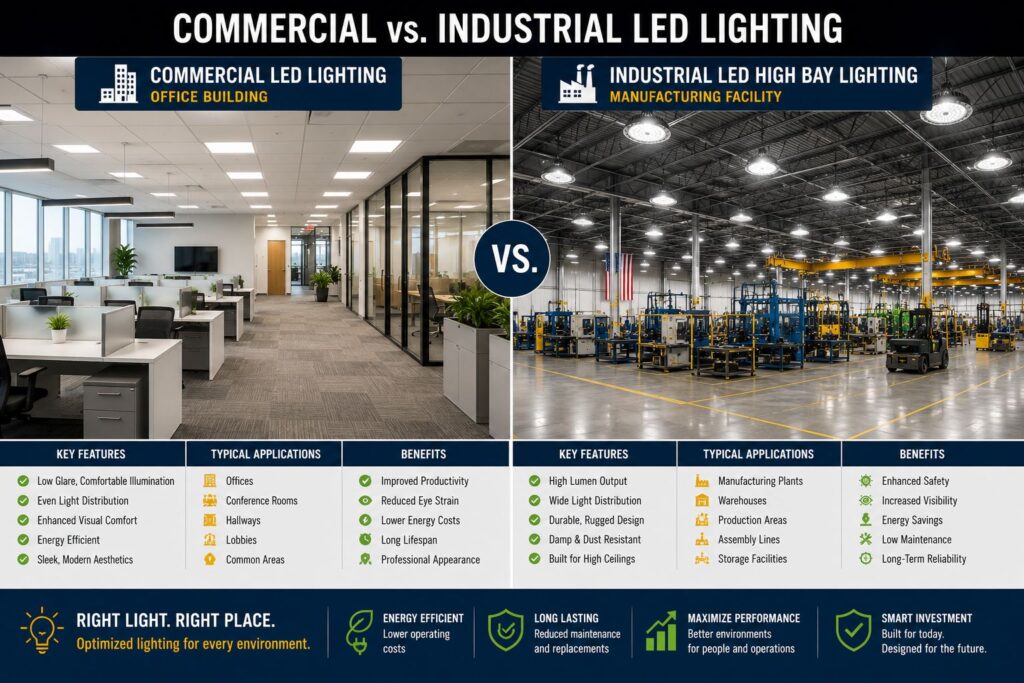
Commercial and industrial lighting systems are designed for different environments. While commercial lighting emphasizes comfort and aesthetics in offices, retail stores, and public spaces, industrial lighting is engineered for durability, high performance, and demanding work environments such as warehouses, manufacturing plants, and distribution centers.
Not Sure Whether You Need Commercial or Industrial Lighting?
The right choice depends on how your facility is used. Ceiling height, required light levels, operating hours, environmental conditions, durability requirements, controls, and maintenance needs can all determine whether commercial or heavy-duty industrial fixtures are the better fit.
Explore our Industrial LED Lighting solutions or call 844-533-7767 for help selecting the right fixtures for your facility.
What Is the Difference Between Commercial and Industrial Lighting?
Although the terms commercial lighting and industrial lighting are often used interchangeably, they serve different purposes and are engineered for different environments.
Commercial lighting is designed to provide comfortable, visually appealing illumination in businesses that serve employees, customers, and the public. Examples include offices, retail stores, schools, restaurants, hotels, and healthcare facilities.
Industrial lighting, on the other hand, is designed for facilities where production, manufacturing, storage, and logistics take place. These environments demand higher light output, greater durability, longer operating life, and fixtures capable of performing under challenging conditions such as dust, moisture, vibration, extreme temperatures, and continuous operation.
Planning an LED retrofit? Our Industrial Lighting Guide explains fixture selection, lighting design, and energy-saving strategies for modern industrial facilities.
Understanding these differences helps facility owners select lighting systems that improve safety, productivity, and long-term operating costs.
What Is Commercial Lighting?
Commercial lighting is intended for everyday business environments where visual comfort, appearance, and energy efficiency are important.
Typical commercial facilities include:
- Office buildings
- Retail stores
- Shopping centers
- Schools
- Universities
- Hospitals
- Hotels
- Restaurants
- Banks
- Churches
- Community centers
Commercial lighting often emphasizes:
- Comfortable illumination
- Decorative appearance
- Customer experience
- Architectural aesthetics
- Lower mounting heights
- Moderate daily operating hours
Common fixtures include:
- LED panels
- Troffers
- Downlights
- Recessed lighting
- Decorative pendants
- Track lighting
- Architectural wall sconces
What Is Industrial Lighting?
Industrial lighting is engineered for demanding work environments where durability and performance take priority over decorative appearance.
Industrial applications include:
- Warehouses
- Manufacturing plants
- Distribution centers
- Machine shops
- Fabrication facilities
- Food processing plants
- Cold storage warehouses
- Chemical processing facilities
- Aircraft hangars
- Utility plants
- Shipping terminals
Industrial lighting typically focuses on:
- Maximum visibility
- High lumen output
- Continuous operation
- Long service life
- Low maintenance
- Environmental protection
- Employee safety
Common fixtures include:
- LED high bays
- Linear high bays
- Vapor tight fixtures
- Explosion proof lighting
- Flood lights
- Wall packs
- High mast lighting
- Industrial task lighting
New to industrial lighting? Start with What Is Industrial Lighting? to understand the fundamentals of industrial lighting systems and where they are used.
Comparing Commercial and Industrial Lighting
| Feature | Commercial Lighting | Industrial Lighting |
|---|---|---|
| Primary Purpose | Comfort and aesthetics | Performance and safety |
| Typical Ceiling Height | 8–20 ft | 20–60+ ft |
| Operating Hours | Standard business hours | Extended or continuous operation |
| Environment | Clean, climate controlled | Harsh, dusty, wet, or hazardous |
| Fixture Construction | Standard commercial | Heavy-duty industrial |
| Maintenance | Moderate | Minimal |
| Durability | Moderate | High |
Interested in learning more about industrial fixture categories? Explore Exploring the Different Types of Industrial Lights for a detailed comparison of today’s most common LED industrial lighting technologies.
Common Fixture Types
| Commercial Fixtures | Industrial Fixtures |
|---|---|
| LED Panels | UFO High Bays |
| Troffers | Linear High Bays |
| Downlights | Vapor Tight Fixtures |
| Pendants | Explosion Proof Fixtures |
| Decorative Fixtures | Flood Lights |
| Track Lighting | High Mast Lighting |
| Wall Sconces | Industrial Wall Packs |
Looking for specific fixture recommendations? Visit Industrial Lighting Fixtures and Their Uses to compare high bays, vapor tight fixtures, flood lights, wall packs, and other industrial lighting solutions.
Environmental Considerations
Commercial buildings generally operate in clean, climate-controlled spaces with minimal exposure to moisture or contaminants.
Industrial facilities often require lighting that withstands:
- Dust
- Water
- Steam
- Oil
- Chemicals
- Corrosion
- Extreme temperatures
- Vibration
- Frequent washdowns
Selecting fixtures designed for these environments improves reliability and extends service life.
Understanding lighting technology is essential when evaluating facility upgrades. Our Industrial Lighting Technologies Guide compares the strengths and limitations of today’s most common industrial lighting systems.
Safety Requirements
Lighting plays a critical role in workplace safety.
Industrial lighting systems are often designed to:
- Improve visibility around machinery
- Reduce shadows in production areas
- Illuminate warehouse aisles
- Enhance forklift safety
- Support quality inspections
- Increase pedestrian visibility
- Improve emergency response
Commercial lighting primarily focuses on providing comfortable illumination for employees, visitors, and customers while creating an inviting environment.
Energy Efficiency
Both commercial and industrial facilities benefit from LED technology.
Modern LED lighting provides:
- Lower electrical consumption
- Longer operating life
- Reduced maintenance
- Instant-on performance
- Improved light quality
- Compatibility with occupancy sensors and daylight controls
Industrial facilities often realize larger energy savings because lighting systems operate for longer periods each day.
Looking to reduce operating costs? Our Industrial LED Energy Savings Guide explains how modern LED lighting lowers electricity consumption, maintenance expenses, and long-term ownership costs.
Which Lighting System Is Right for Your Facility?
Choosing between commercial and industrial lighting depends on how your building is used.
Commercial lighting is generally appropriate for customer-facing businesses, offices, schools, and hospitality properties.
Industrial lighting should be selected whenever facilities involve manufacturing, warehousing, production, logistics, food processing, or other demanding operating environments requiring durable, high-performance lighting systems.
Commercial vs Industrial Lighting at a Glance
| Facility Type | Recommended Lighting |
|---|---|
| Office | Commercial |
| Retail Store | Commercial |
| School | Commercial |
| Restaurant | Commercial |
| Hotel | Commercial |
| Warehouse | Industrial |
| Manufacturing Plant | Industrial |
| Distribution Center | Industrial |
| Food Processing Facility | Industrial |
| Aircraft Hangar | Industrial |
Designing lighting for manufacturing or warehouse facilities? Read What Type of Manufacturing Facilities Require High Bay Lighting to learn when high bay fixtures provide the best performance.
Inline Buyer Q&A
Can commercial lighting be used in a warehouse?
While some commercial fixtures may work in small storage areas, warehouses with high ceilings generally require industrial lighting designed for greater mounting heights, higher light output, and long operating hours.
Are industrial lights brighter than commercial lights?
Industrial fixtures often produce significantly more lumens because they are designed to illuminate larger spaces and higher mounting heights.
Why are industrial fixtures built differently?
Industrial fixtures are engineered to withstand demanding environments, including dust, moisture, vibration, chemicals, and extended operating schedules.
Commercial or Industrial—Choose the Right Lighting for Your Facility
Selecting the proper lighting system is about more than choosing a fixture—it’s about matching lighting performance to the way your facility operates. Whether you’re illuminating an office, warehouse, manufacturing plant, or distribution center, the right LED lighting improves visibility, reduces maintenance, lowers energy costs, and supports a safer working environment.
Our lighting specialists can help you evaluate your facility and recommend the ideal commercial or industrial LED lighting solution for your application.
👉 Visit our Industrial Lighting Fixtures homepage to explore our complete selection of commercial and industrial LED lighting products or request a free lighting consultation today.Frequently Asked Questions
Can industrial lighting be installed in commercial buildings?
Yes. Certain industrial fixtures may be appropriate in commercial environments where durability or high light output is required, such as service bays or maintenance facilities.
Are industrial lights more energy efficient?
Modern LED commercial and industrial fixtures are both highly energy efficient. Industrial facilities often experience greater total energy savings because of longer daily operating hours.
What is the biggest difference between commercial and industrial lighting?
Industrial lighting prioritizes durability, performance, and safety in demanding environments, while commercial lighting emphasizes occupant comfort, appearance, and architectural integration.
Which lighting is best for manufacturing?
Industrial LED lighting specifically designed for manufacturing environments provides the best combination of visibility, reliability, and long-term operating efficiency.